When you click on links to various merchants on this site and make a purchase, this can result in this site earning a commission. Affiliate programs and affiliations include, but are not limited to, the eBay Partner Network.
I've personally seen Super Seals, ALS and E&J do that same kind of damage on pump gas even with the usual premix lubrication amounts. I don't have any experience with Goopy seals though.
I do know that It's not E85 dependent for this type of damage to happen, E85 will just require a different type of lubrication as standard premix does not suspend/mix in E85 for long. OMP may work ok without premix on E85 but I haven't tried it.
i do completely agree on the Super Seals but they were what the customer wanted. the other seals are certainly softer and the degree of degradation seemed to line up primarily with mileage rather than either the seal or premix.
RXParts seals did not cause rotor housing wear on E85, or even pump gas. I'm not the only one who has experienced this. Mine had around 15k miles on them and could have been reused they were in such good shape, all of them at or over 35psi of boost on only E85. https://www.rx7club.com/rotary-car-p...seals-1097504/
I've heard Power Seals do not do this type of damage as well but do not have first hand experience with this. Tearbo2 recommends them.
I know the OEM Mazda seals do not scratch housings up but they are a bit of a gamble to use on a high horsepower build.
Ceramics do not do this damage but they're a gamble to run as well.
Again this is all regardless of fuel choice, E85 is not the enemy here. I understand using pump gas for convenience instead of E85 but please don't say it causes engine damage when it is not a majority contributor.
Alcohol is a powerful solvent to mineral class aka petroleum oils (and all oil products of similar molecular structure including synths). Alcohol can dissolve or dilute these oils upon contact; therefore, a different type of substance is required to lubricate and/or to prime a surface to hold a lubricating agent when using an alcohol fuel. Castor oil, apparently the oil of choice for use with alcohols, is a vegetable oil--a triglyceride--and an entirely different molecule than typical engine oils; one which does not react with alcohol in the same manner as mineral type oils do. The short story, iirc, is that alcohols and organic acids join to form esters. This may be in part responsible for the gummy deposits that form after extended use of a castor oil lubricant. I suspect it may be in evidence in the pics Howard posted above. Sniff tests are indicated to characterize the odor of the depicted rotors which might give some clue as to the culprit.
Second point: given alcohols' solvent action as outlined above, does this render the OMP and the usual engine oil injection ineffectual for lubrication when using alcohol fuels? And if so, to what extent?
Final comment: This is centered around engine operating temps and what is discussed in the quoted paragraph #5 above. In my observation, many, if not most, want to operate their engines too cold. Having considerable experience with engine dynos (for the purpose of racing), I can unequivocally say that virtually every engine I have seen or dynoed has performed the best with water temps around 212deg F and oil temps about 225-ish deg F --given constant IATs and gasoline as the fuel. I've also noticed that engines with aluminum components need slightly more heat in them to maintain the same power output. This may seem way too hot to many folks, especially those that do everything in their power to hold temps to a minimum, but it is where engines consistently make the most power, all else being equal. Rotary engines are not exempt from these effects either; the caveat being that care must be exercised to prevent overheating the spark plug boss/land area under sustained high load conditions.
My own take away, without getting too theoretical on those reading this, is to maintain temps as close to the proven ideals as is possible and to keep temp swings to a minimum under the various operating conditions encountered. The idea of the latter point is to reduce the cyclic thermal stresses on the engine assembly over time. This is where a good cooling system (e.g., ducted v-mount) shows its oats. One can maintain the engine at closer to optimum temps without having to resort to artificially low operating temps to prevent overheating. Consistently operating an engine under temp will significantly accelerate wear, regardless of fuel."
Copeland, thanks for the additional info. it certainly is possible that a particular apex seal might solve the wear issue.
since my interest is 600 or less i can get what i need with gasoline and benefit from the added lubricity.
i am sure you are way on the other side of 600 and ethanol might be a better suit.
as to premixes, you mention Benol. that was my first premix... i ran the Texas Mile with it and as i mentioned i had significant housing wear. i do love alcohol and i use it. i have been running between 1000 and 1500 CC of methanol as AI. i get the benefits, way lower IAT, knock resistance, clean internals without the problems i encountered with E85. love it.
j9fd3s mentions coolant temp being a factor... too cool, you lose.
when i was dynoing my racing 4 cylinders on an engine dyno i found max power at 195 F. cooler cost power. i have spent quite a bit of time with fast boats and all the owners were always wanting to go faster. many had built their powerplants to the max... i would always ask them what water temp they were running and most looked at me like... "who cares?" most were really running really cold due to the lake water. they all picked up power once they started controlling coolant flow and upping temps..
i have forever ran 87 C tooling around in the summer... after i installed a Mishimoto MMTS-89 thermostat i now am generally around 67 C. i couldn't believe it and thoroughly checked and it was accurate. while i realize this is a bit cool (154 F) my motor did make 585 at 24.9 psi boost while reading 67C. no doubt on track it would be a bit different but it is amazing to open the hood and not be met with a blast of hot air.
i remain w the view that if you are in the max 600 power range you are better off with the additional lubricity of gasoline. systems at 500-600 i like switching AI injectant from water or 50/50 to straight methanol. the only AI system to use with straight methanol is Alkycontrol.
alcohol beat gasoline at the higher power levels, i would just rather have the benefit only when i need it so make mine gasoline with a dash of methanol straight up.
On the temps thing I saw a reply from a guys with engine dyno that ran rotaries (bridgeport turbos IIRC) in race boats on guild of efi facebook group some time ago. He had intentionally varied oil and water temps to check output and found about 70C water and 110C oil was the winning combination which makes sense from a frictional vs charge density heat transfer perspective.
i have forever ran 87 C tooling around in the summer... after i installed a Mishimoto MMTS-89 thermostat i now am generally around 67 C. i couldn't believe it and thoroughly checked and it was accurate. while i realize this is a bit cool (154 F) my motor did make 585 at 24.9 psi boost while reading 67C. no doubt on track it would be a bit different but it is amazing to open the hood and not be met with a blast of hot air.
.
Howard, what do your temps do at speed? if they stay steady (plenty of air flow vs max heat at max power), then you're still in pump gas territory. Scoots old red car is probably a good one to look at, Time Machine: Flat Out On The Tokyo Aqua-Line - Speedhunters
"Where do you have your methanol tank mounted Howard?"
The AI tank equation changes with 100% methanol. Think fire. I have run this 4.5 gallon Jaz fuel cell since 2003. You would be surprised how modest the consumption is but i do like the capacity. The dash 3 SS line is the breather and the cell does have a low level sender..
here's another view. both the Alkycontrol cockpit command module and the master settings controller are on the side of the tank. once you arrive at your settings they are not needed to be in the cockpit. the other two modules are my Kenne Bell Boost A Pump and Kenne Bell Boost A Spark with the controllers.
If you are often running on the other side of 500 rwhp i highly recommend 100% methanol as injectant. Methanol is around $2.50 a gallon, stores well and the motor loves it. Alkycontrol is, IMO, the only proper system as it employs SS braided lines in recognition that fires are bad. Julio Don, Alkycontrol proprietor, is an Electrical Engineer, a long time very accomplished racer---- currently running in the pump gas only class in Florida with a twin turbo fox body 1200 hp Mustang. He is "Razor" on the TurboBuick forum which has over 250 PAGES of AI tuning... a good guy BTW. his product fits the single turbo like sauerkraut and brown mustard on bratwurst. (hey i am from Wisconsin)
as to ECTs... i haven't tracked my car recently and probably never will looking forward for a couple of reasons... having road raced for 22 seasons i have pretty much done what i wanted to do... the other reason is the car is too fast. it would need a 6 point cage a good size fire system etc as i couldn't drive it 8/10. i have two speeds, zero tenths and ten tenths. it will be on track in the Fall for something i really want to do at the Texas Mile. that said, i have had it running pretty good on some back roads and the ECT has yet to move more than a coupe of degrees C. maybe i saw 69.
Last edited by Howard Coleman; Jun 5, 2019 at 08:36 PM.
Looks good, but Is that a plastic tank? I know very few materials are compatible to hold methanol but I’d be nervous to have just a plastic tank holding meth in cab. I’d like the other benefits though.
great question as we are dealing w fuel and it is in the cockpit. having really raced for 22 seasons i am quite aware of fire protection. SCCA requires a real "fuel cell." bullet proof (literally) inner liner in a steel enclosure w a roll-over valve etc etc. so, when i was looking for a tank for my methanol i was quite aware of the safety aspect. burn one gallon of gas sometime which they often do as part of Driver's School and you will be pretty shocked at the pyrotechnics. big fire. ATL has been (1970) the go-to fuel cell source although there are many others today.
Jaz is another legitimate fuel cell outfit. they offer, as does ATL, seamless cross-linked polymer cells in addition to the aforementioned type. both Jaz and ATL are SFI certifiable at various levels and they are perfectly fit for 100% alcohol. Jaz dropped a fully loaded cell like mine from a 2 story height onto a concrete floor and it didn't rupture. anecdotal but...
there are numerous companies today that offer lots of options as to tanks for 100% methanol. i also recommend you fill your tank w anti-slosh alcohol safe foam.
if you are running water meth or water i recommend the newish beautifully designed tank from Sakebomb.
There are many alcohol rated cross-linked fuel cell tanks out there. Mine has the pump mounted directly to the underside of the tank and I mounted the electronics to the backside. I believe it has a 3 or 3.5 gallon capacity and is more splash resistant due to the shape of the lower tank from the pump without the need to baffle therefore.
Mike
P.S. That is a NO2 tank that actually contains liquid CO2 for intercooler spraying.
super cool... i would love to know what you are getting for IAT. getting IAT down is gold for 2 reasons:
more oxygen into the motor = more power
cooler IA better resists knock
there is a problem as to knowing this accurately and it is called LAG. i don't mean turbo lag, i mean sensor lag. i believe it is important to install a Type K thermocouple in the OE IAT port under the UIM. things happen so fast on a run that you need a sensor that runs at 4 readings per second and is accurate to 1%. only a thermocouple will do this. i have searched all over the place trying to find out the accuracy and response time of the typical open element "fast" sensor with no results. if anyone has the data i would love to see it.
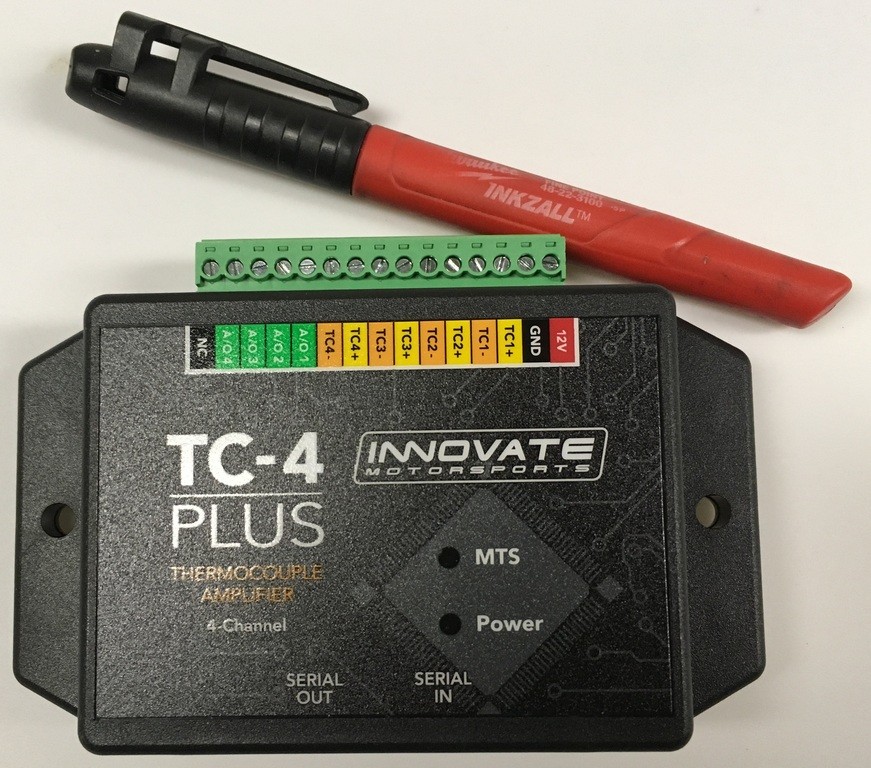
here's a picture of my new toy/discovery... the Innovative 4 channel thermocouple amplifier. i run two EGT sensors in my turbo manifold, one just after the turbo/before the intercooler and one in the UIM IAT port so it fits me fine...
super cool... i would love to know what you are getting for IAT. getting IAT down is gold for 2 reasons:
more oxygen into the motor = more power
cooler IA better resists knock
there is a problem as to knowing this accurately and it is called LAG. i don't mean turbo lag, i mean sensor lag. i believe it is important to install a Type K thermocouple in the OE IAT port under the UIM. things happen so fast on a run that you need a sensor that runs at 4 readings per second and is accurate to 1%. only a thermocouple will do this. i have searched all over the place trying to find out the accuracy and response time of the typical open element "fast" sensor with no results. if anyone has the data i would love to see it.
here's a picture of my new toy/discovery... the Innovative 4 channel thermocouple amplifier. i run two EGT sensors in my turbo manifold, one just after the turbo/before the intercooler and one in the UIM IAT port so it fits me fine...
I am one of those guys, like you from some of your posts I have seen, that loves to think outside of the box. I added a billet 120 degree multi-holed motorcycle NO2 sprayer in the air box going to my U-type dual bank IC. I limit the psi to 250 through a paintball regulator and control the spraying with a NO2 Pro Shot/Big Shot solenoid. A NO2 tank filled with liquid CO2 is in the trunk and has an automatic bottle opener on it. I made a timing circuit started by an additional momentary switch(a stock defroster switch) in the center console replacing where the overheat light was. I made a circuit timer and delay system that once the button is pressed, the bottle is opened, 3 sec later the solenoid is tripped for 40 sec, 3 sec later the bottle is closed and ready for another cycle. I did early testing on the tabletop with my IC out of the car using a hair dryer to simulate hotter air coming from the turbos. I know this was much lower flow than from the turbos in a real situation but it at least gave me an idea to the function. Air temp in was around 185 degrees in the intake of the IC and steady state output was around 85 degrees with my high efficiency IC and with two 300 cfm Spal puller fans on the IC. After 40 sec on spraying the output air was 31 degrees, an almost 55 degree F decrease.
I have yet to test this in real time on my car since I just got the WMI system up and running. Unfortunately, I rebuilt almost the entire car by myself over the last 3 years ( my original car new in 1994) but left the short block or keg alone since it was last rebuild in 2014 and was running fine before the rebuild. I started having idle problems just over the last three weeks and did compression testing and the front rotor is shot. 83, 84, 85 psi. After the new motor is installed, I will get back to you on the CO2 spraying benefit in real time.
Mike
P.S. If anyone else ever tries the IC liquid CO2 spraying(-80 degrees), do not use NO2 even though it is colder(-120 degrees). Since the sprayed in liquid, then turning to gas, might inundate the engine compartment and it can get sucked into the engine air intake if under the hood. If NO2, you can go lean since you have no fuel compensation for the additional oxygen particle in the intake charge. If CO2 displaces a little O2 you may go a little rich, but no harm done.
super cool... i would love to know what you are getting for IAT. getting IAT down is gold for 2 reasons:
more oxygen into the motor = more power
cooler IA better resists knock
there is a problem as to knowing this accurately and it is called LAG. i don't mean turbo lag, i mean sensor lag. i believe it is important to install a Type K thermocouple in the OE IAT port under the UIM. things happen so fast on a run that you need a sensor that runs at 4 readings per second and is accurate to 1%. only a thermocouple will do this. i have searched all over the place trying to find out the accuracy and response time of the typical open element "fast" sensor with no results. if anyone has the data i would love to see it.
here's a picture of my new toy/discovery... the Innovative 4 channel thermocouple amplifier. i run two EGT sensors in my turbo manifold, one just after the turbo/before the intercooler and one in the UIM IAT port so it fits me fine...
I would love to see a write up of how and why you used your TC-4 this way. I am currently installing my TC-4 but I was only running thermocouples in each exhaust manifold runner pre-turbo.
P.S. I have enjoyed reading your write-ups on your website. Good stuff and nice of you to pass on your recommendations and experiences.
bending the thread a bit but just thought i would follow up re IATs. after focusing on a number of areas over the years IAT is my primary current (for the last few years) interest. i recently read a piece on EngineLabs re Gale Banks' Density Meter. many will know Gale as one of the pre-eminant makers of HUGE POWER. Gale's meter that reads IA Density is just another way of measuring (and Gale has always measured Everything) the amount of oxygen into our motors. oxygen makes power. you can always put more fuel into a motor but getting more oxygen in is the challenge and it isn't necessarily as simple as turning up the boost.
charge air compression creates heat which reduces density. less density, less oxygen. there is a point on all turbos where more boost results in less oxygen.
normal operation with a modern fairly efficient turbo, an EFR or SX-E, around 20 PSI of boost IAT immediately out of the compressor before the IC the charge air exceeds 400 F!
think of how your turbo car runs in cool air. living in Wisconsin and doing a pull in October V August is almost a religious experience.
there are so many ways to effect your IAT... both good and bad.
while we now can learn our AFR to the tenth or our EGTs, i maintain the very few of us have any idea of our actual IAT into our engines measured under the UIM at the OE location.
this is because we aren't using the proper type of sensor. an "air" thermocouple is needed.
the "thermistor" temperature sensor was designed as a substitute for the mechanical choke plate which moves at glacial speed. it was also used to monitor ECT which also is a slow mover. you can see the speed of the thermistor by looking at various logs that have been posted. they look like a staircase. IAT do not move in this manner. i know since i use a thermocouple which generates 4 accurate readings per second.
after spending too much time looking for an indication of the actual rate of change of the a "fast" thermosensor i installed one under my UIM along with the thermocouple. i am breaking in my motor so don't yet have comparative data in boost but will shortly. i know what i will find but it is always nice to have the data.
which leads me to the more important point... many of us are running way too much IAT. given gasoline autoignites at 458 F it is important to lower our IATs especially when running one bar or more of boost.
and it can be done...it is the setup that is the key.