


4-Rotor FC Build


Thread Starter

Joined: Oct 2010
Posts: 605
Likes: 13
From: The Netherlands
Yup, what ^ he said. Already took the rotors to a local company that does dynamic balancing for a second opinion.
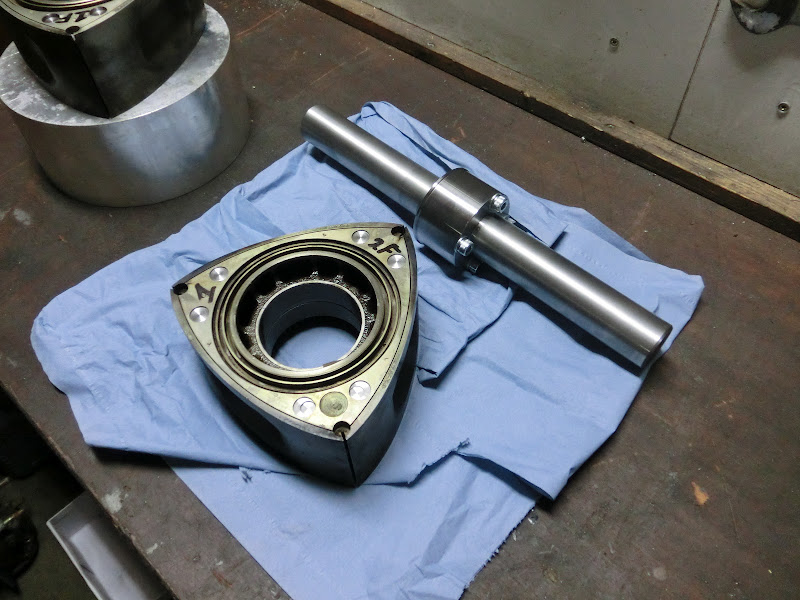
Of course they thought it was a good idea to balance the rotors (duh), but they couldn't fit the rotors on the balancing machine without a jig. We came up with a jig that would work, so I'm going to fabricate that later this week, then take the rotors with the jig back to the balancing shop and have them balance the rotors, then I need to re-check the rotor weights, correct the dummy bob-weights, re-design and machine the counterweights, assemble the entire rotating assembly, take that to the balancing shop and hope everything will work out. Holy crap, this is going to be a lot of work.
Of course they thought it was a good idea to balance the rotors (duh), but they couldn't fit the rotors on the balancing machine without a jig. We came up with a jig that would work, so I'm going to fabricate that later this week, then take the rotors with the jig back to the balancing shop and have them balance the rotors, then I need to re-check the rotor weights, correct the dummy bob-weights, re-design and machine the counterweights, assemble the entire rotating assembly, take that to the balancing shop and hope everything will work out. Holy crap, this is going to be a lot of work.

Gold Wheels FTW

Joined: Apr 2004
Posts: 458
Likes: 44
From: Nashville, TN
these lightweight rotors are only usefull if you plan on running 10-12k+ rpm in a race engine. for running pretty much normal rev-limits in a streetcar the standard ones are more then sufficient.
and if you have read the thread you would have known this a pretty much a low-budget build. instead of buying stuff, John makes it himself to keep things interesting..
buying titanium rotors to use in a 4-rotor will pretty much bankrupt anyone
and if you have read the thread you would have known this a pretty much a low-budget build. instead of buying stuff, John makes it himself to keep things interesting..
buying titanium rotors to use in a 4-rotor will pretty much bankrupt anyone



Joined: Mar 2001
Posts: 31,857
Likes: 3,243
From: https://www2.mazda.com/en/100th/
Are you sure about that? I know that the rotors are balanced from the factory, so in it's stock shape it should be in balance when spun around the rotor bearing center axis. I aligned the milling machine to this axis, and machined the holes a certain dimension from this axis. They are all exactly the same size, and machined outside of the stock balancing holes so those are unaffected. I also did both sides of the rotor equally. I wonder if this will affect the balance a lot, if it does what about people running carbon apex seals, or people grinding down the sides of the rotor for clearance, or people beveling the edges of the rotors for earlier intake opening, I've even seen people removing the oil slinger. There isn't a great deal or material removed, the worst one had 51 grams removed. But maybe I'll take them to the local balancing shop and see if they can check it.
i think if you do any rotor mods, balancing would come last?
and then it depends on how well you need it balanced! on a stock engine i would have just made sure i had the correct counterweights for the series and called it good, but since 12A PP rotor housings are hard to come by, and it might see 9K here and there, it was cheap insurance!
it DOES run really smoothly.
although i agree, 51g on a 5400g rotor isn't that big of a deal, its not like 51g on a 200g piston!

Joined: Mar 2001
Posts: 31,857
Likes: 3,243
From: https://www2.mazda.com/en/100th/
sounds good to me. a 50g on a 5400g is 1%, and the slower it moves the better... not that i know, i put mine in boxes and mailed it...

i just take it into consideration, as you see the factory rotors are cut with varying amounts milled from each corner to balance each of the 6 tips as it rotates.
probably will not be an issue unless pushing past 9k or expecting the bearings to last 150+k miles like the factory ones do.
probably will not be an issue unless pushing past 9k or expecting the bearings to last 150+k miles like the factory ones do.
Thread Starter
Joined: Oct 2010
Posts: 605
Likes: 13
From: The Netherlands
That's also what I thought in the first place, but I'm going ahead with making some tooling and checking out the balance. Even if the rotors for this engine are probably still within spec it's worth it because I'll have one thing less to worry about, and I'll have the tooling and know-how on how to balance these things, could be helpfull for future projects or other people here in the area, since there isn't really anyone out here that can balance a rotary.
it's just good insurance to prevent premature bearing wear/failures as well as possible apex seal chattering or rotor tip to iron contact. i have seen a few out of balance assemblies gouge up the irons off the rotor tips.
Last edited by RotaryEvolution; Apr 18, 2012 at 12:20 PM.


Thread Starter
Joined: Oct 2010
Posts: 605
Likes: 13
From: The Netherlands


Aluminium rotors would be cool in a 4-rotor, but they are a bit too complex to be machined manually. I really need some cnc equipment

 tiny bit disappointed lol. i had my hopes up all day thinking about seeing some sexy alloy rotors being machined up!


Senior Member

Joined: Nov 2003
Posts: 533
Likes: 3
From: Sweden

 haha
haha
So insure it for $100k and if they damage it, you can make yourself 10 more. Mandeville will be able to balance your rotating assembly and you will have confidence that everything is perfect.
and insurance isn't free, it is usually a % of the price you are insuring the item against. plus you have to prove it's value of $100k.. i doubt it would be damaged if packaged well, i'd be more worried about it disappearing somewhere in a customs warehouse.

Thread Starter
Joined: Oct 2010
Posts: 605
Likes: 13
From: The Netherlands
Right, and it will take a very long time and cost a lot to insure and ship it halfway around the world and back, and when it finally does get back dutch customs will probably charge a pile of tax and import duty's on it. I'm really confident it will work out ok this way. The local guy who's doing it has already done a few crankshafts I've modified, delivers top notch work everytime. Balancing an e-shaft isn't really rocket science, figuring out the bob weights is the 'hard' part, but I've already got that one covered.
Did some more progress, but not much. Rotors are out for balancing, and I'm busy getting the rest of the rotating assembly ready for it. Tried modifying stock counterweights so I can use them on the 4-rotor. Works for the front counterweight, but not for the rear one. Wasted an evening and a counterweight to find that one out. There needs to be a keyway added to get the angle of the counterweight right, but when adding a keyway the old stock one is not used anymore. When mounting the counterweight this area is now unsupported. This affects strength and reliability, not such a big problem for the front one since that one isn't transferring all the power but different story for the rear one. I don't want a failing counterweight because that will do bad things, so I tried closing the old keyway by adding a piece of key material and machining the conical bore afterwards which didn't go well. Cast iron gets brittle and super hard when welding, so it wouldn't machine very good, by the time the bore was nice and smooth too much material was removed and the counterweight sat 2mm's too far towards the rear stationairy gear.
Going to machine a new rear counterweight from billet material now, should've done that in the first place anyway.
Machining away, normally welds can be machined fine, but these ones ate my tooling

Front counterweight is fine, Rear one is junk

Also having troubles finding a decent radiator which suits the car well. Thinking about getting a radiator core and making one myself, always wanted to try that.
Did some more progress, but not much. Rotors are out for balancing, and I'm busy getting the rest of the rotating assembly ready for it. Tried modifying stock counterweights so I can use them on the 4-rotor. Works for the front counterweight, but not for the rear one. Wasted an evening and a counterweight to find that one out. There needs to be a keyway added to get the angle of the counterweight right, but when adding a keyway the old stock one is not used anymore. When mounting the counterweight this area is now unsupported. This affects strength and reliability, not such a big problem for the front one since that one isn't transferring all the power but different story for the rear one. I don't want a failing counterweight because that will do bad things, so I tried closing the old keyway by adding a piece of key material and machining the conical bore afterwards which didn't go well. Cast iron gets brittle and super hard when welding, so it wouldn't machine very good, by the time the bore was nice and smooth too much material was removed and the counterweight sat 2mm's too far towards the rear stationairy gear.
Going to machine a new rear counterweight from billet material now, should've done that in the first place anyway.
Machining away, normally welds can be machined fine, but these ones ate my tooling
Front counterweight is fine, Rear one is junk
Also having troubles finding a decent radiator which suits the car well. Thinking about getting a radiator core and making one myself, always wanted to try that.