When you click on links to various merchants on this site and make a purchase, this can result in this site earning a commission. Affiliate programs and affiliations include, but are not limited to, the eBay Partner Network.
not sure if this is in the right section, but i just wanted to provide some pictures for any one looking for a cheap and very well working cooling fan setup
note: this is for the 83-85 tall radiator setup.
it may fit on the older stacked setup with short radiator, and oil cooler underneath
part number from dorman: 620-101
they run about 100$ ive had it on my car a few years now with no issues. but I would highly recommend using a high amp relay. your typical autozone one will fry
EDIT: would not recommend with a factory alternator atleast a s4 or better is highly recommended!!!
ive been using an s4 for a few years with no issues, but if available id go with a higher amp option
CLEARANCE IS VERY TIGHT WITH A THICKER RADIATOR BUT IT WILL FIT
ALSO NOTE THAT I HAVE AFTERMARKET ENGINE MOUNTS THAT MAY BE TALLER THAN FACTORY HELPING WITH CLEARANCE
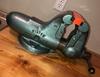
small tab made to adapt radiator top mount to shroud top mount shroud slides right under "factory" shround mounts on radiator. fastened by radiator zip ties here you can see the trimming needed at the upper RH side to fit arounf the "factory" shroud mount. same thing for the lower RH side here you can see where it was trimmed to fit it the tab
Last edited by thatbrokenrx7; Feb 17, 2022 at 11:25 AM.
Reason: alternator info
Nicely done. One thing you should probably think about is how you're going to feed it. Taurus fans are quite the thirsty beast and Alternators weren't exactly Mazda's strong suit until the 90s. Suffice to say they were rather optimistic in this area, as most 2nd Gen owners learn firsthand. For reference, a stock SA22C's alternator is rated at either 35 or 50 amps in 1979. 1980 got a modest increase to 55 amps rated output, but was still doing 40 amps on a good day. A Taurus fan uses a constant 20A on low and 30A on high speed, give or take a few depending on age. Add another 10A or so for inrush current when starting up, lasting for 1 second usually.
If there's a You-Pull-It salvage yard near you, spending $20 on a Ford 3G alternator from a 92-95 Taurus 3.8L or 95+ 3.8L Mustang is hard to beat since their idle output under load is roughly 80A. At 2000rpm engine speed, the minimum acceptable output is 87A per Ford's EVTM. 92+ Crown Vics have the same 130A output as the Taurus one, but different mounts that might work better for your application. That's the beauty about the 3G design, the only change they made are the mounting ears for each application.
good point, ive been using an s4 alternator with it for a few years with no issues, only ran on high!
should also add my car is very bare bones, not much electronics going on being carbed.
good point, ive been using an s4 alternator with it for a few years with no issues, only ran on high!
should also add my car is very bare bones, not much electronics going on being carbed.
Good point, though I'd be concerned about killing the alternator as soon as a considerable load is introduced beyond the fan, such as the Blower, lights, wipers, etc. Mitsubishi Electric Co. Alternators from the 80s seem to be rated on the same scale that most Chinese amplifiers/inverters/etc currently are (imaginary Watts/Amps), creating a failure scenario when they are expected to perform for more than a few seconds at their listed specifications. I go into it further here: https://www.rx7club.com/2nd-generati...or-s4-1155604/
If there's a decent salvage yard near you, grabbing a Taurus Alternator wouldn't be a bad idea considering that a S4 alternator's maximum (read: lifespan measured in minutes) is only 70A and a Taurus fan on high will consistently use about 50% of that. I'm not sure what it takes to keep a Carb'ed car running, but the spec for EFI ones is Approx. 60A at idle on the 20B Cosmo (100A alternator, same Mitsubishi design). I'm sure you can see how this could be a problem, considering how a stock S4 alternator is almost maxed out at idle in its original application (~85% of maximum power). This explains why Series 4 RX7s often have failing alternators, and why Mazda went to an 80A one for Series 5 in an effort to "stop the bleeding". Mitsubishi Electric finally learned their lesson in the 90s with the FD (100A) and GTO (110A) by building the base output up a bit to handle their rather lightweight electric fans.
Meanwhile, 80A on a Taurus alternator (or any other 130A Ford 3G Alternator like on my Expedition) is it just waking up and idling. This was necessary because they had to account for the 2-speed fan being on High when stuck in the middle of a LA Traffic Jam with the A/C on. Otherwise, Ford's best selling car would gain a reputation for a LOT of issues like overheating, dying alternators, stalling, etc that would have to all be fixed under warranty and/or recall. As for maximum output, the 130 Amp figure is a bit conservative in the same manner as a vehicle's tow rating. I've seen them trip a 150A breaker through 17ft of cable when full-fielded (voltage regulator failure or Test Mode). Ends up being around 170A at their peak, they just published a lower number to ensure they wouldn't burn out from being worked too hard. This way, it never goes over 75% capacity.
Same setup was also used on Crown Vic P71s for police usage, so they absolutely had to get it right from day 1. That engineering effort paid Ford back for decades too, proof that building a stronger base means you end up with a stronger end product.
kinda forgot these cars actually came with some creature comforts that being said on a car with all the factory electronics equipped ( heaters, a/c, radio, etc) id go with some like the taurus alternator stated above
I installed the same fan (rockauto 620-101) and have been using a Derale 16759 fan controller for four years now. I was skeptical to use a pin-in-radiator type sensor vs a thermoswitch in the t-stat housing, but wanted to retain my fast idle function. The Derale controller was cheap and works like a dream- just don't fry it upon install like I did (they sent me new unit, free of charge despite my admission of guilt.)
Relying on a manually activated Toggle Switch for such a vital item is a bad idea. However, using it in PARALLEL with a suitable thermoswitch setup is a good idea. Since most Thermoswitches supply a Ground at their Trigger Temperature and above, just have the Manual Switch supply a Ground too. Just label the Switch "ON" and "AUTO".














 that being said on a car with all the factory electronics equipped ( heaters, a/c, radio, etc) id go with some like the taurus alternator stated above
 Buy a fan controller now!


