


She Followed Me Home, Honest



I work in the auto repair field and I have done dozens of heater cores on many different makes. No OEM grounds the heater core anymore. They used to, until they found out that it causes a huge warranty claim issue. The coolant is not conductive natively, that happens over time as it wears out.
In your application, leave the core ungrounded and use the regular green. The newer coolants are designed for longer life, dissimilar metals, reduced cavitation, pH balance, and hydrostatic shock. In diesel engines, such as Ford, special HOAT coolant with a additive is used to prevent steam pockets around the cylinder liners. During the compression ignition event, that "knock" causes the coolant to cavitate around the liners and eat head gaskets. That is why coolant quality and maintenance is crucial in newer vehicles. The passages are smaller and the coolant flow is faster.
In your application, leave the core ungrounded and use the regular green. The newer coolants are designed for longer life, dissimilar metals, reduced cavitation, pH balance, and hydrostatic shock. In diesel engines, such as Ford, special HOAT coolant with a additive is used to prevent steam pockets around the cylinder liners. During the compression ignition event, that "knock" causes the coolant to cavitate around the liners and eat head gaskets. That is why coolant quality and maintenance is crucial in newer vehicles. The passages are smaller and the coolant flow is faster.


OAT and HOAT antifreeze is more conductive due to the additives so I am not surprised. Dissolved Potassium in it will definitely conduct electricity.
De-mineralized water is not conductive at all and combined with ethylene glycol is still non-conductive. It's the crap that gets dissolved in it that makes it conductive.
Use the regular green stuff.
De-mineralized water is not conductive at all and combined with ethylene glycol is still non-conductive. It's the crap that gets dissolved in it that makes it conductive.
Use the regular green stuff.

We had a difficult and trying day but finally (almost) solved Sigfrid's main complaint that the steering shimmies above 60mph.
She's perfect below that speed but does pick up some vibration as you cruise faster...I've been convinced it was wheel balance for a while but S. thought it was everything but.
We decided yesterday to carpet bomb the issue by pulling the wheels and taking them to be redone.
Meanwhile, back in the garage, we went over every single possible bolt/nut that could possibly affect steering...and found nothing. That car is as tight as the factory ever made it (not very, really) and absolutely nothing pointed to a problem.
After we picked up the wheels, she went out on I-70 for the high speed test and was dead steady and smooth right up till about 95mph, where the shimmy begins to manifest again. Not even very scary, but definitely present. Since about 80% of his commute is at highway speed, the fact that he can cruise at 75 with one finger on the wheel means success in my book, but probably not his.
To be candid, the fact the Z would top an indicated 100mph (so probably closer to 94-96mph given our speedo error) greatly surprised and gratified me. We've never checked valve lash or even set the timing on this completely unknown engine and she pulled strong and steady right up to 6k rpm...we both laughed.
Oil pressure and water temp remained nominal, all seems fine.
I've had difficulty figuring out my CHARGE light circuit and was concerned that perhaps the alt was not kicking in at idle, so I finally got around to testing that.
Car off, battery reads 12.6v.
Car idling at 750rpm, battery reads 14.56v and does not quiver as more accessories are turned on.
We had lights, stereo, wipers and blower motor all going at once...14.5v. She didn't get hot enough to trip the fan but I'm not worried about that.
Other than the turn signals not self cancelling yet, I think she's perfectly suitable for daily use.
She's perfect below that speed but does pick up some vibration as you cruise faster...I've been convinced it was wheel balance for a while but S. thought it was everything but.
We decided yesterday to carpet bomb the issue by pulling the wheels and taking them to be redone.
Meanwhile, back in the garage, we went over every single possible bolt/nut that could possibly affect steering...and found nothing. That car is as tight as the factory ever made it (not very, really) and absolutely nothing pointed to a problem.
After we picked up the wheels, she went out on I-70 for the high speed test and was dead steady and smooth right up till about 95mph, where the shimmy begins to manifest again. Not even very scary, but definitely present. Since about 80% of his commute is at highway speed, the fact that he can cruise at 75 with one finger on the wheel means success in my book, but probably not his.
To be candid, the fact the Z would top an indicated 100mph (so probably closer to 94-96mph given our speedo error) greatly surprised and gratified me. We've never checked valve lash or even set the timing on this completely unknown engine and she pulled strong and steady right up to 6k rpm...we both laughed.
Oil pressure and water temp remained nominal, all seems fine.
I've had difficulty figuring out my CHARGE light circuit and was concerned that perhaps the alt was not kicking in at idle, so I finally got around to testing that.
Car off, battery reads 12.6v.
Car idling at 750rpm, battery reads 14.56v and does not quiver as more accessories are turned on.
We had lights, stereo, wipers and blower motor all going at once...14.5v. She didn't get hot enough to trip the fan but I'm not worried about that.
Other than the turn signals not self cancelling yet, I think she's perfectly suitable for daily use.
With my Z baby released into the wild and no longer sucking up all my energy, it's time to pivot back to Sprocket, the dead FC.
And I must admit, I'm finding it difficult.
After the extreme simplicity of the carb setup, the FC's manifolding and the myriad moving parts attached to it seem, ah....excessive.
Not bewildering, I have a reasonable grasp of what's going on, appreciate the Mazda solutions and willingly admit that my bone stock engine ran well and without issue long past it's sell by date.
In other words, I wouldn't delete anything just "to clean up the bay"...my bay is pretty spiffy as is.
But, how much of this stuff do I actually need?
Almost certainly I'll be deleting the OMP, a system I consider pretty lame right from the factory.
I'm already running a "modded" throttle body and this time the thermowax is being deleted, along with the water passage through the BAC. I've already removed the outlet on the rear of the waterpump housing and drilled/tapped it for the BMW fan trigger switch. Haven't decided what to do about the return bung on the top of the keg.
Now I'm wondering about the VDI and aux ports...what happens if I just keep 'em wide open all the time? Yeah, I know, I lose bottom end but there's so little to begin with, how bad could it get?
What if it had a lightweight flywheel, would the fast revving zoom past the anemic lower revs and get to a sweet spot up top?
Yup, just kinda rambling here, trying to find an approach that piques my interest because just throwing all the stock stuff back on seems like a lot of boring work.
And I must admit, I'm finding it difficult.
After the extreme simplicity of the carb setup, the FC's manifolding and the myriad moving parts attached to it seem, ah....excessive.
Not bewildering, I have a reasonable grasp of what's going on, appreciate the Mazda solutions and willingly admit that my bone stock engine ran well and without issue long past it's sell by date.
In other words, I wouldn't delete anything just "to clean up the bay"...my bay is pretty spiffy as is.
But, how much of this stuff do I actually need?
Almost certainly I'll be deleting the OMP, a system I consider pretty lame right from the factory.
I'm already running a "modded" throttle body and this time the thermowax is being deleted, along with the water passage through the BAC. I've already removed the outlet on the rear of the waterpump housing and drilled/tapped it for the BMW fan trigger switch. Haven't decided what to do about the return bung on the top of the keg.
Now I'm wondering about the VDI and aux ports...what happens if I just keep 'em wide open all the time? Yeah, I know, I lose bottom end but there's so little to begin with, how bad could it get?
What if it had a lightweight flywheel, would the fast revving zoom past the anemic lower revs and get to a sweet spot up top?
Yup, just kinda rambling here, trying to find an approach that piques my interest because just throwing all the stock stuff back on seems like a lot of boring work.
I know the S5 meters a lot less oil at lower RPM's and loads than the S4 setup due to it being designed to meet tighter 1990 emission levels. I still run the factory S5 OMP, but I also premix at about 1/4 oz per gal of fuel just as a form of cheap insurance, especially with the higher ethanol content of today's pump gas. I like the idea of having oil metered directly to where it is needed the most, the apex seals. I have seriously considered running the Rotary Aviation adapter;
Oil Metering Pump Adapters
with a remote reservoir filled with TC-W3 2-stroke oil vs. the factory setup that uses the crank case oil.
As far as the entire intake setup, for a full weight street driven RX7, I would just leave it alone and make sure it is in proper working condition. If you want to know how much low end torque you lose, just install the stock setup and then wire the 6-port actuators open, leave the VDI alone and drive it that way for awhile. You maybe surprised that she will be even more of a torqueless wonder running the setup that way, let alone with the VDI wired open as well.
If you really want to modify the intake, the only alternate system I would consider is a complete gut job and switch to a Racing Beat upper intake for a Weber side draft carburetor;
Sidedraft Carburetor Upper Manifold Section for 86-92 13B 6-Port - Racing Beat
just not sure what visual inspection process is involved for your emissions testing.
Oil Metering Pump Adapters
with a remote reservoir filled with TC-W3 2-stroke oil vs. the factory setup that uses the crank case oil.
As far as the entire intake setup, for a full weight street driven RX7, I would just leave it alone and make sure it is in proper working condition. If you want to know how much low end torque you lose, just install the stock setup and then wire the 6-port actuators open, leave the VDI alone and drive it that way for awhile. You maybe surprised that she will be even more of a torqueless wonder running the setup that way, let alone with the VDI wired open as well.
If you really want to modify the intake, the only alternate system I would consider is a complete gut job and switch to a Racing Beat upper intake for a Weber side draft carburetor;
Sidedraft Carburetor Upper Manifold Section for 86-92 13B 6-Port - Racing Beat
just not sure what visual inspection process is involved for your emissions testing.



Joined: Mar 2001
Posts: 31,863
Likes: 3,245
From: https://www2.mazda.com/en/100th/
Now I'm wondering about the VDI and aux ports...what happens if I just keep 'em wide open all the time? Yeah, I know, I lose bottom end but there's so little to begin with, how bad could it get?
What if it had a lightweight flywheel, would the fast revving zoom past the anemic lower revs and get to a sweet spot up top?
What if it had a lightweight flywheel, would the fast revving zoom past the anemic lower revs and get to a sweet spot up top?
Thanks for the input, guys...I realize I'm not being very focused or logical here as I bluesky future moves, really just looking for a way to keep interested in my boring car.
Deacon, I've long pondered the RA adaptor kit, it makes a lot of sense IF you approve of the stock system and only object to the source of the injected oil.
PROs:
- simple and reversible
- allows use of more suitable oil
CONs:
- retains external oil feed lines and requires metered air bleeds
- OMP pump failure still results in limp mode
- is site specific oil injection better than premix, which lubes everything?
I can't see how premix wouldn't be "better" for the engine, it seems to be a question of putting up with the hassle and that's what I can't decide.
As for the carb option- I'd do it in a heartbeat if visual emissions inspection wasn't a factor.
In fact, it's my dream option and I've explored how to evade the inspection requirement (possibly by registering in a different state).
The carb option is probably the cheapest also...no need for the ECU to be modded to delete the OMP (or buying the RA adaptor, which costs about the same), no replacing my two (?) bad port actuators, no vacuum, no airpump...no nothin, really.
Of course, I must consider the fact that my engine has been dead nuts reliable- in its bone stock state- for almost nine years. I've never really had any issues at all, so I can hardly argue that stock doesn't work because in my limited experience, it does.
As I dither around this dilemma, I did decide that no matter what, I wanted a lightweight flywheel to go with the new clutch and a RB aluminum unit will be here Monday.
This could be a terrible mistake but screw it, I wanted to try.
And yes, j9, I know how crappy a non-functional S5 intake would be, it's size/complexity only makes sense if all the subsystems (aux ports/VDI) actually work...I was only dreaming.
Being bored and broke is a dangerous condition.
Deacon, I've long pondered the RA adaptor kit, it makes a lot of sense IF you approve of the stock system and only object to the source of the injected oil.
PROs:
- simple and reversible
- allows use of more suitable oil
CONs:
- retains external oil feed lines and requires metered air bleeds
- OMP pump failure still results in limp mode
- is site specific oil injection better than premix, which lubes everything?
I can't see how premix wouldn't be "better" for the engine, it seems to be a question of putting up with the hassle and that's what I can't decide.
As for the carb option- I'd do it in a heartbeat if visual emissions inspection wasn't a factor.
In fact, it's my dream option and I've explored how to evade the inspection requirement (possibly by registering in a different state).
The carb option is probably the cheapest also...no need for the ECU to be modded to delete the OMP (or buying the RA adaptor, which costs about the same), no replacing my two (?) bad port actuators, no vacuum, no airpump...no nothin, really.
Of course, I must consider the fact that my engine has been dead nuts reliable- in its bone stock state- for almost nine years. I've never really had any issues at all, so I can hardly argue that stock doesn't work because in my limited experience, it does.
As I dither around this dilemma, I did decide that no matter what, I wanted a lightweight flywheel to go with the new clutch and a RB aluminum unit will be here Monday.
This could be a terrible mistake but screw it, I wanted to try.
And yes, j9, I know how crappy a non-functional S5 intake would be, it's size/complexity only makes sense if all the subsystems (aux ports/VDI) actually work...I was only dreaming.
Being bored and broke is a dangerous condition.
Joined: Mar 2001
Posts: 31,863
Likes: 3,245
From: https://www2.mazda.com/en/100th/
they did not try premix, but we can infer that most of the premix would just go right out the tailpipe without doing much.
or in the paper they found that the oil leaking past the side seals is from the side housing distorting, and B they could redesign the land between the side seal and the oil seals, and lubricate the seals better with less oil.
the paper is from 2014, so its new.
And yes, j9, I know how crappy a non-functional S5 intake would be, it's size/complexity only makes sense if all the subsystems (aux ports/VDI) actually work...I was only dreaming.
Being bored and broke is a dangerous condition.
Being bored and broke is a dangerous condition.
There has been a discussion in the alternate fuel area about pre-mix vs. OMP for high boost engines running E85. In those applications, some doubt has been raised as to if the premix is actaully finding its way to everywhere it needs to, especially considering the astringent nature of E85. Now admittedly, not sure how much of that can truly translate directly to a n/a street S5 running pump gas, but it still makes me feel better about keeping the low dosage S5 OMP in place and also add a small amount of premix as insurance.
https://www.rx7club.com/alternative-...s-e85-1096476/
I am rounding up the parts to do a new clutch install this spring and have decided to go with the Racing Beat flywheel and an Exedy Stage 1 clutch. I had a lightweight aluminum flywheel on another street driven car (not rotary powered) and it was fun as hell, but could also be a PITA in traffic or when you were just trying to drive smooth and easy at a leisurely pace. Engine revs would fall off just as quickly as it would spin up - which is no fun if you are not shifting rather quickly. Based on that experience, I decided to go for the middle ground and selected the Racing Beat steel flywheel.
https://www.rx7club.com/alternative-...s-e85-1096476/
I am rounding up the parts to do a new clutch install this spring and have decided to go with the Racing Beat flywheel and an Exedy Stage 1 clutch. I had a lightweight aluminum flywheel on another street driven car (not rotary powered) and it was fun as hell, but could also be a PITA in traffic or when you were just trying to drive smooth and easy at a leisurely pace. Engine revs would fall off just as quickly as it would spin up - which is no fun if you are not shifting rather quickly. Based on that experience, I decided to go for the middle ground and selected the Racing Beat steel flywheel.

Joined: Apr 2005
Posts: 3,785
Likes: 30
From: And the horse he rode in on...
Thanks for the input, guys...I realize I'm not being very focused or logical here as I bluesky future moves, really just looking for a way to keep interested in my boring car.
Deacon, I've long pondered the RA adaptor kit, it makes a lot of sense IF you approve of the stock system and only object to the source of the injected oil.
PROs:
- simple and reversible
- allows use of more suitable oil
CONs:
- retains external oil feed lines and requires metered air bleeds
- OMP pump failure still results in limp mode
- is site specific oil injection better than premix, which lubes everything?
I can't see how premix wouldn't be "better" for the engine, it seems to be a question of putting up with the hassle and that's what I can't decide.
As for the carb option- I'd do it in a heartbeat if visual emissions inspection wasn't a factor.
In fact, it's my dream option and I've explored how to evade the inspection requirement (possibly by registering in a different state).
The carb option is probably the cheapest also...no need for the ECU to be modded to delete the OMP (or buying the RA adaptor, which costs about the same), no replacing my two (?) bad port actuators, no vacuum, no airpump...no nothin, really.
Of course, I must consider the fact that my engine has been dead nuts reliable- in its bone stock state- for almost nine years. I've never really had any issues at all, so I can hardly argue that stock doesn't work because in my limited experience, it does.
As I dither around this dilemma, I did decide that no matter what, I wanted a lightweight flywheel to go with the new clutch and a RB aluminum unit will be here Monday.
This could be a terrible mistake but screw it, I wanted to try.
And yes, j9, I know how crappy a non-functional S5 intake would be, it's size/complexity only makes sense if all the subsystems (aux ports/VDI) actually work...I was only dreaming.
Being bored and broke is a dangerous condition.
Deacon, I've long pondered the RA adaptor kit, it makes a lot of sense IF you approve of the stock system and only object to the source of the injected oil.
PROs:
- simple and reversible
- allows use of more suitable oil
CONs:
- retains external oil feed lines and requires metered air bleeds
- OMP pump failure still results in limp mode
- is site specific oil injection better than premix, which lubes everything?
I can't see how premix wouldn't be "better" for the engine, it seems to be a question of putting up with the hassle and that's what I can't decide.
As for the carb option- I'd do it in a heartbeat if visual emissions inspection wasn't a factor.
In fact, it's my dream option and I've explored how to evade the inspection requirement (possibly by registering in a different state).
The carb option is probably the cheapest also...no need for the ECU to be modded to delete the OMP (or buying the RA adaptor, which costs about the same), no replacing my two (?) bad port actuators, no vacuum, no airpump...no nothin, really.
Of course, I must consider the fact that my engine has been dead nuts reliable- in its bone stock state- for almost nine years. I've never really had any issues at all, so I can hardly argue that stock doesn't work because in my limited experience, it does.
As I dither around this dilemma, I did decide that no matter what, I wanted a lightweight flywheel to go with the new clutch and a RB aluminum unit will be here Monday.
This could be a terrible mistake but screw it, I wanted to try.
And yes, j9, I know how crappy a non-functional S5 intake would be, it's size/complexity only makes sense if all the subsystems (aux ports/VDI) actually work...I was only dreaming.
Being bored and broke is a dangerous condition.
I like the advantages conceptually of premix, but I loath the obligation. I like choices but hate coercion. If I don't feel like f-ing with the 2 stroke oil at one fill-up for whatever reason, I don't have to because the mop is still functioning.
At this point in my life, I pretty much don't do anything I don't want to do.
 Unless my wife says, then I do as I'm told.
With lots of past two stroke experience, I feel like I should embrace premixing, I just don't wanna.
Logically, the Atkins solution seems like the most beneficial approach but it adds one more external component (the oil reservoir and feed line) to a system I already consider horribly halfassed. If supplementary oil delivery was so damn crucial, why slap it on externally with vulnerable/flimsy lines?
I invested in some RE braided OMP lines a few years ago, so yeah, this is mostly theoretical and I haven't had any problems so far but I can't help but wonder how long I can continue to depend on an aging electronic pump- a pump that can disable the car and is stupid expensive to replace new (a mere $1625 from Mazdatrix!!??).
I am also concerned with the port/VDI actuators. One port actuator moves freely with just lung pressure, one moves a little and the VDI moves not at all. I haven't even found a listing to be outraged about the price...maybe Mazda still sells them but I'll bet not cheaply.
Basically, maintaining all the function that enables the enormously complex intake to eke out it's pathetic power is becoming unfeasibly expensive and difficult.
Of course, I also can't help but be influenced by recent experience with the Z...all of which tells me to ditch the electronics and go carb.
Oh, the simplicity...
Joined: Mar 2001
Posts: 31,863
Likes: 3,245
From: https://www2.mazda.com/en/100th/
I am also concerned with the port/VDI actuators. One port actuator moves freely with just lung pressure, one moves a little and the VDI moves not at all. I haven't even found a listing to be outraged about the price...maybe Mazda still sells them but I'll bet not cheaply.
one of my Mazda dealership friends tells me about a Mazda/Ford thing where the intake actuator goes bad, and the only way to get the actuator is to buy the whole intake for $1000, which of course doesn't come with the actuator, so its not replaceable, but in CA it fails the visual part of the smog test without it. since its a Ford, it serves them right, but still...

Rotary Enthusiast


Joined: Jan 2002
Posts: 845
Likes: 38
From: Oscoda, MI
I've been running an external OMP tank adapter using a re-purposed sub-zero starting tank to hold the oil. It actually works pretty well except there were two problems: I had to check the oil tank every fuel up and the modifications I made to the tank weren't well done. The result is that it leaked badly. I eventually got fed up trying to fix it and started looking for a new tank. Remembering that 2-stroke engines use oil tanks, I started looking at oil tanks for PWCs and scooters. Eventually, I found a tank from a Honda NQ50 that has an oil level sensor (simple, two-wire switch) that fits in the space where the sub-zero tank goes (though not precisely) and its fitting is the same size as the line that connects to the OMP pump adapter.
Not only was the NQ50 tank cheap but I was able to replace it on the spot during a road trip with hand tools and some containers to hold the oil. I've only recently hooked up the oil sensor to a light in the idiot cluster. Though in that case, I've recently re-worked the dash harness and put in a diode to isolate it from the oil level sensor in the oil pan. A simple 12V light with the trigger wired to ground though the level switch would also work.
You do need to bleed out the air when you put in a tank or if you run the tank empty, but the NQ50 tank is far from ungainly and you can lift it well above the level of the OMP itself and bleed the air out of the line. I've been using Amsoil Dominator 2-stroke oil for a few years with no issues. https://www.amsoil.com/shop/by-produ...?code=TDRQT-EA
I'm running clear OMP lines, so that also helps with the bleeding process and allows you to visually check that the oil injectors are getting oil. If you do run out of oil, you can add it to the gas tank. I carry a few quarts in the car.
Not only was the NQ50 tank cheap but I was able to replace it on the spot during a road trip with hand tools and some containers to hold the oil. I've only recently hooked up the oil sensor to a light in the idiot cluster. Though in that case, I've recently re-worked the dash harness and put in a diode to isolate it from the oil level sensor in the oil pan. A simple 12V light with the trigger wired to ground though the level switch would also work.
You do need to bleed out the air when you put in a tank or if you run the tank empty, but the NQ50 tank is far from ungainly and you can lift it well above the level of the OMP itself and bleed the air out of the line. I've been using Amsoil Dominator 2-stroke oil for a few years with no issues. https://www.amsoil.com/shop/by-produ...?code=TDRQT-EA
I'm running clear OMP lines, so that also helps with the bleeding process and allows you to visually check that the oil injectors are getting oil. If you do run out of oil, you can add it to the gas tank. I carry a few quarts in the car.
Thanks for the heads up! There are a bunch of Honda NQ50 oil tanks on eBay right now and they are fairly cheap. Since I am running the Atkin oil pan, I don't use the factory oil pan oil level sensor anymore. So wiring the sensor from the NQ50 tank into the dash idiot light would be simple and straight forward.
Might just be time to order the Rotary Aviation adapter, buy the Honda NQ50 oil tank and finally remove the not used sub-zero tank.
Might just be time to order the Rotary Aviation adapter, buy the Honda NQ50 oil tank and finally remove the not used sub-zero tank.
Thanks for jogging my memory, clousborne.
Not so much about the oil tanks but the comment about two stroke engines, which lead to a fond (and certainly rose-tinted) ramble down old Yamaha RD lane. The original RD 350 had a metal oil tank and would be totally unsuitable for the Atkins application, but it also had a widget that brought me back to an idea I was toying with a few months ago.
More about that later.
Our weather, unnaturally crappy for the past nine days or so, finally started behaving reasonably well and I was able to emerge into the garage for some hands on time with the engine.
Still flailing for a reason to be excited (other than having a running car again...), I started easy with a dry fit of the major intake components. Along the way I ran taps through all the bosses on the block, so everything screws together nicely.
This is kinda boring and I couldn't help imagining some changes:

Concept needs some work.
Meanwhile, the actual throttle body (which needs cleaning still) showed up:

And I spent a great deal of time staring at this:
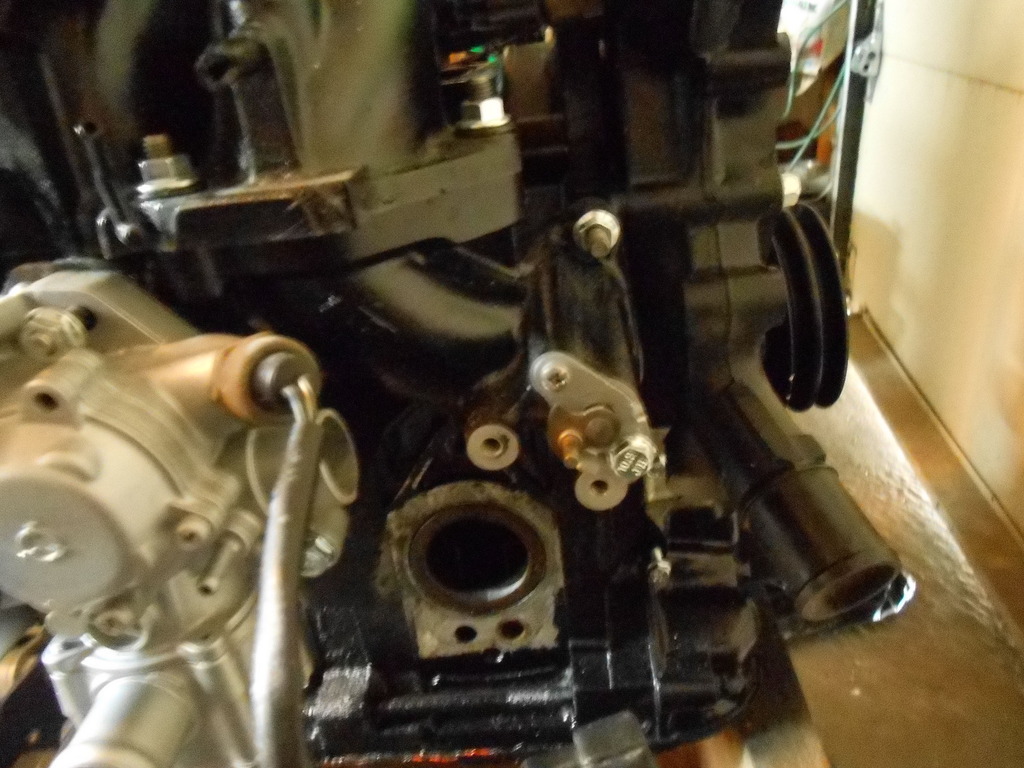
The port actuator is what I mean although I must admit I was also checking clearance of the newly installed BMW fan switch (on the back of the WP housing and not very clear in this pic...but it's fine).
Because I'm stubborn and easily intrigued by analogue/mechanical solutions, I never stopped mulling the possibilty of cable actuated aux ports/VDI.
I'll admit it's probably a harebrained idea but I can't shake the belief it might work...even if only "kinda". And this is where the RD350 comes in again.
The RD was a twin carb engine with an oil pump more or less like the S4's in that it was throttle activated. Their control solution was a single cable on the handlebar control that went into a simple manifold type device that had three cables coming out. If memory serves, I could use this part (and probably the cables too) without too much modification to pull the ports/VDI open, using the cruise control cable fitting on the throttle body.
The pull on the actuators does not even have to be linear with throttle opening, a delay can be built in so they begin/finish opening at whatever percentage of throttle opening you desire.
What can I say, the idea fascinates me.
The lightweight flywheel I purchased here on the forum arrives today (in theory)...another idea that fascinates me and simultaneously seems like a terrible mistake.
Not sure what I'll do yet.
Not so much about the oil tanks but the comment about two stroke engines, which lead to a fond (and certainly rose-tinted) ramble down old Yamaha RD lane. The original RD 350 had a metal oil tank and would be totally unsuitable for the Atkins application, but it also had a widget that brought me back to an idea I was toying with a few months ago.
More about that later.
Our weather, unnaturally crappy for the past nine days or so, finally started behaving reasonably well and I was able to emerge into the garage for some hands on time with the engine.
Still flailing for a reason to be excited (other than having a running car again...), I started easy with a dry fit of the major intake components. Along the way I ran taps through all the bosses on the block, so everything screws together nicely.
This is kinda boring and I couldn't help imagining some changes:
Concept needs some work.
Meanwhile, the actual throttle body (which needs cleaning still) showed up:
And I spent a great deal of time staring at this:
The port actuator is what I mean although I must admit I was also checking clearance of the newly installed BMW fan switch (on the back of the WP housing and not very clear in this pic...but it's fine).
Because I'm stubborn and easily intrigued by analogue/mechanical solutions, I never stopped mulling the possibilty of cable actuated aux ports/VDI.
I'll admit it's probably a harebrained idea but I can't shake the belief it might work...even if only "kinda". And this is where the RD350 comes in again.
The RD was a twin carb engine with an oil pump more or less like the S4's in that it was throttle activated. Their control solution was a single cable on the handlebar control that went into a simple manifold type device that had three cables coming out. If memory serves, I could use this part (and probably the cables too) without too much modification to pull the ports/VDI open, using the cruise control cable fitting on the throttle body.
The pull on the actuators does not even have to be linear with throttle opening, a delay can be built in so they begin/finish opening at whatever percentage of throttle opening you desire.
What can I say, the idea fascinates me.
The lightweight flywheel I purchased here on the forum arrives today (in theory)...another idea that fascinates me and simultaneously seems like a terrible mistake.
Not sure what I'll do yet.
Rotary Enthusiast
Joined: Jan 2002
Posts: 845
Likes: 38
From: Oscoda, MI
You're welcome.
In regard to the NQ50 tank, if you can, get the black 90-degree hose attachment and clips with the tank. There's a screen filter inside the hose that might or not be handy and is easily removed. The feed line would then attach to that hose.
In regard to the auxiliary ports/VDI, what about tying the actuator cables to a linear actuator or a solenoid run by an RPM switch? You shouldn't need a lot of push/pull force for it to work.
In regard to the NQ50 tank, if you can, get the black 90-degree hose attachment and clips with the tank. There's a screen filter inside the hose that might or not be handy and is easily removed. The feed line would then attach to that hose.
In regard to the auxiliary ports/VDI, what about tying the actuator cables to a linear actuator or a solenoid run by an RPM switch? You shouldn't need a lot of push/pull force for it to work.
Well, I decided it was worth $23 to pursue the cable concept and just bought the "cable set" (Yamaha terminology) from my friendly neighborhood parts stockist...who happens to be in Mumbai, India.
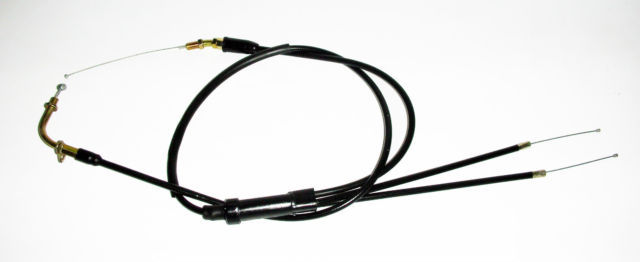
The cable length/freeplay will need changing but I think there's enough material to start with and I'm quite familiar with cable fabbing, so I think it'll work at least as a proof of concept and prototype rig.
As I await delivery, next up is figuring out the operating mech for the actuators, which is basically all about levers. I figure I'll have to super clean and final install the full assembly (sleeves,rods, seals and LIM gasket), so I'm working with "real life" forces and can design accordingly.
Probably a lot of work for something that won't end up on the car...
The cable length/freeplay will need changing but I think there's enough material to start with and I'm quite familiar with cable fabbing, so I think it'll work at least as a proof of concept and prototype rig.
As I await delivery, next up is figuring out the operating mech for the actuators, which is basically all about levers. I figure I'll have to super clean and final install the full assembly (sleeves,rods, seals and LIM gasket), so I'm working with "real life" forces and can design accordingly.
Probably a lot of work for something that won't end up on the car...
You're welcome.
In regard to the NQ50 tank, if you can, get the black 90-degree hose attachment and clips with the tank. There's a screen filter inside the hose that might or not be handy and is easily removed. The feed line would then attach to that hose.
In regard to the auxiliary ports/VDI, what about tying the actuator cables to a linear actuator or a solenoid run by an RPM switch? You shouldn't need a lot of push/pull force for it to work.
In regard to the NQ50 tank, if you can, get the black 90-degree hose attachment and clips with the tank. There's a screen filter inside the hose that might or not be handy and is easily removed. The feed line would then attach to that hose.
In regard to the auxiliary ports/VDI, what about tying the actuator cables to a linear actuator or a solenoid run by an RPM switch? You shouldn't need a lot of push/pull force for it to work.
Last edited by DeaconBlue; May 4, 2016 at 10:22 AM.
I've figured out a prototype path and shall procure materials today, I hope.
The feasibility of this whole project is based on the belief that our stock ECUs are relatively simple minded and the fact that the ports are not stepper actuated, but rather, ON/OFF switches (schematically speaking).
I'm betting that whatever simple algorithm Mazda used can be effectively duplicated with a direct throttle opening>port actuation correlation. In other words, the ports open at "X" percentage of throttle opening, regardless of speed/load/gear...whatever factors the ECU is considering.
Based on nothing but intuition and ignorance, I'm guessing this transition to OPEN should occur just before the secondary injectors kick in at 3800rpm. VTEK, yo?
I have no idea about the VDI.
None of this- at least, as envisioned so far- requires any permanent changes, so I can revert to stock after my inevitable failure.
Rotary Enthusiast
Joined: Jan 2002
Posts: 845
Likes: 38
From: Oscoda, MI
I can't speak for the S5 VDI system, but the S4 basically is an on/off setup. On the S4, when exhaust backpressure reaches a certain point (roughly 3-4PSI), the valves are opened and additional air flows at high RPM. When the backpressure is gone, the valves close again giving you more low-end torque at low RPM. I think VDI is similar but relies on engine vacuum instead of exhaust backpressure and is though a solenoid controlled by the ECU (FSM should have that answer).

I'm willing to bet the VDI is RPM specific since it essentially changes the intake from a long runner to a short runner intake. I know this is how the long runner/short runner intake on my Honda works.
Clousborne:
All the actuators on a S5 work with pressure, supplied by the airpump.
There is no vacuum or exhaust involved.
Spent some time with cardboard, making prototypes and basically shooting down all my original concepts.
Concentrating on the 5/6th ports for now and finally came up with a solution that I can implement with my limited tooling. I have a lathe but not a mill, which is by far the more useful machine.
It will require drilling a hole in the transfer rod but if not used, it won't hinder a return to stock.
I figured the machining steps (it's a fairly straightforward part) but had to stop when it came time to assign dimensions...because I need the cable assembly to figure min/max freeplay #s. This range has nothing to do with the cables, rather it's the manifold housing that determines how much distance you can cover.
Ebay tells me the part has shipped but no details about who/how, so it's just a waiting game, I guess.
Meanwhile, I decided to take a restorative ramble through the junkyard.
Sometimes I like to not focus on a specific need and just let any neat thing distract me...and there are lots of cool widgets to see.
Oddly, unfocused as I was, I ended up with three things for the Z- two of which we actually need and one was just a lark.
-I finally got what I need to make our turn signals self cancel. That's now a done deal.
-I may have found a rear hatch release handle-at least it's a place to start. We still haven't really decided where we want it to go, which would be helpful.
-Although we just reskinned our ebrake lever a few weeks ago, I found a more stylish handle that may be better, so I gambled and snagged it on spec.
The entire haul was $9, so even if only the TS bit works, it's still worth it.
Concentrating on the 5/6th ports for now and finally came up with a solution that I can implement with my limited tooling. I have a lathe but not a mill, which is by far the more useful machine.
It will require drilling a hole in the transfer rod but if not used, it won't hinder a return to stock.
I figured the machining steps (it's a fairly straightforward part) but had to stop when it came time to assign dimensions...because I need the cable assembly to figure min/max freeplay #s. This range has nothing to do with the cables, rather it's the manifold housing that determines how much distance you can cover.
Ebay tells me the part has shipped but no details about who/how, so it's just a waiting game, I guess.
Meanwhile, I decided to take a restorative ramble through the junkyard.
Sometimes I like to not focus on a specific need and just let any neat thing distract me...and there are lots of cool widgets to see.
Oddly, unfocused as I was, I ended up with three things for the Z- two of which we actually need and one was just a lark.
-I finally got what I need to make our turn signals self cancel. That's now a done deal.
-I may have found a rear hatch release handle-at least it's a place to start. We still haven't really decided where we want it to go, which would be helpful.
-Although we just reskinned our ebrake lever a few weeks ago, I found a more stylish handle that may be better, so I gambled and snagged it on spec.
The entire haul was $9, so even if only the TS bit works, it's still worth it.

Enjoying the updates!
I'm sure you already know, but the S4 5/6 ports use exhaust back pressure to open and close, originally fed to them by the split air pipe going to the main cat. I had a RB exhaust that had a vacuum hose fitting coming off the header that replaced the cat feed. Very simple that way.
If it was a simpler option for you, you could use an S4 LIM and S4 5/6 port actuators, then tap into your header to get the pressure feed. If you enlarge a hole on the S5 UIM, you can attach it to the S4 LIM, letting you retain the VDI feature. I had planned to do that in my FC days but never could get the VDI working properly.
I'm sure you already know, but the S4 5/6 ports use exhaust back pressure to open and close, originally fed to them by the split air pipe going to the main cat. I had a RB exhaust that had a vacuum hose fitting coming off the header that replaced the cat feed. Very simple that way.
If it was a simpler option for you, you could use an S4 LIM and S4 5/6 port actuators, then tap into your header to get the pressure feed. If you enlarge a hole on the S5 UIM, you can attach it to the S4 LIM, letting you retain the VDI feature. I had planned to do that in my FC days but never could get the VDI working properly.

