


How the nonturbo rotor housing exhaust sleeves work


How the nonturbo rotor housing exhaust sleeves work
Here's some information about the engineering behind the n/a FC exhaust sleeves, which have the MCPI or "multi-chamber port insert." This comes from the series 4 training manual and Kita, "Noise and Vibration Reduction Technology for Rotary Engine," 1989.
The fundamental issue here is that a pre-Renesis rotary engine's exhaust port opens much faster than a piston engine:
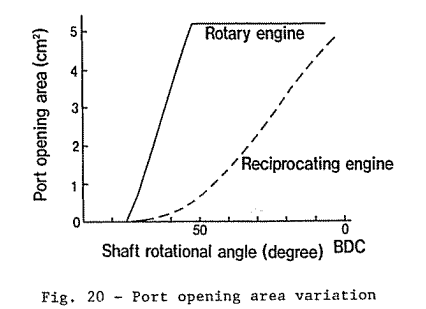
This helps for power but hurts for noise:
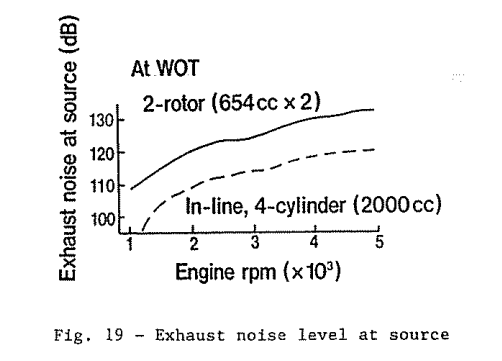
The MCPI disperses exhaust energy, which reduces the "exhaust noise at source" (y axis above) and also functions as a muffler. The MCPI was very carefully designed in terms of the size of each chamber (A and B below) and the distance between the insert and the rotor housing wall (h below):
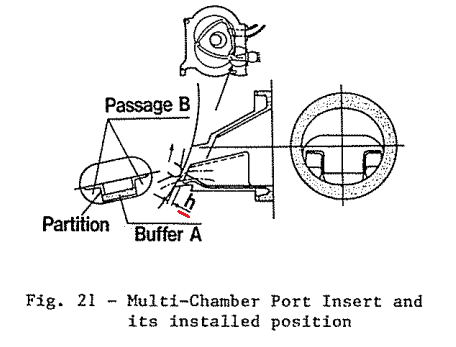
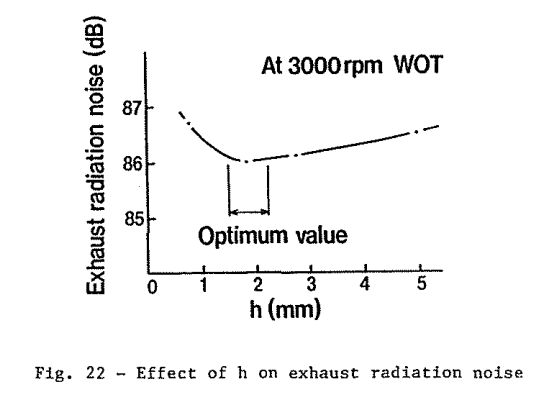
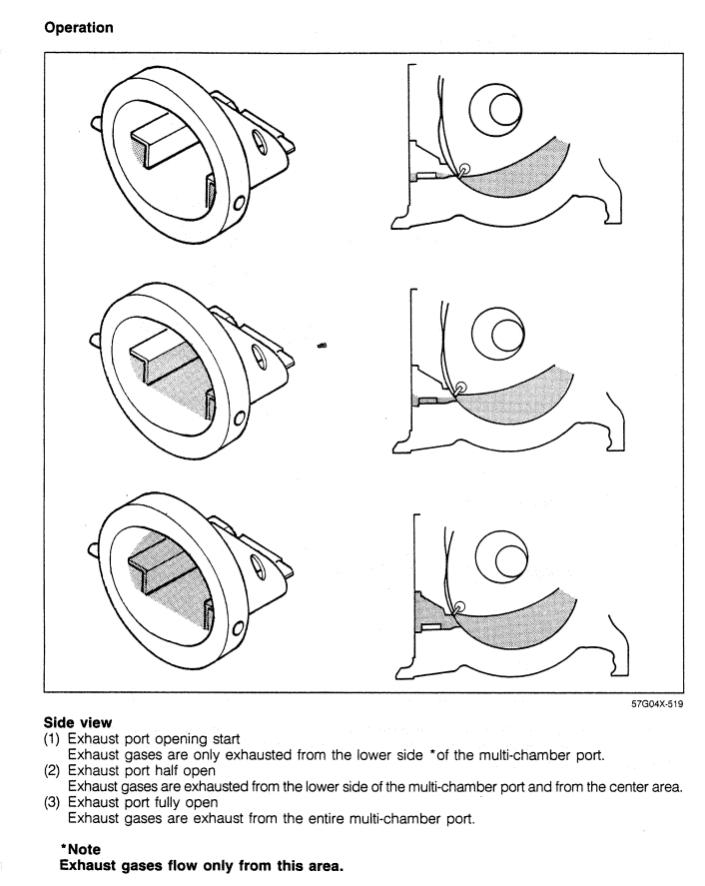
Exhaust flows through the MCPI in stages:
Mazda found that if the dimensions of the MCPI were not exactly right it would cause excessive restriction and/or ineffective noise suppression. They also had to figure out the ratio between the diameter of the stock exhaust manifold and the diameter of the MCPI. There's a bunch of math involved that I won't get into.
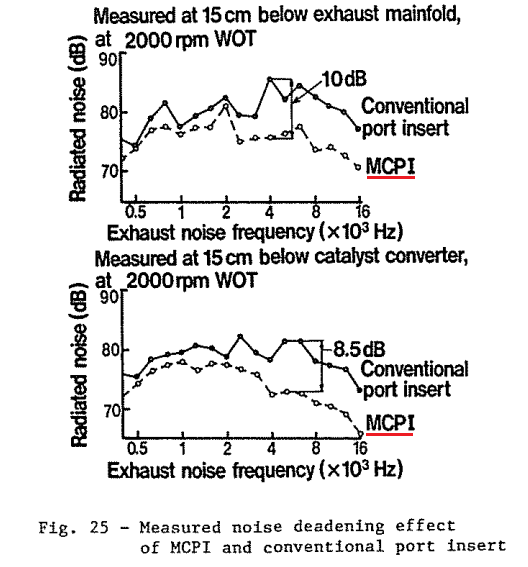
One thing that is interesting here are some charts that confirm what had been suspected--the MCPI built into the n/a housings reduces obnoxious high frequencies in the exhaust.
On my '88 GTU the previous owner had built the engine with T2 housings and after owning the car for a while I ended up wishing he had retained the port inserts. I changed out parts of the exhaust system a bunch of times and had to decide whether to add more restriction or put up with the hassles of excessive NVH (noise/vibration/harashness). Now, that is my own personal experience and I certainly didn't try every single exhaust setup out there. You're all welcome to make up your own mind.
So before you ditch your n/a exhaust port inserts think long and hard whether you want to increase the high frequencies in the exhaust for the sake of a few horsepower.
The fundamental issue here is that a pre-Renesis rotary engine's exhaust port opens much faster than a piston engine:
This helps for power but hurts for noise:
The MCPI disperses exhaust energy, which reduces the "exhaust noise at source" (y axis above) and also functions as a muffler. The MCPI was very carefully designed in terms of the size of each chamber (A and B below) and the distance between the insert and the rotor housing wall (h below):
Exhaust flows through the MCPI in stages:
Mazda found that if the dimensions of the MCPI were not exactly right it would cause excessive restriction and/or ineffective noise suppression. They also had to figure out the ratio between the diameter of the stock exhaust manifold and the diameter of the MCPI. There's a bunch of math involved that I won't get into.
One thing that is interesting here are some charts that confirm what had been suspected--the MCPI built into the n/a housings reduces obnoxious high frequencies in the exhaust.
On my '88 GTU the previous owner had built the engine with T2 housings and after owning the car for a while I ended up wishing he had retained the port inserts. I changed out parts of the exhaust system a bunch of times and had to decide whether to add more restriction or put up with the hassles of excessive NVH (noise/vibration/harashness). Now, that is my own personal experience and I certainly didn't try every single exhaust setup out there. You're all welcome to make up your own mind.
So before you ditch your n/a exhaust port inserts think long and hard whether you want to increase the high frequencies in the exhaust for the sake of a few horsepower.

[Sorry for the double post - I think this reply is more relevant here than the other thread]
That's something I'd never considered.. Vibration from turbo exhaust ports.. The noise increase compared with my previous engine [All S4 NA with S5 NA housings] was negligible [full RB exhaust, header/presilencer/catback], but it does feel like there's a fair bit of exhaust vibration that shouldn't be present...
That's something I'd never considered.. Vibration from turbo exhaust ports.. The noise increase compared with my previous engine [All S4 NA with S5 NA housings] was negligible [full RB exhaust, header/presilencer/catback], but it does feel like there's a fair bit of exhaust vibration that shouldn't be present...


Joined: Mar 2001
Posts: 31,849
Likes: 3,238
From: https://www2.mazda.com/en/100th/
interesting, the inserts actually DO work in the sound frequencies that the human ear hears really well....
http://en.wikipedia.org/wiki/Equal-loudness_contours
http://en.wikipedia.org/wiki/Equal-loudness_contours

It's no secret that they work. That's why they are there. However not using them and then using a good exhaust system is far nicer than keeping them and then using the average "ricer" muffler that everyone seems to love. I'd argue that while they do work, the muffler selected will always have the biggest effect. My exhaust sleeves which maintain a constant area as opposed to the crap stock design are very loud. A good muffler tames them down quite nicely.
The thing that you need to remember when you look at technical papers is that while they all have a purpose, there is nothing saying that it is the best way to do things. If it were then manufacturers would never improve on them from year to year.
The thing that you need to remember when you look at technical papers is that while they all have a purpose, there is nothing saying that it is the best way to do things. If it were then manufacturers would never improve on them from year to year.
Joined: Mar 2001
Posts: 31,849
Likes: 3,238
From: https://www2.mazda.com/en/100th/
your exhaust sleeves are actually a great example. the stock FC sleeve is designed to quiet the engine, and deliver the port air more effectively, and it does. your sleeve, being more like the race engine, should make more power. saying that one or the other is best depends on the intended use too. for a race car, its obvious you take the best flow, for a street car its nice to have it quiet.
the papers are also nice because they are about the engines we actually have. so its nice to know what compromises they made, and why they made them. it also gives us a nice metric to measure improvements or changes we make.
It's no secret that they work. That's why they are there. However not using them and then using a good exhaust system is far nicer than keeping them and then using the average "ricer" muffler that everyone seems to love. I'd argue that while they do work, the muffler selected will always have the biggest effect.
A lot of guys prefer the style of a canister muffler(s), and when you combine that with no exhaust port diffuser sleeves you either have to
1) put up with the extra noise and vibration and everything that entails
2) install some form of restriction (silencer in the tips, resonators, etc) which has the potential to cancel out much of the performance benefit of removing the diffusers in the first place
headers amplify this problem. Of course if you have a full RB system it's not going to matter so much.


i'd prefer to tune the exhaust than to leave them in there. they are a rather large restriction to the potential performance of the n/a engines.
will know the exact difference once i install the engine into my gf's GXL.
will know the exact difference once i install the engine into my gf's GXL.
Trending Topics
I'm not disagreeing with this. I have had many combinations of exhaust components on n/a engines with the diffusor removed. Cat, no cat, resonators, presilencers, canister vs non-canister (RB) style.
A lot of guys prefer the style of a canister muffler(s), and when you combine that with no exhaust port diffuser sleeves you either have to
1) put up with the extra noise and vibration and everything that entails
2) install some form of restriction (silencer in the tips, resonators, etc) which has the potential to cancel out much of the performance benefit of removing the diffusers in the first place
headers amplify this problem. Of course if you have a full RB system it's not going to matter so much.
A lot of guys prefer the style of a canister muffler(s), and when you combine that with no exhaust port diffuser sleeves you either have to
1) put up with the extra noise and vibration and everything that entails
2) install some form of restriction (silencer in the tips, resonators, etc) which has the potential to cancel out much of the performance benefit of removing the diffusers in the first place
headers amplify this problem. Of course if you have a full RB system it's not going to matter so much.
this is true. you do have to take them for what they are, however all of them in context really shows the progression of both the street engines and the racing engines. the street engines have a different problem set than the race engines do.
your exhaust sleeves are actually a great example. the stock FC sleeve is designed to quiet the engine, and deliver the port air more effectively, and it does. your sleeve, being more like the race engine, should make more power. saying that one or the other is best depends on the intended use too. for a race car, its obvious you take the best flow, for a street car its nice to have it quiet.
the papers are also nice because they are about the engines we actually have. so its nice to know what compromises they made, and why they made them. it also gives us a nice metric to measure improvements or changes we make.
your exhaust sleeves are actually a great example. the stock FC sleeve is designed to quiet the engine, and deliver the port air more effectively, and it does. your sleeve, being more like the race engine, should make more power. saying that one or the other is best depends on the intended use too. for a race car, its obvious you take the best flow, for a street car its nice to have it quiet.
the papers are also nice because they are about the engines we actually have. so its nice to know what compromises they made, and why they made them. it also gives us a nice metric to measure improvements or changes we make.
People typically seem to gravitate towards the way that makes them feel most warm and fuzzy inside which is power. People do it with dyno numbers. They discount the ones that measure lower and believe the ones that measure higher when the reality is that they are both probably off. Selective understanding does the same thing here. "Mazda did it this way because it must be the best way (to make power)". The reality is they did this to quiet the exhaust for street use and for no other reason and this may be, and in fact is, a negative when it comes to making power. If your goal is to make the most power, using the n/a sleeves isn't the way to do it.
They made the sleeves expand in area for much the same reason and again this is another place where people surmise incorrectly that they did it that way for flow or for power when the whole point was to reduce exhaust energy for street use. Partially for emissions reasons and partially because it's easier to quiet. This may seem a bit strange since it is shaped like a megaphone but a constant area sleeve is much louder so clearly it works.

Not to hijack but speaking of exhaust sleeves. Whatever came about with the straight trough non tapered sleeves that you made rotarygod? I made a set for the engine that is in my car right now but i have no before and after data to make a comparison.
i think this would be the ideal time for dual pass mufflers to come into play.
as far as the port sleeves go, something else to chew on... if they were removed, the cars generally pickup about 20 horsepower even in stock form. all their research and investment into the turbo models would have been wasted as most people would not spend the extra cash for the minor power gains from n/a to turbo.
with the stock manifold, dual catalytic converters and dual baffled mufflers, do you really think that raspy exhaust tone would make it out the exhaust? the stock cars were VERY quiet. perhaps they had droning issues inside the exhaust, but that is my only thought.
as far as the port sleeves go, something else to chew on... if they were removed, the cars generally pickup about 20 horsepower even in stock form. all their research and investment into the turbo models would have been wasted as most people would not spend the extra cash for the minor power gains from n/a to turbo.
with the stock manifold, dual catalytic converters and dual baffled mufflers, do you really think that raspy exhaust tone would make it out the exhaust? the stock cars were VERY quiet. perhaps they had droning issues inside the exhaust, but that is my only thought.
Last edited by RotaryEvolution; Dec 1, 2011 at 12:07 PM.
Joined: Mar 2001
Posts: 31,849
Likes: 3,238
From: https://www2.mazda.com/en/100th/
You clearly understand the compromises made between street and race level performance. I do love seeing the natural progression of things and the information gained from them. The problem I have is that someone may read a paper, this one for example, and then come to the conclusion that this sleeve design is used because it is the best way to do it and their millions of dollars of research has shown this. As you have pointed out though "best" in which way?
People typically seem to gravitate towards the way that makes them feel most warm and fuzzy inside which is power. People do it with dyno numbers. They discount the ones that measure lower and believe the ones that measure higher when the reality is that they are both probably off. Selective understanding does the same thing here. "Mazda did it this way because it must be the best way (to make power)". The reality is they did this to quiet the exhaust for street use and for no other reason and this may be, and in fact is, a negative when it comes to making power. If your goal is to make the most power, using the n/a sleeves isn't the way to do it.
They made the sleeves expand in area for much the same reason and again this is another place where people surmise incorrectly that they did it that way for flow or for power when the whole point was to reduce exhaust energy for street use. Partially for emissions reasons and partially because it's easier to quiet. This may seem a bit strange since it is shaped like a megaphone but a constant area sleeve is much louder so clearly it works.
People typically seem to gravitate towards the way that makes them feel most warm and fuzzy inside which is power. People do it with dyno numbers. They discount the ones that measure lower and believe the ones that measure higher when the reality is that they are both probably off. Selective understanding does the same thing here. "Mazda did it this way because it must be the best way (to make power)". The reality is they did this to quiet the exhaust for street use and for no other reason and this may be, and in fact is, a negative when it comes to making power. If your goal is to make the most power, using the n/a sleeves isn't the way to do it.
They made the sleeves expand in area for much the same reason and again this is another place where people surmise incorrectly that they did it that way for flow or for power when the whole point was to reduce exhaust energy for street use. Partially for emissions reasons and partially because it's easier to quiet. This may seem a bit strange since it is shaped like a megaphone but a constant area sleeve is much louder so clearly it works.
with the PP though, if i could drop 10db with the sleeves (its a 12A) i would do it. not only would it be quiet enough to pass any kind of sound test on the street, it might not vibrate the entire car over 5000rpm either!
the stock sleeve is also designed to have the air pump air mix in with the exhaust gasses, so turbulence is good there.
but does it help with the bottom end performance? if not, figure out a different way of quieting it down.
remember that they do hinder peak performance. that big brick is blocking a good 30% of the exhaust flow.
remember that they do hinder peak performance. that big brick is blocking a good 30% of the exhaust flow.
You really think you can reduce sound without losing engine output anywhere in the rpm band? Some mufflers are better designed than others for a particular application but this is a bold statement.
The sleeves reduce exhaust noise, especially at high frequency. This is indisputable. The data speaks for itself. That doesn't mean you can't or shouldn't get rid of them. It just means that they are there for a reason and they were engineered by guys in lab coats trying to meet very strict noise/vibration targets. If you take them out and change nothing else, your car will have more noise and/or vibration. That's all I'm saying. It doesn't mean you can't put up with it or you can't mitigate it in some way.

Thread
Thread Starter
Forum
Replies
Last Post
cdn
2nd Generation Specific (1986-1992)
14
Sep 10, 2015 06:23 AM
cdn
2nd Generation Non-Technical and pictures
0
Aug 11, 2015 08:59 PM
