


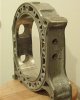
My Beveled S5 Turbo Rotors *Pics*


Originally Posted by c00lduke
How does beveling the rotors have the same effects as bridge porting without the crappy idle?


I wish I was driving!

Joined: Dec 2001
Posts: 5,241
Likes: 84
From: BC, Canada
Justin,
It is screamingly obvious you have never seen engine components being balanced, and seen how they look before balancing is completed, nor have you seen the effects of counterweight mass mismatched to the rotors and the destruction it wreaks on bearings.
There is no factory spec b/c you balance the assembly based on the lowest rotor mass. You balance each rotor so that they match in weight by removing mass from the sides of the rotor.
Then you make up bob weight equal to the of each rotor + the mass of oil which fills the rotor, and attach them to the eccentric shaft, and then assemble the front and rear counterweight assemblies, and then balance the eccentric shaft by drilling out mass/adding in slugs to the counterweights.
Since you have removed a significant mass from your rotors, while they remain statically blanced, you have thrown out the balance of the counterweights.
The volume of oil in each rotor remains a constant whenever the engine is running due to centripetal force acting on the rotor, which is contsantly being filled via the eccentric shaft oil jets. I am not sure if all balancing shops are aware of this and factor in this mass, but most rotary specific balancer's do.
Here is a thread where you have a lot of more experienced builders telling you what to do, and you argue against it based on ignorance.
What a waste of our time. We should just let you find out yourself after 10,000 when your engine spins a bearing and grenades itself.
But hey, you know better than us, right?
It is screamingly obvious you have never seen engine components being balanced, and seen how they look before balancing is completed, nor have you seen the effects of counterweight mass mismatched to the rotors and the destruction it wreaks on bearings.
There is no factory spec b/c you balance the assembly based on the lowest rotor mass. You balance each rotor so that they match in weight by removing mass from the sides of the rotor.
Then you make up bob weight equal to the of each rotor + the mass of oil which fills the rotor, and attach them to the eccentric shaft, and then assemble the front and rear counterweight assemblies, and then balance the eccentric shaft by drilling out mass/adding in slugs to the counterweights.
Since you have removed a significant mass from your rotors, while they remain statically blanced, you have thrown out the balance of the counterweights.
The volume of oil in each rotor remains a constant whenever the engine is running due to centripetal force acting on the rotor, which is contsantly being filled via the eccentric shaft oil jets. I am not sure if all balancing shops are aware of this and factor in this mass, but most rotary specific balancer's do.
Here is a thread where you have a lot of more experienced builders telling you what to do, and you argue against it based on ignorance.
What a waste of our time. We should just let you find out yourself after 10,000 when your engine spins a bearing and grenades itself.
But hey, you know better than us, right?
Last edited by scathcart; Feb 27, 2006 at 08:11 PM.

Seduced by the DARK SIDE

Joined: Apr 2001
Posts: 7,323
Likes: 2
From: Orange Park FL (near Jax)
When I beveled my rotors, I cut both the opening & closing corners.
Then since I had no way to estimate the quantity of oil retained in a spinning rotor, I had to guess at how much to cut off the corners of the counterweights.
It was an economy rebuild with 80,000 miles on the bearings.
At 3500 miles with a fair amount of thrashing, oil pressure is still solid.
If my balance was too far off I'm sure I would have noticed a buzz in my almost rigid torque brace by now.
Then since I had no way to estimate the quantity of oil retained in a spinning rotor, I had to guess at how much to cut off the corners of the counterweights.
It was an economy rebuild with 80,000 miles on the bearings.
At 3500 miles with a fair amount of thrashing, oil pressure is still solid.
If my balance was too far off I'm sure I would have noticed a buzz in my almost rigid torque brace by now.
Originally Posted by scathcart
Justin,
Since you have removed a significant mass from your rotors, while they remain statically blanced, you have thrown out the balance of the counterweights.
Since you have removed a significant mass from your rotors, while they remain statically blanced, you have thrown out the balance of the counterweights.
This is a great point that can easliy be lost when doing mods like this. This would be like adding the lighter weight Rx-8 rotors and still using the counter weights from the 9.5 lb rotors. If your beveled rotors weigh the same as the Rx8 rotors, then a cheaper alternative would be to just buy the Rx8 front and rear counter weights.
http://www.mazdatrix.com/faq/rotorwgt.htm
Last edited by t-von; Mar 3, 2006 at 03:08 PM.

Photo Diety
Joined: Mar 2001
Posts: 2,311
Likes: 0
From: Florida
I believe Mazda allows for a 50 gram discrepancy between rotors (which is huge) and still be in factory "spec". The CNC's rotor pictured is mine and they started out as TII rotors, heavier than the FD rotors. They were all lightened, via the machining on the sides of the rotors, to the lowest allowable weight for an FD rotor. This allowed for the retention of my Cosmo counterweight.
If I remember correctly, the port phasing exposes the intake port to 130 degrees TOTAL more crank rotation.
Have yours balanced at the very least.
If I remember correctly, the port phasing exposes the intake port to 130 degrees TOTAL more crank rotation.
Have yours balanced at the very least.


Originally Posted by pp13bnos
What i think is funny, is that you think it *might* be close. Just like in horse shoes, and handgranades.  CJ
CJ
CJI like playing horse shoes, with hand grenades


Thread Starter
Senior Member
Joined: Oct 2002
Posts: 685
Likes: 1
From: Portland, OR
This is my logic, tell me where I have gone wrong:
I weighed these two rotors:
"B" 4377.57g (9.650lb)
"D" 4343.67g (9.576lb)
The “2-letter” weight deviation of this pair seems to be 33.9g. Half of this value must be the “1-letter” deviation, which is 16.95g. Mazda letters rotors from A to E, which is (4) “1-letter” deviations in weight, which is 67.8g.
Given the above 2 values let assume that the mean rotor weights are:
“A” = 4394g
“B” = 4277g
“C” = 4360g
“D” = 4343g
“E” = 4326g
That means the lightest pair of rotors is:
2 x 4326 = 8652g
And the heaviest pair of rotors is:
2 x 4394 = 8788g
The difference of these is:
8788 – 8652 = 136g
There must also be an allowable range for the weights of counter weights (drilling them brings the rough casting into this range). Let’s be conservative and assume all of the counterweights are exactly the same weight.
If Mazda does not dynamically balance every engine, and Mazda does not stamp counterweights to be used with their matching rotors then Mazda must allow rotor pairs that range over 136g in weight to be used with the same counterweights. Right?
So how does my removal of 60g (30g x (2)) make my setup any worse than what Mazda ships out the door?
Justin
ps: If someone could weigh a larger selection of rotors then a better idea of the mean rotor weights could be found.
I weighed these two rotors:
"B" 4377.57g (9.650lb)
"D" 4343.67g (9.576lb)
The “2-letter” weight deviation of this pair seems to be 33.9g. Half of this value must be the “1-letter” deviation, which is 16.95g. Mazda letters rotors from A to E, which is (4) “1-letter” deviations in weight, which is 67.8g.
Given the above 2 values let assume that the mean rotor weights are:
“A” = 4394g
“B” = 4277g
“C” = 4360g
“D” = 4343g
“E” = 4326g
That means the lightest pair of rotors is:
2 x 4326 = 8652g
And the heaviest pair of rotors is:
2 x 4394 = 8788g
The difference of these is:
8788 – 8652 = 136g
There must also be an allowable range for the weights of counter weights (drilling them brings the rough casting into this range). Let’s be conservative and assume all of the counterweights are exactly the same weight.
If Mazda does not dynamically balance every engine, and Mazda does not stamp counterweights to be used with their matching rotors then Mazda must allow rotor pairs that range over 136g in weight to be used with the same counterweights. Right?
So how does my removal of 60g (30g x (2)) make my setup any worse than what Mazda ships out the door?
Justin
ps: If someone could weigh a larger selection of rotors then a better idea of the mean rotor weights could be found.
^ Provided you have correct weight estimates of the other rotors, you have a great point. To my knowledge, Mazda doesn't sell varying counter weights to match with different rotors weights.
Edit wait a sec in your first post you said you weighed a "B" and "C" rotor? In your above example you are now saying to weighed a "B" and "D" rotors? Which is it because this will throw off your weight estimates?
First post:
Above post:
Edit wait a sec in your first post you said you weighed a "B" and "C" rotor? In your above example you are now saying to weighed a "B" and "D" rotors? Which is it because this will throw off your weight estimates?
First post:
I also weighed these before and after:
Rotor 1=> Letter="C" => Before=>4342.11g After=>4312.68g Net=>29.43g
Rotor 2=> Letter="B" => Before=>4377.57g After=>4347.83g Net=>29.74g
Rotor 1=> Letter="C" => Before=>4342.11g After=>4312.68g Net=>29.43g
Rotor 2=> Letter="B" => Before=>4377.57g After=>4347.83g Net=>29.74g
I weighed these two rotors:
"B" 4377.57g (9.650lb)
"D" 4343.67g (9.576lb)
"B" 4377.57g (9.650lb)
"D" 4343.67g (9.576lb)
Last edited by t-von; Mar 4, 2006 at 01:19 PM.
Thread Starter
Senior Member
Joined: Oct 2002
Posts: 685
Likes: 1
From: Portland, OR
Originally Posted by t-von
^ Provided you have correct weight estimates of the other rotors, you have a great point. To my knowledge, Mazda doesn't sell varying counter weights to match with different rotors weights.
Originally Posted by t-von
Edit wait a sec in your first post you said you weighed a "B" and "C" rotor? In your above example you are now saying to weighed a "B" and "D" rotors? Which is it because this will throw off your weight estimates?
https://www.rx7club.com/showthread.p...r+weight+stamp
"B" 4377.57g (9.650lb)
"C" 4342.11g (9.573lb)
"D" 4343.67g (9.576lb)
If someone could weigh some clean S5 turbo or S6 rotors with bearings and no seals we could all better understand what weights are allowable.
Justin
As far as I know, Mazda will only put a "B" Rotor with a "C" or "A" rotor, never any further than one letter away. They would never put a "A" rotor with a "C" or "D" rotor. Its been *along* time since talking to Rob Golden about this, but I'm fairly certain this is what he told me. CJ
Originally Posted by pp13bnos
As far as I know, Mazda will only put a "B" Rotor with a "C" or "A" rotor, never any further than one letter away. They would never put a "A" rotor with a "C" or "D" rotor. Its been *along* time since talking to Rob Golden about this, but I'm fairly certain this is what he told me. CJ
We understand that but the issue here is how Mazda used the counter weights with all 5 rotor weights without any balancing problems. The same counter weight can be used with an engine with all "A" rotors or all "E" rotors without any balancing problems. For this reason, pistonsuk feels his beveled rotors should be perfectly fine in his engine without any re-balancing.
Thread Starter
Senior Member
Joined: Oct 2002
Posts: 685
Likes: 1
From: Portland, OR
Originally Posted by t-von
We understand that but the issue here is how Mazda used the counter weights with all 5 rotor weights without any balancing problems. The same counter weight can be used with an engine with all "A" rotors or all "E" rotors without any balancing problems. For this reason, pistonsuk feels his beveled rotors should be perfectly fine in his engine without any re-balancing.

Savanna Rx-7


Joined: Jun 2004
Posts: 1,577
Likes: 12
From: yokosuka japan
actually, the counterweight argument is the best one I have heard in his favor so far, I had not even thought about it but he his argument is very valid when looked at in that light......
regardless, keep trying, there is so little inovation these days that any little bit helps a lot.
kenn
regardless, keep trying, there is so little inovation these days that any little bit helps a lot.
kenn

Laying Down Rotary Law
Joined: Mar 2001
Posts: 2,075
Likes: 1
From: central florida
Eh my friend has rotors done on a CNC here locally
and it sound just like a bridge port
He wants to try on another car
"cut" rotors and secondary bridge on a FD..crazy
The only problem I have
doesn't it lower the compression of the rotors?
The RX8 rotors have very small cuts
compared to the ones I've seen done here in FL
and it sound just like a bridge port
He wants to try on another car
"cut" rotors and secondary bridge on a FD..crazy
The only problem I have
doesn't it lower the compression of the rotors?
The RX8 rotors have very small cuts
compared to the ones I've seen done here in FL
Thread Starter
Senior Member
Joined: Oct 2002
Posts: 685
Likes: 1
From: Portland, OR
Originally Posted by kabooski
doesn't it lower the compression of the rotors?
By finding the volume change of the cavity between any to compression rotors (maybe using something like silly putty and then weighing it?) and then using this to create a proportion one could estimate the new compression ratio by including the volume addition of the cuts (you would have to estimate this by assuming the removed area to be a triangular shaped cross-section and then extruding this to a volume like in my weight removed calulation).
My guess is somewhere around one or two tenths of a ratio at the most....but thats just ballparking from the volume addition.
Justin
Thread Starter
Senior Member
Joined: Oct 2002
Posts: 685
Likes: 1
From: Portland, OR
Rotor Weigh Deviations
Kevin at Rotary Resurrection PM'd me these "mean" rotor weights. Thanks Kevin for taking the time.
I have heard of using one or two letter deviations in a build. I am not positive what mazda does. To be conservative let's assume it is one. That means, for example, worst case would be a heavy "B" (4388g) being used with a light "C" (4342g). This allows for 45g difference between the two rotors. After removing material from my rotors I noted less then 0.3grams difference in material removed.
More importantly, if it is true that mazda uses the same counterweights on all builds then sets of rotors weighing anywhere from 8800g (2 mean "A's") to 8628g (2 mean "E's"), a range of 172grams, can be used with the same counterweights.
Given this info why would the removal of 60grams from my rotors merit the need for $200 of balancing?
Justin
Originally Posted by RotaryResurrection
Just for you, I weighed a few s5/6 rotors while rearranging/cleaning some for the shelf.
A 9.7lb 4400g
B 9.65lb 4377g
C 9.6lb 4354g
D 9.55lb 4331g
E 9.51lb 4314g
A few of these I had more than one rotor of each letter of, and I noticed that within each letter there is still a tolerance of 0.03lb one way or another. So a C could be anywhere from about 9.58 to 9.63. As i've stated before, the letters are just a tolerance scale, and not absolute. For instance, the general rule is to stay within 1 letter when doing a build, like C and D, which should be something like 9.55 with 9.6, a variance of 0.05lb. In reality you could have a light B and a heavy D that would mate up just fine, like 9.63 and 9.57, still a tolerane of 0.05, but not within the "rule" of 1 letter.
A 9.7lb 4400g
B 9.65lb 4377g
C 9.6lb 4354g
D 9.55lb 4331g
E 9.51lb 4314g
A few of these I had more than one rotor of each letter of, and I noticed that within each letter there is still a tolerance of 0.03lb one way or another. So a C could be anywhere from about 9.58 to 9.63. As i've stated before, the letters are just a tolerance scale, and not absolute. For instance, the general rule is to stay within 1 letter when doing a build, like C and D, which should be something like 9.55 with 9.6, a variance of 0.05lb. In reality you could have a light B and a heavy D that would mate up just fine, like 9.63 and 9.57, still a tolerane of 0.05, but not within the "rule" of 1 letter.
More importantly, if it is true that mazda uses the same counterweights on all builds then sets of rotors weighing anywhere from 8800g (2 mean "A's") to 8628g (2 mean "E's"), a range of 172grams, can be used with the same counterweights.
Given this info why would the removal of 60grams from my rotors merit the need for $200 of balancing?
Justin

What Subscription?
Joined: Apr 2001
Posts: 5,926
Likes: 2
From: Aiken SC USA
Originally Posted by pistonsuk
Given this info why would the removal of 60grams from my rotors merit the need for $200 of balancing?
Justin
Justin
Not Pretty

well, it all comes down to an "each his own"-thing. i admit it's difficult to argue against the counterweight issue because it IS a valid argument. however, i'd still get the whole assembly balanced if they were mine.
Originally Posted by banzaitoyota
Justin: Have you ever witnessed the balancing of a set of rotors that were out of balance?
Not Pretty
Not Pretty
But still look at his point of view, you take two "C" weight rotors and perform the bevel on them. Now both rotors weigh as much as a par of "E" rotors. Balancing shouldn't be needed. Now I could see a problem if you bevel the lightest "E" weight rotors making them even lighter than what's on the rotor weight scale causing an imbalance compared to the counter weights. Now if re-balancing is out of the question, ideally the DIY'fer would want to start with the heaviest weight "A" rotors so that you could remove enough material to equal the "C" weight rotors since that's the middle and the perfect balance weight for the counter weights.
Last edited by t-von; Mar 20, 2006 at 04:49 AM.
Thread Starter
Senior Member
Joined: Oct 2002
Posts: 685
Likes: 1
From: Portland, OR
Originally Posted by pistonsuk
I also weighed these before and after:
Rotor 1=> Letter="C" => Before=>4342.11g After=>4312.68g Net=>29.43g
Rotor 2=> Letter="B" => Before=>4377.57g After=>4347.83g Net=>29.74g
Rotor 1=> Letter="C" => Before=>4342.11g After=>4312.68g Net=>29.43g
Rotor 2=> Letter="B" => Before=>4377.57g After=>4347.83g Net=>29.74g
.By comparing with the numbers given by Kevin it looks like I ended up with a light "C" and an average "E" rotor after cutting them. They have ~35g difference between them.
Justin
Thread Starter
Senior Member
Joined: Oct 2002
Posts: 685
Likes: 1
From: Portland, OR
Ceramic Coating
I finished these up over spring break.
To prep them I scrubbed them with kerosene to remove the carbon, then washed them twice in the dishwasher (roomates were thrilled about this), heated them to 500F for 1 hour to "outgas" them, sandblaster them with a $15 Harbor Freight Gun (check that thing out it actually worked!) and wiped them down with acetone.
I sprayed them with a $10 Harbor Freight Air Brush(worked great!, easy to "tune in"). The curing process took 1hr at 350F. I used an oven I have access to here on campus.
Blaster $15: http://www.harborfreight.com/cpi/cta...emnumber=93221
100lb Sand (used ~5-10lbs): $8: Local Industrial Supply
Acetone $12 : Home Depot
Masking Tape $3 : Home Depot
Brush $10: http://www.harborfreight.com/cpi/cta...emnumber=47791
CBX Coating $35 (used ~20%): http://techlinecoatings.com/BulkEngine.htm
Total spent: $83
DIY: Priceless (unless is fails and wipes out my rotor housings and turbine
The $15 Blaster!

Taped and Clean:

Blasted:

Coated and Air Dryed:

I havent taken any pics of them after I cured them but they look almost identical to the above air dryed pic.
To prep them I scrubbed them with kerosene to remove the carbon, then washed them twice in the dishwasher (roomates were thrilled about this), heated them to 500F for 1 hour to "outgas" them, sandblaster them with a $15 Harbor Freight Gun (check that thing out it actually worked!) and wiped them down with acetone.
I sprayed them with a $10 Harbor Freight Air Brush(worked great!, easy to "tune in"). The curing process took 1hr at 350F. I used an oven I have access to here on campus.
Blaster $15: http://www.harborfreight.com/cpi/cta...emnumber=93221
100lb Sand (used ~5-10lbs): $8: Local Industrial Supply
Acetone $12 : Home Depot
Masking Tape $3 : Home Depot
Brush $10: http://www.harborfreight.com/cpi/cta...emnumber=47791
CBX Coating $35 (used ~20%): http://techlinecoatings.com/BulkEngine.htm
Total spent: $83
DIY: Priceless (unless is fails and wipes out my rotor housings and turbine
The $15 Blaster!
Taped and Clean:
Blasted:
Coated and Air Dryed:
I havent taken any pics of them after I cured them but they look almost identical to the above air dryed pic.
That is nice! Thx for posting the links ect. How long does that sand blast gun last per fill? I was thinking about buying one of these since I have a shop and may use it for more projects.
http://cgi.ebay.com/ABRASIVE-BLAST-C...QQcmdZViewItem
http://cgi.ebay.com/ABRASIVE-BLAST-C...QQcmdZViewItem
Last edited by t-von; Mar 20, 2006 at 06:45 PM.
Thread Starter
Senior Member
Joined: Oct 2002
Posts: 685
Likes: 1
From: Portland, OR
Sand Blaster
Originally Posted by t-von
How long does that sand blast gun last per fill? I was thinking about buying one of these since I have a shop and may use it for more projects.
Justin

Newbie
Joined: Apr 2006
Posts: 1
Likes: 0
From: England
Originally Posted by pistonsuk
Looks like I have made my point. Like any engineer I have been taught to justify by decisions based on some rational process. Again, like in engineering, nobody really knows until it has been teted. That is the next step. I will be sure to update this thread with pics when the engine comes back apart (probably ~20k or so unless something fails.
By comparing with the numbers given by Kevin it looks like I ended up with a light "C" and an average "E" rotor after cutting them. They have ~35g difference between them.
Justin
.By comparing with the numbers given by Kevin it looks like I ended up with a light "C" and an average "E" rotor after cutting them. They have ~35g difference between them.
Justin
All the forces are constrained within the crank itself and that is why the engine is smooth.
Bit like couterbalance shafts in 4 cyl engines (porsche s216v 3.0) these are removed by racers to reduce inertia.
The key is to make BOTH ROTOR ASSEMBLY'S THE SAME MASS.
Make a simple balance and pile everything from each rotor onto each side of the arm. Machine a small amount from all 6 corner faces on the heavy rotor until they are the same.
Mazda balance the shaft pulley assy. There are balance drillings in the pulleys.
Regards,
Jonathan

