


How to improve spool, scientifically speaking


How to improve spool, scientifically speaking
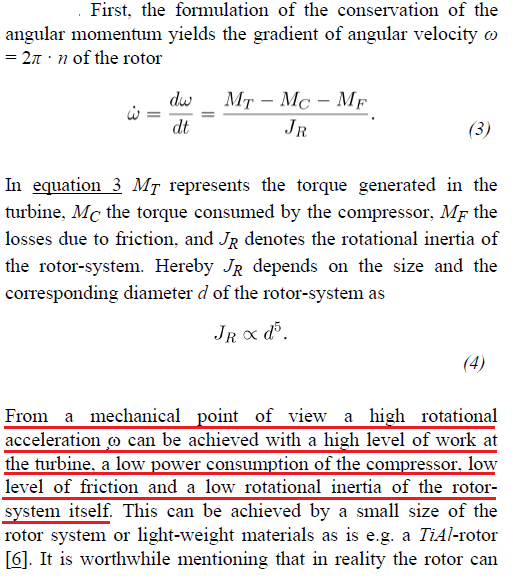
According to Stoffels, "Analysis of Transient Operation of Turbo Charged Engines," 2010 (PM me if interested in this),
the angular acceleration (spool) of the turbo is based on:
1) The torque generated by the turbine wheel
2) The torque consumed by the compressor wheel
3) Frictional losses
4) rotational inertia
When selecting a turbo the basic ways to improve spool are:
1) make the turbine more efficient through optimization of the turbine wheel, turbine housing, and exhaust manifold
2) use a more efficient compressor wheel that requires less torque from the turbine to generate the required airflow
3) reduce frictional losses due to better bearing design etc
4) reduce rotational inertia by decreasing size and weight of the rotating assembly

talking head

Joined: Apr 2008
Posts: 2,775
Likes: 15
From: Perth, WA, OZ
on a rotary engine,,,, increase fuel, reduce timing= more energy in the exhaust gas= faster spool
read,, not the same power at the wheels,, but turbo up to efficient speed at an earlier rpm
read,, not the same power at the wheels,, but turbo up to efficient speed at an earlier rpm



Can Post Only in New Member Section
iTrader: (2)
Joined: Jul 2004
Posts: 930
Likes: 0
From: Calgary, Canada

You can improve other variables as well... one of them being the length of the tubuing used on your exhaust manifold..and also the diameter of each individual runner as well as the inlet of the exhaust flange to the single runners. My fab guy talked to me one night about how you can actually improve the velocity of the exhaust gas coming out of your engine...not just by using larger exhaust runner diameter. Beveled..or tapered inlets can speed up exhaust gas...and depending where you have these taperings it can improve spool to the turbo.
Trending Topics


Can Post Only in New Member Section
iTrader: (2)
Joined: Jul 2004
Posts: 930
Likes: 0
From: Calgary, Canada
My fab guy talked to me one night about how you can actually improve the velocity of the exhaust gas coming out of your engine...not just by using larger exhaust runner diameter. Beveled..or tapered inlets can speed up exhaust gas...and depending where you have these taperings it can improve spool to the turbo.
I've seen a 1000+hp 20b use D-shaped pipe that slowly changed to round in one continuous piece for the ultimate smooth transition.

umm. larger pipe will reduce velocity... too small and its restrictive. it's a fine line. but yes smooth transitions and port matching will help.
I've seen a 1000+hp 20b use D-shaped pipe that slowly changed to round in one continuous piece for the ultimate smooth transition.
I've seen a 1000+hp 20b use D-shaped pipe that slowly changed to round in one continuous piece for the ultimate smooth transition.
Joined: May 2005
Posts: 2,745
Likes: 0
From: North Bay, Ontario
I've always been interested in doing a rally-style anti-lag; switching a bypass air control valve to wide open, dumping fuel and retarding ignition when you lift the throttle. The new PS series Haltech's have the ability to, my friend picked one up for his DSM and I'm looking forward to trying it with him. Even with 1-2 psi between shifts you're eliminating a lot of lag. Sounds mean as hell though.
Me too except that kind of stuff supposedly really busts your manifold/turbine fast. You have any insight or know anyone that's actually put some miles on that kind of setup? I have an ECU capable of it too (MS3X) on two cars (turbo miata and FB) but am kind of scared to mess with it due to the possibility of melting hardware.
talking head
Joined: Apr 2008
Posts: 2,775
Likes: 15
From: Perth, WA, OZ
i think the easiest method is to hook up the clutch switch and use it to send the ( aftermarket ) ECU a retard on shift command
( like an auto ECU does to the main ECU in most OEM auto's )
and use the input to pull 10- 15 degrees out of the timing,, and leave the decel fuel cut off
you would need to run the switch with a changeover relay through the later type TPS's which have the 4 or 5 wires
( one of them is a NC at idle )
[ if there is an NO at idle position on the switch you could run directly through that sans the changeover relay ]
so that the idle position breaks the switch ,, so that a normal idle occurs
,, and the retard happens only when the idle switch is not fully shut on the trailing throttle
( like an auto ECU does to the main ECU in most OEM auto's )
and use the input to pull 10- 15 degrees out of the timing,, and leave the decel fuel cut off
you would need to run the switch with a changeover relay through the later type TPS's which have the 4 or 5 wires
( one of them is a NC at idle )
[ if there is an NO at idle position on the switch you could run directly through that sans the changeover relay ]
so that the idle position breaks the switch ,, so that a normal idle occurs
,, and the retard happens only when the idle switch is not fully shut on the trailing throttle
Last edited by bumpstart; Feb 6, 2011 at 01:03 AM.
The original post was just some general information to consider as far as putting together a whole turbo system.
Part of the reason why the racing-style "anti lag" systems work is because, depending on the implementation, they are basically loading the engine down to increase exhaust gas flow and temperature to speed up the turbine. In some ways it's like brake boosting on the highway.
Some of the problems with racing "anti lag" systems include:
1. additional fuel consumption (not a big deal around here)
2. It's not really something you can use in "regular" driving. you have to "switch it on"
3. It's abusive. That heat certainly doesn't help longevity of parts.
4. Noise when driving on the street
The OEM's actually do the opposite of a racing anti lag system. They lean out the mixture and advance the timing. Some Evos and Ralliarts have a "lean spool" system which consists of a transfer function designed to run a leaner target AFR.
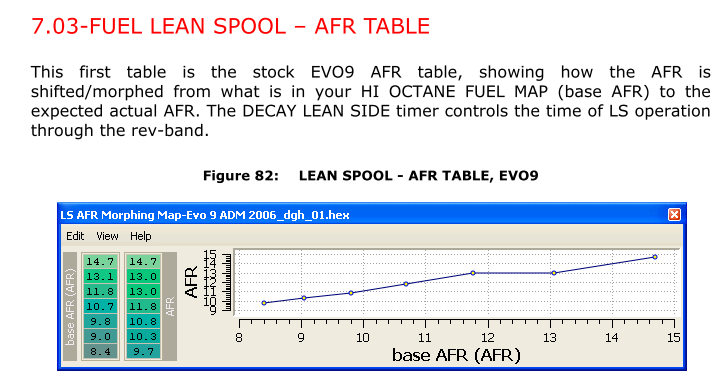
The knock control system also allows them to advance timing to improve spool.
Part of the reason why the racing-style "anti lag" systems work is because, depending on the implementation, they are basically loading the engine down to increase exhaust gas flow and temperature to speed up the turbine. In some ways it's like brake boosting on the highway.
Some of the problems with racing "anti lag" systems include:
1. additional fuel consumption (not a big deal around here)
2. It's not really something you can use in "regular" driving. you have to "switch it on"
3. It's abusive. That heat certainly doesn't help longevity of parts.
4. Noise when driving on the street
The OEM's actually do the opposite of a racing anti lag system. They lean out the mixture and advance the timing. Some Evos and Ralliarts have a "lean spool" system which consists of a transfer function designed to run a leaner target AFR.
The knock control system also allows them to advance timing to improve spool.
Joined: May 2005
Posts: 2,745
Likes: 0
From: North Bay, Ontario
I hear you man, the things we could do with a closed-loop knock system...
Good information as always arghx. Someday we'll have a sub-forum with all your technical documents, I hope.
Good information as always arghx. Someday we'll have a sub-forum with all your technical documents, I hope.
Joined: May 2005
Posts: 2,745
Likes: 0
From: North Bay, Ontario
i think the easiest method is to hook up the clutch switch and use it to send the ( aftermarket ) ECU a retard on shift command
( like an auto ECU does to the main ECU in most OEM auto's )
and use the input to pull 10- 15 degrees out of the timing,, and leave the decel fuel cut off
you would need to run the switch with a changeover relay through the later type TPS's which have the 4 or 5 wires
( one of them is a NC at idle )
[ if there is an NO at idle position on the switch you could run directly through that sans the changeover relay ]
so that the idle position breaks the switch ,, so that a normal idle occurs
,, and the retard happens only when the idle switch is not fully shut on the trailing throttle
( like an auto ECU does to the main ECU in most OEM auto's )
and use the input to pull 10- 15 degrees out of the timing,, and leave the decel fuel cut off
you would need to run the switch with a changeover relay through the later type TPS's which have the 4 or 5 wires
( one of them is a NC at idle )
[ if there is an NO at idle position on the switch you could run directly through that sans the changeover relay ]
so that the idle position breaks the switch ,, so that a normal idle occurs
,, and the retard happens only when the idle switch is not fully shut on the trailing throttle
talking head
Joined: Apr 2008
Posts: 2,775
Likes: 15
From: Perth, WA, OZ
if you use the NC/NO contacts on a 4 or 5 wire TPS as a double switch
,, the retard on shift will only happen while the clutch is in
,, but the throttle NOT shut ( not in the idle position )
if you only have NC switch on your TPS at idle you would put that across a change over relay to reverse the condition
( so the clutch switch is changed over to the unused 87a pin when the idle switch is closed making the retard aux in open circuit )
naturally you would use the throttle delay dash pot to exploit the throttle to float open and slowly close
advanced ECU's could use the decay in the TPS signal if they are good enough
similarly a hobbs switch set at more than 20 inches Hg vac could also sense the shut throttle ,, and hooked via the clutch switch would amount to similar control parameters
( ie anti lag on closing throttle with clutch in )
though i suspect might be tricky to catch the motor and kill the circuit before stall
i don't agree though that any aux air needs to be added
and possibly not all that much extra fuel either
that observation comes from seeing just how much heat is in the exhaust charge when a 13b is around 15-30 retarded
( ie,, when you lose the leading ignition with a 15 split,,, or when the idiot at the haltech dealership cant work out trigger tooth and reference angle and gets it 30 out )
i have seen turbines you can see into and see the wheel turning and can see the blue ozone glow on the outside ( more than red hot ! )
and cat converters see through,, in 30 secs of run time
( when said idiot got **** 30 degrees out )
when in said "cook" mode,, you can build boost on the free rev
this is the same energy,, and plenty of it,, you need to exploit
adding too much fuel will require aux air to prevent the unburned component quenching your exhaust temps
and PS,, yes very hard on the apex seals for heatsoak,, harder on the turbo,, harder on the exhaust manifolds
but those things dont count as long as this race is not a DNF ( when racing )
,, the retard on shift will only happen while the clutch is in
,, but the throttle NOT shut ( not in the idle position )
if you only have NC switch on your TPS at idle you would put that across a change over relay to reverse the condition
( so the clutch switch is changed over to the unused 87a pin when the idle switch is closed making the retard aux in open circuit )
naturally you would use the throttle delay dash pot to exploit the throttle to float open and slowly close
advanced ECU's could use the decay in the TPS signal if they are good enough
similarly a hobbs switch set at more than 20 inches Hg vac could also sense the shut throttle ,, and hooked via the clutch switch would amount to similar control parameters
( ie anti lag on closing throttle with clutch in )
though i suspect might be tricky to catch the motor and kill the circuit before stall
i don't agree though that any aux air needs to be added
and possibly not all that much extra fuel either
that observation comes from seeing just how much heat is in the exhaust charge when a 13b is around 15-30 retarded
( ie,, when you lose the leading ignition with a 15 split,,, or when the idiot at the haltech dealership cant work out trigger tooth and reference angle and gets it 30 out )
i have seen turbines you can see into and see the wheel turning and can see the blue ozone glow on the outside ( more than red hot ! )
and cat converters see through,, in 30 secs of run time
( when said idiot got **** 30 degrees out )
when in said "cook" mode,, you can build boost on the free rev
this is the same energy,, and plenty of it,, you need to exploit
adding too much fuel will require aux air to prevent the unburned component quenching your exhaust temps
and PS,, yes very hard on the apex seals for heatsoak,, harder on the turbo,, harder on the exhaust manifolds
but those things dont count as long as this race is not a DNF ( when racing )
Last edited by bumpstart; Feb 6, 2011 at 10:59 AM.
The original post was just some general information to consider as far as putting together a whole turbo system.
Part of the reason why the racing-style "anti lag" systems work is because, depending on the implementation, they are basically loading the engine down to increase exhaust gas flow and temperature to speed up the turbine. In some ways it's like brake boosting on the highway.
Some of the problems with racing "anti lag" systems include:
1. additional fuel consumption (not a big deal around here)
2. It's not really something you can use in "regular" driving. you have to "switch it on"
3. It's abusive. That heat certainly doesn't help longevity of parts.
4. Noise when driving on the street
The OEM's actually do the opposite of a racing anti lag system. They lean out the mixture and advance the timing. Some Evos and Ralliarts have a "lean spool" system which consists of a transfer function designed to run a leaner target AFR.
The knock control system also allows them to advance timing to improve spool.
Part of the reason why the racing-style "anti lag" systems work is because, depending on the implementation, they are basically loading the engine down to increase exhaust gas flow and temperature to speed up the turbine. In some ways it's like brake boosting on the highway.
Some of the problems with racing "anti lag" systems include:
1. additional fuel consumption (not a big deal around here)
2. It's not really something you can use in "regular" driving. you have to "switch it on"
3. It's abusive. That heat certainly doesn't help longevity of parts.
4. Noise when driving on the street
The OEM's actually do the opposite of a racing anti lag system. They lean out the mixture and advance the timing. Some Evos and Ralliarts have a "lean spool" system which consists of a transfer function designed to run a leaner target AFR.
The knock control system also allows them to advance timing to improve spool.
Rally style anti lag actually has additional throttle bodies, and many retarded features like overrev supression by variable ignition cuts etc. Its basically horrible for the entire car. To even think about you would want to have a sponsorship deal and be making money by racing not spending your own money on a street/track car.

Old [Sch|F]ool


Joined: May 2001
Posts: 12,876
Likes: 575
From: Cleveland, Ohio, USA
Me too except that kind of stuff supposedly really busts your manifold/turbine fast. You have any insight or know anyone that's actually put some miles on that kind of setup? I have an ECU capable of it too (MS3X) on two cars (turbo miata and FB) but am kind of scared to mess with it due to the possibility of melting hardware.
Think about how much ignition retard you need to get the engine to idle at 2500-3000rpm and 2psi boost.
It's worse the more you're off throttle, but from the things I hear, you basically need a $2000 turbine wheel if you want the turbo to last more than a half hour, and manifolds are a regular maintenance item too. This is for bang-bang style setups (not modern antilag) that will keep about 1-5psi manifold pressure when off throttle.
Think about how much ignition retard you need to get the engine to idle at 2500-3000rpm and 2psi boost.
Think about how much ignition retard you need to get the engine to idle at 2500-3000rpm and 2psi boost.
Old [Sch|F]ool
Joined: May 2001
Posts: 12,876
Likes: 575
From: Cleveland, Ohio, USA
Simply put, the ducting between the intercooler and throttle body is made to be very large for the power output (3-4" for a 300hp car) and I theorize that this is to increase tip-in airflow, because high velocity air takes more energy to accelerate than low velocity air. When the throttle opens, it takes energy to start the air moving again, so if the air doesn't have to speed up very much to begin with, it will more readily enter the intake manifold.
Increase the response like this, and you decrease the need for "conventional" antilag. The cars are still running with idles sufficiently high that cylinder dropping is required to get the idle down, but they need less/no in-exhaust combustion.
Another thing that I've only heard rumor about is a form of air storage. Whether this air is injected into the intake manifold, the compressor housing, or the exhaust housing is unknown. The very first crude antilag systems used a wastegate in a fashion like a blowoff valve, to dump boost directly into the exhaust header. (It was extremely harsh to say the least) Blowoff valves are not used on rally cars, they throw away airflow and when you are trying to pull air through a 32-34mm restrictor practically bolted to the compressor inlet, every gram of air is to be used and not wasted.
ANOTHER thing that I've heard rumor of is a kind of blowoff valve but in reverse. It vents pressure when under boost. (Huh?) This allows a compressor to run at a high pressure ratio that the engine might not be flowing enough CFM to properly utilize.
Another thing to bear in mind: At least at the top levels, there is a maximum number of turbochargers, IIRC it's one spare per car per event. No more changing the turbos three or four times per rally. So, the antilag systems have to be a lot more turbo friendly than the Group A days. Go to YouTube and find Group A Escort or Impreza footage (Imprezas were the worst IMO) and compare to modern WRC. Large difference.

Senior Member
Joined: Jul 2009
Posts: 377
Likes: 2
From: England
Slighlty odd comments on this thread about anti-lag, but as so little people have used it, the internet rumour mill goes wild about it, and all kinds of things are said.
I've ran 'bang bang' throttle bypass anti-lag on a road car, could happily see 29psi boost off throttle slowing for a corner, and it would happily idle at 1000rpm too.
That wasnt with a fancy manifold or turbo, just a decently strong one.
For 20min track sessions or long stage rallies (as you are off throttle so much) it may smash stuff quick, but for short sprints and fast road, it's not as bad as the BS internet talk would have you think.
Only reason for a very high idle is if you had an incredibly basic setup with either a jacked open throttle, not enough ignition retard, or simply done strangely. No need in 99% of occasions.
Ignition retard is, give for take, 30deg retarded off the normal settings for a closed throttle. A lot of ECUs without dedicated ALS ability cannot retard that far, thats the main issue electronically.
Modern ALS runs exactly what is suggested is so terrible, and was done as far back as the mid-80s- it dumps the boost directly into the exhaust pre-turbo.
Air storage is also true, albeit 'against the spirit of the rules' so although Ford and Subaru did it, Ford removed it and I think Subaru phased it out.
Its not half as complex as you might think though.
I would happily run proper rally anti-lag on my RX-7, there's just a few bits I'm unsure of (due to the way a rotary engine works) and as I cant find anyone who's ever done it on a rotary (just 2step etc, which is similar but not the same), its not easy to put my mind at rest about them!
I've ran 'bang bang' throttle bypass anti-lag on a road car, could happily see 29psi boost off throttle slowing for a corner, and it would happily idle at 1000rpm too.
That wasnt with a fancy manifold or turbo, just a decently strong one.
For 20min track sessions or long stage rallies (as you are off throttle so much) it may smash stuff quick, but for short sprints and fast road, it's not as bad as the BS internet talk would have you think.
Only reason for a very high idle is if you had an incredibly basic setup with either a jacked open throttle, not enough ignition retard, or simply done strangely. No need in 99% of occasions.
Ignition retard is, give for take, 30deg retarded off the normal settings for a closed throttle. A lot of ECUs without dedicated ALS ability cannot retard that far, thats the main issue electronically.
Modern ALS runs exactly what is suggested is so terrible, and was done as far back as the mid-80s- it dumps the boost directly into the exhaust pre-turbo.
Air storage is also true, albeit 'against the spirit of the rules' so although Ford and Subaru did it, Ford removed it and I think Subaru phased it out.
Its not half as complex as you might think though.
I would happily run proper rally anti-lag on my RX-7, there's just a few bits I'm unsure of (due to the way a rotary engine works) and as I cant find anyone who's ever done it on a rotary (just 2step etc, which is similar but not the same), its not easy to put my mind at rest about them!

The OEM's actually do the opposite of a racing anti lag system. They lean out the mixture and advance the timing. Some Evos and Ralliarts have a "lean spool" system which consists of a transfer function designed to run a leaner target AFR.
The knock control system also allows them to advance timing to improve spool.
The knock control system also allows them to advance timing to improve spool.
take a look at the stock FD twins fuelling maps and it is apparent that they push the AFRs quite lean for nearly as long as possible, in the low 14's all the way up to about 8-9PSI of boost at low RPMs. the stock twins are hardly lag monsters either with that type of setup, of course the same rules aren't exactly applied to larger single turbos but they will still take to them somewhat.
Last edited by RotaryEvolution; Feb 13, 2011 at 12:58 PM.
[QUOTE=Karack;10467530]reading everyone's responses it confused me also. richening up the spool areas and reducing timing are not ideal for any car that is going to see a decent amount of miles, it is harsh on the exhaust components constantly going into drastic transitions. leaning out the AFRs and advancing timing also has good effect on spooling the turbo without hurting much, not quite as well as the opposite but that is more for full on racecars that don't see many hours and then have to drive home afterwards.
I have never put a wideband on a completely stock FD, but running in closed loop at low rpm/high oad is more like the rule rather than the exception when you consider completely stock calibrations. There are different control strategies used across manufacturers. I already mentioned the lean spool system for Mitsu. GM uses the "power enrichment" mode which has a set of conditions to enable it. Subaru uses an open loop/closed loop transition with a delay timer. Nissan has a max torque limitation for stoichiometric operation and then a separate torque curve when enrichment is allowed.
take a look at the stock FD twins fuelling maps and it is apparent that they push the AFRs quite lean for nearly as long as possible, in the low 14's all the way up to about 8-9PSI of boost at low RPMs. the stock twins are hardly lag monsters either with that type of setup, of course the same rules aren't exactly applied to larger single turbos but they will still take to them somewhat.
[QUOTE=arghx;10467639]
So like I asked, is the mitsu system operating on the premise of maxing timing and leaning to provide max power in a throttle off condition? Is there more to it?
reading everyone's responses it confused me also. richening up the spool areas and reducing timing are not ideal for any car that is going to see a decent amount of miles, it is harsh on the exhaust components constantly going into drastic transitions. leaning out the AFRs and advancing timing also has good effect on spooling the turbo without hurting much, not quite as well as the opposite but that is more for full on racecars that don't see many hours and then have to drive home afterwards.
I have never put a wideband on a completely stock FD, but running in closed loop at low rpm/high oad is more like the rule rather than the exception when you consider completely stock calibrations. There are different control strategies used across manufacturers. I already mentioned the lean spool system for Mitsu. GM uses the "power enrichment" mode which has a set of conditions to enable it. Subaru uses an open loop/closed loop transition with a delay timer. Nissan has a max torque limitation for stoichiometric operation and then a separate torque curve when enrichment is allowed.
I have never put a wideband on a completely stock FD, but running in closed loop at low rpm/high oad is more like the rule rather than the exception when you consider completely stock calibrations. There are different control strategies used across manufacturers. I already mentioned the lean spool system for Mitsu. GM uses the "power enrichment" mode which has a set of conditions to enable it. Subaru uses an open loop/closed loop transition with a delay timer. Nissan has a max torque limitation for stoichiometric operation and then a separate torque curve when enrichment is allowed.