updates on custom intake manifold with pics


updates on custom intake manifold with pics
well after a very informative thread here
https://www.rx7club.com/rotary-car-performance-77/fabricating-intake-manifold-766574/
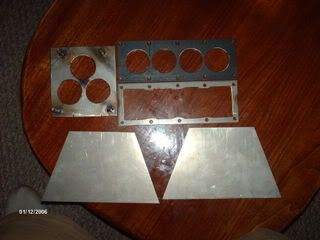
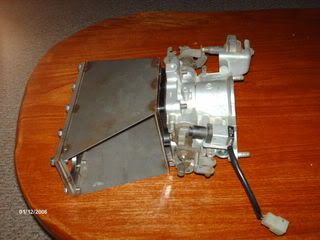
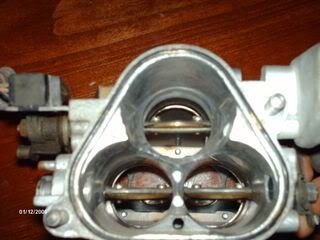
i decided to go with a single plane manifold with a plemun that could be unbolted and rediesgned if needed, i also due to cost decided to use the stock T.B. ported. i made all the parts below on a manual turn bridgeport.
the tb flange with welded studs
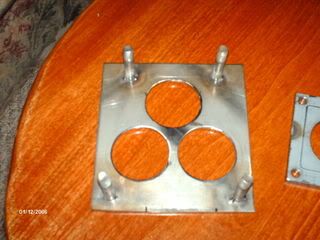
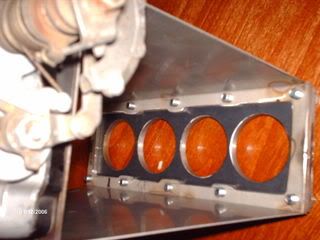
the flange that the runners will bolt its still need the smooth transitions welded on and blended. it has thu holes for a 1/4-20 bolt
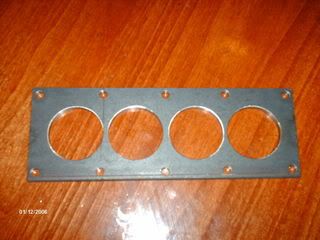
the flange that is the back side of the plemun and will bolt to the above flange. its tapped for 1/4 bolts
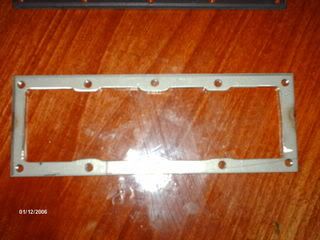
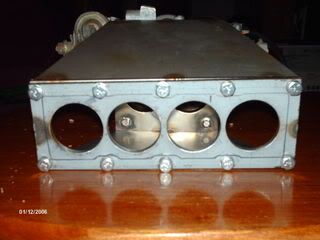
pic of the whole group, just missing the sides.
i will post more pics as i start welding it all together and the mock up
--joe
https://www.rx7club.com/rotary-car-performance-77/fabricating-intake-manifold-766574/
i decided to go with a single plane manifold with a plemun that could be unbolted and rediesgned if needed, i also due to cost decided to use the stock T.B. ported. i made all the parts below on a manual turn bridgeport.
the tb flange with welded studs
the flange that the runners will bolt its still need the smooth transitions welded on and blended. it has thu holes for a 1/4-20 bolt
the flange that is the back side of the plemun and will bolt to the above flange. its tapped for 1/4 bolts
pic of the whole group, just missing the sides.
i will post more pics as i start welding it all together and the mock up
--joe
the plemun flange is .185 thick S.S. and the flange the runners weld to is 3/16 steel, the tb flange is .100 thick ss and the rest of the plemun is made of .048 s.s.
--joe
--joe


SS won't heat soak nearly as fast as aluminum will anyways which is a good thing. True that it weighs more but a couple of pounds is a very worthwhile tradeoff when it comes to reduced intake temperatures.
However aluminum will cool down way faster won't it? I understand the op's reason, but I don't think there is much to discuss as far as aluminum being the superior material for im fabrication compared to ss.
Trending Topics


It will cool down faster, however thats not what we are typically concerned with is it? I would not want it to heat up as fast, not cool off faster when I shut off the motor.
Manifold looks like it will be sweet, keep us updated.
- Chris
Manifold looks like it will be sweet, keep us updated.
- Chris
I suppose you're not a drag racer then. Aluminum may heat soak quicker, but ss will heat soak longer. I may be wrong but won't ss also get hotter?I'm very concerned about cool down between rounds. There has to be a reason everyone uses aluminum over ss besides just weight savings of a couple pounds. I'd love to hear some technical information rather than speculation.
Last edited by Uncle Hungry; Jul 24, 2008 at 10:00 PM.
If SS doesn't heat up as much as quickly, it also doesn't need to cool down as much. Aluminum is actually a poor material to use where heat is concerned. Remember air is always flowing through the manifold which means it's always being pulled away from it but consequently into the engine. The more radiant heat a manifold can keep out, the less gets into the engine. I'd love to see someone use aluminum as an exhaust manifold. It won't survive very long but the amount of heat getting radiated would be pretty bad. SS is far superior but it's weight and price compared to aluminum are why it's not used. That and the fact that casting aluminum is a much easier process that gets done at lower temperatures than other materials.
There's definitely a reason that aluminum is used and I just stated them but it has nothign to do with it being a "superior material" unless you apply that statement to mean "cheaper and easier to work with". The composite manifolds on many cars today are superior to the metals because of their weight, and heat rejection properties. Strength is not an issue for a street car.
There's definitely a reason that aluminum is used and I just stated them but it has nothign to do with it being a "superior material" unless you apply that statement to mean "cheaper and easier to work with". The composite manifolds on many cars today are superior to the metals because of their weight, and heat rejection properties. Strength is not an issue for a street car.
I wasn't talking about other materials ( carbon fiber and such ) but just the diff between Al and SS. I also find your statement to be pure speculation and would like to see some fact. Who is to say that ss can't reach the same temp is a close enough time frame for what you said to even be considered. Not I and apparently not you. I also don't know If the cost factor is a viable argument. Via Road Race Engineering a 3" stainless u bend is $34 where a 304 ss simular bend is $32. No one ever spoke of exhaust manifolds also, at least not I because they are a completely different animal and subject to conditions an IM would never see. About the only thing I agree with is that Al is easier to work with. Is it true that Al is able to be cast at lower temps? I wasn't aware of that because you need more heat to weld Al than SS, I would think it would be the complete opposite. Anyway we are talking about custom fabrication of an im in this particular conversation, not casting.

Rotary Freak

Joined: Dec 2001
Posts: 2,402
Likes: 0
From: chandler, AZ
I have a steel manifold on my car. It stays much cooler than a stock AL manifold. Also AL needs more heat to weld simply because it transfers heat so well and doesn't want to stay in puddle form..
 I also see I screwed up one of my replies, the AL bend was 34 and ss 32. I suspect the only way to prove either point about this is to take air intake temps with a ss mani and then an AL on the same setup in the same conditions. That'll never happen I suppose.


Aluminium melts at about *1250. Stainless is closer to *2000. Depends on the type. All steels transfer heat at much slower rate as compared to most common non-ferrous metals. That is why you can maintain a much smaller puddle and back off on the pedal when welding steel (TIG) as compared to aluminium. The extra power needed for aluminium is going to make up for the heat that left to soak the part. You ever notice how much hotter the aluminium pieces are after welding than steel?