


Addressing the hot spark plug problem


Thread Starter
BDC Motorsports

Joined: Jun 2002
Posts: 3,667
Likes: 6
From: Grand Prairie, TX
 Addressing the hot spark plug problem
Howdy folks,
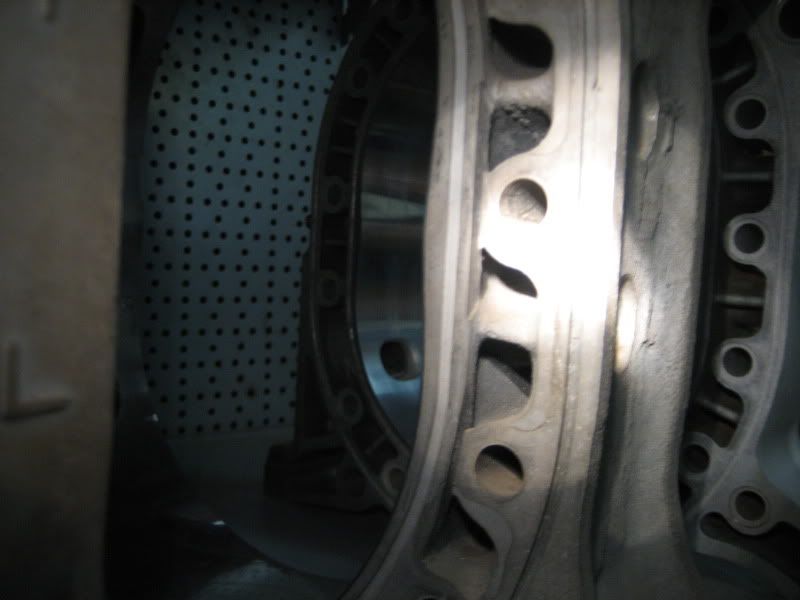
I've been doing some thinking lately about the problem that our RE's have with the rotor housing warming around the outer edges of the spark plug recess (as evidenced by carbon smears on both lateral sides of the leading plug hole) and I noticed something. I'm not sure if many of you guys here have or not but a couple of days ago I was building a Renesis motor and I noticed some subtle differences in how the final product of that model's rotor housing was machined; namely there appears to be both a big chunk of metal taken out of the water jacketting surrounding both leading and trailing plugs as well as there's some "notching" of the metal around some of the tension through-bolt holes that appears to allow water to criss-cross from parallel water jackets. I'll post two pictures to illustrate.
Even though we don't have access to CHT gauges or anything else to really eyeball plug temps, I still think I may machine and notch the rotor housings on my Turbo II's engine prior to its assembly here soon to see what happens. I've got the tooling to do it and I'm tempted to tear into it. Am I the only person who's seen this before?
B
I've been doing some thinking lately about the problem that our RE's have with the rotor housing warming around the outer edges of the spark plug recess (as evidenced by carbon smears on both lateral sides of the leading plug hole) and I noticed something. I'm not sure if many of you guys here have or not but a couple of days ago I was building a Renesis motor and I noticed some subtle differences in how the final product of that model's rotor housing was machined; namely there appears to be both a big chunk of metal taken out of the water jacketting surrounding both leading and trailing plugs as well as there's some "notching" of the metal around some of the tension through-bolt holes that appears to allow water to criss-cross from parallel water jackets. I'll post two pictures to illustrate.
Even though we don't have access to CHT gauges or anything else to really eyeball plug temps, I still think I may machine and notch the rotor housings on my Turbo II's engine prior to its assembly here soon to see what happens. I've got the tooling to do it and I'm tempted to tear into it. Am I the only person who's seen this before?
B

Rotary Enthusiast
Joined: Jun 2004
Posts: 862
Likes: 0
From: Austin TX.
i have noticed that machine work on 93 and up housings, in the water jacket, behind the spark plug area, and some later had the small notches around the tension bolt bosses.
my opinion is to let small boiling bubbles allow to move quickly thru the cooling system, because you do not want localized bubbles near the plug area.
you would think by now, someone would have done external cooling lines, outside the rotor housings?? to help pump coolant to that area.
my opinion is to let small boiling bubbles allow to move quickly thru the cooling system, because you do not want localized bubbles near the plug area.
you would think by now, someone would have done external cooling lines, outside the rotor housings?? to help pump coolant to that area.
Thread Starter
BDC Motorsports
Joined: Jun 2002
Posts: 3,667
Likes: 6
From: Grand Prairie, TX
i have noticed that machine work on 93 and up housings, in the water jacket, behind the spark plug area, and some later had the small notches around the tension bolt bosses.
my opinion is to let small boiling bubbles allow to move quickly thru the cooling system, because you do not want localized bubbles near the plug area.
you would think by now, someone would have done external cooling lines, outside the rotor housings?? to help pump coolant to that area.
my opinion is to let small boiling bubbles allow to move quickly thru the cooling system, because you do not want localized bubbles near the plug area.
you would think by now, someone would have done external cooling lines, outside the rotor housings?? to help pump coolant to that area.
B

http://www.delikon.com/teflon.html there ya go brian


Trending Topics


Pretty common knowledge especially in the road racing community. Racing beat has offered this mod for a very long time. Gives more surface area and aids in cooling.
http://www.racingbeat.com/Tech/Tech.Engine.4.htm
BDC your work looks spot on.
http://www.racingbeat.com/Tech/Tech.Engine.4.htm
BDC your work looks spot on.
Thread Starter
BDC Motorsports
Joined: Jun 2002
Posts: 3,667
Likes: 6
From: Grand Prairie, TX
Pretty common knowledge especially in the road racing community. Racing beat has offered this mod for a very long time. Gives more surface area and aids in cooling.
http://www.racingbeat.com/Tech/Tech.Engine.4.htm
BDC your work looks spot on.
http://www.racingbeat.com/Tech/Tech.Engine.4.htm
BDC your work looks spot on.
I did two mods: the old school wall grinding w/ a ball-shaped tungsten cutter but the second one I did was machining out the aluminum splitter in the water jacketting to mimic what the Renesis casting/machining is like. As far as I know, nobody's done this on the older (REW and back) rotor housings.
B
"Elusive, not deceptive!”

Joined: May 2007
Posts: 930
Likes: 13
From: Slidell, LA
Brian, glad that you are addressing this problem. The factory racing housings have material removed from the housing heated side.
I found that the most critical area is what I call #5 water passage.
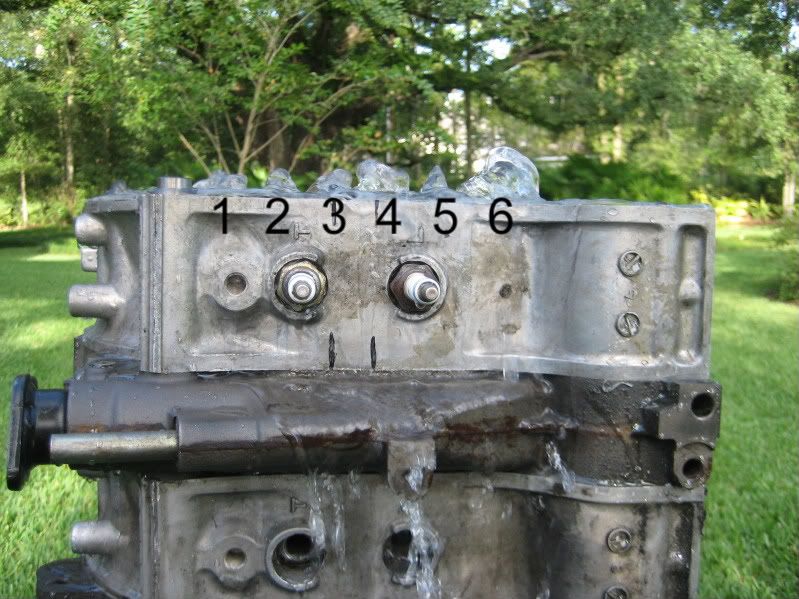
I would take about .200" out of the passage and toward the housing and .200" toward the tie bolt boss to increase flow.
Try not to take much off of the sparkplug boss itself ( don't ask how I know that).
Barry

I found that the most critical area is what I call #5 water passage.
I would take about .200" out of the passage and toward the housing and .200" toward the tie bolt boss to increase flow.
Try not to take much off of the sparkplug boss itself ( don't ask how I know that).
Barry


"Elusive, not deceptive!”
Joined: May 2007
Posts: 930
Likes: 13
From: Slidell, LA
I cut mine at the bottom only allowing the remaining fin to help cool the sparkplug boss but not distort the housing face.
My thought is that we can cut as deep as the two Mazda machine cuts in housing. They are over .250" deep. If you notice the mazda reliefs still show after the porting this old reject housing.
Barry


Thread
Thread Starter
Forum
Replies
Last Post
trickster
2nd Generation Specific (1986-1992)
25
Jul 1, 2023 04:40 PM
Skeese
Adaptronic Engine Mgmt - AUS
65
Mar 28, 2017 03:30 PM
alphawolff
1st Generation Specific (1979-1985)
17
Nov 17, 2015 05:57 PM
