When you click on links to various merchants on this site and make a purchase, this can result in this site earning a commission. Affiliate programs and affiliations include, but are not limited to, the eBay Partner Network.
Dear All,
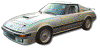
I am joining from Turkey. I have the exact original 1990 Mazda RX7 FC without turbo.
I have a problem with my ECU computer, you will see from the photos.
Last edited by diabolical1; Mar 3, 2023 at 01:48 PM.
Reason: removed solicitation from post
Welcome to the club. Based on the exterior pictures, it looks like a European-spec Series 5. the round side marker lights behind the wheels in the fenders are an unmistakable sign. Do you know where the car originally was sold?
To be completely honest, this is the first time I've heard of or seen a N368 ECU. However, it is clear that yours does exist so I am rather intrigued by this. Let me see what I can come up with through my resources, based on your VIN number.
EDIT: I did some digging on it and this is quite the unicorn. A closer inspection of the picture with the hood open shows a Series 4 NA (86-88) intake setup, an Early Series 4 cooling system with two pressure caps, plus a distributor and coil setup from the European Series 4 NA cars with the N323 ECU. Plus, it shares the 3-connector setup on the ECU with all other Series 4 cars too.
All of the officially released European market Series 5 cars were turbocharged and had N38x ECUs, a revision from the N370 and N374 ones used for the US and Japan respectively.
My current hypothesis is that this is an evolution or carry-over from Series 4 since the numbering system puts N36x right in Series 5 NA for European market, which officially doesn't exist. However, Series 4 in the US has a similar "jump" for all 1988 convertibles (N338 ECU). Also, a similar "jump" occurred in Japan between the HB Cosmo 12A Turbo (N245 ECU, September 1983) to the SA22 RX7 (N253 ECU, also September 1983). The N253 ECU was then retrofitted back to the HB Cosmo on July 1, 1984. So, strange things happened in Japan in the 1980s
Is there any other documentation that came with the car?
EDIT Numero Dos:
So I dug around in the European S5 data files and found some info on it.
FD8 (Interior code for Black)
19890424 (April 24, 1989)
JMZFC183200200288 (German market VIN)
DE (for Germany)
FC56 (chassis code)
AAB (Not sure)
SQ (Paint code SQ)
Last edited by Akagis_white_comet; Mar 2, 2023 at 10:09 PM.
Reason: Additional Info
Dear my friend,
Thanks for your comment. I think my car is one of a kind for Turkey and Europe , because it's full original parts and only 90.000 Km.
I only use my car on sundays without any problems at the moment. But sometimes there may be a problem with the signal going from the ECU to the injectors, if I find a suitable ECU for my car, I will fix this problems.
Dear my friend,
Thanks for your comment. I think my car is one of a kind for Turkey and Europe , because it's full original parts and only 90.000 Km.
I only use my car on sundays without any problems at the moment. But sometimes there may be a problem with the signal going from the ECU to the injectors, if I find a suitable ECU for my car, I will fix this problems.
Have you noticed what condition(s) cause this issue? Engine hot? Cold Start? A certain RPM? etc.
I would not be so quick as to say your ECU is the problem.
The ECU supplies a Ground signal to the injectors to make them operate. But if the ECU ground path back to Battery Negative is poor or failing, it will produce the known "3800rpm hesitation" which sounds like what you are experiencing.
Since I do not have any information on the N368 ECU as of yet, the ECU pinout described may be different than what is in your car. However, the principles and ideas still apply when it comes to Ohm's Law. The ECU Ground will still be on top of the Shortblock ("keg") as seen in the pictures, the Ground cable will be in the same location, etc.