


6 Port Porting Advice


Thread Starter
Isaiah 53.7
Joined: Mar 2013
Posts: 114
Likes: 0
From: Indiana
6 Port Porting Advice
The plan: I have a spare S4 6 port to trade places with my current 6 port that sips coolant. The spare is staying S4 6 port for simplicity and availability, 9.4:1 rotors and all. I plan on individual throttle bodies, either one throttle body per rotor or one throttle body per port, still up in the air. I also plan on welding up a header, the length of which I'm still researching along with the exhaust system itself.
The goal: 200whp minimum below 8500 rpm. I'm thinking a solid exhaust and itb's would get a 6 port to at least 160whp as is. However, since my engine will be open, might as well get saucy.
The problem: Porting what I got for my power goal. My theory is to leave the ports relatively stock, especially the already late closing "auxiliaries", but adding a small bridge to both sides minus the auxiliary ports, making sure not to go high enough to make the intake close any later.
What do you think, and what's your advice? Again, I know 6 ports aren't ideal na platforms, but it's what I got! Thanks.
The goal: 200whp minimum below 8500 rpm. I'm thinking a solid exhaust and itb's would get a 6 port to at least 160whp as is. However, since my engine will be open, might as well get saucy.
The problem: Porting what I got for my power goal. My theory is to leave the ports relatively stock, especially the already late closing "auxiliaries", but adding a small bridge to both sides minus the auxiliary ports, making sure not to go high enough to make the intake close any later.
What do you think, and what's your advice? Again, I know 6 ports aren't ideal na platforms, but it's what I got! Thanks.

Full Member

Joined: Jan 2008
Posts: 122
Likes: 1
From: Huntington Beach, CA
Kahren made 180whp with a stock s5 block, racing beat exhaust, and his custom intake manifold. That is the direction i would head down if i was in your boat and if nothing else it wouldpoint you in the right direction.

talking head

Joined: Apr 2008
Posts: 2,775
Likes: 15
From: Perth, WA, OZ
get the turbo centre plate.. one stamped G is best stock port ( jap and oz spec )
this will bring the underhand horizontal ACv passage ( ie like a S5 NA centre plate )
and thus allows the primary port to be taken up significantly more than your current plate
you cannot quite get the s4NA plate to the starting point this G plate is
( a D centre plate from a 13bt can be taken same but is more work )
6P brings almost bridge like closing time ... there is no real need to fully compromise the low down power by having an outrageous exhaust overlap
more is achieved by keeping the primary port to mild extend port specs and then opening up the exhaust to achieve slightly more overlap than stock
your engine will be much more tractable in traffic from low down and have superior port area..and similar port close timing to a bridged engine .. all cake
you will be required to use s5 na .. or custom inlet manifold.. or mod the bottom edge of the s4 NA one to cover the rectangular ACv passage on the middle plate
this will bring the underhand horizontal ACv passage ( ie like a S5 NA centre plate )
and thus allows the primary port to be taken up significantly more than your current plate
you cannot quite get the s4NA plate to the starting point this G plate is
( a D centre plate from a 13bt can be taken same but is more work )
6P brings almost bridge like closing time ... there is no real need to fully compromise the low down power by having an outrageous exhaust overlap
more is achieved by keeping the primary port to mild extend port specs and then opening up the exhaust to achieve slightly more overlap than stock
your engine will be much more tractable in traffic from low down and have superior port area..and similar port close timing to a bridged engine .. all cake
you will be required to use s5 na .. or custom inlet manifold.. or mod the bottom edge of the s4 NA one to cover the rectangular ACv passage on the middle plate

spoon!

Joined: Sep 2002
Posts: 1,208
Likes: 50
From: Dousman, WI
Via Dave Lemon of Mazdatrix, don't or barely touch the closing of the aux ports. I'd almost just go with not moving it at all. If you grind away the port divider, fill in the ramp of the port with devcon or your epoxy of choice and blend it in you can make pretty radical ports. Dave said he chucked one of the over-ported 6-port engines from his E-Production development program in a car with a Berg 58IDA and 50mm chokes and made 251whp; that's a "street" port, not bridge or peripheral.
Thread Starter
Isaiah 53.7
Joined: Mar 2013
Posts: 114
Likes: 0
From: Indiana
Awesome advice, gentlemen. Just what I'm looking for.
I've read some threads from Kahren, and that's what got me set on ditching stock intake manifolds and pre-made headers.
Bumpstart,
Are you referring to the primary as in the center plate, or the "primary port" on the 6 port end housings? Also, creating overlap through the exhaust port would be by making it stay open later, right?
Kenku, thanks for that info. I was just looking at the hideous opening in the aux ports, and my first thought was to seize an Atkins sleeve in or epoxy in material somehow. Seeing 250+ whp from a "streetport" is very encouraging, even though the peak power came in at an unknown rpm.
I've read some threads from Kahren, and that's what got me set on ditching stock intake manifolds and pre-made headers.
Bumpstart,
more is achieved by keeping the primary port to mild extend port specs and then opening up the exhaust to achieve slightly more overlap than stock
Kenku, thanks for that info. I was just looking at the hideous opening in the aux ports, and my first thought was to seize an Atkins sleeve in or epoxy in material somehow. Seeing 250+ whp from a "streetport" is very encouraging, even though the peak power came in at an unknown rpm.
talking head
Joined: Apr 2008
Posts: 2,775
Likes: 15
From: Perth, WA, OZ
Are you referring to the primary as in the center plate, or the "primary port" on the 6 port end housings? Also, creating overlap through the exhaust port would be by making it stay open later, right?
( basically up and out to 13bt secondary specs.. you cannot port downwards far )
this brings a little more,, but not unacceptable overlap with exhaust
.. the main changes to overlap will occur because you now bring the exhaust port roof up slightly,, and drop the floor
( chucking back in the 13bt inserts,, or modding out the wing in the NA ones )
all this will bring a slight but not unpleasant burble to the idle
.. the overlap is not far beyond what mazda builds into its engines with intended internal EGR
but in effect give you the biggest combination of inlet ports you can have without going bridge ,, or without having the side seal ends float
it will lose a small amount of TQ under 2500 rpm
.. it will improve greatly in the mid range and top end
.. seal life is in no way compromised and fuel and muffler useage is normalish,, unlike the bridged engine


Trending Topics
Thread Starter
Isaiah 53.7
Joined: Mar 2013
Posts: 114
Likes: 0
From: Indiana
Just a little update. I likely ruined my front 6 port plate by shamefully breaking off the ear for the water pump housing. My local welding shop said in order to weld cast iron, they need to preheat the piece to 500 degrees Fahrenheit to eliminate cracking around the bead. I'm going there tomorrow to at least see what they think. It just sounds like another thing to be concerned about all the time if it's welded.
On a more positive note, I found a nicely priced 75k S4 turbo engine and tranny. Looks like an na 4 port with an S4 na rotating assembly may be in order.
On a more positive note, I found a nicely priced 75k S4 turbo engine and tranny. Looks like an na 4 port with an S4 na rotating assembly may be in order.
Thread Starter
Isaiah 53.7
Joined: Mar 2013
Posts: 114
Likes: 0
From: Indiana
Here's a rough outline for fun until I gather more stuff. I made sure not to make it close any later, and there will be some sort of insert in the top. According to a familiar source, this type of merged port only makes good power above 9k, but there could be many variables to this information. What are your thoughts on this big port?
This is just a practice iron.
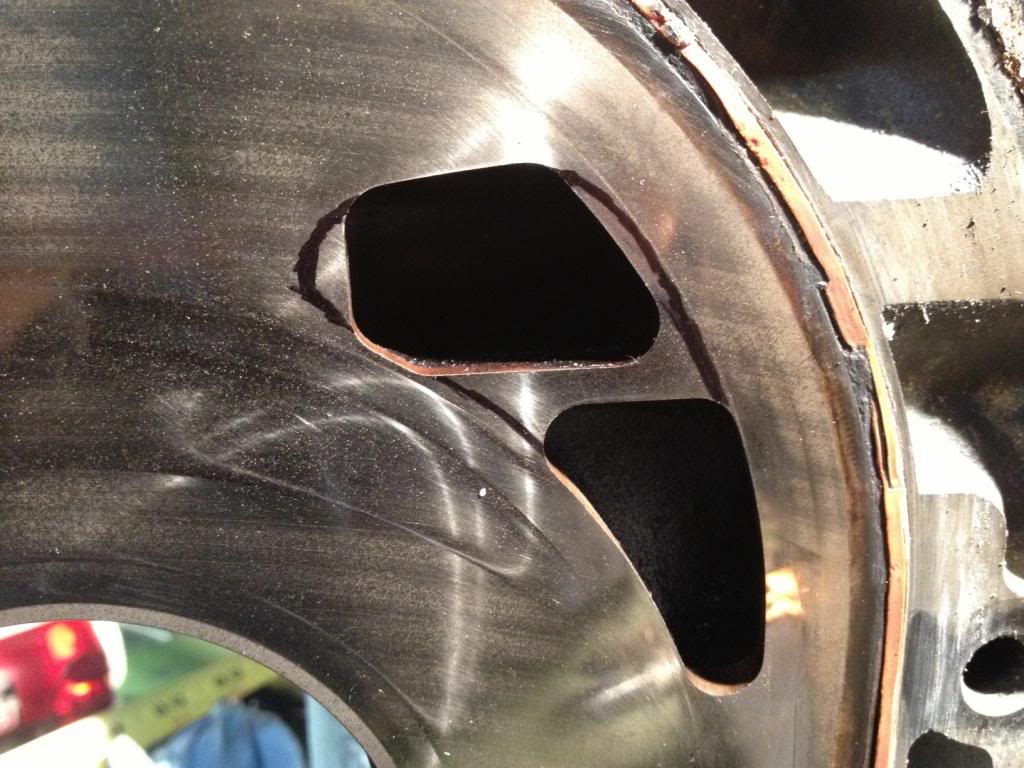
This is just a practice iron.

spoon!
Joined: Sep 2002
Posts: 1,208
Likes: 50
From: Dousman, WI
From playing with doing merged ports myself (not having any in running cars, mind, just doing shade tree flow visualization) the big thing to look at is area changes. Like, if you just cut away the divider down to even with the port floor without filling in with anything, you go from the area of the two runners to suddenly this big area where there used to be the divider, killing velocity. I'm playing with filling in part of the port floor with devcon and shaping it more like the stock port ramp dealie. Seems like it makes sense to me anyway, but no results yet so who knows?

Old [Sch|F]ool


Joined: May 2001
Posts: 12,876
Likes: 575
From: Cleveland, Ohio, USA
Port window looks good. Closing no later than stock is a big plus. It closes way too late as it is...
IMO, any epoxy should go in the port roof and in the end of the upper port. It's atrocious.
IMO, any epoxy should go in the port roof and in the end of the upper port. It's atrocious.
Thread Starter
Isaiah 53.7
Joined: Mar 2013
Posts: 114
Likes: 0
From: Indiana
I'll have to stew on that. If the 6 port irons in my car are good, it looks like we have a guinea pig.
No doubt. If everything pans out, I'm going to order Atkins inserts to modify and seize in there, which I also want to use to shape the final design on the aux port.
Thanks again for the input!
I'll hog off some material for practice and post another pic of the damage.
Thanks again for the input!
I'll hog off some material for practice and post another pic of the damage.
Thread Starter
Isaiah 53.7
Joined: Mar 2013
Posts: 114
Likes: 0
From: Indiana
Some quick and rough porting practice on my scrap iron. The secondaries are opened up towards the coolant seal to increase overlap, but I didn't give it much. I don't know how far is too far until I get a pre made template. The closing time is exactly the same, still late. I outlined the port with sharpie just for reference.
Kenku, was this your theory, having the divider still somewhat there? Of course, there's nothing in the aux port to fill in the cave at the end.
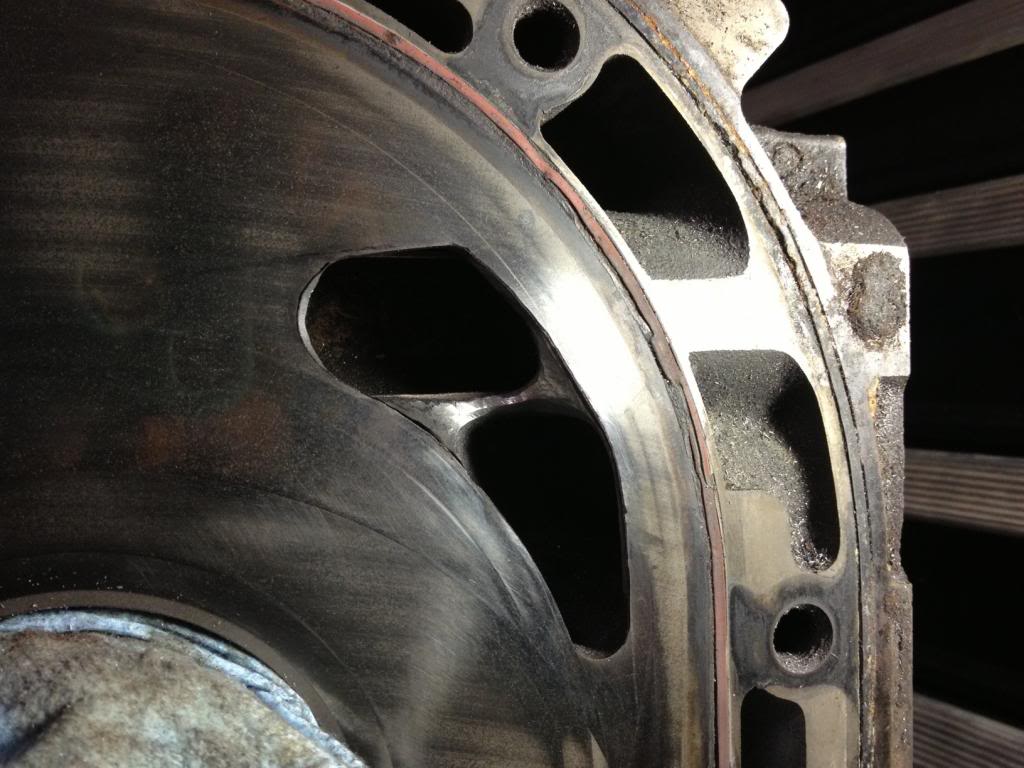
Kenku, was this your theory, having the divider still somewhat there? Of course, there's nothing in the aux port to fill in the cave at the end.

spoon!
Joined: Sep 2002
Posts: 1,208
Likes: 50
From: Dousman, WI
My idea was to take it all the way down to where you can smooth it like it's a single port by adding material back with devcon, sort of a "hey, I'll just make the port I want from scratch" sort of thing. Like, the divider adds volume but not necessarily where you'd want it, but if you keep cutting away metal it can work out. But again, unproven.
I've seen inside a bunch of pro built EProd 13Bs; there's a lot of different ideas that seem to work judging from performance on track. Some leave the divider intact at the port face but hollow out the runners behind it, some do it more like I was talking with carving it away. I wish I had more scientific explanations for what does and doesn't work, may need to build a flowbench some day.
I've seen inside a bunch of pro built EProd 13Bs; there's a lot of different ideas that seem to work judging from performance on track. Some leave the divider intact at the port face but hollow out the runners behind it, some do it more like I was talking with carving it away. I wish I had more scientific explanations for what does and doesn't work, may need to build a flowbench some day.


Joined: Mar 2001
Posts: 31,849
Likes: 3,238
From: https://www2.mazda.com/en/100th/
From playing with doing merged ports myself (not having any in running cars, mind, just doing shade tree flow visualization) the big thing to look at is area changes. Like, if you just cut away the divider down to even with the port floor without filling in with anything, you go from the area of the two runners to suddenly this big area where there used to be the divider, killing velocity. I'm playing with filling in part of the port floor with devcon and shaping it more like the stock port ramp dealie. Seems like it makes sense to me anyway, but no results yet so who knows?
if the 6 ports don't work @20psi, it doesn't look good @0 psi...
spoon!
Joined: Sep 2002
Posts: 1,208
Likes: 50
From: Dousman, WI
i heard about a shop in japan that tried a 6 port turbo setup, i'm not sure about the steps, but they got to the part where they milled out the divider between the ports, so it was just one huge "normal" port, and they were STILL down on power vs the normal 4 port irons.
if the 6 ports don't work @20psi, it doesn't look good @0 psi...
if the 6 ports don't work @20psi, it doesn't look good @0 psi...
Not saying its easy. There's a buttload of work that needs to go into reshaping the 6-port runners.
Old [Sch|F]ool
Joined: May 2001
Posts: 12,876
Likes: 575
From: Cleveland, Ohio, USA
I think leaving the port divider in once you get to this situation is a big mistake. When the rotor closes the port, the flow in each runner is going to be stopping and restarting at different times, diluting the harmonics in the intake manifold runner.
Granted, this is going to happen anyway (and I feel it's a good chunk of why the 6 ports are weird for tuning, and notice the RX-8 doesn't share the runners in the manifold?) but when you open up communication on both ends, the pulses that originate at the rotor not only get confused at the manifold end, but they might not even get started properly in the first place. Kind of the intake harmonics equivalent of fibrillation.
This is all gut feeling, of course.

Information Regurgitator
Joined: Feb 2001
Posts: 2,008
Likes: 213
From: Sparta TN. United States
On the prod forum, Dave Lemon said that using some leftover irons that were too over-ported for EProd, he threw together a 6 port streetport making 251hp at the wheels. Highest HP 4-port streetport I know of is Defined Autoworks's test mule and I think they were at around 240. I'd reckon with the money people are willing to dump into EProd engines, there's a lot more work done by pro builders on 6-port engines over here than over there.
Not saying its easy. There's a buttload of work that needs to go into reshaping the 6-port runners.
Not saying its easy. There's a buttload of work that needs to go into reshaping the 6-port runners.
"We have spent a LOT of time on our engine dyno and have have been very successful in making this type (VERY large) work on our road-race cars, but only at VERY high RPM-- meaning above 9000!"
Seems these ports need some rpm to make that power and probably ITBs or something other than the stock manifolds( seems 200whp is about tops for the stock S5 manifolds) plus a standalone. Not sure if the Rtek removes the rev limit or lets you map that high. Not to mention rotor mods to safely spin past 9k. If the original goal was 200whp below 8500rpm seems this would be the wrong port.
Sorry if I'm too negative, but I'm not sure if this is the best port on a street car without the other supporting mods needed to support it. Now for racing if the class doesn't allow bridges or peripheral ports this looks promising.
spoon!
Joined: Sep 2002
Posts: 1,208
Likes: 50
From: Dousman, WI
Exactly. My "idea" involves a piece of iron machined to the same diameter as the aux port + a thou or two of interference, and Green Loctite. Many hours of porting later, you have a 4 port housing...
I think leaving the port divider in once you get to this situation is a big mistake. When the rotor closes the port, the flow in each runner is going to be stopping and restarting at different times, diluting the harmonics in the intake manifold runner.
Granted, this is going to happen anyway (and I feel it's a good chunk of why the 6 ports are weird for tuning, and notice the RX-8 doesn't share the runners in the manifold?) but when you open up communication on both ends, the pulses that originate at the rotor not only get confused at the manifold end, but they might not even get started properly in the first place. Kind of the intake harmonics equivalent of fibrillation.
This is all gut feeling, of course.
I think leaving the port divider in once you get to this situation is a big mistake. When the rotor closes the port, the flow in each runner is going to be stopping and restarting at different times, diluting the harmonics in the intake manifold runner.
Granted, this is going to happen anyway (and I feel it's a good chunk of why the 6 ports are weird for tuning, and notice the RX-8 doesn't share the runners in the manifold?) but when you open up communication on both ends, the pulses that originate at the rotor not only get confused at the manifold end, but they might not even get started properly in the first place. Kind of the intake harmonics equivalent of fibrillation.
This is all gut feeling, of course.
Though this is true and can be done according to this quote from Mazdatrix's website
"We have spent a LOT of time on our engine dyno and have have been very successful in making this type (VERY large) work on our road-race cars, but only at VERY high RPM-- meaning above 9000!"
Seems these ports need some rpm to make that power and probably ITBs or something other than the stock manifolds( seems 200whp is about tops for the stock S5 manifolds) plus a standalone. Not sure if the Rtek removes the rev limit or lets you map that high. Not to mention rotor mods to safely spin past 9k. If the original goal was 200whp below 8500rpm seems this would be the wrong port.
Sorry if I'm too negative, but I'm not sure if this is the best port on a street car without the other supporting mods needed to support it. Now for racing if the class doesn't allow bridges or peripheral ports this looks promising.
"We have spent a LOT of time on our engine dyno and have have been very successful in making this type (VERY large) work on our road-race cars, but only at VERY high RPM-- meaning above 9000!"
Seems these ports need some rpm to make that power and probably ITBs or something other than the stock manifolds( seems 200whp is about tops for the stock S5 manifolds) plus a standalone. Not sure if the Rtek removes the rev limit or lets you map that high. Not to mention rotor mods to safely spin past 9k. If the original goal was 200whp below 8500rpm seems this would be the wrong port.
Sorry if I'm too negative, but I'm not sure if this is the best port on a street car without the other supporting mods needed to support it. Now for racing if the class doesn't allow bridges or peripheral ports this looks promising.
Thread Starter
Isaiah 53.7
Joined: Mar 2013
Posts: 114
Likes: 0
From: Indiana
Just for comparison; if this port I'm playing with still had the normal divider, it would hardly be a minor streetport, mainly an extra bit of overlap and smoother aux port opening (without closing later). Not only that, but it would have a machined sleeve in the aux port, also taking up more volume compared to the typical merge port job. Also, since my goal is 200 whp below 8500, I have a header length and almost an intake length to attempt to peak before 8k.
Joined: Mar 2001
Posts: 31,849
Likes: 3,238
From: https://www2.mazda.com/en/100th/
you know LSx heads have a really tall, thin intake port too, so maybe it can be made to work in a rotary.
or just go Rx8, the intakes are tweaked a bunch, and the only real hurdle is getting the exhaust ports to work, but GSL-SE rotor housings fix that....
Information Regurgitator
Joined: Feb 2001
Posts: 2,008
Likes: 213
From: Sparta TN. United States
Notice OP specifically mentioned ITBs? And yeah, street ports need RPM to make really big power - peripherals make better torque but have their own compromises. But if you don't go nuts with increasing port timing, and narrow down the runners a bit why wouldn't it work lower down the RPM range? EProd doesn't let you add all that much material, legally.
Information Regurgitator
Joined: Feb 2001
Posts: 2,008
Likes: 213
From: Sparta TN. United States
My thoughts exactly. From what I've gathered, making one big port out of 6 port irons seems to include giving as much overlap as possible and hogging out the runners into one oval, or at least ovalish, runner... basically one ginormous port. If you take a look at the Mazdatrix 6 port street port section on their site, that street port ads some overlap, increases closing time, and drops the secondary port down (which I can't visualize why?). I wonder how much less opening volume this street port has compared to a stock 6 port with the divider ground away?
Just for comparison; if this port I'm playing with still had the normal divider, it would hardly be a minor streetport, mainly an extra bit of overlap and smoother aux port opening (without closing later). Not only that, but it would have a machined sleeve in the aux port, also taking up more volume compared to the typical merge port job. Also, since my goal is 200 whp below 8500, I have a header length and almost an intake length to attempt to peak before 8k.
Just for comparison; if this port I'm playing with still had the normal divider, it would hardly be a minor streetport, mainly an extra bit of overlap and smoother aux port opening (without closing later). Not only that, but it would have a machined sleeve in the aux port, also taking up more volume compared to the typical merge port job. Also, since my goal is 200 whp below 8500, I have a header length and almost an intake length to attempt to peak before 8k.
Thread Starter
Isaiah 53.7
Joined: Mar 2013
Posts: 114
Likes: 0
From: Indiana
Slight update for whomever it may concern.
I cleaned and prepped the irons and checked for warpage. Unfortunately, my turbo S4 center iron has a bulge on the bottom of the face on both sides. I didn't bother to take an accurate measurement, but I'm guessing the bulge is 1.5 to 2 mm high. I still need to clean up the turbo housings to check for warpage.
I've read from one source that the US S4 turbo center iron (Cast Z) is very similar to the S4 NA center iron (Cast E) in terms of meat to take out for the intake port. I'll test this on a scrap NA center iron and my turbo large street port template. It there's truly not much there to port, I'll just bridge it and call it good. This engine needs to come together soon!
Also, I'm eying Arctic Cat M1000 throttle bodies. 50mm, TPS, fuel rail... we'll see.
I cleaned and prepped the irons and checked for warpage. Unfortunately, my turbo S4 center iron has a bulge on the bottom of the face on both sides. I didn't bother to take an accurate measurement, but I'm guessing the bulge is 1.5 to 2 mm high. I still need to clean up the turbo housings to check for warpage.
I've read from one source that the US S4 turbo center iron (Cast Z) is very similar to the S4 NA center iron (Cast E) in terms of meat to take out for the intake port. I'll test this on a scrap NA center iron and my turbo large street port template. It there's truly not much there to port, I'll just bridge it and call it good. This engine needs to come together soon!
Also, I'm eying Arctic Cat M1000 throttle bodies. 50mm, TPS, fuel rail... we'll see.