When you click on links to various merchants on this site and make a purchase, this can result in this site earning a commission. Affiliate programs and affiliations include, but are not limited to, the eBay Partner Network.
A couple posts back i suggested looking at the polarity of pickup wiring and possibly switching positions at pickup connector on dist. You're chasing your tail a bit here.... The polarity of pickup sensor wiring is important. -side not a ground,+side not hot. Pickup coil is an ac voltage generator &generates a specific signal that oe J109 & now your HEI module uses to figure ignition coil dwell and to an extent ignition timing.
Hooking up backwards,spark is still produced but is weaker and on wrong end of signal switching causing ignition timing event to be 20 degrees or more retarded-regardless of correct physical distributor timing. This can be seen on an oscilloscope and a strobe timing light. Leading and trailing ignition both apply here,this may be the source of your no/difficult starting problems.
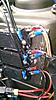
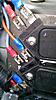
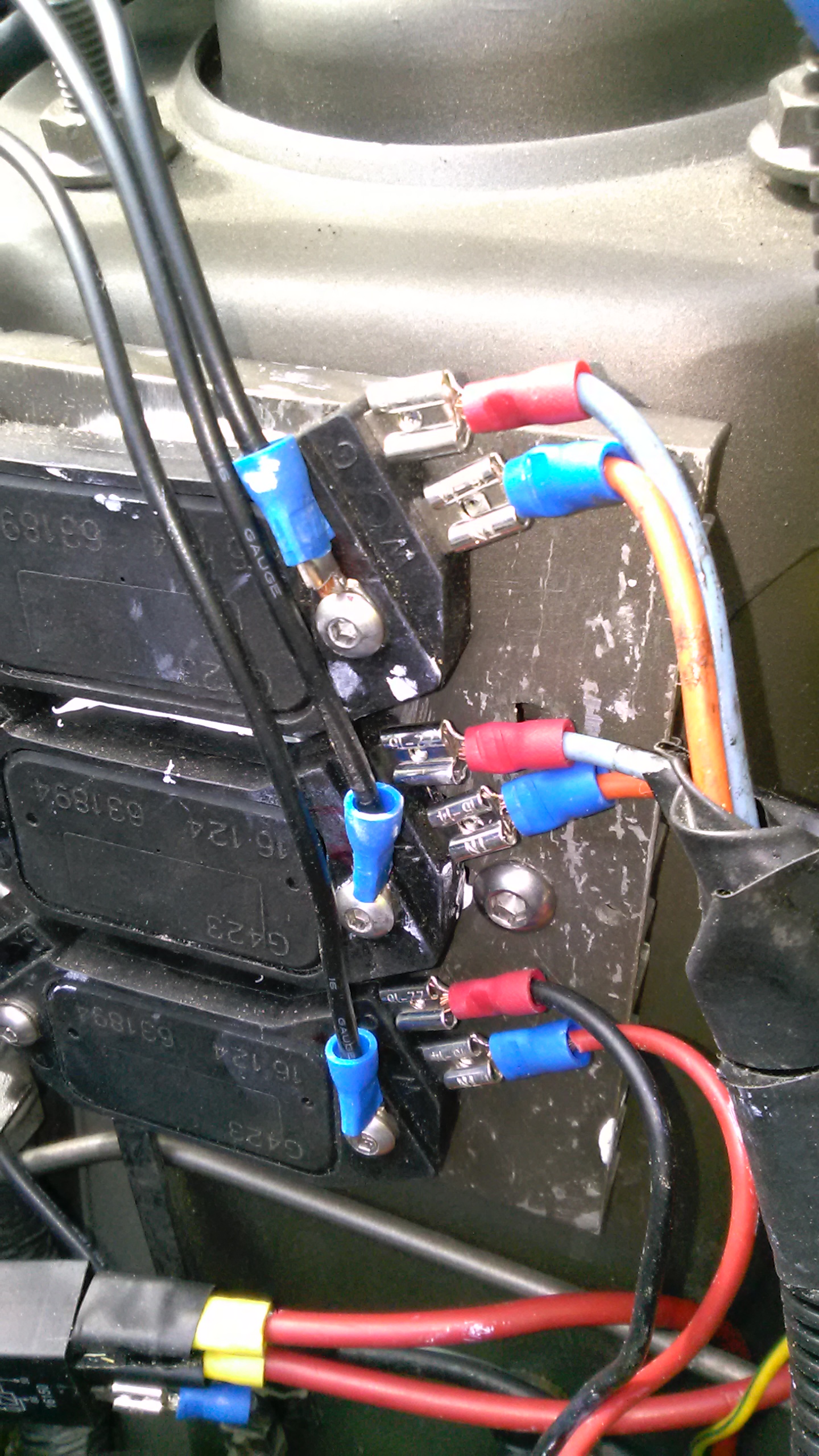
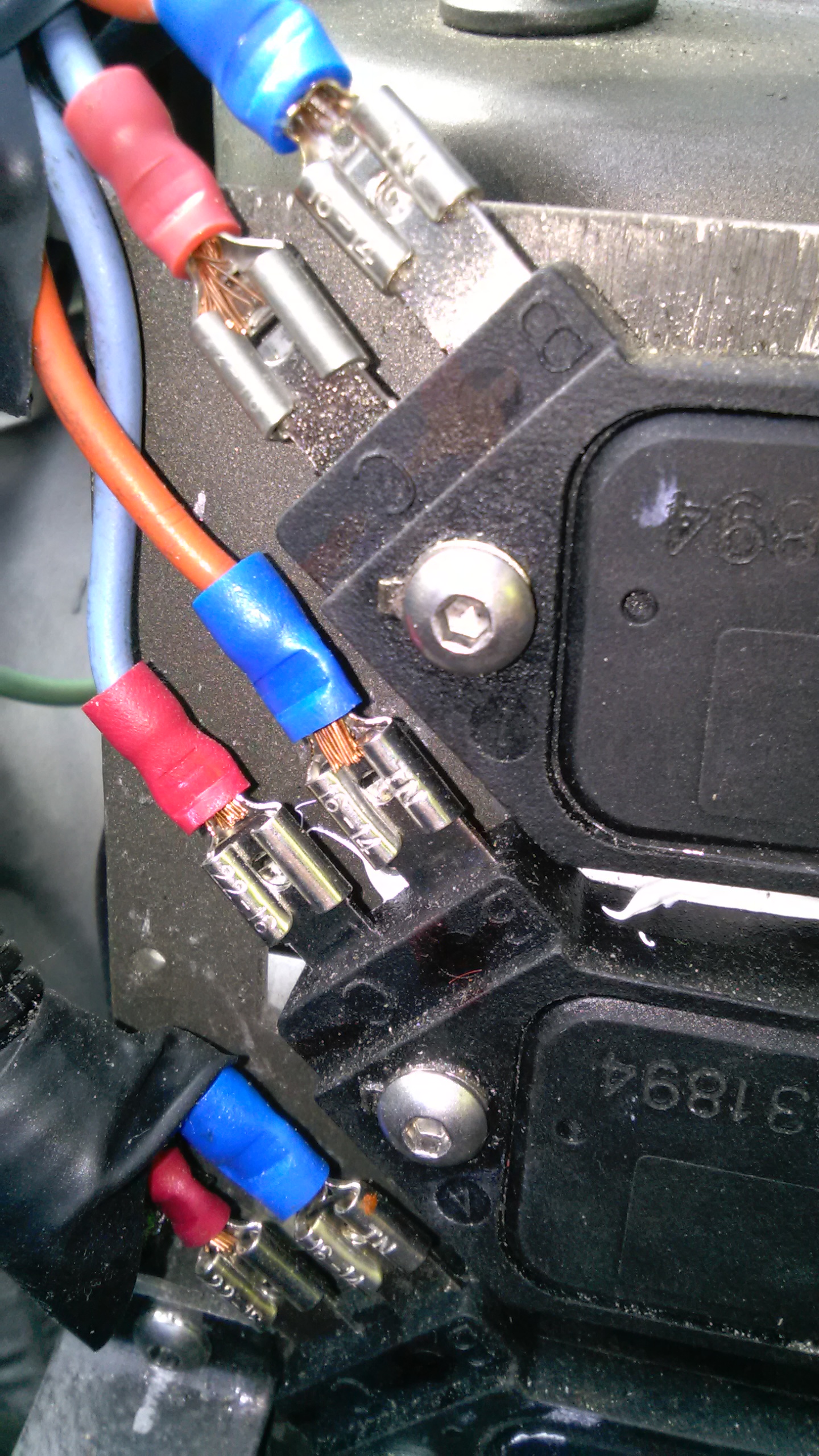
Correct color orientation of pickup wiring is simplest method to determine correct polarity,so...G terminal on HEI module gets red wire from pickup and W terminal gets green wire. B terminal of module is +ig.coil feed & C is -ig.coil feed. Suggest using ohmmeter to trace wiring from pickup to module/coil and rectify if incorrect. Are you losing ignition after 30 seconds,or running out of fuel? How old is fuel in tank of car? A pic from a recent DI conversion showing connections at module. Hope this helps.
That clears up some questions.
I am NO electrical magician; I just followed TGfarrel's guide on here to the t and it worked.
Use an ohmmeter and prove out the circuits from pickups to modules and straighten out anything you find there,then do same from
modules to coils +module grounds. Since car seems to only run for short intervals,you have to set up and be ready for when it shuts off so you can eliminate possible causes. Hook timing light to battery and to one of leading coil hi-tension wires,rubber band trigger to on position and aim light where you can see it while engine running. Engine shuts off,light still flashes,that coil still firing. Move
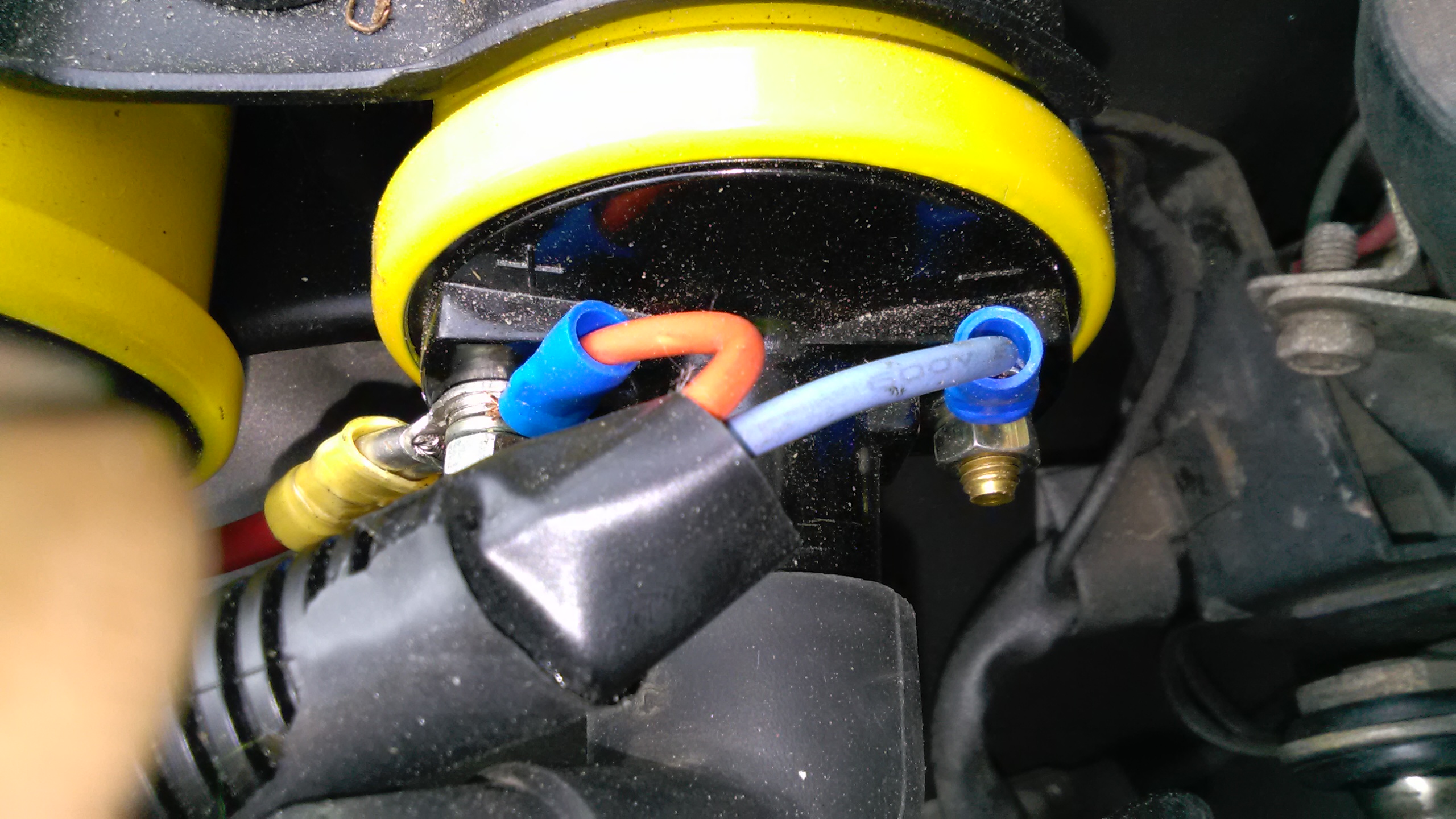
inductive clamp to other coil wire and crank over,light=ok. Fuel,some other issue? Timing light will check secondary ignition,for primary ignition hook up a test light to -battery terminal and with a jumper wire hook up other end to -ig.coil primary terminal. 2 test lights can check both leading primary circuits simultaneously,use what you have. When car is running test light will flicker,Quickly, that indicates module is firing coil and primary ignition ok. Car stops,test light doesn't flicker during crank=module not firing coil. Check other coil to see if its being fired. Light on steady indicates coil is getting 12 volts. Take test light and check B terminal on each module for voltage,something not right there go back to pin 87 on relay and check. Nothing there check pin 30 & pin 86 for 12 volts and pin 85 for ground.
I checked continuity, grounds, hot leads at coils, ect. everything looked good.
I decided to stick the old j109's on, in case I had somehow fried the Gm ignitors (the 109's measured 500 ohms across terminals, the GM's 850). No spark, nothing. They were getting juice, but the plugs weren't firing. WTF eh?
Swapped my brand new coils for a spare pair in the car, no spark either.
Lastly I checked the pickups themselves. Nothing. NO ac output at all. NO DC either. I think I found the problem! When I spin the motor, with the starter, I measure no voltage in any which way under any settings. Didn't matter which way I used the test leads either. I assume since the reluctor isn't sending any sort of signal at cranking speeds, nothing else works, no?
I want to be sure, because a new reluctor looks pretty expensive, i.e. half what I paid for the car
The very few time I've been able to start the car it had the starter spinning very fast. Like abnormally fast, which took a lot of time to get to. Correct me if I'm wrong, but shouldn't the passage of the metal reluctor past the magnet, produce a signal even at 1 rpm?
TL;DR Don't buy a new dizzy or pickups if you just tested by looking for an AC voltage using a digital multimeter (DMM).
The signal coming off of the reluctor is not reliably readable using a simple multimeter...it's variable frequency (based on RPM) and variable amplitude (voltage) signal.
Has anyone in the forum ever put an oscilloscope onto one of the pickups?
You could test the pickup by doing a resistance check across the pickup coil....disconnect where the J109 normally fits and check the resistance across your red and green wires.
It's should be some number of Ohms but not open circuit. I'll measure my working pickup and get you a number.
Only ever replaced one bearing plate/pickup assly and that was physically damaged. They're very reliable units and have doubt that's cause of no start. Are you saying you have no trailing ignition either? Really unlikely scenario to have both pickups inop,car ran at some point recently and these pickups don't fail and start working again...something else is at play here. At cranking speed output around.5 volt & pulses,no way for a digital multimeter to pick that up as meter will read an average of the sine. Toruki has supplied an ohm spec,ohm both of pickups,whatever the # they should be nearly identical. Scope is the only way to read output/signal. Fairly sure pickups are ok,more likely your connection to them may be questionable. Have a close look at your connections to the pickup leads,if all else ignition wise has checked out,need to concentrate your attention here.
I just tested mine, and I get 0 ohms. Same as putting the probe points together. It's an analog meter, and yeah I checked the ohms adjustment. Does that mean the pickups are shorting somewhere internally?
Rigged up a little experiment, I taped a 19mm socket to distributor drive gear, and spun it with my drill. I read about .1-0 volts AC at 450 rpm. I read 2-2.5 volts AC at 1800 rpm. To get this output, wouldn't the engine need to be in the 3k rpm range as the dizzy is rotating at 1/2 engine speed? I only mention this because I read that the GM igniters need a 2+ volt AC signal to function.
I did go ahead an order a new reluctor/pickup set this morning, only $65 or so from RA. if I don't need it I'll send it back, but it's cheap, relatively.
Will double check the solidity and continuity of the feeds from the pickups to the GM igniters.
Tested for continuity in the wires I ran between the leads from the pickups to the igniters, and everything rings out true. Even shook them and pulled on them a bit, no problems. GM ignitors also spec'd out at 850, which is within spec for a hot day (it's 90+).
Are you testing from the wires or at the pickups them selves?
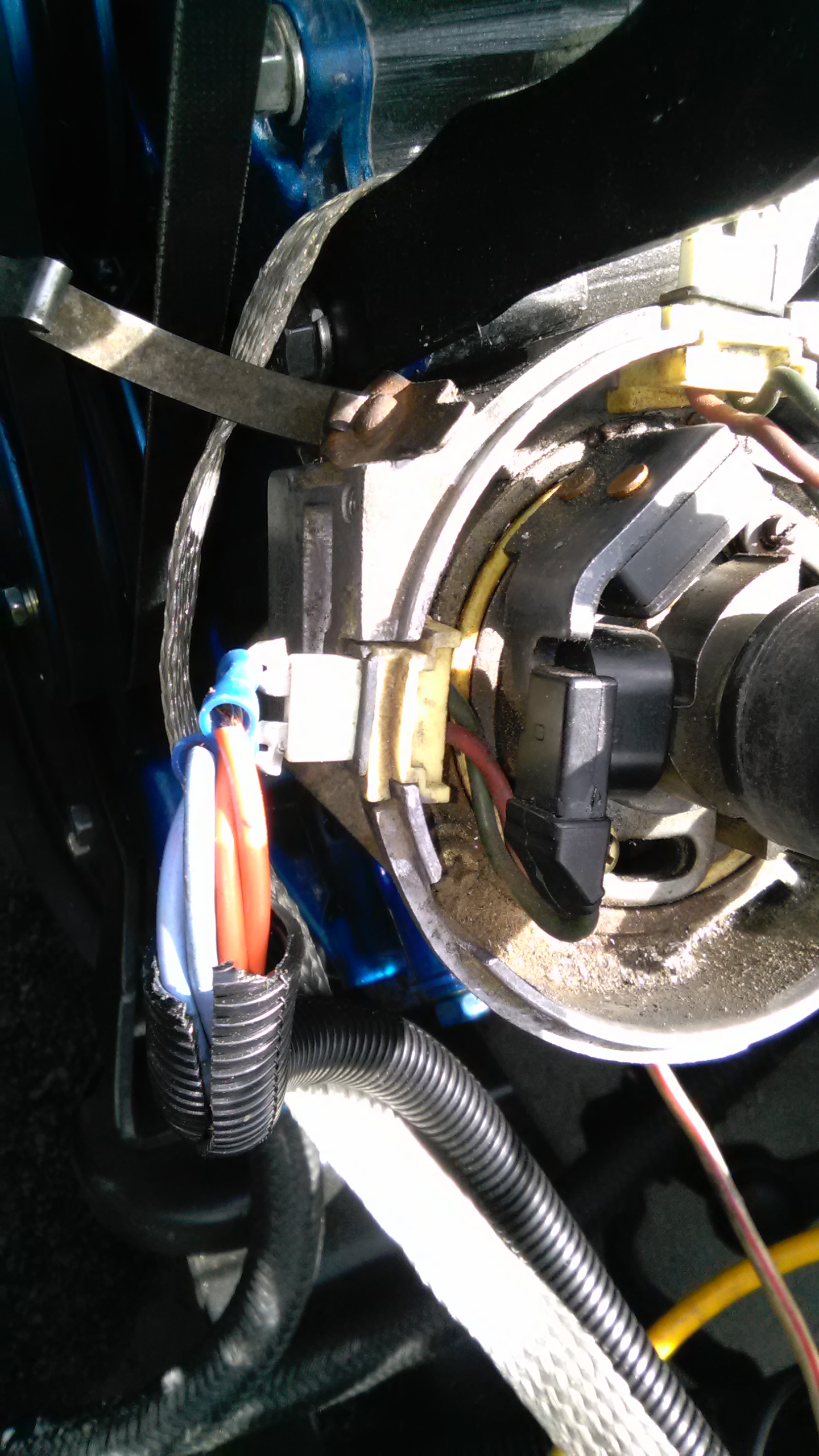
I see how you have your wires hooked into the old housing for the J-109. I did the same thing on my car, but I noticed it isn't the best solution. Are you sure the connection there is good and tight and free from any corrosion?
I'm not sure what you mean by theJ109's housing. I removed them entirely, except once when I reverted to stock to see if it was the igniters/coils I bought. Got no fire at all, from stock wiring, which I find telling. I've only had the car run, briefly. Never heard it run before purchase either, so no real clue of history of the car. Unless of course you mean hooked into the white clip thing that the J109 plugs into.
The connection is tight fit, and connectors are all brand new, no chance of corrosion. I suppose I could cut the white connectors off, and wire directly to the pickups, but then I'd have holes in my dizzy.
Pulled the rear brake line, going to Midas tomorrow to have a new fitting put on the part I mangled.
Are you testing from the wires or at the pickups them selves?
I see how you have your wires hooked into the old housing for the J-109. I did the same thing on my car, but I noticed it isn't the best solution. Are you sure the connection there is good and tight and free from any corrosion?
Mentioned this in a previous post,wish i was close to put hands/eyes on,am pretty certain that both pickups are good and VERY good chance the problem is in connections /wiring to the pickups.
GSLSEforme was super helpful, and we think we've solved the problem. I heated up the system, and turned over the dizzy by hand, got spark. What changed was the little connectors I made, didn't fit very well, so they've got to go. I'm also switching from 14 ga, to 18 ga, to minimize signal loss. Also going to put weather-tite connectors and some big shrink tube on the ends.
Any ideas what some guys are using to plug into where the j190's were? I hear some members are using speaker wiring bits, but I'm not entirely sure what to ask for at the store. Will bring the dizzy whenever I end up going, to test connections anyway.
"Any ideas what some guys are using to plug into where the j190's were? I hear some members are using speaker wiring bits, but I'm not entirely sure what to ask for at the store."
Some folks use a dead J109 and gut it out, internally connect the input to the output male spades, which are easier to attach to.
I use ground down connectors like in his picture. I'll admit its NOT an optimal solution, but its the only one I can imagine save having an open hole in my distributer. I don't have any non-working J-109s; if I did I would definitely hollow them out.
This weekend GSLSEforme, and I chatted, he's super helpful.
I tore out the wiring for my GM igniters, and am searching for the male .110's. Every car audio place around here seems to only have females, and the NAPA and other places are useless too. I'm as surprised as you are. I'll have to order online.
In the meantime I put the j109's back on, and using a bulb found out one of them is bad. I put the good one on the leading position and the car runs!But not very well at all. Need choke it to do any sort of idle. I'm going to return the spare reluctor/pickup assembly to RA.
I fixed the fuel leak at the base of the carb, again...Put some gasoline-proof dressing on the paper thin gasket, and it's holding.
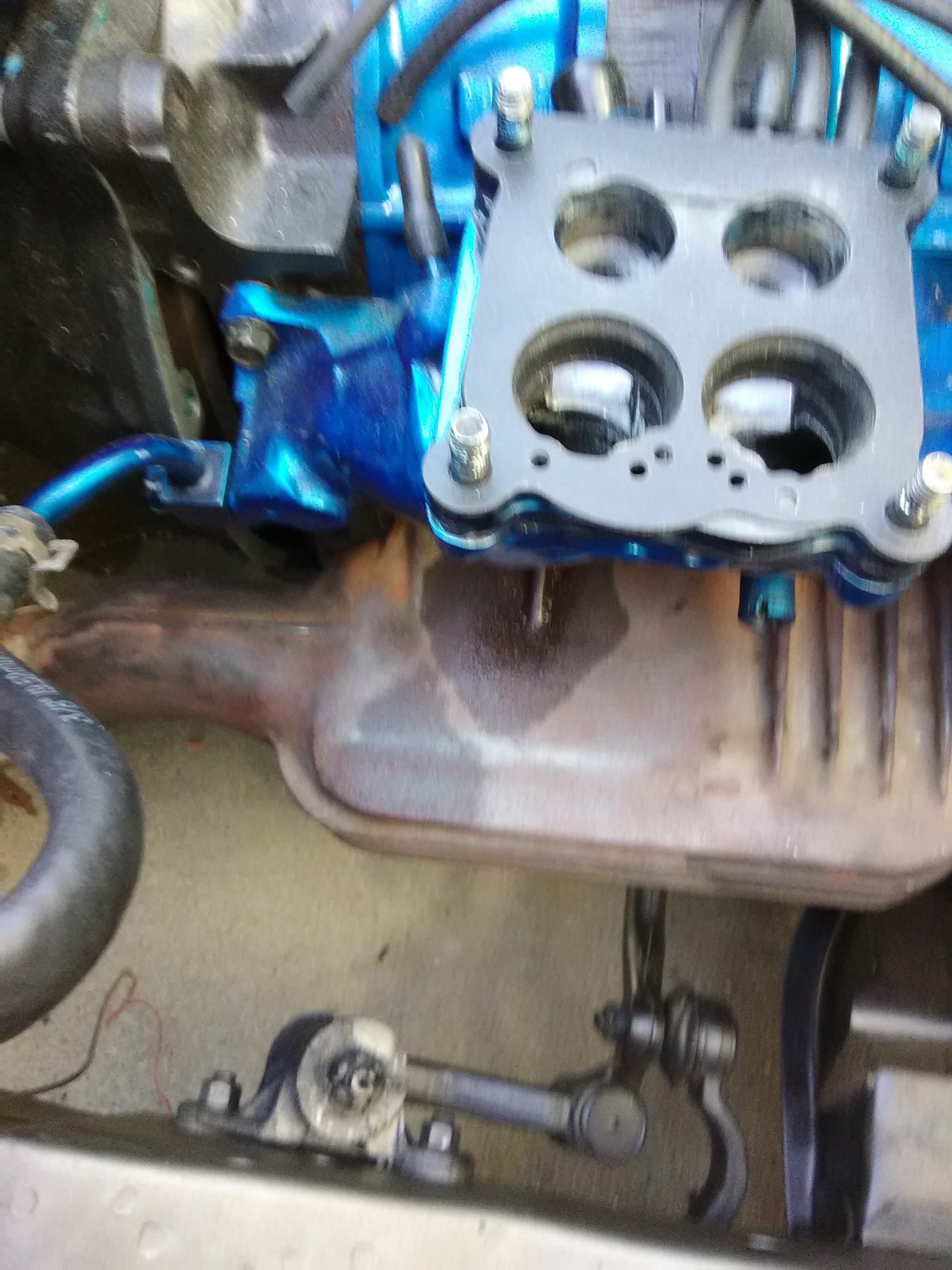
But wait there's more! I still seem to have gas puddling on my exhust manifold (I know, perfect spot for it right?).
So I get to thinking, it seems like the car isn't getting fuel, and from what I read only running on choke means there's a vacuum leak, yeah?
After trying my spare carb and getting very similar results to the carb I've rebuilt (almost starts, very hard to start seemingly no fuel), I know something's wrong.
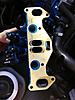
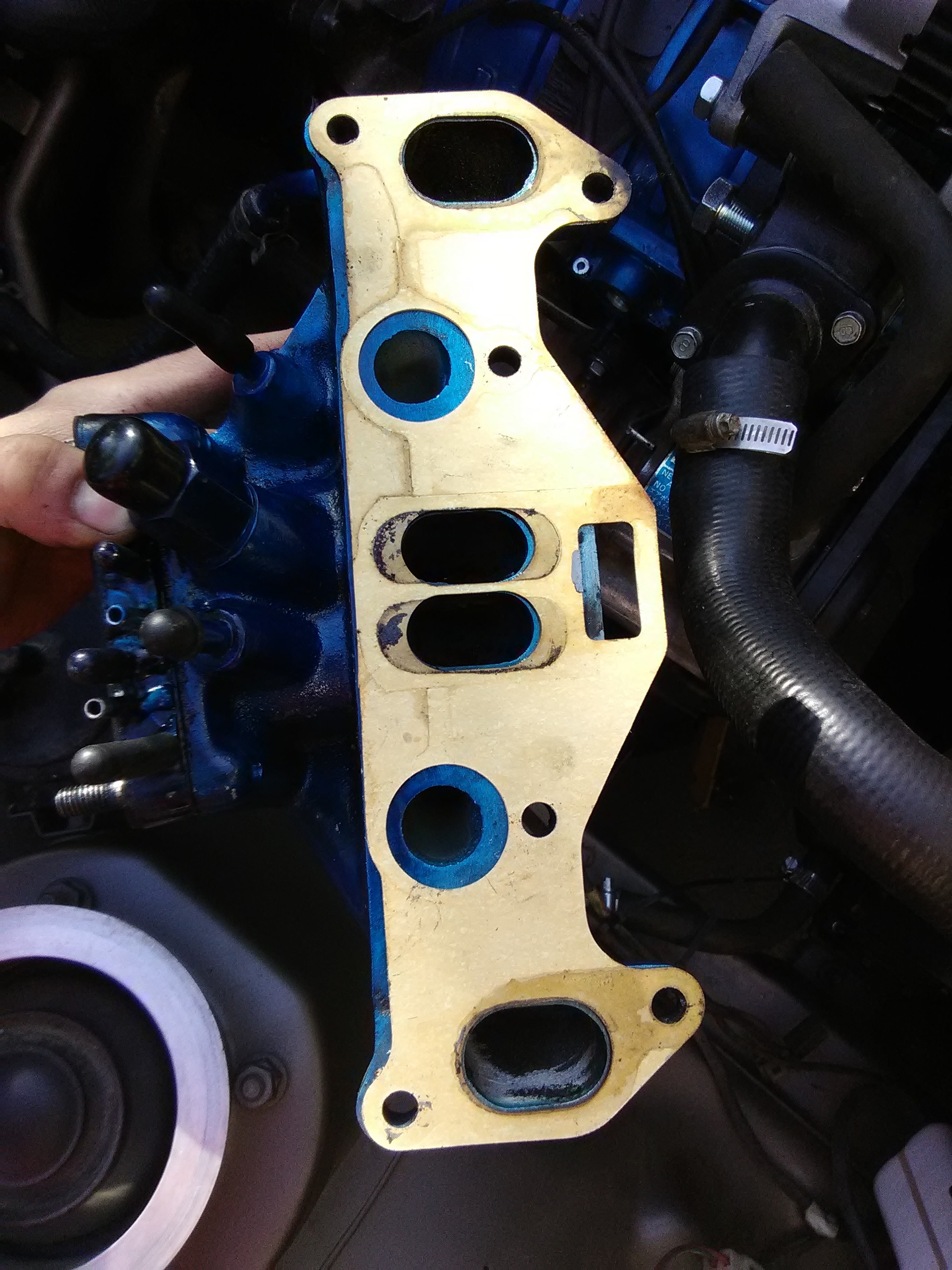
I pulled the intake manifold and found this:
It looks like the gasket is curling, and seeps fuel if I press on it! This was a brand new gasket, wtf? No more DNJ rebuild parts I guess? One more thing to check is manifold straightness, but I think I'm ok there.
This would explain the vacuum lean, no? And the odd no-fuel and leak on the exhaust manifold!
The .110" male terminals can be faked if you file a set of common .250" oppositely to help clearance.
The paper-thin gasket will still probably buckle and leak on you.
Don't use the crappy thick baseplate gaskets from the cheap-*** rebuild kits. Ever.
I assume the ACV port in your intermediate plate has been filled already, as it it not a very common sight to see an SA intake manifold with an FB exhaust manifold on the same engine, unless some work have been done to address it.
I have had not such good luck with filing the .250 terminals. Maybe my file is broken, right?
You're talking about the paper thin one between the aluminum carb body and the iron bottom of the carb, right? Yeah I suspect it will fail eventually despite the dressing. Who would you recommend for gaskets?
I'm using the stock looking carb to manifold gasket, not very thick. I still have the crappy thick one in my spares.
I have filled the ACV with Steel-Weld stuff. So the Intake is off an SA? That would make sense! It had the same purple paint as my SA trans that came with the car.
Any ideas why the intake manifold to engine gasket failed like that? Do they need some sort of goop on them? I did check both the irons/housings and the manifold for true and straightness, and both checked out good.
Hey guys, got some time to work on the car the last 2 days.
So far I've cut a new manifold gasket, new airhorn gasket, and new iron-base to manifold gasket for the carb. I used Felpro 3137 which they recommend for fuel resistance. I've eliminated all the leaks except the iron base to manifold. It still drips fuel. I'm not sure what to do.
I tried starting the car, I get it to start, but it still dies about 30 seconds later (less if pushing rpm). It sounds like it's getting no fuel, but the fuel is soaking the inside of the manifold. I'm totally lost now. It's like the carb isn't vaporizing, or metering the amount of fuel the engine is needing. No the needles aren't stuck. Fuel level is roughly right in the middle of the windows. Could the float bowl vent solenoid cause this to happen?
I did get the ignition wiring figured out, good firing on my leading plugs, will fix trailing later.
Can you post a video of car running so we can see/hear what it sounds like? Does fuel leak at base of carb with key on and engine not running? Can you look down the venturies and see fuel dripping onto throttle plates? Which Venturi is it,primary,secondary? Believe you have a 2nd carb,are symptoms identical with that one installed?
I'll try to figure out how to video and start the thing a the same time. Maybe a stick and some tape.
No leaks when letting the fuel pump cycle, and the car not running. Will have to double check inside of the carb when I let it 'idle' like that.
I will check out the venturies tomorrow, when it's light out.
Symptoms are pretty identical with the second carb. I'm not sure I even got it to run at all on the second, it's pretty junk. Very hard to start, and would not stay running at all. It's a Nikki stripped all the wrong way, with some sort of cobbled linkage.