When you click on links to various merchants on this site and make a purchase, this can result in this site earning a commission. Affiliate programs and affiliations include, but are not limited to, the eBay Partner Network.
Nothing says rotary alchemy quite like pre-mix discussions. Add to that some C2H6O and the fun really get going. So I'm spinning the rotary wheel of lube fortune trying to determine the right Ethanol percentage fuel and pre-mix (choice and rate). It's kindda important to me. Not like there isn't a completely brand new engine with Mandeville internals on the line or anything...
First nugget I come across was when I opened my I-Rotary seals package. Inside the lovely package, Francesco include instructions to pre-mix 2 - 2.5 oz/gal... MAMA MIA!! Not exactly the ubiquitous 1 oz/gal, much less the stock OMP dribble! Ok, so I'll set that as the upper bounds. But I still don't know how to adjust that rate for ethanol. More screen time searching ahead.
The 2.5oz/gallon number was derived from a no-OMP running alcohol, he recommended 1.5oz (or 1oz minimum) for street application with a good OMP. 2oz+ for track. I'll just run 2.5oz, I don't care if it smokes on track.
Still seems like a lot, though (for lack of empirical data) I give GREAT deference to "Doctor Ceramic".
Coincidentally. I also came across this interesting tidbit today from what I consider one of 5 rotary "gods", Racing Beat:
.
The requirement for turbo engines in racing is high enough that use of a metering oil pump is impractical. Therefore, we premix up to 22 oz (650ml) of oil to 5 gallons of fuel in a 600 HP 2-rotor.
... While undertaking development work on the RX-8 Renesis engine for SCCA T2/T3 use, we decided to introduce extra oil into the fuel to monitor the effect. To our surprise, this additional oil increased power! Further dyno testing found that by adding 10 oz. of Royal Purple 2-Stroke Oil to 6 gallons of fuel, we gained an average of 1.7 HP from 2000-9000 RPM, along with an increase in peak power of 4 HP. We validated this increase by changing back to a "non-oiled" fuel - and the power returned to the previous level. Later, we tried the same test with another brand of synthetic oil with nearly the same results.
.
DR Iannetti + Jim Mederer = SOLD! So, looks like it'll be 10 gals E85, 5 gals 94 octane dino juice, 38 oz of premix, an eye of newt, a lock of hair from a virgin Cuban girl, and three bat wings per fill-up. Let the Witches' Brew burn!
Last edited by Carlos Iglesias; Jan 17, 2021 at 10:21 AM.
i pre-mixed 1 oz/gal plus OMP and my rotor housings were trashed after ~20 hours. (50/50 meth, RXparts seals)
It has been recommended to me to use at least 2 oz/gal and use Klotz Super Techniplate (pre-mix only) which supposedly stands up to alcohol. Now was it the pre-mix or the seals?? (or combination)
I'm planning to tune to E85 but run E50. Initial maps will be for E85 and then another tune at E10. All fuel and ignition maps in between with be extrapolations with reduced boost at the lower corn contents.
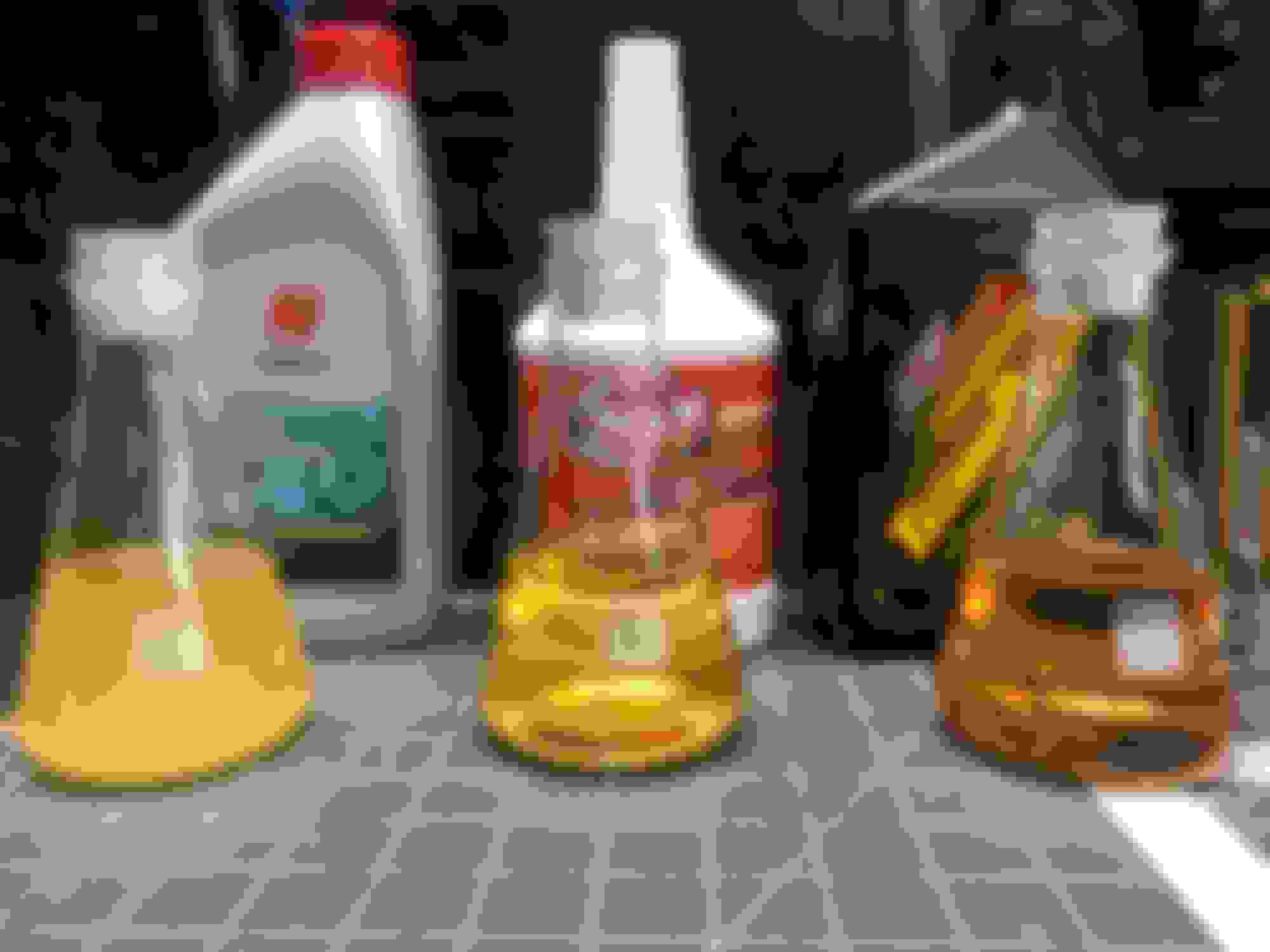
One unresolved fuel issue is the ability of the premix to stay in corn juice (VP C85) suspension. After a little research, I narrowed down test prospects to:
Idemitsu Racing Rotary Premix
Redline 2-Cycle Alcohol Premix
Klotz Original TechniPlate.(KL-200)
Test Conditions:
It was 73F and 71% humidity. Nights will be in the 40's.
Planning to run 2.5 oz / gal per Dr Iannetti's I-Rotary seals directions. The test is at that ratio. I also assume this to be an effective upper bounds of for non-methanol rotaries. The ratio looks like...
Initial impressions: The Idemitsu took some stirring to dissolve and then remained cloudy. The Redline impressively dissolve completely by just pouring into the E85. Klotz took some stirring dissolve into solution but was completely clear.
Now to wait a couple of weeks...
Last edited by Carlos Iglesias; Jan 31, 2021 at 06:16 AM.
Reason: ADD
I'm planning to tune to E85 but run E50. Initial maps will be for E85 and then another tune at E10. All fuel and ignition maps in between with be extrapolations with reduced boost at the lower corn contents.
One unresolved fuel issue is the ability of the premix to stay in corn juice (VP C85) suspension. After a little research, I narrowed down test prospects to:
Idemitsu Racing Rotary Premix
Redline 2-Cycle Alcohol Premix
Klotz Original TechniPlate.(KL-200)
Test Conditions:
It was 73F and 71% humidity. Nights will be in the 40's.
Planning to run 2.5 oz / gal per Dr Iannetti's I-Rotary seals directions. The test is at that ratio. I also assume this to be an effective upper bounds of for non-methanol rotaries. The ratio looks like...
Initial impressions: The Idemitsu took some stirring to dissolve and then remained cloudy. The Redline impressively dissolve completely by just pouring into the E85. Klotz took some stirring dissolve into solution but was completely clear.
Now to wait a couple of weeks...
love this test! this is at the 2.5oz ratio pictured?
love this test! this is at the 2.5oz ratio pictured?
Howdy Z!! After some of our discussion, I thought it might pique your interest.
Yep, 2.5oz/gal ratio which is what I'm planning to run on E85.
Coincidentally, the next day I found the bottle of Motul Micro 2T I had purchased earlier, so I've included it in the test. I'll post the three-week results this weekend...
.
.<spoiler alert> and it mostly good news!
BTW Z, Looks like I may have been your 3000the post. Congrats!
Last edited by Carlos Iglesias; Feb 10, 2021 at 04:16 AM.
That's really interesting on the alcohol mixing. I assume it'll be different with Gasoline.
I'm wondering—if what's happening is, the alcohol in fuel, or alcohol in water injection essentially "washes" the oil away, is adding alcohol-compatable premix to the water injection mixture a thing that needs to happen? I'm getting WI built into my build, but if it just de-lubes lube-sensitive seals (i-Rotary), maybe I'll rethink or run it infrequently.
PS: You've no idea how geeked out I was to get that random call from Dr. Ianetti at the gym.
That's really interesting on the alcohol mixing. I assume it'll be different with Gasoline.
I'm wondering—if what's happening is, the alcohol in fuel, or alcohol in water injection essentially "washes" the oil away, is adding alcohol-compatible premix to the water injection mixture a thing that needs to happen? I'm getting WI built into my build, but if it just de-lubes lube-sensitive seals (i-Rotary), maybe I'll rethink or run it infrequently.
PS: You've no idea how geeked out I was to get that random call from Dr. Ianetti at the gym.
Indeed Peter, I think you bring up some excellent points about the alcohol (i.e. Methanol) in water injection. I like the quasi-OMP proxy of adding pre-mix to AI solution. Definitely worth some thought and research about cost/benefits.
As for having no idea about how geeked out you were from a call from "Dr. Ceramic"... alas, I venture to add that I have some inkling!!
Last edited by Carlos Iglesias; Feb 11, 2021 at 04:54 AM.
That's really interesting on the alcohol mixing. I assume it'll be different with Gasoline.
I'm wondering—if what's happening is, the alcohol in fuel, or alcohol in water injection essentially "washes" the oil away, is adding alcohol-compatable premix to the water injection mixture a thing that needs to happen? I'm getting WI built into my build, but if it just de-lubes lube-sensitive seals (i-Rotary), maybe I'll rethink or run it infrequently.
If you can control IATs and detonation, you don't need AI
That's sort of the thing though. You really can't after a point.
Even with a completely breathed out engine, single turbo, inconel heat sheilding, v-mount, 100 octane fuel, the IATs on track on a hot day at 12psi can still get up to the point where you're punishing stuff and losing power. My goals for it are simply, cooling on track when it needs it—like be able to go down to VIR in August and flog it—and being able to run higher than 15psi on short street sprints, which you can't otherwise do on pump gas.
So my housings were completely thrashed from track duty. Was it the seals (RXParts)? Was it not enough premix (1 oz/gal+OMP)? Was it AI (50/50 on at 7 psi)? Or all of the above
Maybe the way to go is max premix with just enough meth (no water) to provide cooling where the cooling comes from evaporation, i.e. there's little liquid to wash anything away. That said, running pure meth gets kinda dicey
TomU, short answer is I don't know. Several potential causal factors, and each exponentially increases the complexity of the 'ground truth'. Without REAL data, anything else is the usual pap of opinion and conjecture (in my professional opinion). Also, you haven't mentioned any mitigater(s) to the housing wear. My money (and this build) would in fact be on that very conjecture: that all of them contributed at some level.
Hopefully your experience and that of others continued to help us build better rotary Rube Goldberg devices. Sadly, at the end of the day, we're all just proxies for Mazda incomplete (through no fault of their own) development of our beloved, Dorito-filled Pandora's Boxes.
TomU, as you know I had a similar rxparts seal warping issue, motor lost compression, but the housings were also trashed as well, and it got 1oz/gallon on street, more on track. My issues with OMP nozzles notwithstanding, I think those are a light street use/drag racing seal that just won't work the way we are going to use them. Very few people are really leaning on these cars, as street cars, on track.
The new build has iRotary. I'm still wary of the oil requirement, but going to give them a shot. I've got a LOT more monitoring/control/safeguard systems built in now. I think that'll be key.
Yeah, i'm going with iRotary seals as well (and a new engine). Will bump up pre-mix to 2.5oz with OMP. Just not sure about AI. Maybe another consideration is how triggering is controlled. It was set up to trigger on at 7 psi regardless. I could move this up, but am thinking it'd be better to trigger by IAT. Detonation's another matter. But on that, think detonation is related to engine temps, so if that can be controlled, risk of detonation goes down.
TomU, no hijacking at all! On the contrary. I always appreciate Peter's and also your perspectives. I'm also poking around in the dark looking for the 'best' premix, housing wear, anti-detonation, IAT, fuel choice track alchemy. Heck of a lot easier for me (and hopefully subscribers) to learn here than go hunting for it. Keep it up!
Last edited by Carlos Iglesias; Feb 12, 2021 at 05:40 PM.
Reason: ADD
The potency of the four brews was summoned after two weeks. The samples have ranged over the last two weeks from 70° F to 30° F today (bitterly cold day for Dallas). The actual temp of the fluid was 33°F.
The winners...
Redline 2-Cycle Alcohol Premix - No discernable precipitate in static. Slightest visible wisp (<.01 ML) of fluid separation when quickly swirled; instantly re-dissolved.
Klotz Original TechniPlate (KL-200) - No discernable precipitate or separation in static or when swirled.
Motul Micro 2T - No discernable precipitate in static or when swirled.
.
Week-2 Results
and one apparently loser...
Idemitsu Racing Rotary Premix - Premix never completely dissolved. After two weeks, there is ~1mm precipitate 'solid' at the bottom. Did not break up when quickly swirled. I did not shake or further agitate beyond what I did with the other samples. Coincidentally, this was a great disappoint for me since I heavily favored it due to it's rotary pedigree.
Idemitsu (static observation) w. precipitate 'solid' at bottom after two weeks.
Will revisit one more time in four weeks... same Bat Thread, same Bat Time...
Last edited by Carlos Iglesias; Feb 14, 2021 at 06:58 PM.
Sweet info.. man. I saw somwhere that Idemitsu and E85 doesnt mix very well. I think it was on a FC running E85 and had fuelpump issues and car didnt run correctly. Idemitsu is for regular fuel.
mr rxeven - Tell me more about this "finger and thumb test". Are you literally recommend rubbing between fingers to determine lubricity?
TeamRX8 - If you look back on my thread, you'll see that I'm (perhaps) the first guys to post firsthand details about the I-Rotary seals. Got wind of them from the Mazda Motorsports team... and promptly purchased. Just haven't been able to actually test in my build due to the usual witch's brew of procrastination, supplier dumbfuckery, and project creep.
As for why E50, it's frankly a educated SWAG (Scientific Wild *** Guess). More specifically, I'm trying to find the Pareto optimal mix of detonation resistance, IAT reduction, housing lubricity, and combustion sealing (i.e. power). Because the benefits of ethanol % increase is nonlinear, I'm "guesstimating" that E40-E60 is in the Paerto maxima ballpark. E50 is my SWAG.
Last edited by Carlos Iglesias; Feb 17, 2021 at 08:40 AM.
Reason: ADDDDDDDD
As for why E50, it's frankly a educated SWAG (Scientific Wild *** Guess). More specifically, I'm trying to find the Pareto optimal mix of detonation resistance, IAT reduction, housing lubricity, and combustion sealing (i.e. power). Because the benefits of ethanol % increase is nonlinear, I'm "guesstimating" that E40-E60 is in the Paerto maxima ballpark. E50 is my SWAG.
It is interesting to note that the blending response of RON and MON as a function of ethanol content is highly non-linear. There is a substantial octane improvement between RG and E10, and between E10 and E50. However, between E50 and E85 there is very little difference in either RON or MON.
High ethanol blends have been shown to permit higher CR operation. Caton et al. [10] showed that for E85 blends, the maximum brake torque (MBT) spark timing could be maintained up to a CR of about 13.5, whereas MBT could not be maintained for gasoline and E10 past a CR of 9.0 in a modified CFR octane rating engine. Nakata et al. [11] showed at a CR of 13.0, MBT timing was knock-constrained for E0, E10, and E20, but not knock-constrained for E50 and E100 at the tested conditions. Stein et al. [12] evaluated a dual fuel system, where gasoline was delivered through a PFI injector as the primary engine fuel, and E85 was delivered as the secondary engine fuel as-needed to prevent knock. It was found that under turbocharged conditions with a 12.0 CR configuration, the maximum amount of E85 required to prevent knock at peak load was less than 60%, which is effectively about E50. The work here is unique in that it investigates, in combination, the effect of several high CR in an engine with DI fueling and with ethanol blends.
Last edited by neit_jnf; Feb 16, 2021 at 09:04 PM.
When life give you lemons, make lemonade.
When Dallas give you hellish cold, make tar mats chips (& slats)!
While I still have a little sound deadening tar mats left on both rear strut towers as well as on the top of the chassis tunnel behind the dash, I removed 9.6 lbs of it. With the remainder, I'd estimate not quite 11 lbs total. Not quite the 20-25 lbs figures I've seen others quote... perhaps they included the under-carpet foam.
Still quite a bit to gooey clean up, especially anywhere I had to resort to the trusty Steinel heat gun. Suspect that's gonna have to wait till next weekend.
E85 Premix - No change in the precipitate. The Idemitsu precipitate is so solid on the bottom that even vigorous shaking of the bottle won't loosen it. Haven't made up my mind between the Redline and the Klotz... though the latter has a large price advantage.
Last edited by Carlos Iglesias; Mar 7, 2021 at 04:27 PM.
Reason: ADD