


Thoughts on Drive-by-wire Conversion (DBW)


I almost didn't see this but this isn't really a sound argument when comparing a GM TB and the S54 actuator. They'd be applied to completely different packaging projects, as well as to bolt the GM TB on you also need to spring for an adapter whereas the S54 bit would be cost of adapting lever arm to lever arm. Both are good solutions, I just think the S54 is more appropriate in the FD engine bay, but I'm weird.



So, I wanted to take a moment to go back to the original question regarding the benefits of DBW. I was out of state at a school when this started and totally forgot about linking in a video I had seen a while ago that breaks down DBW functionality really well!
Hopefully this is valuable for other people who have the same question..
Hopefully this is valuable for other people who have the same question..
^Thanks for posting that! Good info there, and highly relevant as my FD has a DBW setup. Previous owner fabricated a custom adapter to adapt a GM (Caddy Escalade) DBW throttle body to a 13B-RE Cosmo UIM, with an adapted RX8 pedal, controlled by a Link G+ Fury ECU. It's that last part that will need some fine tuning to dial in the throttle response just right - it's a bit too temperamental now, especially during warm up, but the hardware aspect of this setup seems bullet proof enough.
Junior Member
Joined: Feb 2020
Posts: 45
Likes: 26
From: San Diego, CA
So I'm in the middle of having mine done right now. Parts wise you'll need an adapter plate for the TB (FFE snd Draklore both make one), the TB itself (I went with an Escalade TB) and the gas pedal out of any junked RX-8. In addition to getting the rx8 pedal you will also need to fashion a spacer to push the pedal far enough out from the firewall.
To my knowledge there is not currently a ready-made kit for getting the gas pedal in the right place, instead you'll need to make the spacers snd figure it out on your own.
Like you mentioned, the benefits of being able to accurately tune the throttlebody to assist in cruise control, traction control, launch control, engine protections, etc., etc., etc. make the conversion a bit of a no-brainer!! The capabilities of your tb will only be limited by the skills of the person programming it and the ability of your ecu
To my knowledge there is not currently a ready-made kit for getting the gas pedal in the right place, instead you'll need to make the spacers snd figure it out on your own.
Like you mentioned, the benefits of being able to accurately tune the throttlebody to assist in cruise control, traction control, launch control, engine protections, etc., etc., etc. make the conversion a bit of a no-brainer!! The capabilities of your tb will only be limited by the skills of the person programming it and the ability of your ecu


Just to further add to the thread a bit, the following add'l forum members have engineered some really nice components to complement DBW capabilities for the FD:
Andrew Zieger w Z Precision has the pedal offset adapter & applicable hardware for mounting a suitable foot pedal; and, Zensation offers a sexy TB adapter for this application.
Andrew Zieger w Z Precision has the pedal offset adapter & applicable hardware for mounting a suitable foot pedal; and, Zensation offers a sexy TB adapter for this application.
Last edited by Topolino; Sep 29, 2021 at 09:23 AM.

The Ancient

Joined: Mar 2001
Posts: 2,629
Likes: 244
From: Pennsylvania
So, what if you have one throttle body for the primaries and one for the secondaries? Can youy set the primary TB to open immediately and the secondary to lopen under various circumstances? Like RPM or TPS or some load?
Gordon, are you referring to the stock TB for the FD? If so, you can just use the DBW actuator from some of the m series BMW's I believe.
If you mean one TB for the primaries and one TB for the secondaries that would be doable based on your ECU, but very custom..
If you mean one TB for the primaries and one TB for the secondaries that would be doable based on your ECU, but very custom..
So for those of you who had questions or concerns with regards to how well a large single plate DBW throttle behaves on a street driven car in comparison to the stock FD setup with its staged primary & secondary throttles, I'll share my experiences. Short answer - Throttle response, idle quality and general drivability is a non-issue once my engine reaches operating temperature.
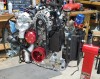
My FD is running a new 13B-REW short block with a Cosmo 13B-RE upper & lower intake manifold, no porting mods done to the engine other than port matching to the Cosmo LIM. To that there's a 90mm GM DBW TB with Zensation's TB adapter, and engine management is done with a Link G4+ Fury wired in ECU. It's a single Borg Warner SXE turbo, more details here on my build thread: https://www.rx7club.com/build-thread...oject-1149941/
Overall I'm very happy with the setup, and it was nice to be able to get cruise control functionality back via the Link G4+ ECU and the factory cruise switches. The one challenge I'm having with it is tuning the warmup enrichment phase. On a cold start & warmup, the engine wants to run a bit lean of my AFR targets at coolant temps below 150*F or so. I have to get smarter with all the available options for warmup enrichment & DBW tuning with the Link, because the simple stupid approach of dumping more fuel in via just the warmup enrichment table is not completely effective. Though it works, and allows me to drive off just fine on a cold engine without stalling it, all that extra fuel is fouling my spark plugs in short order. I think there's a way to factor coolant temps into the DBW throttle tables on the Link, need to research that some more - that might allow me to restrict air intake on a cold engine enough so that I won't have to set the warmup enrichment table stupid rich.
My FD is running a new 13B-REW short block with a Cosmo 13B-RE upper & lower intake manifold, no porting mods done to the engine other than port matching to the Cosmo LIM. To that there's a 90mm GM DBW TB with Zensation's TB adapter, and engine management is done with a Link G4+ Fury wired in ECU. It's a single Borg Warner SXE turbo, more details here on my build thread: https://www.rx7club.com/build-thread...oject-1149941/
Overall I'm very happy with the setup, and it was nice to be able to get cruise control functionality back via the Link G4+ ECU and the factory cruise switches. The one challenge I'm having with it is tuning the warmup enrichment phase. On a cold start & warmup, the engine wants to run a bit lean of my AFR targets at coolant temps below 150*F or so. I have to get smarter with all the available options for warmup enrichment & DBW tuning with the Link, because the simple stupid approach of dumping more fuel in via just the warmup enrichment table is not completely effective. Though it works, and allows me to drive off just fine on a cold engine without stalling it, all that extra fuel is fouling my spark plugs in short order. I think there's a way to factor coolant temps into the DBW throttle tables on the Link, need to research that some more - that might allow me to restrict air intake on a cold engine enough so that I won't have to set the warmup enrichment table stupid rich.
Hey Pete,
Here is a tech article on cold start tuning from HPA, you may find it useful. I'm not sure if it's open to the public or locked behind a member login though... please let me know if you have issues accessing it.
https://www.hpacademy.com/technical-...cold-starting/
Here is a tech article on cold start tuning from HPA, you may find it useful. I'm not sure if it's open to the public or locked behind a member login though... please let me know if you have issues accessing it.
https://www.hpacademy.com/technical-...cold-starting/
Hey Pete,
Here is a tech article on cold start tuning from HPA, you may find it useful. I'm not sure if it's open to the public or locked behind a member login though... please let me know if you have issues accessing it.
https://www.hpacademy.com/technical-...cold-starting/
Here is a tech article on cold start tuning from HPA, you may find it useful. I'm not sure if it's open to the public or locked behind a member login though... please let me know if you have issues accessing it.
https://www.hpacademy.com/technical-...cold-starting/
Cold start the car (say 15-25C ambient), let it idle until warm up (80C). record a log. make sure you are including AFR, timing, and any parameters that include cold start or warm up enrichment
next day, Cold start the car, and try to go drive it within a few seconds and record a log as it's warming up while driving.
Post those two logs and screen shots of all your enrichment settings, closed loop control, main VE tables etc.
next day, Cold start the car, and try to go drive it within a few seconds and record a log as it's warming up while driving.
Post those two logs and screen shots of all your enrichment settings, closed loop control, main VE tables etc.
another thing to keep in mind for cold idle is that you may have hit the limit of what throwing fuel at it will accomplish. You may need to add air (open the electronic throttle), and retard spark to keep the idle down. so you want to check out your temperature based compensation for spark and electronic throttle duty / idle target settings.
Remember that on a stock car, during cold start you get additional air through the throttle valve because a mechanical thing (fast idle cam) pushes open the mechanical throttle. That's fixed based on coolant temperature. Then the stock ECU can add or subtract air with the idle air valve, and also adjust spark timing (although I don't think the stock 1993-1995 ECU is that smart).
So you want:
additional cranking fuel based on water temperature
some after starting fuel if necessary (depends on ECU, can be timer based)
water temperature based warm up fuel compensation
water temperature based electronic throttle duty compensation
water temperature based electronic throttle target idle
water temperature based spark compensation, if necessary.
Remember that when cold you need a higher idle target to help warm up the engine and guarantee idle quality. Then for any given target idle speed you need additional air (more open throttle angle) and fuel (injection pulse) to account for poor vaporization and poor combustion stability, which ramps out as water temperature increases. From your limited description I suspect you need to dial back the the water temperature based warm up fuel and increase the electronic throttle duty compensation. Spark adds complexity that I could get into later, but I don't want to make it more complicated than necessary. I also don't know the specifics of what tables are in your ECU and how it's tuned now. I'm speaking from general principle.
You can also use closed loop fuel control to help the fuel aspect, but you said that throwing fuel at it is hitting its limit so maybe that's not what you want. It depends on what the logs show.
Remember that on a stock car, during cold start you get additional air through the throttle valve because a mechanical thing (fast idle cam) pushes open the mechanical throttle. That's fixed based on coolant temperature. Then the stock ECU can add or subtract air with the idle air valve, and also adjust spark timing (although I don't think the stock 1993-1995 ECU is that smart).
So you want:
additional cranking fuel based on water temperature
some after starting fuel if necessary (depends on ECU, can be timer based)
water temperature based warm up fuel compensation
water temperature based electronic throttle duty compensation
water temperature based electronic throttle target idle
water temperature based spark compensation, if necessary.
Remember that when cold you need a higher idle target to help warm up the engine and guarantee idle quality. Then for any given target idle speed you need additional air (more open throttle angle) and fuel (injection pulse) to account for poor vaporization and poor combustion stability, which ramps out as water temperature increases. From your limited description I suspect you need to dial back the the water temperature based warm up fuel and increase the electronic throttle duty compensation. Spark adds complexity that I could get into later, but I don't want to make it more complicated than necessary. I also don't know the specifics of what tables are in your ECU and how it's tuned now. I'm speaking from general principle.
You can also use closed loop fuel control to help the fuel aspect, but you said that throwing fuel at it is hitting its limit so maybe that's not what you want. It depends on what the logs show.
Last edited by arghx; Oct 8, 2021 at 11:30 AM.
The Ancient
Joined: Mar 2001
Posts: 2,629
Likes: 244
From: Pennsylvania
What I thought about6some time ago and now might be more reasonable to try is to run 6 smaller motorcycle TB's where I size the primary and secondary runners more ideally. That is, to have longer, smaller diameter runners for the primaries and shorter larger diameter runners for the secondaries. I think I could control each set of 3 through traditional linkages. I kind of want to swap out my current apex seals over the winter. So, it would be a good time to do whatever else.
another thing to keep in mind for cold idle is that you may have hit the limit of what throwing fuel at it will accomplish. You may need to add air (open the electronic throttle), and retard spark to keep the idle down. so you want to check out your temperature based compensation for spark and electronic throttle duty / idle target settings.
Remember that on a stock car, during cold start you get additional air through the throttle valve because a mechanical thing (fast idle cam) pushes open the mechanical throttle. That's fixed based on coolant temperature. Then the stock ECU can add or subtract air with the idle air valve, and also adjust spark timing (although I don't think the stock 1993-1995 ECU is that smart).
-> That's the warmup enrichment table discussed above
-> Haven't tried this yet, but this can be done with the Link. I started with the PO's DBW throttle map, which is currently an RPM vs. Accellerator pedal sensor (APS) position. My current DBW throttle map is just a 1:1 relationship between the TPS & APS positions for all RPMs, but the 0% APS vs. RPM row has throttle at 3.5%, which is where the engine will happily idle warm at 1000RPM with no additional air via the other idle compensations (discussed next)
(2) As for water temp based spark compensation, the Link can do that, but I haven't tried it yet. I am using the Link's spark timing idle compensation feature, but I haven't added the additional dimension of coolant temperature to that function yet. So for now, the spark timing idle compensation will advance/retard timing a fixed amount in proportion to the idle speed error, independent of coolant temps.
I think I see what your getting at in using features (1) and (2) in combination - use (1) to allow more throttle/air in at lower coolant temps, which by itself would likely result it a too high cold idle speed, then use feature (2) to keep the high idle in check with more aggressive real time spark timing adjustments than would be necessary at full operating temps. More air flow in theory would allow for more effective fuel atomization once the warmup enrichment fuel is tuned to the appropriate level.
Remember that when cold you need a higher idle target to help warm up the engine and guarantee idle quality. Then for any given target idle speed you need additional air (more open throttle angle) and fuel (injection pulse) to account for poor vaporization and poor combustion stability, which ramps out as water temperature increases. From your limited description I suspect you need to dial back the the water temperature based warm up fuel and increase the electronic throttle duty compensation. Spark adds complexity that I could get into later, but I don't want to make it more complicated than necessary. I also don't know the specifics of what tables are in your ECU and how it's tuned now. I'm speaking from general principle.
You can also use closed loop fuel control to help the fuel aspect, but you said that throwing fuel at it is hitting its limit so maybe that's not what you want. It depends on what the logs show.
You can also use closed loop fuel control to help the fuel aspect, but you said that throwing fuel at it is hitting its limit so maybe that's not what you want. It depends on what the logs show.
I haven't watched it yet, but I plan to do it this evening,
just came out yesterday on cold start tuning. It's from Haltech, but the concepts are obviously going to be similar to other stand alones. I have all the wiring in place for the DBW but I have not switched over yet, this is encouraging! Although I do cheat a bit by paying someone who knows more than I do about haltech tuning to do remote sessions.


The Ancient
Joined: Mar 2001
Posts: 2,629
Likes: 244
From: Pennsylvania
Thanks, Colin. That's exactly the kind of linkage setup I would want to use. Very helpful. Only I would have 2 actuators controlling 2 linkages -- primary and secondary -- and would want to stage them according to various factors or conditions.

Senior Member
Joined: Aug 2015
Posts: 323
Likes: 37
From: Eugene, Oregon
In case anyone wants more info about DBW and how it works with the FD, it works very well and has been working on street duty for almost two years now.
My set up was all home made outside of the FFE adapter. I utilized the standard Chevy pedal and the 90mm LS throttle body. My only gripe was having to use silicone for a throttle body gasket, but it holds 20psi so I can't argue.
As far as ecu goes, I utilized the Haltech Elite 1500. When I tuned the car, I didn't utilize the max throttle range mapping so I was probably missing out on some torque realistically. I was also utilizing the EFR8374 with the 1.05AR.
Throttle response was quite amazing and felt just as snappy as my NA K20 in my Integra, but was also easy to to cruise around. Tuning idle is a lot more consistent compared to the thermowax and idle valve cable throttle method. You set it around 7% throttle opening on a stock port and it simply just works. To anyone thinking about the conversion, you should do it without hesitation as the OG TPS hardware is getting harder to find. The only disadvantage will be if you're in a racing series in the car as it will bump you up to a really high class generally.
If I were to do it again, I would look in to the S54 throttle actuator like HPAcademy did as to utilize the OEM secondary throttle as it does benefit the car.
My set up was all home made outside of the FFE adapter. I utilized the standard Chevy pedal and the 90mm LS throttle body. My only gripe was having to use silicone for a throttle body gasket, but it holds 20psi so I can't argue.
As far as ecu goes, I utilized the Haltech Elite 1500. When I tuned the car, I didn't utilize the max throttle range mapping so I was probably missing out on some torque realistically. I was also utilizing the EFR8374 with the 1.05AR.
Throttle response was quite amazing and felt just as snappy as my NA K20 in my Integra, but was also easy to to cruise around. Tuning idle is a lot more consistent compared to the thermowax and idle valve cable throttle method. You set it around 7% throttle opening on a stock port and it simply just works. To anyone thinking about the conversion, you should do it without hesitation as the OG TPS hardware is getting harder to find. The only disadvantage will be if you're in a racing series in the car as it will bump you up to a really high class generally.
If I were to do it again, I would look in to the S54 throttle actuator like HPAcademy did as to utilize the OEM secondary throttle as it does benefit the car.
(1) The Link does have a coolant temp based throttle target idle table, that basically increases the my base throttle opening (the 3.5% referenced above) by a few more % based on coolant temps. That function seems to be working fine, as the car settles into its correct CLT dependent high idle speed, which gradually drops to the normal idle speed at full operating temp.
(2) As for water temp based spark compensation, the Link can do that, but I haven't tried it yet. I am using the Link's spark timing idle compensation feature, but I haven't added the additional dimension of coolant temperature to that function yet. So for now, the spark timing idle compensation will advance/retard timing a fixed amount in proportion to the idle speed error, independent of coolant temps.
I think I see what your getting at in using features (1) and (2) in combination - use (1) to allow more throttle/air in at lower coolant temps, which by itself would likely result it a too high cold idle speed, then use feature (2) to keep the high idle in check with more aggressive real time spark timing adjustments than would be necessary at full operating temps. More air flow in theory would allow for more effective fuel atomization once the warmup enrichment fuel is tuned to the appropriate level.
(2) As for water temp based spark compensation, the Link can do that, but I haven't tried it yet. I am using the Link's spark timing idle compensation feature, but I haven't added the additional dimension of coolant temperature to that function yet. So for now, the spark timing idle compensation will advance/retard timing a fixed amount in proportion to the idle speed error, independent of coolant temps.
I think I see what your getting at in using features (1) and (2) in combination - use (1) to allow more throttle/air in at lower coolant temps, which by itself would likely result it a too high cold idle speed, then use feature (2) to keep the high idle in check with more aggressive real time spark timing adjustments than would be necessary at full operating temps. More air flow in theory would allow for more effective fuel atomization once the warmup enrichment fuel is tuned to the appropriate level.
Your ECU is like a simplified version of airflow based (it uses duty cycles and doesn't have tables that call up liters of air or whatever), so the spark and the airflow are basically separate algorithms that need to be adjusted in consideration of each other because they could interfere. I will try to explain using words, not equations, as it's easier to understand.
On an airflow based system, the ECU knows the airflow rate of the throttle body based on the physical dimensions (width etc) and the throttle angle. So a given throttle angle is equivalent to a volume airflow, and controls are based in airflow, not duty cycle for a given condition (which is a different calculation done in the background). Every electronic throttle has a minimum airflow in case of failure, for limp home purposes. So that's the lowest airflow entering the engine when running, with the ETC motor dead and the car in limp home mode.
Then the ECU has some baseline air it knows it needs for warm idle with no accessories. Then on top of that it has some fixed amount of compensation for each accessory's use. The alternator needs an extra amount of liters per minute or whatever, the power steering system needs a certain amount based on steering demand, the A/C needs a certain amount based on pressure in the system, etc. Then there is additional airflow required as a fudge factor to stabilize combustion when cold. Then there's an airflow based on target idle speed. They all layer on top of each other as a feed forward control, all open loop. On top of that is a feed back control. It's not that different from fuel control.
Each one of those demands can also be considered in terms of torque. The alternator demands engine torque etc. Torque can be made, simply speaking, based on airflow and spark. Airflow is a slower way to change engine torque -- the throttle only moves so fast. Spark is faster, but it has to be considered carefully due to impact on combustion stability and exhaust temp, etc. If the spark is operating at maximum efficiency to achieve best torque (forget about knock, low engine load), then you are maxed on what spark can do if there is a sudden need for engine torque. If best torque is at 15 degrees spark, I'm running 15 degrees, and I suddenly kick on the air conditioning, well guess what: the engine speed drops quickly, because it's waiting for the electronic throttle to catch up (or idle valve on a non ETC vehicle).
Based on that there's a concept called torque reserve. Torque reserve is basically operating the engine intentionally not at best torque spark, so that the spark can quickly change engine torque rather than relying on the throttle. It is primarily used at idle, during gear shifts (to protect transmission or reduce shift shock), switching emissions modes and such, or oddball things like anti lag. It is a perfectly normal thing to not run at optimum spark at idle. That's how modern cars do it from the factory. You just have to make the spark tables and the airflow tables work together and not fight each other, because you don't have a complicated algorithm to do that for you. On a stock ECU that's tuned from the factory, there are tables that just set a target torque reserve and the ECU figures out how to adjust airflow and spark on its own.
I haven't messed with closed loop lambda control yet, as I'm still fine tuning open loop lambda/VE. At this point, I've got the N/A portions of the VE table in pretty good shape, but had to extrapolate to the VE cells that you really can't get log data on (i.e., cranking RPMs, very deep vacuum)

Thread
Thread Starter
Forum
Replies
Last Post
1987RX7guy
2nd Generation Specific (1986-1992)
5
May 12, 2003 08:47 AM