


mods and alititude


Thread Starter
Full Member
Joined: Aug 2010
Posts: 99
Likes: 0
From: albuquerque
mods and alititude
hey so i have a few questions ( i know rare right)
i recently did a few mods to the rx and im getting to the point where im a tad concerned about fuel and intercooling, but something that i have never heard anyone discuss is altitude? I live at a little over 5000ft and the air up here is pretty thin. While im new to rx7's i did experiment with a lot of tuning in the subaru world, and what we had learned there was that we could run boost numbers up MUCH MUCH higher up here than say those in California with the same mods safely.
As far as i can gather the saftey number in the RX world is 14psi then fuel and intercooling? does that change as altitude increases?
That all being said I'm now running, airbox mod (no k&n, just holes) catless DP, Midpipe, custom magnaflow exhaust. in first gear in barley topping 11psi (auto trans) in second and third im usually holding steady around 13 and on a good day (or bad depending on how you look at it) i can spike to 14 briefly. being at 5000 feet, should i be worried?
i recently did a few mods to the rx and im getting to the point where im a tad concerned about fuel and intercooling, but something that i have never heard anyone discuss is altitude? I live at a little over 5000ft and the air up here is pretty thin. While im new to rx7's i did experiment with a lot of tuning in the subaru world, and what we had learned there was that we could run boost numbers up MUCH MUCH higher up here than say those in California with the same mods safely.
As far as i can gather the saftey number in the RX world is 14psi then fuel and intercooling? does that change as altitude increases?
That all being said I'm now running, airbox mod (no k&n, just holes) catless DP, Midpipe, custom magnaflow exhaust. in first gear in barley topping 11psi (auto trans) in second and third im usually holding steady around 13 and on a good day (or bad depending on how you look at it) i can spike to 14 briefly. being at 5000 feet, should i be worried?


You have 2psi less ambient absolute air pressure at your altitude than others do at sea level. I am at 4996ft myself. The factory MAP sensor is an absolute pressure sensor, so it compensates for altitude.
The best way to think about your boost pressure is with absolute pressure in mind, because absolute pressure is standard regardless of altitude since it factors in your atmospheric pressure. You can get away running more boost in altitude than you could at sea level, but it isn't always more power since you're starting with less air to begin with.
The best way to think about your boost pressure is with absolute pressure in mind, because absolute pressure is standard regardless of altitude since it factors in your atmospheric pressure. You can get away running more boost in altitude than you could at sea level, but it isn't always more power since you're starting with less air to begin with.


Thread Starter
Full Member
Joined: Aug 2010
Posts: 99
Likes: 0
From: albuquerque
Thread Starter
Full Member
Joined: Aug 2010
Posts: 99
Likes: 0
From: albuquerque
You have 2psi less ambient absolute air pressure at your altitude than others do at sea level. I am at 4996ft myself. The factory MAP sensor is an absolute pressure sensor, so it compensates for altitude.
The best way to think about your boost pressure is with absolute pressure in mind, because absolute pressure is standard regardless of altitude since it factors in your atmospheric pressure. You can get away running more boost in altitude than you could at sea level, but it isn't always more power since you're starting with less air to begin with.
The best way to think about your boost pressure is with absolute pressure in mind, because absolute pressure is standard regardless of altitude since it factors in your atmospheric pressure. You can get away running more boost in altitude than you could at sea level, but it isn't always more power since you're starting with less air to begin with.
yes, that's what we noticed with the subys. my wrx was tuned for 18psi up here, when i would drive it to california i would reflash the ecu with a sealevel tune set at 16ish it was noticibly faster with 16 at sealevel than 18 up here.
There's the same pressure of air being fed into the engine at sea level as at altitude because the ecu's goal is 10psi above the baseline.
There are other more complicated reasons the cars perform better at lower altitudes, but to answer your question, no, you cannot boost more -safely, at altitude.
14psi on stock fuel and spark is a grenade.
Thread Starter
Full Member
Joined: Aug 2010
Posts: 99
Likes: 0
From: albuquerque
You're measuring absolute pressure. So 10psi of pressure is 10psi of pressure above ambient.
There's the same pressure of air being fed into the engine at sea level as at altitude because the ecu's goal is 10psi above the baseline.
There are other more complicated reasons the cars perform better at lower altitudes, but to answer your question, no, you cannot boost more -safely, at altitude.
14psi on stock fuel and spark is a grenade.
There's the same pressure of air being fed into the engine at sea level as at altitude because the ecu's goal is 10psi above the baseline.
There are other more complicated reasons the cars perform better at lower altitudes, but to answer your question, no, you cannot boost more -safely, at altitude.
14psi on stock fuel and spark is a grenade.
Trending Topics
No, oxygen percentage is relatively constant at just under 21% until well into the stratosphere. The reason it's hard to breathe at high altitude isn't because there's less oxygen, it's because there's less atmosphere. There's the same amount of oxygen in the available air.
Basically, to keep it simple. You cannot run more boost safely, actually it's less boost. To make the same boost at high altitude, your turbos must work harder, the stock twins aren't very efficient much above stock levels, and there's a whole different problem set you start running into.
Thread Starter
Full Member
Joined: Aug 2010
Posts: 99
Likes: 0
From: albuquerque
No, oxygen percentage is relatively constant at just under 21% until well into the stratosphere. The reason it's hard to breathe at high altitude isn't because there's less oxygen, it's because there's less atmosphere. There's the same amount of oxygen in the available air.
Basically, to keep it simple. You cannot run more boost safely, actually it's less boost. To make the same boost at high altitude, your turbos must work harder, the stock twins aren't very efficient much above stock levels, and there's a whole different problem set you start running into.
Basically, to keep it simple. You cannot run more boost safely, actually it's less boost. To make the same boost at high altitude, your turbos must work harder, the stock twins aren't very efficient much above stock levels, and there's a whole different problem set you start running into.
Although i appreciate you simplifying for me, i would like to understand a little more about whats going on here rather than just follow a blind rule that says 14psi=fuel.
I don't know i saw a bumpersticker that said question authority and it changed my life :P


Being from El Paso (4k ft) I was in the same boat as you when I got my FD. Truth is you can maybe push 1 or 2 psi but its not worth the risk. Do a quick search on the stock fuel system and you'll see its really limited to about 12 psi before you have to look at pumps and injectors. Do further research on the stock twin turbo's and you'll see they're capped at about 14-15 psi before they melt or crap out on you in no time. Some say dont even take them above stock psi.
Like i said, do some quick searches (seriously the FAQ thread is my bible, very extensive). When owning an FD, these are things you have to know to prevent losing a lot of money, sanity, and time. People will debate over every detail about these cars but there is one constant in our Rotor World; do NOT run lean. Or you'll start reading threads about engine rebuild costs.
Like i said, do some quick searches (seriously the FAQ thread is my bible, very extensive). When owning an FD, these are things you have to know to prevent losing a lot of money, sanity, and time. People will debate over every detail about these cars but there is one constant in our Rotor World; do NOT run lean. Or you'll start reading threads about engine rebuild costs.

You're measuring absolute pressure. So 10psi of pressure is 10psi of pressure above ambient.
There's the same pressure of air being fed into the engine at sea level as at altitude because the ecu's goal is 10psi above the baseline.
There are other more complicated reasons the cars perform better at lower altitudes, but to answer your question, no, you cannot boost more -safely, at altitude.
14psi on stock fuel and spark is a grenade.
There's the same pressure of air being fed into the engine at sea level as at altitude because the ecu's goal is 10psi above the baseline.
There are other more complicated reasons the cars perform better at lower altitudes, but to answer your question, no, you cannot boost more -safely, at altitude.
14psi on stock fuel and spark is a grenade.
the ecu doesn't set boost pressure...the wastegate spring does.
If you boost 10PSI at sea level your MAP sensor is reading
14.7 + 10 = 24.7PSIA
your wastegate is driven off pressure, so when you go to 6000ft in CO, your car will now boost 13PSI at stock pressure.
the absolute pressure boosting 13PSI at 6000ft is
11.7 + 13 = 24.7PSIA
Its exactly the same absolute pressure. the turbo is now working WAY harder as your pressure ratio now went way up.
The same amount of fuel would be consumed at sea level 10PSI boost as that of 13PSI boost at 6,000 ft.
No, oxygen percentage is relatively constant at just under 21% until well into the stratosphere. The reason it's hard to breathe at high altitude isn't because there's less oxygen, it's because there's less atmosphere. There's the same amount of oxygen in the available air.
Basically, to keep it simple. You cannot run more boost safely, actually it's less boost. To make the same boost at high altitude, your turbos must work harder, the stock twins aren't very efficient much above stock levels, and there's a whole different problem set you start running into.
Basically, to keep it simple. You cannot run more boost safely, actually it's less boost. To make the same boost at high altitude, your turbos must work harder, the stock twins aren't very efficient much above stock levels, and there's a whole different problem set you start running into.
at altitude there is less oxygen...because air density is less. 21% of less dense air means you have less oxygen. and it just so happens that at 6,000 ft there is about 20% less oxygen/air.
If you were to take a cubic foot worth of air...you would have 20% less air....and 20% less oxygen at 6,000ft than sea level.
Pressure ratio of the turbo.
14.7 psi boost at sea level has a pressure ratio of 2.
to make the same absolute pressure as sea level at 6,000ft...you would need to run 17.7psi.....but your pressure ratio is now at 2.51.
way higher.
if you ran 14.7psi at 6,000ft pressure ratio is now at 2.25.
That's not fully true, your math isn't entirely accurate.
We measure manifold pressure, so yes, to get to the same number as at sea level, the turbos need to compress the air higher. However, the manifold pressure of a stock car will read 10psi regardless of where it's at.
To get there, the turbos are working harder obviously, I've never said they weren't. I'm just saying that 10psi of manifold pressure is the same at 0' MSL vs 10,000' MSL. You're dealing with 1 atmosphere + 10psi either way. AFRs will be the same at either altitude as long as the manifold pressure is the same.
You're talking about the amount of air the turbos have to move, and you're right, the turbos need to move more air to make up for the thinner atmosphere. High altitude cars essentially start off 'in the hole.'
We measure manifold pressure, so yes, to get to the same number as at sea level, the turbos need to compress the air higher. However, the manifold pressure of a stock car will read 10psi regardless of where it's at.
To get there, the turbos are working harder obviously, I've never said they weren't. I'm just saying that 10psi of manifold pressure is the same at 0' MSL vs 10,000' MSL. You're dealing with 1 atmosphere + 10psi either way. AFRs will be the same at either altitude as long as the manifold pressure is the same.
You're talking about the amount of air the turbos have to move, and you're right, the turbos need to move more air to make up for the thinner atmosphere. High altitude cars essentially start off 'in the hole.'
at altitude there is less oxygen...because air density is less. 21% of less dense air means you have less oxygen. and it just so happens that at 6,000 ft there is about 20% less oxygen/air.
If you were to take a cubic foot worth of air...you would have 20% less air....and 20% less oxygen at 6,000ft than sea level.
Pressure ratio of the turbo.
14.7 psi boost at sea level has a pressure ratio of 2.
to make the same absolute pressure as sea level at 6,000ft...you would need to run 17.7psi.....but your pressure ratio is now at 2.51.
way higher.
if you ran 14.7psi at 6,000ft pressure ratio is now at 2.25.
If you were to take a cubic foot worth of air...you would have 20% less air....and 20% less oxygen at 6,000ft than sea level.
Pressure ratio of the turbo.
14.7 psi boost at sea level has a pressure ratio of 2.
to make the same absolute pressure as sea level at 6,000ft...you would need to run 17.7psi.....but your pressure ratio is now at 2.51.
way higher.
if you ran 14.7psi at 6,000ft pressure ratio is now at 2.25.
There's less air here, so it needs to be compressed more to get the same result. That result is measured in manifold pressure. You don't need to pressurize the manifold to 13psi to get the same, because that would be a total of 27.7psi. You need to pressurize it to the exact same 10psi for a total of 24.7.
Your turbos work harder at altitude, but the end result is the same, 10psi of manifold pressure in a stock car. Same power (aside from turbo inefficiencies because they're working harder), same fuel burn.
That's not fully true, your math isn't entirely accurate.
We measure manifold pressure, so yes, to get to the same number as at sea level, the turbos need to compress the air higher. However, the manifold pressure of a stock car will read 10psi regardless of where it's at.
To get there, the turbos are working harder obviously, I've never said they weren't. I'm just saying that 10psi of manifold pressure is the same at 0' MSL vs 10,000' MSL. You're dealing with 1 atmosphere + 10psi either way. AFRs will be the same at either altitude as long as the manifold pressure is the same.
You're talking about the amount of air the turbos have to move, and you're right, the turbos need to move more air to make up for the thinner atmosphere. High altitude cars essentially start off 'in the hole.'
We measure manifold pressure, so yes, to get to the same number as at sea level, the turbos need to compress the air higher. However, the manifold pressure of a stock car will read 10psi regardless of where it's at.
To get there, the turbos are working harder obviously, I've never said they weren't. I'm just saying that 10psi of manifold pressure is the same at 0' MSL vs 10,000' MSL. You're dealing with 1 atmosphere + 10psi either way. AFRs will be the same at either altitude as long as the manifold pressure is the same.
You're talking about the amount of air the turbos have to move, and you're right, the turbos need to move more air to make up for the thinner atmosphere. High altitude cars essentially start off 'in the hole.'
so 10PSI of manifold pressure at sea level IS NOT THE SAME as 10,000ft above sea level's 10PSI.
the map sensor sees the two pressures as this.
sea level 10PSI boost manifold pressure
14.7 PSI (atmosphere) + 10 PSI (manifold) = MAP sensor sends fuel for 24.7 PSI pressure.
at 10,000 ft you have 10PSI boost manifold pressure
10.1 (atmosphere) + 10 PSI (manifold) = MAP sensor sends fuel for 20.1 PSI pressure.
as you can see, the difference is 4.6PSI absolute pressure LESS at 10,000ft than sea level when both boost manifold pressures are 10PSI.
the boost manifold pressure is a pressure differential from atmosphere to inside the manifold. that is what your boost controller/gauge is reading. Its not an absolute gauge.
Also....as you go up in altitude, you must turn down the boost to protect your turbo....as your turbo works off pressure ratio's....at 10,000ft atmosphere is only 10.1 pressure...which means if you held a constent 2.0 pressure ratio...boost must be dropped from 14.7 PSI to 10.1 PSI to remain at the same pressure ratio.
furthermore, if you are upgrading your turbo, ensure to adjust the compressor map to high altitude. lots of turbo's that work for sea level will surge at low rpms at high altitude, some do so very badly.


that is incorrect. you are right that 10PSI boost pressure + atmospheric is absolute pressure. our MAP sensor is an absolute pressure sensor.
so 10PSI of manifold pressure at sea level IS NOT THE SAME as 10,000ft above sea level's 10PSI.
the map sensor sees the two pressures as this.
sea level 10PSI boost manifold pressure
14.7 PSI (atmosphere) + 10 PSI (manifold) = MAP sensor sends fuel for 24.7 PSI pressure.
at 10,000 ft you have 10PSI boost manifold pressure
10.1 (atmosphere) + 10 PSI (manifold) = MAP sensor sends fuel for 20.1 PSI pressure.
so 10PSI of manifold pressure at sea level IS NOT THE SAME as 10,000ft above sea level's 10PSI.
the map sensor sees the two pressures as this.
sea level 10PSI boost manifold pressure
14.7 PSI (atmosphere) + 10 PSI (manifold) = MAP sensor sends fuel for 24.7 PSI pressure.
at 10,000 ft you have 10PSI boost manifold pressure
10.1 (atmosphere) + 10 PSI (manifold) = MAP sensor sends fuel for 20.1 PSI pressure.
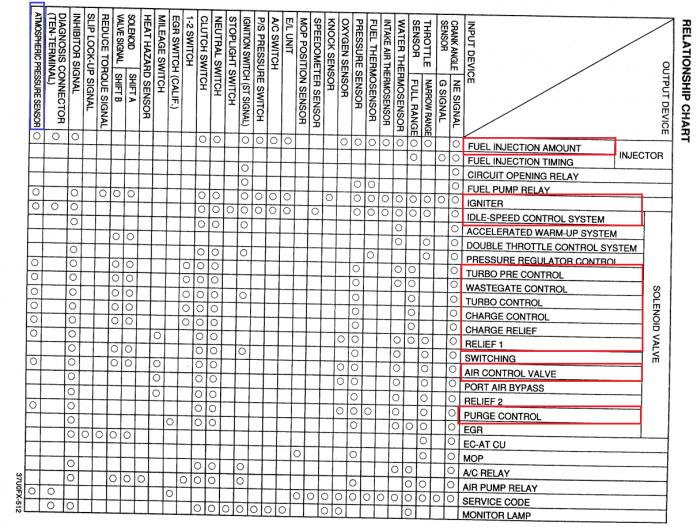
Looking on the right, you can see that that includes boost control functions, secondary air injection, and fuel control. Now, looking through the published block diagram for the boost control system we don't see the atmospheric pressure sensor listed:
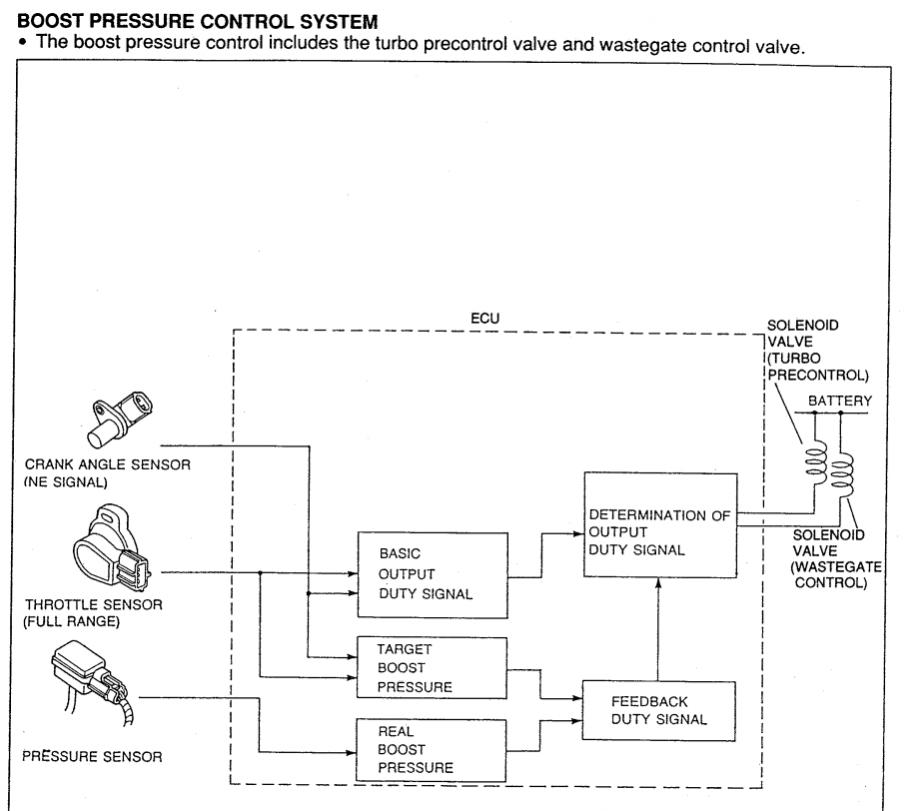
I bet that was simply an oversight by whoever put this together 20 years ago. We know for sure that the ECU has atmospheric pressure compensation for fuel injection quantity:
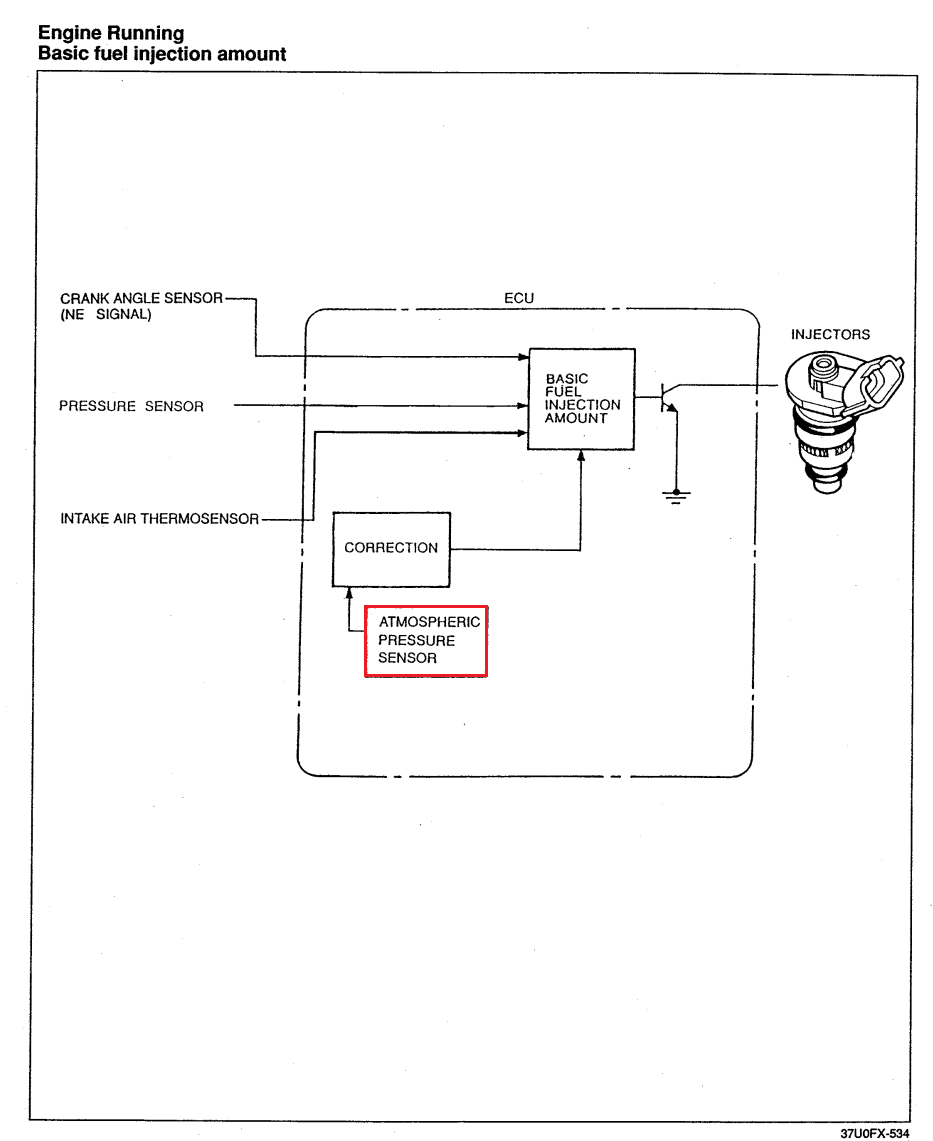
So the real question comes down to how much margin was built into the stock components, especially after 20 years of degradation. I wouldn't be concerned about a healthy set of stock turbos running at high altitudes with mostly stock intake and exhaust systems. Yes they're at higher pressure ratios, but clearly the stock turbos have a margin built in. Think about how many hours were spent in real-world testing and in controlled engine dyno conditions to evaluate high altitude performance of this engine. Now if you are at higher altitude and you as the owner raise the relative boost pressure higher, the turbos run at a higher pressure ratio and you increase stress on components. A drastic reduction in restriction (catless exhaust) exacerbates this.
For the fuel amount... on the stock ECU all I have to say is, if the pump and injectors are ok and you don't go catless I wouldn't worry about it unless you do see a wideband O2 sensor showing a lean mixture.
Also....as you go up in altitude, you must turn down the boost to protect your turbo....as your turbo works off pressure ratio's....at 10,000ft atmosphere is only 10.1 pressure...which means if you held a constent 2.0 pressure ratio...boost must be dropped from 14.7 PSI to 10.1 PSI to remain at the same pressure ratio.
furthermore, if you are upgrading your turbo, ensure to adjust the compressor map to high altitude. lots of turbo's that work for sea level will surge at low rpms at high altitude, some do so very badly.
that is incorrect. you are right that 10PSI boost pressure + atmospheric is absolute pressure. our MAP sensor is an absolute pressure sensor.
so 10PSI of manifold pressure at sea level IS NOT THE SAME as 10,000ft above sea level's 10PSI.
the map sensor sees the two pressures as this.
sea level 10PSI boost manifold pressure
14.7 PSI (atmosphere) + 10 PSI (manifold) = MAP sensor sends fuel for 24.7 PSI pressure.
at 10,000 ft you have 10PSI boost manifold pressure
10.1 (atmosphere) + 10 PSI (manifold) = MAP sensor sends fuel for 20.1 PSI pressure.
as you can see, the difference is 4.6PSI absolute pressure LESS at 10,000ft than sea level when both boost manifold pressures are 10PSI.
the boost manifold pressure is a pressure differential from atmosphere to inside the manifold. that is what your boost controller/gauge is reading. Its not an absolute gauge.
Also....as you go up in altitude, you must turn down the boost to protect your turbo....as your turbo works off pressure ratio's....at 10,000ft atmosphere is only 10.1 pressure...which means if you held a constent 2.0 pressure ratio...boost must be dropped from 14.7 PSI to 10.1 PSI to remain at the same pressure ratio.
furthermore, if you are upgrading your turbo, ensure to adjust the compressor map to high altitude. lots of turbo's that work for sea level will surge at low rpms at high altitude, some do so very badly.
so 10PSI of manifold pressure at sea level IS NOT THE SAME as 10,000ft above sea level's 10PSI.
the map sensor sees the two pressures as this.
sea level 10PSI boost manifold pressure
14.7 PSI (atmosphere) + 10 PSI (manifold) = MAP sensor sends fuel for 24.7 PSI pressure.
at 10,000 ft you have 10PSI boost manifold pressure
10.1 (atmosphere) + 10 PSI (manifold) = MAP sensor sends fuel for 20.1 PSI pressure.
as you can see, the difference is 4.6PSI absolute pressure LESS at 10,000ft than sea level when both boost manifold pressures are 10PSI.
the boost manifold pressure is a pressure differential from atmosphere to inside the manifold. that is what your boost controller/gauge is reading. Its not an absolute gauge.
Also....as you go up in altitude, you must turn down the boost to protect your turbo....as your turbo works off pressure ratio's....at 10,000ft atmosphere is only 10.1 pressure...which means if you held a constent 2.0 pressure ratio...boost must be dropped from 14.7 PSI to 10.1 PSI to remain at the same pressure ratio.
furthermore, if you are upgrading your turbo, ensure to adjust the compressor map to high altitude. lots of turbo's that work for sea level will surge at low rpms at high altitude, some do so very badly.
I had a 100% stock car put down 217 uncorrected hp at the wheels 6000 feet above sea level. You couldn't do that with the claimed 20% loss of usable oxygen.
^Interesting.
Anectodally, I took my car out to Colorado for a week of mountain driving a couple years ago. I didn't notice much degradation in performance at elevations up to around 10k ft. It ran (essentially) like it did at home at 1100 Ft. (A guy I met with a Boxster couldn't say the same )
)

To the OP: Be careful of boost creep with your open exhaust, especially on a stock ECU. A boost controller won't help.
Anectodally, I took my car out to Colorado for a week of mountain driving a couple years ago. I didn't notice much degradation in performance at elevations up to around 10k ft. It ran (essentially) like it did at home at 1100 Ft. (A guy I met with a Boxster couldn't say the same
)To the OP: Be careful of boost creep with your open exhaust, especially on a stock ECU. A boost controller won't help.
The turbos simply pressurize the manifold to 24.7psi, regardless of where they're at. This reads on our gauges as 10psi because the gauges have been calibrated to read 0 at atmosphere. When your gauge reads 10psi it's not 10psi above the baseline atmosphere at whatever elevation you happen to be at. It's 10psi above 1 atmosphere, 14.7psi.
I had a 100% stock car put down 217 uncorrected hp at the wheels 6000 feet above sea level. You couldn't do that with the claimed 20% loss of usable oxygen.
I had a 100% stock car put down 217 uncorrected hp at the wheels 6000 feet above sea level. You couldn't do that with the claimed 20% loss of usable oxygen.
I didn't realize the stock ecu makes this adjustment. I know I left my boost controller at the same power percent as lower levels and my manifold pressure is higher at higher altitudes at the same boost controller setting.

Thread
Thread Starter
Forum
Replies
Last Post
demetlaw
3rd Generation Specific (1993-2002)
6
Oct 2, 2015 06:22 PM
