


Help find Oil Catch Can Install Thread


Help find Oil Catch Can Install Thread
I can’t locate an excellent thread I once read about a ‘trial and error process and final solution’ for a Oil Catch Can for a Track Build. Can anyone point me in that direction? Just weeks away from getting my car to the track...only 58 weeks in process.
HaHaHaHa
Thanks in advance-Rick
HaHaHaHa
Thanks in advance-Rick


Rick,
What have you already searched for and what threads have you already ruled out? Further, what is your search criteria?
Using the Advanced Search feature, I found these threads using the keywords oil+catch+can, track.
https://www.rx7club.com/race-car-tec...ch-can-729453/
https://www.rx7club.com/3rd-generati...-track-211213/
What have you already searched for and what threads have you already ruled out? Further, what is your search criteria?
Using the Advanced Search feature, I found these threads using the keywords oil+catch+can, track.
https://www.rx7club.com/race-car-tec...ch-can-729453/
https://www.rx7club.com/3rd-generati...-track-211213/

https://robrobinette.com/pcv.htm
Triple-R: JAZ Pint Oil Catch Can Install
basically you install a can between the oil filler neck and primary turbo inlet
Triple-R: JAZ Pint Oil Catch Can Install
basically you install a can between the oil filler neck and primary turbo inlet

Full Member


Joined: Aug 2018
Posts: 60
Likes: 6
From: Okinawa, Japan
What I did was run a -10AN line from the oil filler neck to a catch can(Doesnt matter the brand they all do the same thing as long as it baffled. I used a cheap amazon one) and the other -10AN line to the secondary turbo oil return since I went single turbo. If you've gone single it can be an option for you and helps vent both sides of the engine. I got the idea from another thread here and my tuner recommened it as well.


I have a semi-custom one on my car and it mostly just catches water. After talking to a seasoned FD track guy it was suggested to me that what is more important than a can is not overfilling your oil. I have found this to be great advice.
One port goes to top filler neck nipple, other port to suction on intake side of turbo. I routed a drain with petcock under my car for easy empty.
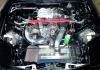
Here is mine:
https://www.rx7club.com/3rd-generati...-heat-1044356/
One port goes to top filler neck nipple, other port to suction on intake side of turbo. I routed a drain with petcock under my car for easy empty.
Here is mine:
https://www.rx7club.com/3rd-generati...-heat-1044356/

@Johnny: Did you run the outlet of your catch can to the single turbo oil drain line? Wouldn't that essentially be pressurizing that line, which is otherwise at atmospheric pressure draining back to the engine via gravity. Apologies for my confusion.
Trending Topics
If one line goes to the oil filler neck and the other to the secondary turbo oil drain... then the lines go to the same place and the can is pointless.
It's really simple. One line to the filler neck. The other line to turbo suction.
It's really simple. One line to the filler neck. The other line to turbo suction.


Joined: Nov 2011
Posts: 3,425
Likes: 489
From: okinawa to tampa
What I did was run a -10AN line from the oil filler neck to a catch can(Doesnt matter the brand they all do the same thing as long as it baffled. I used a cheap amazon one) and the other -10AN line to the secondary turbo oil return since I went single turbo. If you've gone single it can be an option for you and helps vent both sides of the engine. I got the idea from another thread here and my tuner recommened it as well.
https://www.rx7club.com/3rd-generati...ce-car-792344/
isnt the point of the catch to vent pressure? to provide a relief? if the can wasnt vented and routed like that then yes, i would agree with you. with that set up from the neck and the rear oil return on an unvented can, you would need the 3rd line to go to the turbo inlet so there is a relief on the system. with the neck and oil return on a vented can, it just uses the atmosphere to vent. same concept just without the vacuum of the turbo inlet.
my set up is the same. i got the idea from this thread
https://www.rx7club.com/3rd-generati...ce-car-792344/
isnt the point of the catch to vent pressure? to provide a relief? if the can wasnt vented and routed like that then yes, i would agree with you. with that set up from the neck and the rear oil return on an unvented can, you would need the 3rd line to go to the turbo inlet so there is a relief on the system. with the neck and oil return on a vented can, it just uses the atmosphere to vent. same concept just without the vacuum of the turbo inlet.
https://www.rx7club.com/3rd-generati...ce-car-792344/
isnt the point of the catch to vent pressure? to provide a relief? if the can wasnt vented and routed like that then yes, i would agree with you. with that set up from the neck and the rear oil return on an unvented can, you would need the 3rd line to go to the turbo inlet so there is a relief on the system. with the neck and oil return on a vented can, it just uses the atmosphere to vent. same concept just without the vacuum of the turbo inlet.
I had an open vent on my can for a while and found that it left an oily mess. Vent to the primary elbow and it's all contained plus the vacuum helps draw off vapors. Win-win in my book.


You're not going to draw much "vacuum" off the turbo inlet, as it's going to pull from the main inlet which is much bigger than the little line you run to it. What you do get is a place for it to go if you exceed the catch can capacity.
The key is, once it draws down a half quart, leave it there and maintain that level, and you'll not overflow that catch can anymore. Mazda just made the pan too shallow and the oil level sits above the pan seal line.
The key is, once it draws down a half quart, leave it there and maintain that level, and you'll not overflow that catch can anymore. Mazda just made the pan too shallow and the oil level sits above the pan seal line.

I think we agree with the exception of using an atmopsheric vent vs connecting the vent to a constant vac source. My opinion is to augment the stock design - keep the filler neck vented to vacuum source but adding a catch can in-line to collect water vapor, oil, and blow-by instead of allowing it to go directly to the turbo inlet..
That is really just a vent to a filtered air source. Mazda vented PCV vapors back to that inlet since they need to be drawn in and burnt in the engine to comply with emissions.
The only vacuum in the engine is between the throttle plates and the engine itself. The throttle plates create a restriction which creates vacuum.
Dale
Agree that it's not a "vacuum source" in the sense that the UIM is with throttle closed.
However, there must be a pressure differential between ambient and the turbo inlet, especially under boost. Without a differential in pressure, you will not have flow. I'm not saying it's 17 in/hg at the turbo inlet. I am just saying it's probably a lower pressure than the oil pan, especially under acceleration with suction at the turbo inlet and the pan pressurized with blow by.
However, there must be a pressure differential between ambient and the turbo inlet, especially under boost. Without a differential in pressure, you will not have flow. I'm not saying it's 17 in/hg at the turbo inlet. I am just saying it's probably a lower pressure than the oil pan, especially under acceleration with suction at the turbo inlet and the pan pressurized with blow by.
I doubt there's much vacuum, unless there restriction in your intake/filter to create it. Would be sort of a fun experiment to stick a boost gauge on it and see though.
But, you don't really need vacuum... you just need a place for crank case pressure to vent, which it will naturally do if it's under pressure to place that isn't. Like I say, the oil gets involved because it's high enough in the oil pan, especially under cornering, and gets pushed out with the air pressure. I've heard of people creating vents higher on the front cover, and alleviating the oil puking entirely.
But, you don't really need vacuum... you just need a place for crank case pressure to vent, which it will naturally do if it's under pressure to place that isn't. Like I say, the oil gets involved because it's high enough in the oil pan, especially under cornering, and gets pushed out with the air pressure. I've heard of people creating vents higher on the front cover, and alleviating the oil puking entirely.

Thread
Thread Starter
Forum
Replies
Last Post
LoLsmileyFC
2nd Generation Specific (1986-1992)
3
Oct 30, 2011 11:30 AM
elwood
Single Turbo RX-7's
11
Oct 13, 2008 11:29 PM
RX7 Rotary Rocket
3rd Generation Specific (1993-2002)
8
Aug 13, 2006 10:35 AM