When you click on links to various merchants on this site and make a purchase, this can result in this site earning a commission. Affiliate programs and affiliations include, but are not limited to, the eBay Partner Network.
There are 3 input resistors in each fan (in the drawing - the 4 tabs on the circle that has letter M inside, one is ground and the other three are inputs).
If you track backwards from those tabs to relays, it becomes kinda obvious what's going on.
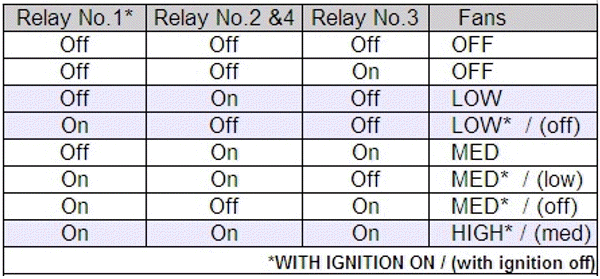
A) If only relay No.1 is activated, both fans get 1 input (hence LOW speed).
B) Otherwise if only relays No.2 and No.4 are activated, both fans again get 1 input (hence LOW speed).
C) If relay No.3 joins to either A) or B) above, it is MEDIUM speed.
D) If relay No.3 joins to BOTH A) and B) then its HIGH speed.
Obviously if your ECU supports PWM fan output, that'd be the way to go.
Where are the resistors in the diagram? Can you circle them for me
I don't know how the fans are wired, but I don't think the orange line is a power "input" since it is connected to ground via Relay 3.
There are 3 input resistors in each fan (in the drawing - the 4 tabs on the circle that has letter M inside, one is ground and the other three are inputs).
How you describe the system logic makes sense and how I thought it worked. But where are you seeing 3 inputs and 1 ground. This looks like the 3rd relay (all the way to the right) activates to ground (orange line). That would mean each motor has 2 inputs for voltage and 2 grounds.
am I reading it wrong? See 2 grounds circled in red.
TwinChargedRX7 is correct and Armans is wrong, there are two power inputs and two grounds per fan. If you understand how circuits work you can manually trigger the relays, and measure the voltage at the fan connectors.
I tested the operation a few years ago; although I don't understand the exact details of how the fan motor internals work, their behavior is clearly three speeds each. In hindsight, I don't think it's dumb to have duplicated relays (2 and 4 both serving the same purpose). Spreading the load to two relays might help with longevity, assuming those two relays are active more often than the others. If I'm being picky, it would have been better to locate the fan relays near the battery to reduce the length of heavy wire between the battery and the fans. https://www.rx7club.com/3rd-generati...0/#post4770880
Last edited by scotty305; May 25, 2024 at 03:25 PM.
Ok I stand corrected - I overlooked that part that it was a switched ground connection to relay N3. That means there should be some "clever" circuitry in the fan that bumps the speed if we ground that wire (relay N3)..?
I reinstalled my fans back couple weeks ago, If I still had them out I'd open them and check the inside out of curiosity.
An idea popped into my head. If the fan has two power inputs and only one ground, that could be the medium speed, then there must be circuitry within the fan where when it gets the second ground, it goes to the high speed. This could be tested by running battery voltage directly to both power inputs, and then play with grounding one or both of the ground wires to see if that changes the speed.
Originally Posted by TwinCharged RX7
How you describe the system logic makes sense and how I thought it worked. But where are you seeing 3 inputs and 1 ground. This looks like the 3rd relay (all the way to the right) activates to ground (orange line). That would mean each motor has 2 inputs for voltage and 2 grounds. am I reading it wrong? See 2 grounds circled in red.
I think those numbers just designate which fans the line grounds. The left #2 circle designates that it grounds the #2 fan, and the #1&2 on the right designate that line grounds fans 1&2 (which they do). Typically resistors have a zigzag symbol in a diagram, and I don't see a key in the manual or diagram that explains what what those circled numbers mean, or expand if they are a resistor or something else. So my guess is on just a fan grounding designation.
Last edited by Billj747; May 26, 2024 at 08:41 AM.
Well, I've just tested it. It was easier for me to do the test as I've a single solid state relay with PWM setup so I just needed to ground that wire.
In this pic I shorted blue/orange wire from B2-03 connector (for N3 relay) to the frame and it gave more oomph to the fans. I did it in test mode, car not running.
Surprising revelation for me) - turns out so far I haven't even used that HIGH speed mode lol. Although no problems with the temps (street driven) - stable ~185F.
Actually no. My SS relay is in the place of stock N1 relay. Other three relay connectors are left unused. I merely jumped the Blue/Orange wire to the ground.
I don't plan to repeat this test soon, but if my notes from 2005 are accurate you will get medium fan speed if any two of the relay triggers are active. It didn't seem to matter whether relays 1&2 were triggered, or 1&3, or 2&3, the fan speed sounded 'medium' to me in each situation.
It would be interesting to repeat the test and measure current, now that DC clamping current meters are more commonly available.
Does anyone know how the fans are wired on the 02 RX7?
I have this diagram but the cabin wiring is different?? Or the same.
Doing a ver.6 abs and wiring swap on my RX7. I had the haltech controlling fan low through the x05 connector and med through the the x14 connector. While fan high was with ac.
Now I only found this adaptronic modular ECU for the 99+ rx7 which shows the fan run off the ECU?
ECU pin 4K & 4L. What would be low and medium and high?