When you click on links to various merchants on this site and make a purchase, this can result in this site earning a commission. Affiliate programs and affiliations include, but are not limited to, the eBay Partner Network.
Please excuse the size of the post in advance, I like to be as specific as possible.
As the title suggests, my friend's dad's RX7 FD is refusing to start. It cranks, but we can't seem to get it running really. They are not too mechanically inclined, and I specialise in Mitsubishi GTO's (3000GTs) and am new to the rotary world.
What's the situation?
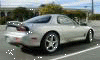
It's a 1995 Efini RX7 (Twin Turbo Manual from 1995), it ran and drove well a few days ago prior to us carrying out some work on the car. It is now currently stuck on a lift as we can't get it to start - it cranks but doesn't fire up.
What's Been Done?
We replaced the clutch, flushed all fluids, and filled it with premium fuel.
Tested for vacuum leaks using a smoke tester - we found two leaks and subsequently removed the intake sponges, top intercooler pipe, elbow, throttle body, and upper intake manifold. We replaced two lines within the rats nest and put it all back together, there are now no vacuum leaks.
The car has had some vacuum lines removed many years ago by the importer and we are not sure which ones, however the car ran well prior to the above works being carried out.
What have we tried?
Deflooding the engine by removing all spark plugs and EGI fuse to blow out excess fuel.
Checked the fuel pump is running.
Vacuum leak testing - no leaks.
Checked fuses and relays, all seem to be fine (EGI, fuel pump, head fuses, etc).
Checking for missing/loose electrical connections, they all seem fine.
Checking starter motor voltage, about a 0.2-0.4V reduction from the battery to the starter itself which seems to be healthy. The battery itself is 12.5ish volts.
Jumpstarting with an extra battery.
Conclusion
It sounds healthy to my ear as it turns over and seems like it wants to fire up but it's just lacking something, and you can smell fuel from the exhaust - this leads me to believe the issue may be spark related but I don't know how to diagnose this. It seems to be a standard CAS sensor paired with a coil pack, leads, and spark plug setup - however I'm not sure what the details are to test these components or to check spark safely. I would like to test components rather than throwing parts at the car and crossing fingers.
Notes
I am absolutely new to the world of rotarys, so I'm entirely open to the idea of us missing things we have already checked. If it sounds like X and we've already checked X, tell us to check again! I'm sure the issue may be glaringly obvious to someone in the know.
I'm not sure if there's anything I've missed while checking, maybe a sneaky plug on the gearbox or under the intake manifold that isn't connected fully? A sensor might have just died? I have no idea!
Wondering if you have the order wrong on the spark plug wires? It sounds like the starter is fine and cranking well. If you are confident you are getting fuel from the pump, and had gas come out of the motor when deflooding, maybe need to look at spark.
Here is a youtube video I found that shows each plug wire and where it should go.
For future reference, so far on Facebook I've received the following suggestions;
Check for spark with a plug in spark plug tester.
Check the MAP sensor near the throttle body.
Check the coolant temp sensor.
Check the spark plug leads themselves individually.
Check the coil packs.
Check the fuel temp sensor.
I'll also try to look for ways to test the CAS.
-Andrew
Wondering if you have the order wrong on the spark plug wires? It sounds like the starter is fine and cranking well. If you are confident you are getting fuel from the pump, and had gas come out of the motor when deflooding, maybe need to look at spark.
Here is a youtube video I found that shows each plug wire and where it should go.
She’s trying. Alot of stuff already mentioned is good to recheck. Especially that you have fuel pressure on an actual gauge. You can tee one in and jumper the F/P & Ground terminals in the diagnostic connector with the key on to see what it is. You need to deflood again and put in new spark plugs. It’s probably so loaded with fuel at this point. Needs to air out and have some oil shot in each rotor housing. If you’re using the stock ecu, you can hold the throttle to the floor and it will shut down the injectors. If you would have held her down in the video it probably would have lit off.
What's the cars VIN. If it starts with a "4" you may have a version 4 car. Watch out for version 4 and newer, as Mazda changed the position of the coils. And therefore some of the advice on hooking up the plug wires might be outdated. Also, watch out that the coil harness was also updated. If you have a version 4 car you should have the updated coil harness and be mindful to hook it up in the right order.
Version 4 Cars started with the 1996 model year, but some were actually made in 1995 and your car might (might) be one of those.
Watch out for redundant wiring to the fuel pump. Pulling the EGI fuse may not be enough. To make sure the pump was was not working, (when deflooding) , we disconnected the harness at the fuel pump end (in the hatch area above it.)
Did anyone talk about possible leaking injectors? Leaking injectors could be sabotaging your deflooding efforts.
Also loss of vacuum to the Fuel Pressure Regulator could cause it to close thereby increasing fuel pressure to the injectors.
This would make any injector leaks worse. Check the solenoid that controls the FPR (or run vacuum directly to the FPR bypassing the solenoid).
Do you have access to a known good ECU to try? If it's not that, your problem is likely the engine (Emissions as Mazda calls it) harness. When you were under the intake manifold something probably cracked, broke, or is shorting out.
If you're planning on keeping the car, a replacement (new or custom commissioned) engine loom is always a goo idea, don't forget about the coil harness when you do that as well. After 30 years the factory emissions and coil harnesses have lived a rough life and are tired.
If I was you I'd do the following:
Verify fuel pressure with a gauge
Try swapping in a known good ECU
Verify your coil harness and engine (emissions) harness grounds are properly secured, that you have the ground strap going from the firewall to the engine bay, and that the ground from the left strut tower to the lower side of the engine block is present and clean.
Consider line checking the essential items from the ECU connector to the harness connectors
Replace the engine and coil harnesses
In earlier wiring manuals what many call the Engine Harness was called Emmisions Harness and the Harness connecting the the Battery, Starter, Alternator, smaller fuse box, etc. was called the Engine harness. The small harness connecting the coils was treated as an extension to one (or both) of those harrness and not necessarily referred to as the coil harness.
Later Mazda started calling both the emiissions harness and engine harness "Engine Harnesses" and they were more clear about the coil harness being a separate short harness.
The early coil harness had "shield wire"" leading to a separate ground. This is likely the coil harness to be found on your car.
The later coil harness did not have the shield wires and the grounding was made somewhere else, like one of the engine harnesses.
Brand new emission harensses and engine harnesses for your generation can still be bought. Try Nengun.
Nengun just shipped my lower engine harness (the battery/starter one). It cost C$1000.
I earlier replaced my coil harness, and that eliminated some backfiring on decel.



 1995 FD Rx7 - Crank No Start - Help a Noob!