


13B-REW to LS1 Perspective




No it's not Turbo'd

Joined: Jun 2002
Posts: 2,511
Likes: 2
From: Los Angeles, Ca
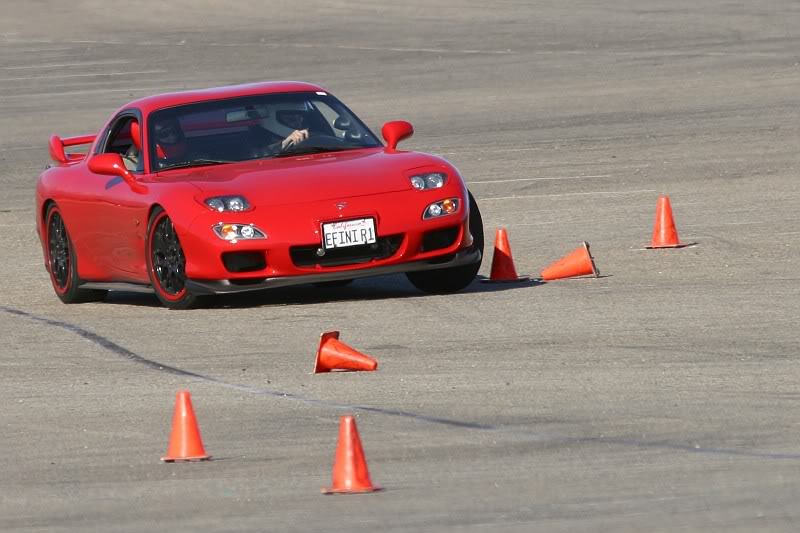
.... and an LS1 swapped RX-7 with suspension mods. I drove both cars on different autocross courses on different days, but I always drove my car for a lap or two first.
Without a doubt, the LS1 was more streetable and the easiest to drive than the modded RX-7. It wasn't as loud and didn't smell funny. Throttle response was linear and instantaneous, there was no turbo lag or sequential transition which made it even easier to drive than my stock RX-7. The LS1 didn't make the car feel unbalanced or heavy, he has posted corner weights on this forum and they were very good compared to mine. If I remember correctly his engine came from a GTO or Camaro (the corvette engines weight less, IIRC).

And most corvettes have LS1's and new LS2's with a slightly different Alternator / Power Brake Setup (Swapped) and only the Z06 had the LS6 or now LS7.
The way I look at it while I had the FD Rotary, I was living in a shitty apartment, trying to save for a house, and every time I thought I'd have a descent sum saved, something happened to the motor.
3 Rotaries and 1 LS1 Later, I live in a House, and spent maybe $200 last year on Beauty / Necessity parts, all of which have nothing to do with the block. It was a set of radiator hoses, and fixing the clutch cylinder, since it was loose. I am finally happy and the car is fun, and no longer drains my bank account unless I let it...
But Please !!! By all means stick with the rotary, if everyone swapped to LS1's, they'd loose some of the Uniqueness, and Mazda'd get Pissed and they'd stop SevenStock !



I also don't see the sense of comparing HP/L of a forced induction car to an N/A car.

Senior Member

Joined: Nov 2006
Posts: 731
Likes: 0
From: Dallas TX
if you think YOUR rotary makes more power under the curve(what really counts) then 99percent of ls1's out there please post your dyno graph so i can enlighten you...ive owned 460whp(low boost) rotary fd with a t78 and i now own a 418whp(all motor) ls-fd and while my old rotary was still "faster" eventually, on the street it would get stepped on....
I'd be interested in seeing some rotary dyno plots for comparison.
edit - I know the chart says flywheel HP, but this was on a chassis dyno, measured at the wheels.

 weird scaling
Here's the dyno sheet for my NA LS1 FD - 442 rwhp, 408 rwtq on 93 octane street pump gas. All motor - no nitrous, no boost, no power enhancers, closed exhaust system, just like it runs on the street every day. You can see the 10% tq and 11% hp gains from tweaking the tune during the dyno session.
I'd be interested in seeing some rotary dyno plots for comparison.
edit - I know the chart says flywheel HP, but this was on a chassis dyno, measured at the wheels.
I'd be interested in seeing some rotary dyno plots for comparison.
edit - I know the chart says flywheel HP, but this was on a chassis dyno, measured at the wheels.


Senior Member
Joined: Mar 2001
Posts: 712
Likes: 0
From: winston-salem, nc
Someone mentioned cost for the swap. My swap cost $500 out of pocket. I sold my engine, tranny and other parts for $6,000 and the cost for the swap was $6,500. Granted, I had just paid for a newly overhauled 13B (I decided not to install and just sell and do the swap). But figure if you have a mid life 13B you could sell it for $1200-1400 vs. the $2500-$3000 for a new engine.
That costs for the swap included an Ls1 with 6 speed at 50K miles, subframe kit from Hinson, and paying them for the wiring harness.
That costs for the swap included an Ls1 with 6 speed at 50K miles, subframe kit from Hinson, and paying them for the wiring harness.

3rd motors a charm I hope

Joined: Apr 2003
Posts: 2,054
Likes: 0
From: Central New York
I too was once a rotary faithful... now, not so much. In my over 5 years of ownership, I'm on my 3rd motor after only 15k miles of ownership. Wouldn't you say this is rediculous? I have properly cared for my car since day 1. I have been a member of the board since day 1 too. I was well informed on the motor, i did everything correct, and guess what? Boom. I'm highly considering doing the swap now, because i just dont want to worry anymore. I'm in grad school for my MBA and the last thing i need is a 5000 motor expense again. From a former engineer to a "business student's" stand point, this just doesnt make sense across the board. I figure, why not sell my stuff now while its worth something, rather than wait till it blows up. That is why I am either selling the car, or starting the swap this winter.

Someone mentioned cost for the swap. My swap cost $500 out of pocket. I sold my engine, tranny and other parts for $6,000 and the cost for the swap was $6,500. Granted, I had just paid for a newly overhauled 13B (I decided not to install and just sell and do the swap). But figure if you have a mid life 13B you could sell it for $1200-1400 vs. the $2500-$3000 for a new engine.
That costs for the swap included an Ls1 with 6 speed at 50K miles, subframe kit from Hinson, and paying them for the wiring harness.
That costs for the swap included an Ls1 with 6 speed at 50K miles, subframe kit from Hinson, and paying them for the wiring harness.


I too was once a rotary faithful... now, not so much. In my over 5 years of ownership, I'm on my 3rd motor after only 15k miles of ownership. Wouldn't you say this is rediculous? I have properly cared for my car since day 1. I have been a member of the board since day 1 too. I was well informed on the motor, i did everything correct, and guess what? Boom. I'm highly considering doing the swap now, because i just dont want to worry anymore. I'm in grad school for my MBA and the last thing i need is a 5000 motor expense again. From a former engineer to a "business student's" stand point, this just doesnt make sense across the board. I figure, why not sell my stuff now while its worth something, rather than wait till it blows up. That is why I am either selling the car, or starting the swap this winter.
If I were blowing engines every 5k miles I would have to take a look at what I was doing wrong and not what the engine is doing wrong, that is just my opinion of course. The rotary isnt as reliable as an ls1, but blowing them every 5k miles??????? Something doesnt add up

 Keep in mind I havent studied many skylines because I dont like them, but are there skylines out there running low 9s on the stock block, tranny, drivetrain???

Darkside FD
Joined: Jan 2004
Posts: 1,175
Likes: 0
From: AZ
$5k motors are a joke unless you are shooting for 600+rwhp and have extral dowel pinning, full bridge, ceramic apex seals, etc.
If I were blowing engines every 5k miles I would have to take a look at what I was doing wrong and not what the engine is doing wrong, that is just my opinion of course. The rotary isnt as reliable as an ls1, but blowing them every 5k miles??????? Something doesnt add up
If I were blowing engines every 5k miles I would have to take a look at what I was doing wrong and not what the engine is doing wrong, that is just my opinion of course. The rotary isnt as reliable as an ls1, but blowing them every 5k miles??????? Something doesnt add up
I lost my first engine to poor assembly, the builder assembled with nearly 100 times spec, e-shaft endplay. That has a way of prematurely wearing your bearings... it spun my pilot bearing and took out the input shaft of my transmission in the process (required replacement). Second engine I lost because of a wastegate line failure. This is within 8000 miles.
I dont think either one of them was my fault (at least not directly, it is my fault for buying the car).
I think the point I am making is that the rotary requires rebuild for any little tiny thing going wrong. There is no real protection built in. You overheat, rebuild ... over boost, rebuild. That certainly isn't the case on piston cars. You might lose a headgasket, but your bottom end is fine. There are a lot of varying degrees of failure. Not so in a rotary...if something goes at all, the whole block has to be torn apart.
I also think it is amazing what the LSx can do. I am in the process of purchasing an LS2, that in an FD with exhaust only (everything else completely stock) put down 404whp. That is completely stock! Maybe a Wednesday engine, but still that is pretty amazing to me. Hard to justify rebuilding the rotary when such options exist.
I was using the $5k figure for just the rebuild. However typical pull and install with all reusuable main engine parts(housings, rotors, irons) will run you around $3k if you bring the car to me. That includes new fuel hoses, dampner, coolant hoses, vacuum lines, engine pull and install. However that isnt the point.
Then you give your two examples of why your engine blew. One, poor assembly Cant blame that on the engine 2nd one you had a wastegate line failure. Hard to believe with a new line on properly secured at both ends that would have happend. Let a turbo LS1 boost spike to 18-20lbs and see what happens. Once again, you cant blame the engine for others mistakes. When they came from mazda most people saw about 60-80k miles, far from the every 5-10k miles that is so common on this forum
Then you give your two examples of why your engine blew. One, poor assembly
Cant blame that on the engine 2nd one you had a wastegate line failure. Hard to believe with a new line on properly secured at both ends that would have happend. Let a turbo LS1 boost spike to 18-20lbs and see what happens. Once again, you cant blame the engine for others mistakes. When they came from mazda most people saw about 60-80k miles, far from the every 5-10k miles that is so common on this forum How much should it cost to Remove, rebuild with new seals and bearings, and replace and engine? Mine was $4600. $5K doesn't seem that far off. I had a very minor street port. I would think a car still running sequential would see a larger labor bill.
I lost my first engine to poor assembly, the builder assembled with nearly 100 times spec, e-shaft endplay. That has a way of prematurely wearing your bearings... it spun my pilot bearing and took out the input shaft of my transmission in the process (required replacement). Second engine I lost because of a wastegate line failure. This is within 8000 miles.
I dont think either one of them was my fault (at least not directly, it is my fault for buying the car).
I think the point I am making is that the rotary requires rebuild for any little tiny thing going wrong. There is no real protection built in. You overheat, rebuild ... over boost, rebuild. That certainly isn't the case on piston cars. You might lose a headgasket, but your bottom end is fine. There are a lot of varying degrees of failure. Not so in a rotary...if something goes at all, the whole block has to be torn apart.
I also think it is amazing what the LSx can do. I am in the process of purchasing an LS2, that in an FD with exhaust only (everything else completely stock) put down 404whp. That is completely stock! Maybe a Wednesday engine, but still that is pretty amazing to me. Hard to justify rebuilding the rotary when such options exist.
I lost my first engine to poor assembly, the builder assembled with nearly 100 times spec, e-shaft endplay. That has a way of prematurely wearing your bearings... it spun my pilot bearing and took out the input shaft of my transmission in the process (required replacement). Second engine I lost because of a wastegate line failure. This is within 8000 miles.
I dont think either one of them was my fault (at least not directly, it is my fault for buying the car).
I think the point I am making is that the rotary requires rebuild for any little tiny thing going wrong. There is no real protection built in. You overheat, rebuild ... over boost, rebuild. That certainly isn't the case on piston cars. You might lose a headgasket, but your bottom end is fine. There are a lot of varying degrees of failure. Not so in a rotary...if something goes at all, the whole block has to be torn apart.
I also think it is amazing what the LSx can do. I am in the process of purchasing an LS2, that in an FD with exhaust only (everything else completely stock) put down 404whp. That is completely stock! Maybe a Wednesday engine, but still that is pretty amazing to me. Hard to justify rebuilding the rotary when such options exist.
I also think it is amazing what the LSx can do. I am in the process of purchasing an LS2, that in an FD with exhaust only (everything else completely stock) put down 404whp. That is completely stock! Maybe a Wednesday engine, but still that is pretty amazing to me. Hard to justify rebuilding the rotary when such options exist.
Darkside FD
Joined: Jan 2004
Posts: 1,175
Likes: 0
From: AZ
I explain the wastegate line failure in other threads...
It is just much more common for a total failure in the rotary. You don't see many other engines on the road with such significant trouble. Whether it be from any one specific reason. I honestly expected to get 50-75K miles out of my last engine. Pretty freak occurrence...but my point is those seem to be all the more common with the rotary.
NA the rotary is VERY reliable. I think an NA 3 rotor would be a sweet engine for this car in stock form. I wonder what sort of efficiency it has (gas mileage and emissions). I am sure there is a reason why Mazda hasn't gone to it. Mazda designs some of the best chassis and suspension in the automotive world. I guess they can get away with their cars being a little underpowered...Hence no 3 rotor rx8.
It is just much more common for a total failure in the rotary. You don't see many other engines on the road with such significant trouble. Whether it be from any one specific reason. I honestly expected to get 50-75K miles out of my last engine. Pretty freak occurrence...but my point is those seem to be all the more common with the rotary.
NA the rotary is VERY reliable. I think an NA 3 rotor would be a sweet engine for this car in stock form. I wonder what sort of efficiency it has (gas mileage and emissions). I am sure there is a reason why Mazda hasn't gone to it. Mazda designs some of the best chassis and suspension in the automotive world. I guess they can get away with their cars being a little underpowered...Hence no 3 rotor rx8.

ls1 should have come in the fd from the factory. very reliable and great sounding engine. one day ill have one. a 3rotor doesnt even make the torque a ls1 makes. its just one 3 more apex seals to break. rotarys break for no reason.



Joined: Mar 2001
Posts: 30,793
Likes: 646
From: FL-->NJ/NYC again!
Edit: It would appear that I'm immune to the sarcasm monster

Last edited by GoodfellaFD3S; Apr 22, 2008 at 12:01 AM.
Joined: Mar 2001
Posts: 30,793
Likes: 646
From: FL-->NJ/NYC again!
I too was once a rotary faithful... now, not so much. In my over 5 years of ownership, I'm on my 3rd motor after only 15k miles of ownership. Wouldn't you say this is rediculous? I have properly cared for my car since day 1. I have been a member of the board since day 1 too. I was well informed on the motor, i did everything correct, and guess what? Boom. I'm highly considering doing the swap now, because i just dont want to worry anymore. I'm in grad school for my MBA and the last thing i need is a 5000 motor expense again. From a former engineer to a "business student's" stand point, this just doesnt make sense across the board. I figure, why not sell my stuff now while its worth something, rather than wait till it blows up. That is why I am either selling the car, or starting the swap this winter.

Junior Member
Joined: Mar 2008
Posts: 6
Likes: 0
From: Earth
I know I'm throwing myself in an endless debate here, but here goes.
I recently purchased an Rx-7 as a weekend / track car with the sole intention of swapping its motor for a LS3. I paid a premium price for a clean example, that has a spotless engine bay, spotless undercarriage, great interior, a strong engine at 60k, and a grindless 5 speed tranny.
I do feel a certain amount of guilt that I am going to pull this perfect running rotary when I know I can tune its original engine with not a whole lot of money, and have a pretty decent sports car for driving around town.
I bought the car as is with a downpipe, and catback with the original cat still intact, so its really tough for me to restrain myself from getting a power FC and cat delete with the supporting cooling mods to complete my package while I save for my LS3 swap.
But I don't spend that money because I would much rather drive my FD in and out of my shop, and out on the weekends, than run the risk of harming the stock rotary engine and having to push it around manually for a few months until I have money for my v8.
IMHO, that is the major crux of the RX-7. To me an ideal sports car is one that is reliable, I don't want to be thinking of potentially blowing my engine at the race track. I want to drive it hard, and concentrate on driving.
I work on turbocharged cars all day, and as a result I am tired of the boost leaks / tests, the $7-$20 race gas, the knock counts, the waiting for your engine builder, the machine shop messed something up, the swapping to your race gas map, your turbo lag, ect. bs. I work/tune on reliable turbocharged engines and I am still tired of it.
All that hp/liter stuff makes for fine and dandy conversation to talk about online, but when you're driving that math doesn't do you any good. The more high strung your engine is, the inherently more unreliable it will be, and more expensive to replace.
That is why I am going LS3, for its minimum of 400 whp on pump gas, factory reliability, and instant throttle response. You can drive it all day at the race course, and not worry about engine failure. In the event that it does break you can order a new replacement from the GM dealership. No waiting for an engine builder, no need for checking your turbo, just bolt your intake, header, exhaust on your replacement long block and you are set.
If you bought your LSX engine used and in good working condition even better. Used engines bought at market value are great at holding their value, even after you've used it more provided you keep it in good working condition.
On one of my other cars, I spent 10 grand building an engine with good parts, and even though it works as great as it did from day 1, I'd be lucky to get 1/3 its value if I sold it.
One of my favorite memories of all time, is driving my 400+ whp car down the straight of a race track with its engine noise bouncing off the retaining walls. Driving a powerful car at the track is so much more fun than driving a low / no power one.
But financially, the run cost of a 400+ whp turbocharged car on the track is insane, even without breaking anything. Converting the car over to natural aspirated v8 will significantly lower the run cost and make operating the car inherently simpler.
The rotary is kool, I get it. It has a small foot print, has a great engine sound, is unique, makes pretty decent power / response for what it is, and fits perfectly in a RX-7.
But in stock form the RX-7 just doesn't not fit what I am looking for, so that's why I am swapping out its rotary.
I recently purchased an Rx-7 as a weekend / track car with the sole intention of swapping its motor for a LS3. I paid a premium price for a clean example, that has a spotless engine bay, spotless undercarriage, great interior, a strong engine at 60k, and a grindless 5 speed tranny.
I do feel a certain amount of guilt that I am going to pull this perfect running rotary when I know I can tune its original engine with not a whole lot of money, and have a pretty decent sports car for driving around town.
I bought the car as is with a downpipe, and catback with the original cat still intact, so its really tough for me to restrain myself from getting a power FC and cat delete with the supporting cooling mods to complete my package while I save for my LS3 swap.
But I don't spend that money because I would much rather drive my FD in and out of my shop, and out on the weekends, than run the risk of harming the stock rotary engine and having to push it around manually for a few months until I have money for my v8.
IMHO, that is the major crux of the RX-7. To me an ideal sports car is one that is reliable, I don't want to be thinking of potentially blowing my engine at the race track. I want to drive it hard, and concentrate on driving.
I work on turbocharged cars all day, and as a result I am tired of the boost leaks / tests, the $7-$20 race gas, the knock counts, the waiting for your engine builder, the machine shop messed something up, the swapping to your race gas map, your turbo lag, ect. bs. I work/tune on reliable turbocharged engines and I am still tired of it.
All that hp/liter stuff makes for fine and dandy conversation to talk about online, but when you're driving that math doesn't do you any good. The more high strung your engine is, the inherently more unreliable it will be, and more expensive to replace.
That is why I am going LS3, for its minimum of 400 whp on pump gas, factory reliability, and instant throttle response. You can drive it all day at the race course, and not worry about engine failure. In the event that it does break you can order a new replacement from the GM dealership. No waiting for an engine builder, no need for checking your turbo, just bolt your intake, header, exhaust on your replacement long block and you are set.
If you bought your LSX engine used and in good working condition even better. Used engines bought at market value are great at holding their value, even after you've used it more provided you keep it in good working condition.
On one of my other cars, I spent 10 grand building an engine with good parts, and even though it works as great as it did from day 1, I'd be lucky to get 1/3 its value if I sold it.
One of my favorite memories of all time, is driving my 400+ whp car down the straight of a race track with its engine noise bouncing off the retaining walls. Driving a powerful car at the track is so much more fun than driving a low / no power one.
But financially, the run cost of a 400+ whp turbocharged car on the track is insane, even without breaking anything. Converting the car over to natural aspirated v8 will significantly lower the run cost and make operating the car inherently simpler.
The rotary is kool, I get it. It has a small foot print, has a great engine sound, is unique, makes pretty decent power / response for what it is, and fits perfectly in a RX-7.
But in stock form the RX-7 just doesn't not fit what I am looking for, so that's why I am swapping out its rotary.
Darkside FD
Joined: Jan 2004
Posts: 1,175
Likes: 0
From: AZ
I work on turbocharged cars all day, and as a result I am tired of the boost leaks / tests, the $7-$20 race gas, the knock counts, the waiting for your engine builder, the machine shop messed something up, the swapping to your race gas map, your turbo lag, ect. bs. I work/tune on reliable turbocharged engines and I am still tired of it.
I wanted a 400whp setup with the rotary that I could drive around the track, and i wont say 'not worry about,' but I wanted to build it right. I spent about $13K building up the last rotary, I have the spreadsheet around here somewhere... This included single turbo, all supporting mods, a high quality engine build, etc. etc.
I am also keeping very strict track of costs and income from sold parts with the LSx swap so I will have a very good comparison of the two at the end of the project. Maybe I will put a thread up in the third gen section to compare the two builds... Finance and accounting is what I do so I assure you all that part of the project is very well accounted for!
Last edited by cozmo kraemer; Apr 22, 2008 at 09:59 AM.
Senior Member
Joined: Mar 2001
Posts: 712
Likes: 0
From: winston-salem, nc
All my point was that I didn't have to come up with $6,000 for to complete a swap. I only had to come up with $500.
I started selling parts, and as I sold them and got the money in, I started buying the engine, tranny, subframe, etc..
Point of it all was so that people could see that if you're considering going LS1, and think it is a huge expense, it really isn't and it can definitely be done, especially if you can have your car sit for 4 months or so while you disassemble, sell parts, install new stuff.

