


Question for Sterling carb owners



Question for Sterling carb owners
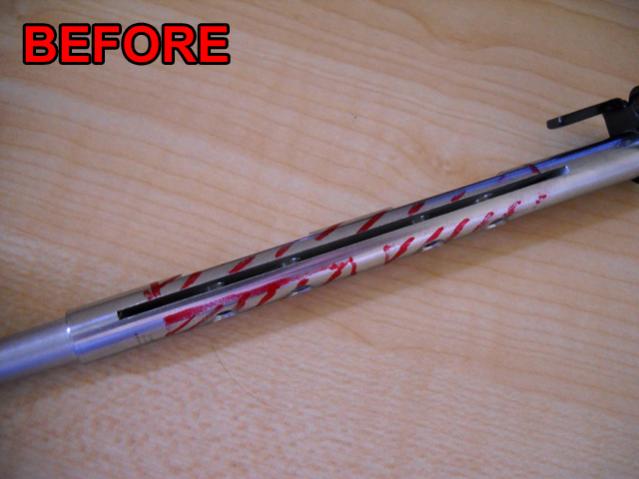
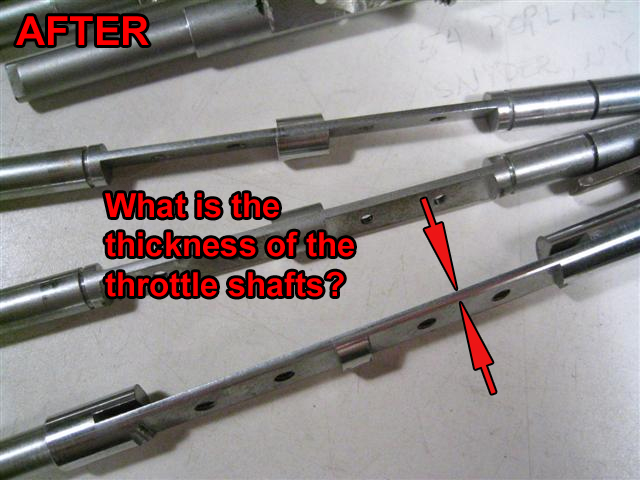
If someone has a Sterling Carb and a caliper, or a good steel ruler, I would really appreciate you taking a measurement on your carb for me. I'm trying to figure out how thick Sterling leaves the throttle shafts when he mills them down. I'm guessing it is somewhere between 3/32" and 1/8"?? If one of you guys with a Sterling carb could measure and let me know that would be awesome. I'm going to be milling down my own throttle shafts, but I need to know how thick to leave them. I posted some pictures below of the measurement that I'm looking for.
Thanks!
Thanks!

That would be great. Thanks! I didn't know that Paul Yaw milled the throttle shafts on his carbs even. If you can measure and let me know that would be awesome.
Thanks,
Jamie
Thanks,
Jamie



Joined: Mar 2001
Posts: 31,851
Likes: 3,239
From: https://www2.mazda.com/en/100th/
if you can wait about a week, we found the 1973 Rx3 competition book, which tells you how to build a sterling carb.... yes its that old and there is a factory book for it!
PDF that section about building a competition carb and send it to me please!

Trending Topics
Joined: Mar 2001
Posts: 31,851
Likes: 3,239
From: https://www2.mazda.com/en/100th/
yep, my friend dug it up and was going to scan it in, and then it can be shared. the 73 book is the stock carb/bridgeport in 3 stages of tune (so there are actually 3 carb mod levels), and the 77 book is a P port.
Joined: Mar 2001
Posts: 31,851
Likes: 3,239
From: https://www2.mazda.com/en/100th/

mine is sitting on my bench - but: disclaimer: village idiot - where do I see the throttle shaft? Is it what the butterflies are attached too? oy. I am assuming this can be seen/measured on an assembled carb? Think mine is an 83-84 nikki Sterling.
Stu Aull
80GS
Alaska
Stu Aull
80GS
Alaska

Stu,
Look at the two pictures at the top of my thread. See the one with the two red arrows? That is what I need the thickness measurement for. Separate your carb from the intake manifold. Flip the carb upside down so you can see the butterflies in the bottom of the throttle body. You should be able to get a measurement on the throttle shafts right there with the carb upside down. No need for disassembly. The best way to measure it would be to use the depth measurement feature on a set of dial or digital calipers. Or you could also measure it with a high quality steel engineering ruler that is graduated into 50ths of an inch.
Look at the two pictures at the top of my thread. See the one with the two red arrows? That is what I need the thickness measurement for. Separate your carb from the intake manifold. Flip the carb upside down so you can see the butterflies in the bottom of the throttle body. You should be able to get a measurement on the throttle shafts right there with the carb upside down. No need for disassembly. The best way to measure it would be to use the depth measurement feature on a set of dial or digital calipers. Or you could also measure it with a high quality steel engineering ruler that is graduated into 50ths of an inch.
Anybody have a chance to measure this yet? I still haven't figure out what the thickness is supposed to be. I'm ready to take these throttle shafts to the machine shop, I just don't know what thickness to tell them to mill down to. If ANYONE has a Sterling carb I would greatly appreciate the help.
J9fd3s, any hope of getting that Rx-3 manual scanned in soon? I'm dying to see what they show in there for carburetor modifications.
Thanks all,
Jamie
J9fd3s, any hope of getting that Rx-3 manual scanned in soon? I'm dying to see what they show in there for carburetor modifications.
Thanks all,
Jamie
Joined: Mar 2001
Posts: 31,851
Likes: 3,239
From: https://www2.mazda.com/en/100th/
the thickness of the shaft isn't actually super critical, IMO. you actually have a small tradeoff, the less you remove the stronger it'll be, but you'd loose a teeny bit of airflow. so for a street car, err on the big side
oh that reminds me, if you cut the throttles like this you should make a throttle stop on the floor of the car. the stock pedal is flimsy, if you get excited while driving it'll bend, and you can bend the shaft. we built one for the race car and tommy pushed it thru the floor!
gonna be about a week or so, its 2 FSM sized books!
the thickness of the shaft isn't actually super critical, IMO. you actually have a small tradeoff, the less you remove the stronger it'll be, but you'd loose a teeny bit of airflow. so for a street car, err on the big side
oh that reminds me, if you cut the throttles like this you should make a throttle stop on the floor of the car. the stock pedal is flimsy, if you get excited while driving it'll bend, and you can bend the shaft. we built one for the race car and tommy pushed it thru the floor!
the thickness of the shaft isn't actually super critical, IMO. you actually have a small tradeoff, the less you remove the stronger it'll be, but you'd loose a teeny bit of airflow. so for a street car, err on the big side
oh that reminds me, if you cut the throttles like this you should make a throttle stop on the floor of the car. the stock pedal is flimsy, if you get excited while driving it'll bend, and you can bend the shaft. we built one for the race car and tommy pushed it thru the floor!
Thanks,
Jamie
Joined: Mar 2001
Posts: 31,851
Likes: 3,239
From: https://www2.mazda.com/en/100th/
if you aren't will to drill holes in the floor the paul yaw one was the same, except he welded a short 1x1" piece of steel to the floor and welded a nut to that.



Joined: Mar 2001
Posts: 31,851
Likes: 3,239
From: https://www2.mazda.com/en/100th/
the good news is that there is xp64 drivers for the scanner so it'll be up shortly

Senior Member
Joined: Nov 2009
Posts: 346
Likes: 3
From: Australia
I cut mine to around 2mm (have been building carbs like sterling's for over 2 years in australia).
Few thoughts on this -
If you go with mechanical secondaries, the secondary shaft could go thinner because it doesn't bear any pressure across the shaft (aside from engine vacuum holding them shut).
Another advantage of mech secondaries is you can use the stop on the secondary linkage, which adjusts the WOT position, to stop the primaries at WOT as well - so a heavy right foot doesn't strain the shafts. IMO this would be preferable to using the stop on primary shaft opposite side (the OMP linkage tab) since it's on the same side and would prevent possible twisting across the shaft if too much pressure is applied.
Also don't forget to file the screws flush with the shafts. I apply some threadlocker for extra security too.
Edit: One more thing I forgot is rust. I sand the shafts and polish them to be as smooth as possible but still get some surface rust over time. Not sure how to avoid this, the best I can think of is routinely cleaning them up with the dremel (can be done with shafts installed).


Few thoughts on this -
If you go with mechanical secondaries, the secondary shaft could go thinner because it doesn't bear any pressure across the shaft (aside from engine vacuum holding them shut).
Another advantage of mech secondaries is you can use the stop on the secondary linkage, which adjusts the WOT position, to stop the primaries at WOT as well - so a heavy right foot doesn't strain the shafts. IMO this would be preferable to using the stop on primary shaft opposite side (the OMP linkage tab) since it's on the same side and would prevent possible twisting across the shaft if too much pressure is applied.
Also don't forget to file the screws flush with the shafts. I apply some threadlocker for extra security too.
Edit: One more thing I forgot is rust. I sand the shafts and polish them to be as smooth as possible but still get some surface rust over time. Not sure how to avoid this, the best I can think of is routinely cleaning them up with the dremel (can be done with shafts installed).
Last edited by Oneiros; Jun 22, 2012 at 09:16 PM.
Awesome! Thanks for the info! I can't believe that those throttle shafts rust. I thought they were stainless steel? Where do they rust at? Perhaps there is some kind of coating or finish that could be applied to prevent it.
Can you post a couple of pictures of the throttle stops you are talking about that could be used to prevent twisting the shafts? I'm not sure I understand what you mean. If you could show a picture that would be awesome. Thanks for the throttle shaft pictures also. Those look really nice!
Can you post a couple of pictures of the throttle stops you are talking about that could be used to prevent twisting the shafts? I'm not sure I understand what you mean. If you could show a picture that would be awesome. Thanks for the throttle shaft pictures also. Those look really nice!
Senior Member
Joined: Nov 2009
Posts: 346
Likes: 3
From: Australia
I don't know much about metals, but the shafts seem to be coated in something that prevents them rusting. But when you cut this away to thin the shafts, it looks like steel underneath. The rust occurs basically anywhere that this finish is removed. I always file, sand and polish the cut-away surface but minor surface rust still shows up. If anyone has any ideas on fuel resistant rust protection I would love to hear them.
These are the stops:

You want to bend them to adjust the WOT position. Note that this is only relevant for mech secondaries. I prefer to rely on the lower one since it's on the same side as the throttle cable. If you relied on the upper one, a heavy right foot could twist the primary shaft, since tension is being applied to opposite sides of the shaft in opposite directions (throttle cable vs. stop).
I use the non-permanent threadlocker, for removable screws. Since the screws are so much smaller than the loctite recommendations, I wouldn't rely on it completely, but it should still help hold them in I think.
These are the stops:
You want to bend them to adjust the WOT position. Note that this is only relevant for mech secondaries. I prefer to rely on the lower one since it's on the same side as the throttle cable. If you relied on the upper one, a heavy right foot could twist the primary shaft, since tension is being applied to opposite sides of the shaft in opposite directions (throttle cable vs. stop).
I use the non-permanent threadlocker, for removable screws. Since the screws are so much smaller than the loctite recommendations, I wouldn't rely on it completely, but it should still help hold them in I think.

Thread
Thread Starter
Forum
Replies
Last Post
