When you click on links to various merchants on this site and make a purchase, this can result in this site earning a commission. Affiliate programs and affiliations include, but are not limited to, the eBay Partner Network.
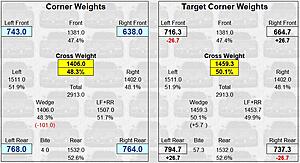
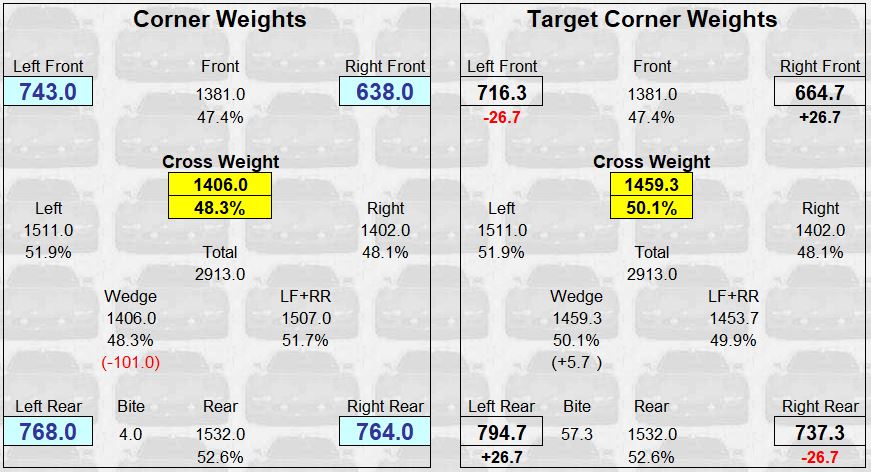
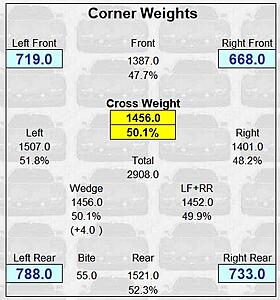
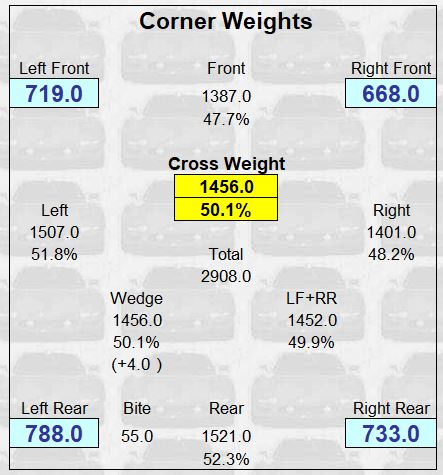
Here's the weight of the car with zero adjustments. Half a tank of gas. I suspect the front right is light because I don't have the stock twins anymore or the airpump.
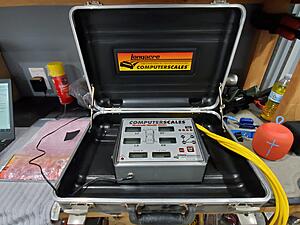
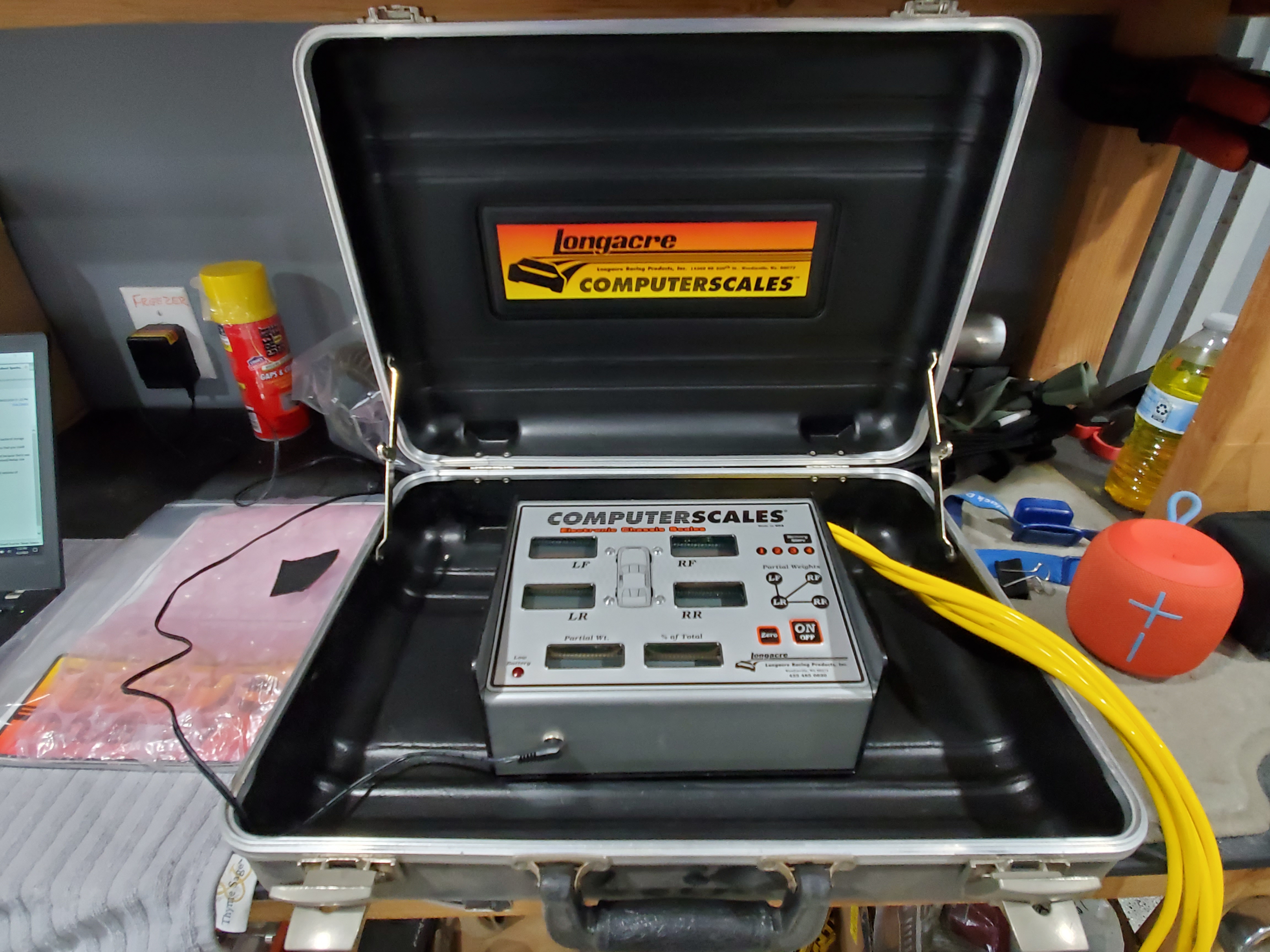
PS: This oldschool scale system is awesome. It's like mission control.
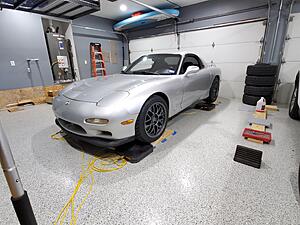
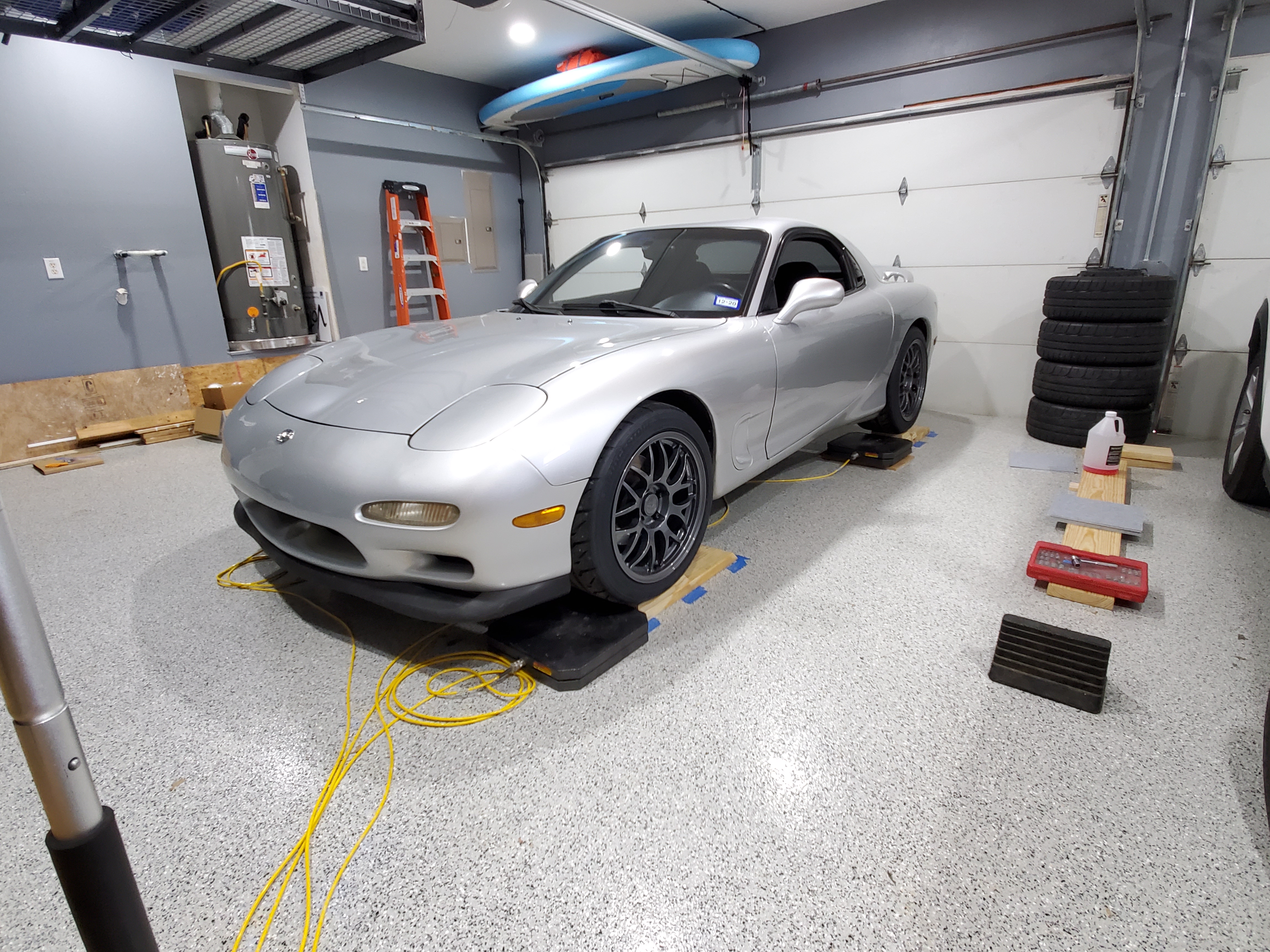
I was able to get the cross weight almost exactly 50% but I simply can't find a way to load up the front right wheel without really screwing the ride height. At least, I've not found a way to do that. If y'all have any suggestions please let me know. Car is sitting level (within 1/16") at all 4 corners in terms of ride height. Right about 3/4 tank of gas, just a touch less.
Last edited by ItalynStylion; Apr 3, 2020 at 08:42 PM.
Do you have driver weight included in those numbers?
Having my 200 lb meat suit in the seat affected all the numbers. Especially driver rear.
Also, what are you using for 'slip' plates? I tend to use lubricated trash bags when I corner balance with wheels and tires. I have hub stands for the Miata which makes life so much easier.
Last edited by gracer7-rx7; Apr 6, 2020 at 11:07 AM.
Do you have driver weight included in those numbers?
Having my 200 lb meat suit in the seat affected all the numbers. Especially driver rear.
Also, what are you using for 'slip' plates? I tend to use lubricated trash bags when I corner balance with wheels and tires. I have hub stands for the Miata which makes life so much easier.
Yes, driver weight is included in those weights.
I too was using grocery bags on the scales. I found that if I pulled the spokes away from the car a bit (using an abrupt tug) I could get the suspension to slip outward a bit to settle.
If you're at the point of actually corner weighting your car and using said balance I really think you shouldn't be concerned with equal ride height. Some of the setups I run for people on their race cars get whacky and they handle beautifully.
On my FD, I was able to get within a few pounds on FL and FR with the battery relocated to the pax side bin. Beginner's luck
My battery is in the driver's side bin. Bad for weight distribution but it means I have a storage bin I can actually reach and use without moving the seats. Sacrifices!
did you drive it yet? ready for round 2? round 2 is where you try some different settings and see what you like. i'd suggest starting with front toe in/out, makes a big difference in steering feel
did you drive it yet? ready for round 2? round 2 is where you try some different settings and see what you like. i'd suggest starting with front toe in/out, makes a big difference in steering feel
Well....I mean, I clearly have some time on my hands lol.
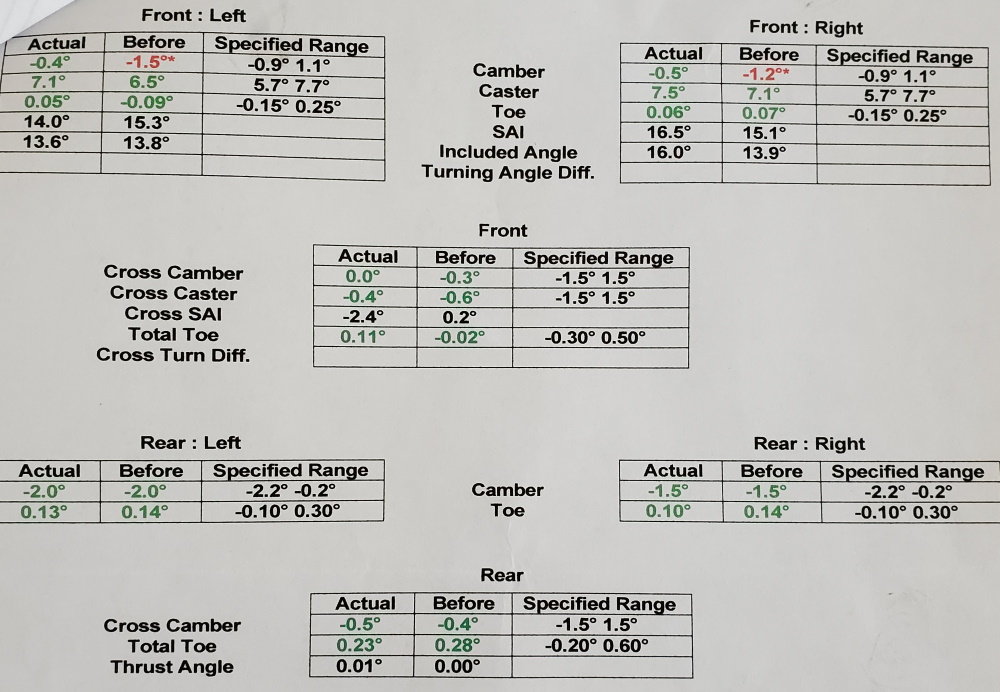
Got the car aligned and here are the numbers. Any tips on where I should go from here? What kind of adjustments should I explore? I have the preload set to what Ohlins recommends (2mm) and I have the dampers at 10 clicks.
so in a race car we end up trying pretty much everything, just to see what it does, and it takes forever, but you end up knowing how the car responds to adjustments. so if we need to make an adjustment on a race weekend, or even during a long race we know what to try (take notes)
on the track its very nice because we only care about speed, but on the street we care about how it feels, which is squishy.
for the shocks, try full hard, and tray full soft, this calibrates your butt shock dyno.
Is there a reason to run such little camber in the front? -0.4 and -0.5 in the front seems kinda of low no? especially if you have the rear at -2.0 and -1.5.
Last edited by hadokenny; Apr 11, 2020 at 02:47 AM.
Is there a reason to run such little camber in the front? -0.4 and -0.5 in the front seems kinda of low no? especially if you have the rear at -2.0 and -1.5.
how much camber a given tire wants in a race car is pretty simple, well just to over simplify, its basically traction + spring rate = roll angle, and roll angle + tire construction + suspension design = the amount of camber that you need.
to put that the other way, a given tire will provide best traction at a certain camber angle, and your job is to make sure the tire is at that angle at max grip, and thus maximum roll. the spring (and sway bar)s job is to have the degree of roll where you want it. the FD has good geometry and we can let it roll more than say the cars in Herb Adam's book which have terrible geometry and work best with almost no roll (or movement at all! stone age stuff)
street cars are hard because they are rarely at maximum grip and in fact actual use might be mostly freeway. given that -0.5 camber is probably fine for a street car that sees normal use, its low for something that goes to the track for sure
In the racing I do in the FD (autox, hillclimb and kart track- typically 40-90mph) as well as street driving I have found I need the opposite alignment.
Front needs more than max available camber and rear needs less than minimum available camber.
At my ride height that is -2.4 deg Front and -1.5 deg Rear.
Actually could get a bit more front Camber if I sacrificed Caster, but I like the strong return to center on steering wheel from max Caster (8 degrees).
You can see how coming through this Left hand turn to the finish line on the gas the front outside wheel looks like it has positive camber and the rear outside looks like it still has some negative camber?
Thats not an illusion, I really could still use more front camber and less rear camber.
Offset bushings are allowed in my class!
I havent done them in front out of sheer laziness.
Meanwhile, I just wore the insides of my race tires to cords driving around wishing there was a race to go to- so I probably wont increase front camber any time soon. XD
I bought some new aftermarket front UCA’s and LCA’s and am curious to see what the consensus here is about what to do with the bushings. I have super pro bushings available to install in all front arms. I have installed the super pro bushings in the rear arms and replaced all the pillow *****, I did not do toe links or the trailing arm.
Should I replace the front bushings with super pro since the rears are done or run them as is?
I bought some new aftermarket front UCA’s and LCA’s and am curious to see what the consensus here is about what to do with the bushings. I have super pro bushings available to install in all front arms. I have installed the super pro bushings in the rear arms and replaced all the pillow *****, I did not do toe links or the trailing arm.
Should I replace the front bushings with super pro since the rears are done or run them as is?
Pics of the aftermarket arms and bushings:
For any future readers- I decided to push out and trash all the new OE style bushings. I removed all of them easily at lunch today with a press and will be installing the Super Pro bushings.
So my car had these replaced with SuperPro poly bushings... should I change back? what are the part numbers for Mazdaspeed or stock parts? Thanks!
rear toe link inner and outer " bushings" (18, 19) Rear trailing arm front bushing. (7)
If memory serves right, the rear lower inner bushing is the want you might want to keep oem. Here is the mazdacomp number - F128-28-460
I don't think there is any need to change the others.
This is probably the reason that SuperPro (PowerFlex does) doesn't even make the rear lower inner bushing (8 on the diagram). However, Blue TII is saying that he recommends keeping 18,19 OEM or mazdacomp. Well, 19 is offered by mazdacomp (F128-28-42Y) but 18 is OEM only (FD01-26-230). These are both pillow ball type bushings, so changing to poly would probably affect the design.
Mazdacomp part number for 7 is F128-28-52Y. Not a pillow ball type bushing. I actually have a trailing arm handy in the garage and that bushing in stock form is stiff rubber without any give by hand.