


Volumetric Efficiency


Volumetric Efficiency
Does anybody know approximately how much volumetric efficiency a turbo adds to an engine, rotary specific of course  . I was able to set up an Excel spreadsheet, and using any given dyno numbers I could calculate the volumetric efficiency by adjusting it until my horsepower calculations matched the dyno recording at every 500 rpms. I did this with an N/A dyno and it came out to 90% at 6000 rpms which I think is about right. I did the same thing with a guy's dyno who made 294 rwhp on 10.4 psi (BNR stage 1 turbo) and his VE came out to be 128% at 6000 rpms.
To anybody who has experience dealing with turbos does this seem accurate that a turbo can add an additional volume of 38% or am I missing something?
. I was able to set up an Excel spreadsheet, and using any given dyno numbers I could calculate the volumetric efficiency by adjusting it until my horsepower calculations matched the dyno recording at every 500 rpms. I did this with an N/A dyno and it came out to 90% at 6000 rpms which I think is about right. I did the same thing with a guy's dyno who made 294 rwhp on 10.4 psi (BNR stage 1 turbo) and his VE came out to be 128% at 6000 rpms. To anybody who has experience dealing with turbos does this seem accurate that a turbo can add an additional volume of 38% or am I missing something?


It depends how you are calculating volumetric efficiency and how you are using that calculation. Take a look at the way that SAE mandates volumetric efficiency be calculated:
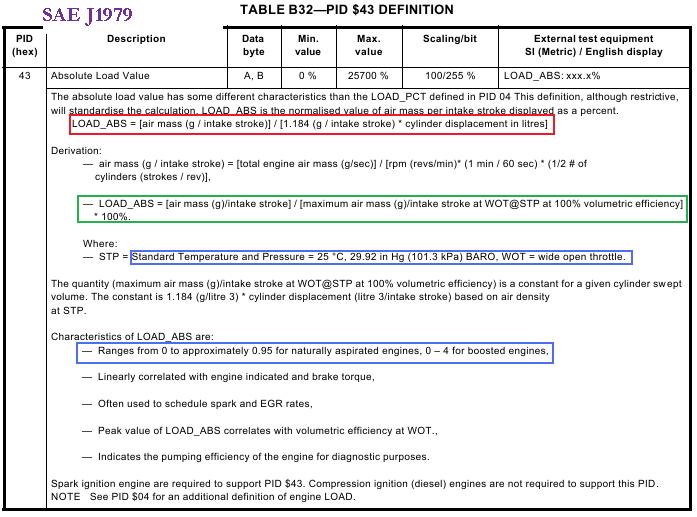
They use the term "absolute load" here, which really is a measurement of VE (note the reference to pumping efficiency at the bottom). There is another type of load calculation that always ranges from 0-100%.
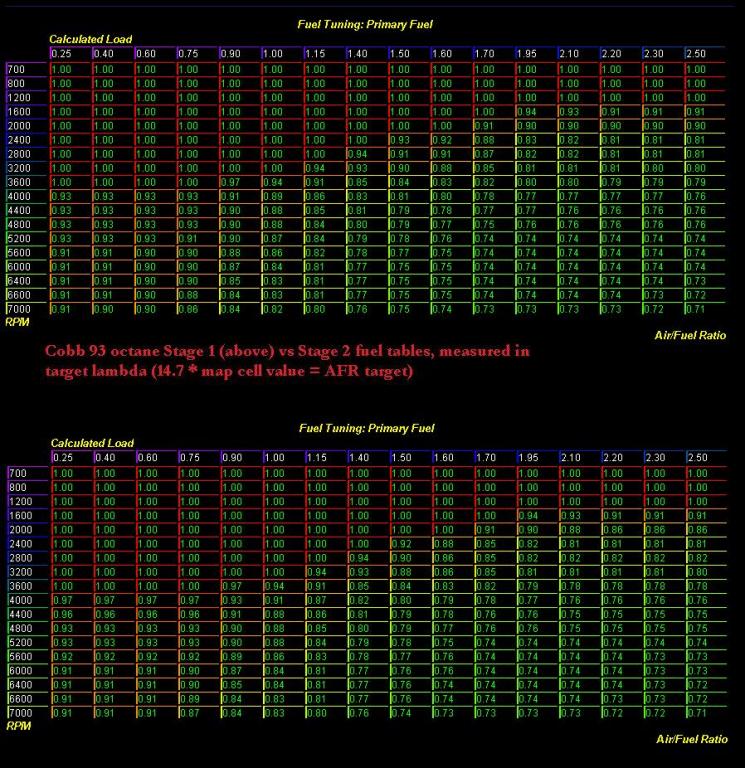
Since VE is a measure of measured air vs theoretical maximum, boosted conditions are pretty much by definition over 100%. Say you do a WOT pull. If measured airflow (either through a MAF sensor or through speed density calculations) is increasing faster than theoretical engine airflow at a given rpm, load will increase. With a turbo car eventually the engine flows more air than it 'should' be able to at a given rpm, and the load value increases to a number over 1.00 (or 100%). Take a look at these Subaru fuel maps, they are target lambda vs rpm vs engine load.
However, when you use those engine airflow calculations for compressor maps (mentioned in one of the sticky threads) I believe they want you to estimate the engine's efficiency without the turbo at a particular rpm.
They use the term "absolute load" here, which really is a measurement of VE (note the reference to pumping efficiency at the bottom). There is another type of load calculation that always ranges from 0-100%.
Since VE is a measure of measured air vs theoretical maximum, boosted conditions are pretty much by definition over 100%. Say you do a WOT pull. If measured airflow (either through a MAF sensor or through speed density calculations) is increasing faster than theoretical engine airflow at a given rpm, load will increase. With a turbo car eventually the engine flows more air than it 'should' be able to at a given rpm, and the load value increases to a number over 1.00 (or 100%). Take a look at these Subaru fuel maps, they are target lambda vs rpm vs engine load.
However, when you use those engine airflow calculations for compressor maps (mentioned in one of the sticky threads) I believe they want you to estimate the engine's efficiency without the turbo at a particular rpm.
Thank you for the thorough replay Arghx, I greatly appreciate it!
I haven't had time to completely go over all of the data you put up (writing a stupid lab paper due tonight), but I'll say a few things.
First of all, it makes sense that if a naturally aspirated car is at approximately 90-95% VE then a turbo car will easily go over that. I believe in your data it said something about an NA car being anywhere from 0-95% and a turbo from 0-400% (top fuel maybe! lol).
So to read a compressor map correctly you have to find out the flow rate of the car w/o the turbo you say right? How about running on a dyno and apply air pressure to the wastegate actuator so that it stays open (like the Hayne's manual prompts for proper function) and do a couple pulls at 0 maybe 1 or 2 pounds at the most. Whatever boost you do read you could subtract maybe 10-15hp and that would give you an approximation on how the engine would breathe on its own correct?
I haven't had time to completely go over all of the data you put up (writing a stupid lab paper due tonight), but I'll say a few things.
First of all, it makes sense that if a naturally aspirated car is at approximately 90-95% VE then a turbo car will easily go over that. I believe in your data it said something about an NA car being anywhere from 0-95% and a turbo from 0-400% (top fuel maybe! lol).
So to read a compressor map correctly you have to find out the flow rate of the car w/o the turbo you say right? How about running on a dyno and apply air pressure to the wastegate actuator so that it stays open (like the Hayne's manual prompts for proper function) and do a couple pulls at 0 maybe 1 or 2 pounds at the most. Whatever boost you do read you could subtract maybe 10-15hp and that would give you an approximation on how the engine would breathe on its own correct?
I'm a little stumped at the moment, if we used the flow rate of our cars w/o the turbo it would flow something similar to a n/a 13B, and I've calculated those to flow at max of a little under 20lb/min under there own will (no force induction). Using those numbers on a compressor map will make it look like you'd be surging all day long.
what formula are you using? When I'm doing a compressor map calculation, I use a graphing calculator (TI-83 or similar) and the formula that's mentioned in the sticky. I go into the Y = screen and use (2.6 * X * 90 * (2.00 / 5660) / 14.47 ) , where 2.6 is the displacement, X is supposed to be the rpm but I leave it as an X independent variable on the graphing calculator, 90 is the VE I'm assuming, 2.00 is the pressure ratio, and 14.47 is the conversion factor from CFM to lb/min at standard temp & pressure. I usually use 90% VE if the motor is ported and 85 if it's not. I've also seen 14.27 as a conversion factor between cfm and lbs/min, but 14.47 is a more conservative estimate so I use that. All this seems to work well enough, but I can't give you a whole lot of technical justification for those numbers.
Here's me doing a similar calculation, but on an EJ25 (STi/Legacy). I can hit the "trace" button and follow the line up and down to see what the airflow would be at a given rpm (the "X" I put in the formula).
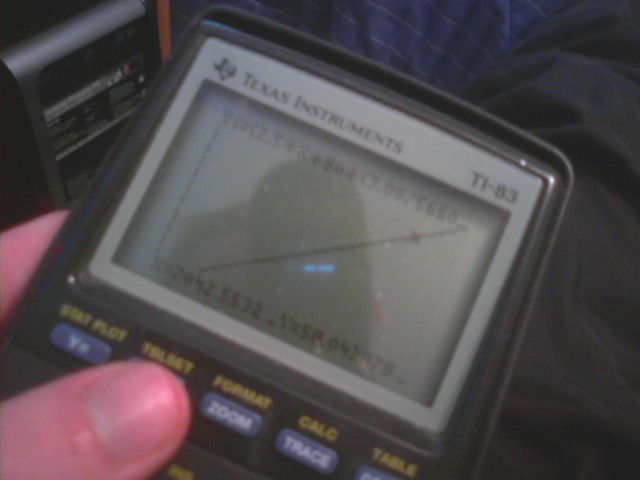
you can see I'm doing it for a high pressure ratio in this calculation. I admit I'm not sure how closely the 85 or 90% VE relates to the SAE volumetric efficiency formula. Somebody suggested that range so I tried it. It's decent for ballpark estimates. It is a linear approximation of airflow, and we all know that real life observations can't always be fit to such a nice little curve.
Here's me doing a similar calculation, but on an EJ25 (STi/Legacy). I can hit the "trace" button and follow the line up and down to see what the airflow would be at a given rpm (the "X" I put in the formula).
you can see I'm doing it for a high pressure ratio in this calculation. I admit I'm not sure how closely the 85 or 90% VE relates to the SAE volumetric efficiency formula. Somebody suggested that range so I tried it. It's decent for ballpark estimates. It is a linear approximation of airflow, and we all know that real life observations can't always be fit to such a nice little curve.
I'm just spinning my wheels at the moment, I'm a little worn out from punching numbers in class all day (mechanical engineering), i'll continue this thread when I've gathered some more valuable information, but thanks for your info Arghx!

Arghx covered it very well, but here is a simple explanation. It varies from turbo to turbo and how much you are pushing it. A small turbo will add less than a very large turbo because it will move a lower volume of air.
Example, a GT4788 can produce say 900whp giving a VE of maybe 300%. A GT35R will make 500whp, giving a VE of maybe 150%.
Example, a GT4788 can produce say 900whp giving a VE of maybe 300%. A GT35R will make 500whp, giving a VE of maybe 150%.
Trending Topics
Is it safer on the motor (aka apex seals) if you can make more power at lower boost and still keep the AIT's down? I ask this because I just upgraded my turbo and it feels like I'm making significantly more power at just 5psi than my stock turbo at 12 psi and I'm assuming that since there's less pressure inside the motor i'm making more reliable power? Is this a safe assumption?

Is it safer on the motor (aka apex seals) if you can make more power at lower boost and still keep the AIT's down? I ask this because I just upgraded my turbo and it feels like I'm making significantly more power at just 5psi than my stock turbo at 12 psi and I'm assuming that since there's less pressure inside the motor i'm making more reliable power? Is this a safe assumption?
I'm not a math wiz or anything special but I do know a little about volumetric stuff. If your thinking it may be safer at a lower psi it might be right. But also if you think more into it, the stock turbo can only move so much air before it becomes just a hot air mover and drops turbo effeciency by just shooting super heated air in the engine. So U get a bigger turbo and it moves as much air at a lower psi than stock And maybe at a cooler temp. So basically what I mean is...
Smaller turbo higher boost = Bigger turbo lower boost. Because of the same amount of air being forced into the engine at a specific psi for each individual turbo. So come to think about it the power is probably just at the same reliabilty as it was before. But also your trying to move more air thru the stock tmic than it was designed for so the air temps may rise anyways because the tmic cant keep up with the cooling demands of the upgraded turbo.. I may not be right at all but its what I get from the whole volumetric efficiency deal.

Hey Matt!
That's exactly wut I was thinking, since the turbo is larger it will move more air at a lower psi. So I'm getting the same or more air into the motor at a lower pressure, which I would assume would not put as much stress on the seals. But you're right about the TMIC, it may experience some heat soak during extended pulls so that's something I should take into account, so far I've only done several small pulls with 30-40F ambient temps so heat soak hasn't been an issue.
That's exactly wut I was thinking, since the turbo is larger it will move more air at a lower psi. So I'm getting the same or more air into the motor at a lower pressure, which I would assume would not put as much stress on the seals. But you're right about the TMIC, it may experience some heat soak during extended pulls so that's something I should take into account, so far I've only done several small pulls with 30-40F ambient temps so heat soak hasn't been an issue.

Rotorhead

Joined: Feb 2001
Posts: 9,136
Likes: 39
From: Charlottesville, Virginia, USA
VE is basically defined as dynamic displacement / static displacement, and as the name implies it is based on volume rather than density.
Oh goodie, I have questions for the engineering student...
If a given larger turbo has the same compressor and turbine efficiency as a given smaller turbo, how can it physically supply more air to an internal combustion (enclosed) engine without raising the pressure? If it truly flows more cfm at a lower pressure, then where does the extra cfm go?
That isn't a calculation of VE, but rather a calculation of load. The equation simply uses 100% VE as a basis, much like it uses STP.
VE is basically defined as dynamic displacement / static displacement, and as the name implies it is based on volume rather than density.
Oh goodie, I have questions for the engineering student...
If a given larger turbo has the same compressor and turbine efficiency as a given smaller turbo, how can it physically supply more air to an internal combustion (enclosed) engine without raising the pressure? If it truly flows more cfm at a lower pressure, then where does the extra cfm go?
VE is basically defined as dynamic displacement / static displacement, and as the name implies it is based on volume rather than density.
Oh goodie, I have questions for the engineering student...
If a given larger turbo has the same compressor and turbine efficiency as a given smaller turbo, how can it physically supply more air to an internal combustion (enclosed) engine without raising the pressure? If it truly flows more cfm at a lower pressure, then where does the extra cfm go?
So we have mdot=pAV. Doing some research online I found that density is (Area^4*Pressure)/(Volume*Acceleration). That would simplify mdot as mdot=(Area^5*Pressure*Velocity)/(Volume*acceleration).
From this equation you can see that the area makes a drastic effect on the mass flow because it is to the power of 5, any slight change in area will have a greater change than merely the pressure. But it is 6 in the morning so I may have made some calculation errors, but its some we can debate about...I have to study for some finals now, lol.

Senior Member

Joined: Nov 2008
Posts: 357
Likes: 0
From: Czech republic
Title says "Volumetric efficiency", but discussion seems to go for mass flow.. You can´t say that boosted engine has lets say 90%*1,5 PR=135%.....
Volumetric efficiency is influenced by everything from intake filter to exhaust tip. We can´t simply say that large turbo has more CFM/airflow, hence more power-if it was that simply, we could bolt GT55 on 13B and except xxxx HP from zero boost.... Reason why larger turbo give us more power/torque at same boost pressure is not even that much about charge temperature but overall gain in VE% of engine as complex system. Simply, with large turbine, Exhaust back-pressure is reduced, IMP/EMP ratio is better, VE% goes up.
Volumetric efficiency is influenced by everything from intake filter to exhaust tip. We can´t simply say that large turbo has more CFM/airflow, hence more power-if it was that simply, we could bolt GT55 on 13B and except xxxx HP from zero boost.... Reason why larger turbo give us more power/torque at same boost pressure is not even that much about charge temperature but overall gain in VE% of engine as complex system. Simply, with large turbine, Exhaust back-pressure is reduced, IMP/EMP ratio is better, VE% goes up.
Title says "Volumetric efficiency", but discussion seems to go for mass flow.. You can´t say that boosted engine has lets say 90%*1,5 PR=135%.....
Volumetric efficiency is influenced by everything from intake filter to exhaust tip. We can´t simply say that large turbo has more CFM/airflow, hence more power-if it was that simply, we could bolt GT55 on 13B and except xxxx HP from zero boost.... Reason why larger turbo give us more power/torque at same boost pressure is not even that much about charge temperature but overall gain in VE% of engine as complex system. Simply, with large turbine, Exhaust back-pressure is reduced, IMP/EMP ratio is better, VE% goes up.
Volumetric efficiency is influenced by everything from intake filter to exhaust tip. We can´t simply say that large turbo has more CFM/airflow, hence more power-if it was that simply, we could bolt GT55 on 13B and except xxxx HP from zero boost.... Reason why larger turbo give us more power/torque at same boost pressure is not even that much about charge temperature but overall gain in VE% of engine as complex system. Simply, with large turbine, Exhaust back-pressure is reduced, IMP/EMP ratio is better, VE% goes up.
I'm not actually sure what you are trying to say, but we're not looking for exact numbers. That would take, time, money, and research, but for street applications approximate values are suffice....with a generous safety factor


Thread
Thread Starter
Forum
Replies
Last Post
BLUE TII
Single Turbo RX-7's
10
Sep 26, 2015 10:12 PM
