


fuel pump testing


Thread Starter

Joined: Oct 2005
Posts: 1,650
Likes: 0
From: Cedar Rapids, IA
fuel pump testing
hey guys, i didnt really know where else to post this, but im in here all the time anyway, so i feel comfortable with the answers i would get in here better than in the other sections.
anyways, in the next week i will be sitting on 3 different fuel pumps. none of which do i have any idea of flow rate, or which is better than the next.
does anyone know of a way to test them? i looked at RC engineering's website, and they test fuel pumps for flow and such, but charge $60 each to do it. that is too much for 3 pumps. i need to figure out which of the 3 is going to be the best one for my 35R build. if anyone knows of a place that does flow testing, or some alternate method, please let me know. thanks!
anyways, in the next week i will be sitting on 3 different fuel pumps. none of which do i have any idea of flow rate, or which is better than the next.
does anyone know of a way to test them? i looked at RC engineering's website, and they test fuel pumps for flow and such, but charge $60 each to do it. that is too much for 3 pumps. i need to figure out which of the 3 is going to be the best one for my 35R build. if anyone knows of a place that does flow testing, or some alternate method, please let me know. thanks!
Thread Starter
Joined: Oct 2005
Posts: 1,650
Likes: 0
From: Cedar Rapids, IA
ok, so i have a thought. is voltage on a fuel pump:
a. linear?
b. proportionate at voltage vs. flow?
( i don't think i worded those right...)
basically, i have a cj motorsports fuel rail kit, and the aeromotive fpr.
can i leave the fpr set at "x" fuel pressure, and check the other pumps flow that way?
i.e. i take pump A and check and it is 38psi at idle, then pump B is 36, then pump C is 44?
therefore, does that mean that pump C flows the best?
i dont know if it would work like that or not.
and, even if it did, would that even mean anything in relation to total pump output?
a. linear?
b. proportionate at voltage vs. flow?
( i don't think i worded those right...)
basically, i have a cj motorsports fuel rail kit, and the aeromotive fpr.
can i leave the fpr set at "x" fuel pressure, and check the other pumps flow that way?
i.e. i take pump A and check and it is 38psi at idle, then pump B is 36, then pump C is 44?
therefore, does that mean that pump C flows the best?
i dont know if it would work like that or not.
and, even if it did, would that even mean anything in relation to total pump output?

It's real simple. Disconnect the fuel hose before the FPR and run it into a a container of known volume. I use a milk jug. Then run power to the fuel pump so it stays on. I removed the wire insulation from a 1/4" section of my fuel pump "+" wire so I can connect an alligator clip from a power wire from the battery. Using a stop watch, time how long the pump takes to fill the container.
Then use some basic math to convert (your container size)/(time taken in sec) to gal/hr
You mention checking the fuel flow after the fpr. Think about that and why that's wrong.
Then use some basic math to convert (your container size)/(time taken in sec) to gal/hr
You mention checking the fuel flow after the fpr. Think about that and why that's wrong.



Joined: Oct 2001
Posts: 6,279
Likes: 728
From: Florence, Alabama
i was in recent PM conversation w someone on the board who has a probable blown motor because he lost gradually fuel pressure.
figure out what the cost of a blown motor is...
spend $70 and screw a digital 0-100 psi pressure sensor into your FPR and LOG FUEL PRESSURE!
you will end all guessing by just looking at the logs which will parallel your boost and if they don't it will be time to turn off the ignition.
now that i have said my piece, post 3 will give you what you initially want.
howard
figure out what the cost of a blown motor is...
spend $70 and screw a digital 0-100 psi pressure sensor into your FPR and LOG FUEL PRESSURE!
you will end all guessing by just looking at the logs which will parallel your boost and if they don't it will be time to turn off the ignition.
now that i have said my piece, post 3 will give you what you initially want.
howard

I would not use unknown fuel pumps, ever.
Also, very good advice on the fuel pressure gauge.
My advice is to buy a NEW pump and make sure its installed properly.
To illustrate-
I was on the dyno a few years ago with a car with a "Supra" Denso pump and the car would lean out majorly under boost. His fuel pressure gauge showed a drop in fuel pressure as power climbed, meaning the pump simply could not keep up. In that case it was a multifold problem- the fuel pump was not re-wired, which is really a necessity with the big Denso pump because it draws more amperage, and he had bought the pump used, so while performance increased, the pump never did put out the volume/pressure it should have.
Also, very good advice on the fuel pressure gauge.
My advice is to buy a NEW pump and make sure its installed properly.
To illustrate-
I was on the dyno a few years ago with a car with a "Supra" Denso pump and the car would lean out majorly under boost. His fuel pressure gauge showed a drop in fuel pressure as power climbed, meaning the pump simply could not keep up. In that case it was a multifold problem- the fuel pump was not re-wired, which is really a necessity with the big Denso pump because it draws more amperage, and he had bought the pump used, so while performance increased, the pump never did put out the volume/pressure it should have.

how about this:
most pumps have a part number stamp somewhere on the pump chassis
plug that info into a google search and see if any results come up with your pump info and base your pump info off of a census that various sources give with your pump info.
if your pump is modified, it should be putting out more than the stamping on the pump chassis.
there, you saved yourself $60 per pump.
if still in doubt sell them all and put that money towards a new supra TT or walbro pump, depending on your goals.
anyone who has an upgraded car with a standalone should put a fuel pump re-wire at the top of their modification list.
most pumps have a part number stamp somewhere on the pump chassis
plug that info into a google search and see if any results come up with your pump info and base your pump info off of a census that various sources give with your pump info.
if your pump is modified, it should be putting out more than the stamping on the pump chassis.
there, you saved yourself $60 per pump.
if still in doubt sell them all and put that money towards a new supra TT or walbro pump, depending on your goals.
anyone who has an upgraded car with a standalone should put a fuel pump re-wire at the top of their modification list.
Last edited by RotaryEvolution; Jan 2, 2011 at 02:54 PM.


It's real simple. Disconnect the fuel hose before the FPR and run it into a a container of known volume. I use a milk jug. Then run power to the fuel pump so it stays on. I removed the wire insulation from a 1/4" section of my fuel pump "+" wire so I can connect an alligator clip from a power wire from the battery. Using a stop watch, time how long the pump takes to fill the container.
Then use some basic math to convert (your container size)/(time taken in sec) to gal/hr
You mention checking the fuel flow after the fpr. Think about that and why that's wrong.
Then use some basic math to convert (your container size)/(time taken in sec) to gal/hr
You mention checking the fuel flow after the fpr. Think about that and why that's wrong.
That will only tell you 0 pressure volume. You'll be most concerned with what the volume is at whatever pressure you'll be running the pump at. All pumps flow less volume as the pressure rises. Some more than others.
Instead of spending a bunch of money on testing used pumps, I would do as Karak says and spend some money on a new pump. Bosch 044 is generally my preference. Just my .02.
Trending Topics
Thread Starter
Joined: Oct 2005
Posts: 1,650
Likes: 0
From: Cedar Rapids, IA
That will only tell you 0 pressure volume. You'll be most concerned with what the volume is at whatever pressure you'll be running the pump at. All pumps flow less volume as the pressure rises. Some more than others.
Instead of spending a bunch of money on testing used pumps, I would do as Karak says and spend some money on a new pump. Bosch 044 is generally my preference. Just my .02.
Instead of spending a bunch of money on testing used pumps, I would do as Karak says and spend some money on a new pump. Bosch 044 is generally my preference. Just my .02.
I have 3 pumps. one that came in my FD (unknown. maybe stock, maybe performance.) one new one from rotary performance. and one new one from a supra TT.
how much difference is there in a bosch 044 and the other 2 performance pumps i have?
Thread Starter
Joined: Oct 2005
Posts: 1,650
Likes: 0
From: Cedar Rapids, IA
if i dont have the car running, and i have the fuel pump on, its doing basically what you suggested i do above (which is a very good suggestion, thank you) but, i dont have to do the extra work of wires and a container and such, i can just put the pump in, prime the system, and messure the pressure, no? as long as i dont change the fpr settings, wont each pump flow something different to the fpr, when it has no vaccum source, and the injectors are not firing?
Thread Starter
Joined: Oct 2005
Posts: 1,650
Likes: 0
From: Cedar Rapids, IA
I would not use unknown fuel pumps, ever.
Also, very good advice on the fuel pressure gauge.
My advice is to buy a NEW pump and make sure its installed properly.
To illustrate-
I was on the dyno a few years ago with a car with a "Supra" Denso pump and the car would lean out majorly under boost. His fuel pressure gauge showed a drop in fuel pressure as power climbed, meaning the pump simply could not keep up. In that case it was a multifold problem- the fuel pump was not re-wired, which is really a necessity with the big Denso pump because it draws more amperage, and he had bought the pump used, so while performance increased, the pump never did put out the volume/pressure it should have.
Also, very good advice on the fuel pressure gauge.
My advice is to buy a NEW pump and make sure its installed properly.
To illustrate-
I was on the dyno a few years ago with a car with a "Supra" Denso pump and the car would lean out majorly under boost. His fuel pressure gauge showed a drop in fuel pressure as power climbed, meaning the pump simply could not keep up. In that case it was a multifold problem- the fuel pump was not re-wired, which is really a necessity with the big Denso pump because it draws more amperage, and he had bought the pump used, so while performance increased, the pump never did put out the volume/pressure it should have.
also, the fuel pump rewiring is already done.
In your first post you asked "none of which do i have any idea of flow rate, or which is better than the next."
The method I suggested will tell you the gph at 0 psi which is how most pumps are identified. For example the walbro 255 flows 255 gph at 0 psi. As Mr. Ludwig mentioned, a pump will flow less when it has to pump against a pressure higher than 0 psi. For example, when there is 15 psi of boost in the manifold the pump has to "push" fuel against that pressure. Colman's suggestion of logging a fuel pressure sensor is a practical way to get the results you should be most interested in.
I think the question you're getting at is not which pump has better stats from the manufacturer but instead, which pump flows better NOW after the wear and tear they've experienced from previous use.
To answer that, install the pressure sensor in the FPR, apply whatever boost pressure you plan to run to the FPR vacuum hose, and measure each pumps flow (like I described with a container and stop watch) from the return line after the FPR and the fuel rails.
But like Karack posted, wouldn't it be easier to sell the used pumps for a profit and buy a brand new one?
The method I suggested will tell you the gph at 0 psi which is how most pumps are identified. For example the walbro 255 flows 255 gph at 0 psi. As Mr. Ludwig mentioned, a pump will flow less when it has to pump against a pressure higher than 0 psi. For example, when there is 15 psi of boost in the manifold the pump has to "push" fuel against that pressure. Colman's suggestion of logging a fuel pressure sensor is a practical way to get the results you should be most interested in.
I think the question you're getting at is not which pump has better stats from the manufacturer but instead, which pump flows better NOW after the wear and tear they've experienced from previous use.
To answer that, install the pressure sensor in the FPR, apply whatever boost pressure you plan to run to the FPR vacuum hose, and measure each pumps flow (like I described with a container and stop watch) from the return line after the FPR and the fuel rails.
But like Karack posted, wouldn't it be easier to sell the used pumps for a profit and buy a brand new one?
Thread Starter
Joined: Oct 2005
Posts: 1,650
Likes: 0
From: Cedar Rapids, IA
how about this:
most pumps have a part number stamp somewhere on the pump chassis
plug that info into a google search and see if any results come up with your pump info and base your pump info off of a census that various sources give with your pump info.
if your pump is modified, it should be putting out more than the stamping on the pump chassis.
there, you saved yourself $60 per pump.
if still in doubt sell them all and put that money towards a new supra TT or walbro pump, depending on your goals.
anyone who has an upgraded car with a standalone should put a fuel pump re-wire at the top of their modification list.
most pumps have a part number stamp somewhere on the pump chassis
plug that info into a google search and see if any results come up with your pump info and base your pump info off of a census that various sources give with your pump info.
if your pump is modified, it should be putting out more than the stamping on the pump chassis.
there, you saved yourself $60 per pump.
if still in doubt sell them all and put that money towards a new supra TT or walbro pump, depending on your goals.
anyone who has an upgraded car with a standalone should put a fuel pump re-wire at the top of their modification list.
In your first post you asked "none of which do i have any idea of flow rate, or which is better than the next."
The method I suggested will tell you the gph at 0 psi which is how most pumps are identified. For example the walbro 255 flows 255 gph at 0 psi. As Mr. Ludwig mentioned, a pump will flow less when it has to pump against a pressure higher than 0 psi. For example, when there is 15 psi of boost in the manifold the pump has to "push" fuel against that pressure. Colman's suggestion of logging a fuel pressure sensor is a practical way to get the results you should be most interested in.
I think the question you're getting at is not which pump has better stats from the manufacturer but instead, which pump flows better NOW after the wear and tear they've experienced from previous use.
To answer that, install the pressure sensor in the FPR, apply whatever boost pressure you plan to run to the FPR vacuum hose, and measure each pumps flow (like I described with a container and stop watch) from the return line after the FPR and the fuel rails.
But like Karack posted, wouldn't it be easier to sell the used pumps for a profit and buy a brand new one?
The method I suggested will tell you the gph at 0 psi which is how most pumps are identified. For example the walbro 255 flows 255 gph at 0 psi. As Mr. Ludwig mentioned, a pump will flow less when it has to pump against a pressure higher than 0 psi. For example, when there is 15 psi of boost in the manifold the pump has to "push" fuel against that pressure. Colman's suggestion of logging a fuel pressure sensor is a practical way to get the results you should be most interested in.
I think the question you're getting at is not which pump has better stats from the manufacturer but instead, which pump flows better NOW after the wear and tear they've experienced from previous use.
To answer that, install the pressure sensor in the FPR, apply whatever boost pressure you plan to run to the FPR vacuum hose, and measure each pumps flow (like I described with a container and stop watch) from the return line after the FPR and the fuel rails.
But like Karack posted, wouldn't it be easier to sell the used pumps for a profit and buy a brand new one?
you didnt read my post then. they indeed are brand new.
in my second post, i asked if flow is linear or not compared to boost or voltage.
i.e., will a pump flow a linear amount of fuel, so if i test it the way you are saying, will pumps that flow the same amount of fuel at 0psi regulator pressure, flow different amounts at 15psi regulator?
Thread Starter
Joined: Oct 2005
Posts: 1,650
Likes: 0
From: Cedar Rapids, IA
i guess i should have worded everything better.
basically, i think everyone who is reading these is skimming them, and not really paying attention the the silly little details. that is my fault.
i have two new fuel pumps.
both from reputable sources.
both flow more than stock.
i have my pump wires redone.
is there is a way to measure flow between the two.
i just want to know if there is a way to definitively tell which pump is going to be better.
basically, i think everyone who is reading these is skimming them, and not really paying attention the the silly little details. that is my fault.
i have two new fuel pumps.
both from reputable sources.
both flow more than stock.
i have my pump wires redone.
is there is a way to measure flow between the two.
i just want to know if there is a way to definitively tell which pump is going to be better.
You're correct, and I spoke without thinking.
From what I remember, isn't the RP either a Walbro or the Supra Denso pump?
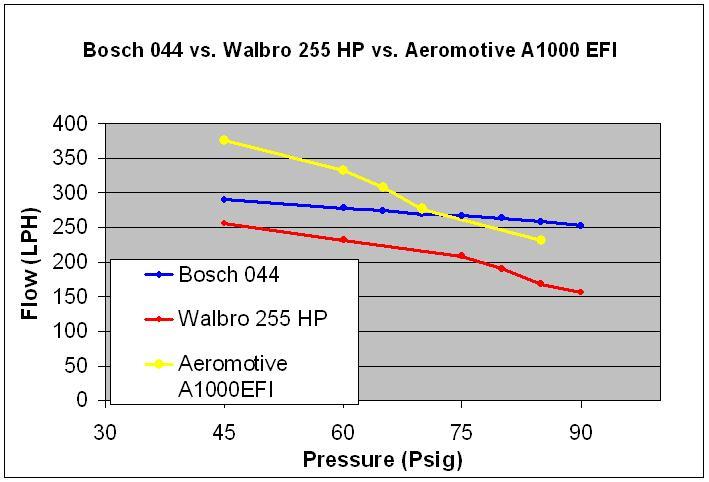
Flow charts for the Bosch 044, Supra Denso, Walbro 255, and Aeromotive A1000.


Thread Starter
Joined: Oct 2005
Posts: 1,650
Likes: 0
From: Cedar Rapids, IA
yes, the RP pump is a denso case. i dont know if RP modifies them, or if it is a stock cosmo/supra pump. i dont know how they market them.
also, RP doesnt say at which voltage they test their pump.
also, RP doesnt say at which voltage they test their pump.
i read it perfectly fine, or so i thought.. you mentioned not knowing the flow rate of the pumps or that you knew what brand they were or that they were brand new. what else is to not read properly?
if you're unsure as to which pump is going to be right, use other people's setups for comparison and horsepower output levels. if you're unsure, you can always run a new fuel line and run 2 pumps(one for each rail). it's not always bad to do some overkill when it comes to fuel(but ideally you want matching pumps so as not to confuse the hell out of the RRFPR, or just run 2 FPRs but this is bordering into the 500WHP and beyond necessity area).
if you're unsure as to which pump is going to be right, use other people's setups for comparison and horsepower output levels. if you're unsure, you can always run a new fuel line and run 2 pumps(one for each rail). it's not always bad to do some overkill when it comes to fuel(but ideally you want matching pumps so as not to confuse the hell out of the RRFPR, or just run 2 FPRs but this is bordering into the 500WHP and beyond necessity area).
Last edited by RotaryEvolution; Jan 3, 2011 at 01:02 PM.
Thread Starter
Joined: Oct 2005
Posts: 1,650
Likes: 0
From: Cedar Rapids, IA
i read it perfectly fine, or so i thought.. you mentioned not knowing the flow rate of the pumps or that you knew what brand they were or that they were brand new. what else is to not read properly?
if you're unsure as to which pump is going to be right, use other people's setups for comparison and horsepower output levels. if you're unsure, you can always run a new fuel line and run 2 pumps(one for each rail). it's not always bad to do some overkill when it comes to fuel(but ideally you want matching pumps so as not to confuse the hell out of the RRFPR, or just run 2 FPRs but this is bordering into the 500WHP and beyond necessity area).
if you're unsure as to which pump is going to be right, use other people's setups for comparison and horsepower output levels. if you're unsure, you can always run a new fuel line and run 2 pumps(one for each rail). it's not always bad to do some overkill when it comes to fuel(but ideally you want matching pumps so as not to confuse the hell out of the RRFPR, or just run 2 FPRs but this is bordering into the 500WHP and beyond necessity area).
anywho, I figured out that the RP pump flows 490lbs per hour, which is about 80.3 gallons per hour, or 304 liters per hour. (at 40psi base pressure, and assuming gasoline weighs 6.1lbs per gallon)
this is comparable to the other pumps, but i dont know if it would be linear to assume that those 3 pumps would flow more at 40psi (the graph is at 45)
and, to further complicate things, i dont know what voltage RP tested their pump at, so i cant really compare it to the supra pump.
basically, I have 3 good graphs, with good info, but they are not really relate-able. and, im missing some info. (what voltage did rp test their pump at, and what would the walbro, a1000, and bosch pumps flow like at 40psi)

Full Member

Joined: Oct 2004
Posts: 161
Likes: 0
From: chicago
run return line into container. set regulator to what pressure you want to test at. be sure and reset pressure if it moves after changing pump. of course, leave the engine off as fuel consumption will lower the actual reading. bypass fuel pump relay to turn on the pump. monitor voltage at each test to make sure it remains close enough to be fair. if you want a more accurate voltage test with a running alternator, just run a direct power cable off the battery terminal of a running car parked next to yours to get the 14ish volts to the pump without your engine consuming any fuel, and still just measure your return fuel quantity versus time to get your flow rate at whatever pressure you have set. keep in mind this method will give you an accurate test of the pumps output when combined with your particular plumbing, not just the pump itself. if youre plumbing isnt good enough, you could be choking the output of the larger of the pumps, narrowing the spread between them.

Thread
Thread Starter
Forum
Replies
Last Post
trickster
2nd Generation Specific (1986-1992)
25
Jul 1, 2023 04:40 PM
Skeese
Adaptronic Engine Mgmt - AUS
65
Mar 28, 2017 03:30 PM
LunchboxSA22
2nd Generation Specific (1986-1992)
37
Oct 26, 2015 10:53 AM
