


Eliminating Oil fill neck, need PCV help


Thread Starter


Joined: May 2008
Posts: 4,389
Likes: 965
From: Stamford, CT
Eliminating Oil fill neck, need PCV help
Hi all,
I need to eliminate the stock oil fill neck and block off the whole in order for my supercharger piping to fit.
I plan to weld a -10 AN bung to the oil pan and run a line from that to a new oil fill piece on the which will have a bracket to hold it somewhere by the coolant fill location. I bought the top part of the SS oil fill neck that Zeeshan sells, this way I can have a -10 AN bung on the bottom to connect the line to the oil pan, and use the stock oil fill cap on top.
I have a few questions that I'm hoping I can get some input on.
Oil fill location (where oil will actually enter the engine)
1. Should I weld the bung to the upper part of the oil pan in the front or rear of the oil pan?
2. I'm single turbo, so should I just "Y" that into the turbo oil drain in the front of the block
3. Again, I'm single turbo, so should i weld the -10 bung onto the block off plate that covers the original rear turbo drain.
As long as the fill pipe is capped off, I don't think any of the above really matter. But I think it will matter if I incorporate a nipple for a PCV on the top of the new oil fill neck.
I don't want oil spraying out that PCV and into the intake when oil is sloshing around in the oil pan and traveling up the hose to the oil fill cap.
If I don't install a PCV nipple on the new oil fill neck (allowing pressure from the oil pan to vent into the UIM), where else would I connect one?
Or should I just delete the PCV entirely, and install a vented catch can instead.
Thanks in advance for any help.
I need to eliminate the stock oil fill neck and block off the whole in order for my supercharger piping to fit.
I plan to weld a -10 AN bung to the oil pan and run a line from that to a new oil fill piece on the which will have a bracket to hold it somewhere by the coolant fill location. I bought the top part of the SS oil fill neck that Zeeshan sells, this way I can have a -10 AN bung on the bottom to connect the line to the oil pan, and use the stock oil fill cap on top.
I have a few questions that I'm hoping I can get some input on.
Oil fill location (where oil will actually enter the engine)
1. Should I weld the bung to the upper part of the oil pan in the front or rear of the oil pan?
2. I'm single turbo, so should I just "Y" that into the turbo oil drain in the front of the block
3. Again, I'm single turbo, so should i weld the -10 bung onto the block off plate that covers the original rear turbo drain.
As long as the fill pipe is capped off, I don't think any of the above really matter. But I think it will matter if I incorporate a nipple for a PCV on the top of the new oil fill neck.
I don't want oil spraying out that PCV and into the intake when oil is sloshing around in the oil pan and traveling up the hose to the oil fill cap.
If I don't install a PCV nipple on the new oil fill neck (allowing pressure from the oil pan to vent into the UIM), where else would I connect one?
Or should I just delete the PCV entirely, and install a vented catch can instead.
Thanks in advance for any help.


First, if you are going to use a PCV valve there needs to be another line coming off a T so the the vapors have somewhere to flow then the PCV closes. A PCV valve closes under boost. Take a look at the stock diagram for a 93-94 FD:
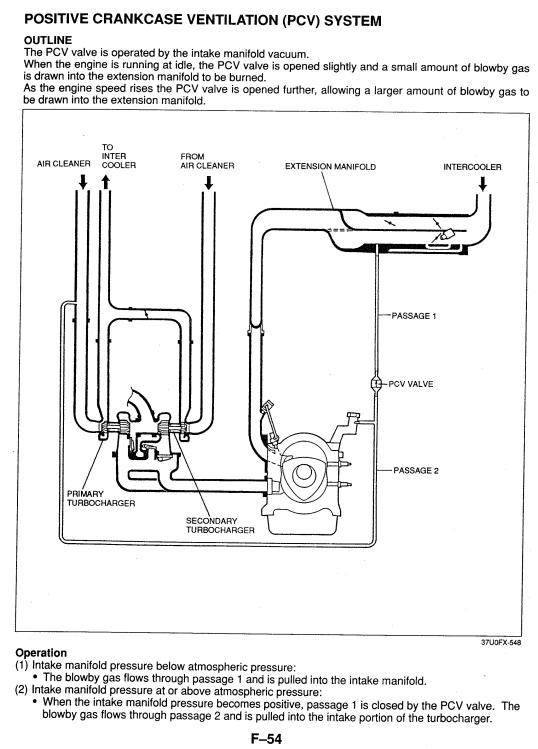
With this configuration you have a line coming off the vent. It splits to a T: one side of the T goes to a manifold vacuum source with a PCV valve in-line. The other side of the T goes to a catch can or back to the intake side. A PCV valve closes under boost; it does not allow blowby gases through it under hard driving.
As for your question about whether oil will spew out, I'm not sure. If this has been done before I haven't heard of it. One common way to vent the crankcase is to drill and tap a blockoff plate for the stock rear turbo drain line. That has a track record of success. But I'm not sure how much you blocking off the oil filler (and thus losing the normal oil filter vent) would hurt the crankcase ventilation. It depends how the vapors circulate inside the engine under heavy loads, and I've never seen any literature on that or heard real-world experiences.
Best case scenario, it behaves like most single turbo cars with catch cans. Worst case scenario, you start blowing out major smoke under boost while still filling up the catch can quickly. It's hard to say what will happen.
With this configuration you have a line coming off the vent. It splits to a T: one side of the T goes to a manifold vacuum source with a PCV valve in-line. The other side of the T goes to a catch can or back to the intake side. A PCV valve closes under boost; it does not allow blowby gases through it under hard driving.
As for your question about whether oil will spew out, I'm not sure. If this has been done before I haven't heard of it. One common way to vent the crankcase is to drill and tap a blockoff plate for the stock rear turbo drain line. That has a track record of success. But I'm not sure how much you blocking off the oil filler (and thus losing the normal oil filter vent) would hurt the crankcase ventilation. It depends how the vapors circulate inside the engine under heavy loads, and I've never seen any literature on that or heard real-world experiences.
Best case scenario, it behaves like most single turbo cars with catch cans. Worst case scenario, you start blowing out major smoke under boost while still filling up the catch can quickly. It's hard to say what will happen.


Hey bud! Long time no talk. Anyway, do you have a picture of your supercharger? I'm only asking as I'm wondering what style it is. If it's a Centrifugal Type you should try to relocated the alternator and sit it right there. Good luck!
Thread Starter
Joined: May 2008
Posts: 4,389
Likes: 965
From: Stamford, CT
First, if you are going to use a PCV valve there needs to be another line coming off a T so the the vapors have somewhere to flow then the PCV closes. A PCV valve closes under boost. Take a look at the stock diagram for a 93-94 FD:
With this configuration you have a line coming off the vent. It splits to a T: one side of the T goes to a manifold vacuum source with a PCV valve in-line. The other side of the T goes to a catch can or back to the intake side. A PCV valve closes under boost; it does not allow blowby gases through it under hard driving.
As for your question about whether oil will spew out, I'm not sure. If this has been done before I haven't heard of it. One common way to vent the crankcase is to drill and tap a blockoff plate for the stock rear turbo drain line. That has a track record of success. But I'm not sure how much you blocking off the oil filler (and thus losing the normal oil filter vent) would hurt the crankcase ventilation. It depends how the vapors circulate inside the engine under heavy loads, and I've never seen any literature on that or heard real-world experiences.
Best case scenario, it behaves like most single turbo cars with catch cans. Worst case scenario, you start blowing out major smoke under boost while still filling up the catch can quickly. It's hard to say what will happen.
With this configuration you have a line coming off the vent. It splits to a T: one side of the T goes to a manifold vacuum source with a PCV valve in-line. The other side of the T goes to a catch can or back to the intake side. A PCV valve closes under boost; it does not allow blowby gases through it under hard driving.
As for your question about whether oil will spew out, I'm not sure. If this has been done before I haven't heard of it. One common way to vent the crankcase is to drill and tap a blockoff plate for the stock rear turbo drain line. That has a track record of success. But I'm not sure how much you blocking off the oil filler (and thus losing the normal oil filter vent) would hurt the crankcase ventilation. It depends how the vapors circulate inside the engine under heavy loads, and I've never seen any literature on that or heard real-world experiences.
Best case scenario, it behaves like most single turbo cars with catch cans. Worst case scenario, you start blowing out major smoke under boost while still filling up the catch can quickly. It's hard to say what will happen.
Hey dude, I'm using an Eaton M62 (roots style), its mounted where my power steering pump used to be. Go check out my twincharged build in the build section, there are lots of pics showing how I mounted it.

Thread
Thread Starter
Forum
Replies
Last Post
