


Rtek new 2.1 install


new 2.1 install
i just installed my 2.1 and i am trying to get everything nominal enough to drive over to my tuner and get him to work on the tune. it's kind of a long drive, so i just want to make sure that i am good all of the way there.
first of all, i know the basics of tuning. i just haven't ever tuned a rotary and going lean scares me to death on these motors.
here it is;
i went with boost-based timing (took advice from a couple of maps here and made a conservative map from them based on my octane and compression) and got the car fired up. got the idle in the mid-13's (afr) and got it really smooth, better than it has ever idled actually. adjusted the fuel maps according to the correction i used at idle, just to be on the safe side. adjusted all of the lean spots out of boost and just kept it at safe numbers for my tuner to correct later. got the secondary staging at a happy place where i don't even notice the injectors staging and it keeps things consistent all of the way across the map. got the high-rpm, low vac numbers nominal for cruising since that is where my car will be most of the time that i am driving to my tuner.
i think that i have done well for a basic tune, but there is one thing that is really getting to me. when i downshift, my afr's go off of the chart (lean). i have had them go up when tuning boingers before, but never to this degree. the two factors that are different here than any car i have ever worked on is where i mounted the wideband and the exhaust set-up. on aem's advice (high egt's and turbocharged) i mounted the o2 on the midpipe at the downpipe (about 40 inches from the turbo). i'm running no cats, so no large amount of backpressure here. i'm running a lot of correction at low vac and high rpms, but i still have wiggle room. it just seems like no matter how i increase the correction, the afr's don't change at downshift.
the afr's are very safe at any other time. i am pulling about 13.1 at the threshold through about 12.5 at full boost. my idle is really good, as i was saying before, and cruising speeds are safe. is a lean downshift normal for my set-up or do i need to keep correcting until i get beyond this? the car isn't moving until i get a common answer for this question.
first of all, i know the basics of tuning. i just haven't ever tuned a rotary and going lean scares me to death on these motors.
here it is;
i went with boost-based timing (took advice from a couple of maps here and made a conservative map from them based on my octane and compression) and got the car fired up. got the idle in the mid-13's (afr) and got it really smooth, better than it has ever idled actually. adjusted the fuel maps according to the correction i used at idle, just to be on the safe side. adjusted all of the lean spots out of boost and just kept it at safe numbers for my tuner to correct later. got the secondary staging at a happy place where i don't even notice the injectors staging and it keeps things consistent all of the way across the map. got the high-rpm, low vac numbers nominal for cruising since that is where my car will be most of the time that i am driving to my tuner.
i think that i have done well for a basic tune, but there is one thing that is really getting to me. when i downshift, my afr's go off of the chart (lean). i have had them go up when tuning boingers before, but never to this degree. the two factors that are different here than any car i have ever worked on is where i mounted the wideband and the exhaust set-up. on aem's advice (high egt's and turbocharged) i mounted the o2 on the midpipe at the downpipe (about 40 inches from the turbo). i'm running no cats, so no large amount of backpressure here. i'm running a lot of correction at low vac and high rpms, but i still have wiggle room. it just seems like no matter how i increase the correction, the afr's don't change at downshift.
the afr's are very safe at any other time. i am pulling about 13.1 at the threshold through about 12.5 at full boost. my idle is really good, as i was saying before, and cruising speeds are safe. is a lean downshift normal for my set-up or do i need to keep correcting until i get beyond this? the car isn't moving until i get a common answer for this question.


First of all, tuning a rotary isn't all that different from tuning piston engines *gasp*. Yeah, I said it. The main thing you have to keep in mind is that there are two of many things. Two sets of plugs, two sets of injectors, and in the case of the FD two sets of turbos and two boost controllers. They do run rich at idle, but that's only on pre-Renesis engines like we are dealing with here. They don't even run that much richer than piston motors under WOT. You should see all the factory fuel tables I have for Evos , STi's, Corvettes. They don't differ from rotaries as much as you would think.
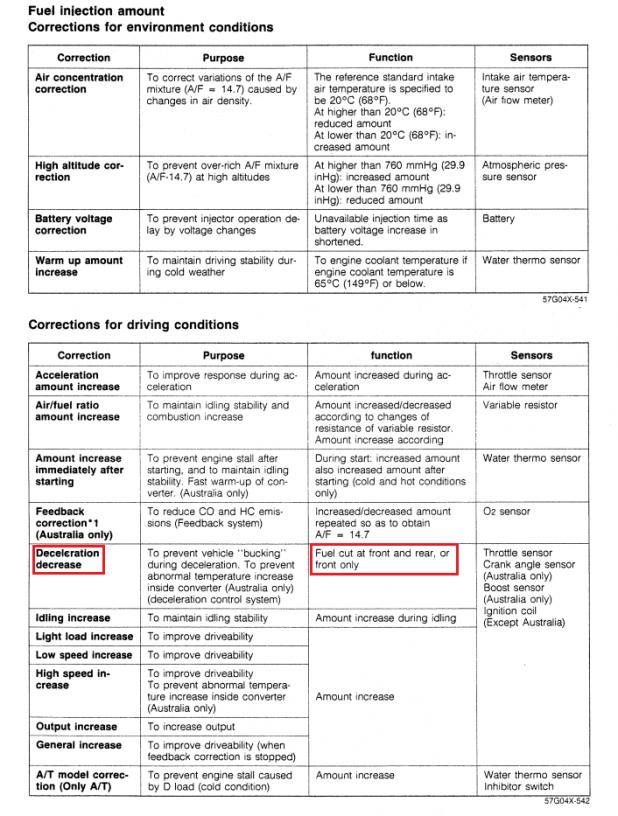
This is normal on both rotary and piston engines. I can't comment on any of the other cars you were working on, but it's a basic principle of electronic fuel injection that the fuel is drastically decreased or completely shut off during deceleration. Here is a page out of the EFI section of the training manual (anything that says "Australia" is referring to a normal USDM or JDM car)
The sensor will read a little leaner as you go farther back in the exhaust due to decreased temperature and pressure, but that's fine.
You tune Hondas? Here's the default Hondata S300 target AFR table for a P28 ECU. vacuum/boost is on the x axis and RPM is on the Y axis.
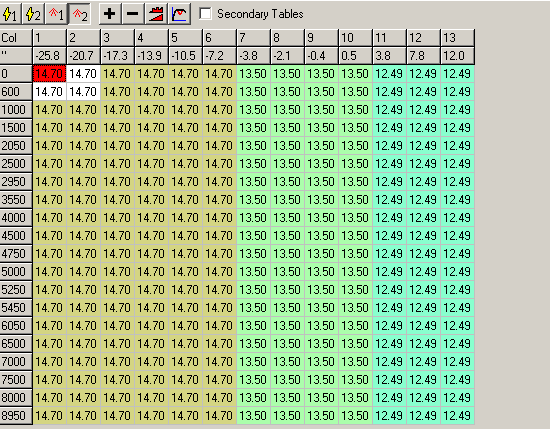
But on a rotary most would only run 12.5:1 at maybe 5-6psi or less. For long term reliability 12:1 is normally considered the leanest you should go running only normal pump fuel while getting into higher boost levels, and that's pushing it some.
You'll also see people running similar mixtures on STi's--on aftermarket tunes, anywhere from high 10s (which is more conservative than necessary IMO) to high 11's. Here is the factory commanded AFR table on a JDM 2007 STi. Y axis is RPM, x axis is airflow grams/revolution, or [(MAF grams/sec * 60) / rpm] :
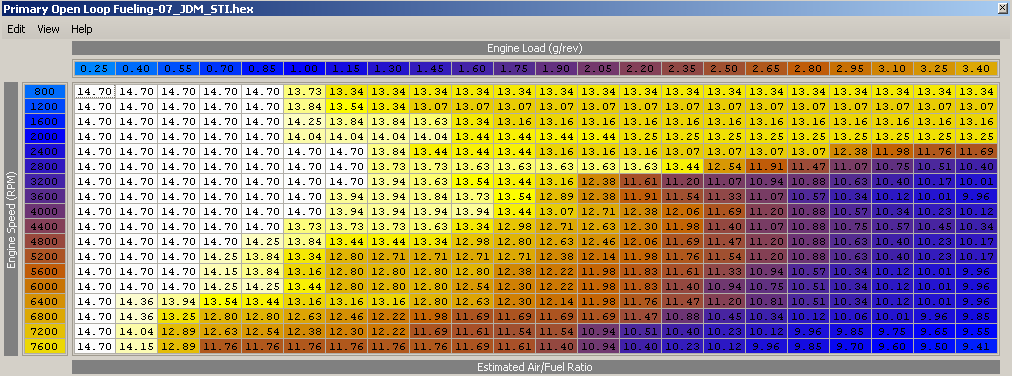
that's not rpm vs boost because it is a MAF based system, but figure you are in the right portion of the map most of the time. On a lot of 6 cylinders you'll see AFR's in the the mid-high 11's or low 12's depending fuel quality and boost level.
I'm putting together some Rx-7 target AFR tables for everybody to look at.
here it is;
i went with boost-based timing (took advice from a couple of maps here and made a conservative map from them based on my octane and compression) and got the car fired up. got the idle in the mid-13's (afr) and got it really smooth, better than it has ever idled actually. adjusted the fuel maps according to the correction i used at idle, just to be on the safe side. adjusted all of the lean spots out of boost and just kept it at safe numbers for my tuner to correct later. got the secondary staging at a happy place where i don't even notice the injectors staging and it keeps things consistent all of the way across the map. got the high-rpm, low vac numbers nominal for cruising since that is where my car will be most of the time that i am driving to my tuner.
i think that i have done well for a basic tune, but there is one thing that is really getting to me. when i downshift, my afr's go off of the chart (lean).
i went with boost-based timing (took advice from a couple of maps here and made a conservative map from them based on my octane and compression) and got the car fired up. got the idle in the mid-13's (afr) and got it really smooth, better than it has ever idled actually. adjusted the fuel maps according to the correction i used at idle, just to be on the safe side. adjusted all of the lean spots out of boost and just kept it at safe numbers for my tuner to correct later. got the secondary staging at a happy place where i don't even notice the injectors staging and it keeps things consistent all of the way across the map. got the high-rpm, low vac numbers nominal for cruising since that is where my car will be most of the time that i am driving to my tuner.
i think that i have done well for a basic tune, but there is one thing that is really getting to me. when i downshift, my afr's go off of the chart (lean).
i have had them go up when tuning boingers before, but never to this degree. the two factors that are different here than any car i have ever worked on is where i mounted the wideband and the exhaust set-up. on aem's advice (high egt's and turbocharged) i mounted the o2 on the midpipe at the downpipe (about 40 inches from the turbo).
the afr's are very safe at any other time. i am pulling about 13.1 at the threshold through about 12.5 at full boost.
But on a rotary most would only run 12.5:1 at maybe 5-6psi or less. For long term reliability 12:1 is normally considered the leanest you should go running only normal pump fuel while getting into higher boost levels, and that's pushing it some.
You'll also see people running similar mixtures on STi's--on aftermarket tunes, anywhere from high 10s (which is more conservative than necessary IMO) to high 11's. Here is the factory commanded AFR table on a JDM 2007 STi. Y axis is RPM, x axis is airflow grams/revolution, or [(MAF grams/sec * 60) / rpm] :
that's not rpm vs boost because it is a MAF based system, but figure you are in the right portion of the map most of the time. On a lot of 6 cylinders you'll see AFR's in the the mid-high 11's or low 12's depending fuel quality and boost level.
I'm putting together some Rx-7 target AFR tables for everybody to look at.




Thread
Thread Starter
Forum
Replies
Last Post
24seven_dada
3rd Generation Specific (1993-2002)
20
Nov 10, 2018 12:03 PM
Jeff20B
1st Generation Specific (1979-1985)
73
Sep 16, 2018 07:16 PM
