


Press on sleeve replacement for rotor housing


Thread Starter
Banned. I got OWNED!!!
Joined: Aug 2009
Posts: 297
Likes: 0
From: Chicago,IL
 Press on sleeve replacement for rotor housing
I don't know if the idea has been discussed before,but it would be nice if a company can figure out a way to manufacture replacement steel/Chrome sleeves instead of replacing the whole rotor housing
Best description i can provide without pics as follows:
1.With an old rotor housing mill away the original steel/chrome insert of at least 3mm or more till you reach the aluminum.
2. Mill interlocking channels on the freshly milled surface of the old rotor housing.
3. Manufacture the new sleeve,it has a new surface for which the apex seals can ride on is on one side,while the other side of the sleeve has interlocking channels so it can mate together with old rotor housing in a semi permanent fashion.
What you guys think?
Best description i can provide without pics as follows:
1.With an old rotor housing mill away the original steel/chrome insert of at least 3mm or more till you reach the aluminum.
2. Mill interlocking channels on the freshly milled surface of the old rotor housing.
3. Manufacture the new sleeve,it has a new surface for which the apex seals can ride on is on one side,while the other side of the sleeve has interlocking channels so it can mate together with old rotor housing in a semi permanent fashion.
What you guys think?





Goopy Performance fixes rotor housings, pretty cheap too. And has great results so far.
The way you posted above, is not really possible. I mean it is, but would cost more than a new housing from Mazda.
The way you posted above, is not really possible. I mean it is, but would cost more than a new housing from Mazda.
Machine shops generally charge with the cost of material, and how long it takes to make something. Also wear on tooling. The amount of time and tooling this would wake adds up real fast.
I am a machinist, and already looked into this. It's just not worth it.
Look to Goopy performance for fixing your housings. There way is working great from what I am hearing.
I am a machinist, and already looked into this. It's just not worth it.
Look to Goopy performance for fixing your housings. There way is working great from what I am hearing.
Thread Starter
Banned. I got OWNED!!!
Joined: Aug 2009
Posts: 297
Likes: 0
From: Chicago,IL

Maybe you misunderstood me,im suggesting this idea to large scale manufactures with a modest foundry to make the sleeves at the predetermined shape. leaving little material as possible to machine in order to keep cost a bay.
Hiring some local machinist to do this will definitely cost a pretty penny hence your skepticism am i correct?
Im surprised mazda didn't incorporated removable sleeve tech yet.
Hiring some local machinist to do this will definitely cost a pretty penny hence your skepticism am i correct?
Im surprised mazda didn't incorporated removable sleeve tech yet.
Trending Topics

Old [Sch|F]ool


Joined: May 2001
Posts: 12,876
Likes: 575
From: Cleveland, Ohio, USA
Just food for thought.
Before the factory 7-liter race blocks were available, a company I worked for was modifying LS1 blocks by boring the blocks out and pressing in new sleeves. This is a fairly simple operation, especially with a CNC block mill: there's nothing fancy, just making straight round holes and pressing in new prefab sleeves, then boring/decking to size.
They stopped doing it because the GMPP block was $3k. Parts (already-available sleeves) and labor (machine time) to modify the LS1 blocks came to over twice that. And the modified blocks aren't as strong.
I see a parallel here.
Now, IF parts are simply nonexistent, you have to do what you can with what you got. But you'll end up paying through the nose. Food for thought: If it wasn't as expensive as new housings, or was more beneficial in some way, at least one of the major rotary aftermarket companies would be doing it.
Dealing with the spark plug interface strikes me as a real problem point with the idea. It's hard enough pulling heat out of that part of the rotor housing when it's all one piece, add a little bit of thermal insulation from the joint and it'd be even worse.
Before the factory 7-liter race blocks were available, a company I worked for was modifying LS1 blocks by boring the blocks out and pressing in new sleeves. This is a fairly simple operation, especially with a CNC block mill: there's nothing fancy, just making straight round holes and pressing in new prefab sleeves, then boring/decking to size.
They stopped doing it because the GMPP block was $3k. Parts (already-available sleeves) and labor (machine time) to modify the LS1 blocks came to over twice that. And the modified blocks aren't as strong.
I see a parallel here.
Now, IF parts are simply nonexistent, you have to do what you can with what you got. But you'll end up paying through the nose. Food for thought: If it wasn't as expensive as new housings, or was more beneficial in some way, at least one of the major rotary aftermarket companies would be doing it.
Dealing with the spark plug interface strikes me as a real problem point with the idea. It's hard enough pulling heat out of that part of the rotor housing when it's all one piece, add a little bit of thermal insulation from the joint and it'd be even worse.

Regardless of whether or not it is cost justifiable, what material would you make the new sleeve out of? I've looked into this and my understanding is that the factory insert is industrial chrome plated (im not sure what the actual insert itself is made from, but it may not matter.)
Also from what i hear there is no bare metal with a coefficient of friction that matches chrome. although i would assume polished chromoly would come quite close, but I may be wrong. This leads me to believe that if you were to insert a sleeve then nomater what material you made the sleeve out of it would have to be chrome plated -or plated/sprayed with some similar acting substance- to perform as well as an OEM piece.
The problem is the addition of chrome plating adds 2 processes. The plating and then polishing the plating to smooth the surface which is not as easy as it sounds since housings are neither flat nor cylindrical
if you are going to get into that much complexity then finding a way to resurface the OEM piece is just as "simple"
Also from what i hear there is no bare metal with a coefficient of friction that matches chrome. although i would assume polished chromoly would come quite close, but I may be wrong. This leads me to believe that if you were to insert a sleeve then nomater what material you made the sleeve out of it would have to be chrome plated -or plated/sprayed with some similar acting substance- to perform as well as an OEM piece.
The problem is the addition of chrome plating adds 2 processes. The plating and then polishing the plating to smooth the surface which is not as easy as it sounds since housings are neither flat nor cylindrical
if you are going to get into that much complexity then finding a way to resurface the OEM piece is just as "simple"
Thread Starter
Banned. I got OWNED!!!
Joined: Aug 2009
Posts: 297
Likes: 0
From: Chicago,IL
To Peejay,I'm sorry but i don't see that parallel happening whats so ever,for one thing we're not increasing bore(eccentricity). we're merely replacing the oem worn chrome steel sleeve of the rotor housing that is of 3mm approx in thickness,with a replacement sleeve.it has on one side the chrome finish while on the other side it has precision milled interlocking channels for which to mate together with the prepared old rotor housing,the fitment itself may require heating of the housing.
Thread Starter
Banned. I got OWNED!!!
Joined: Aug 2009
Posts: 297
Likes: 0
From: Chicago,IL
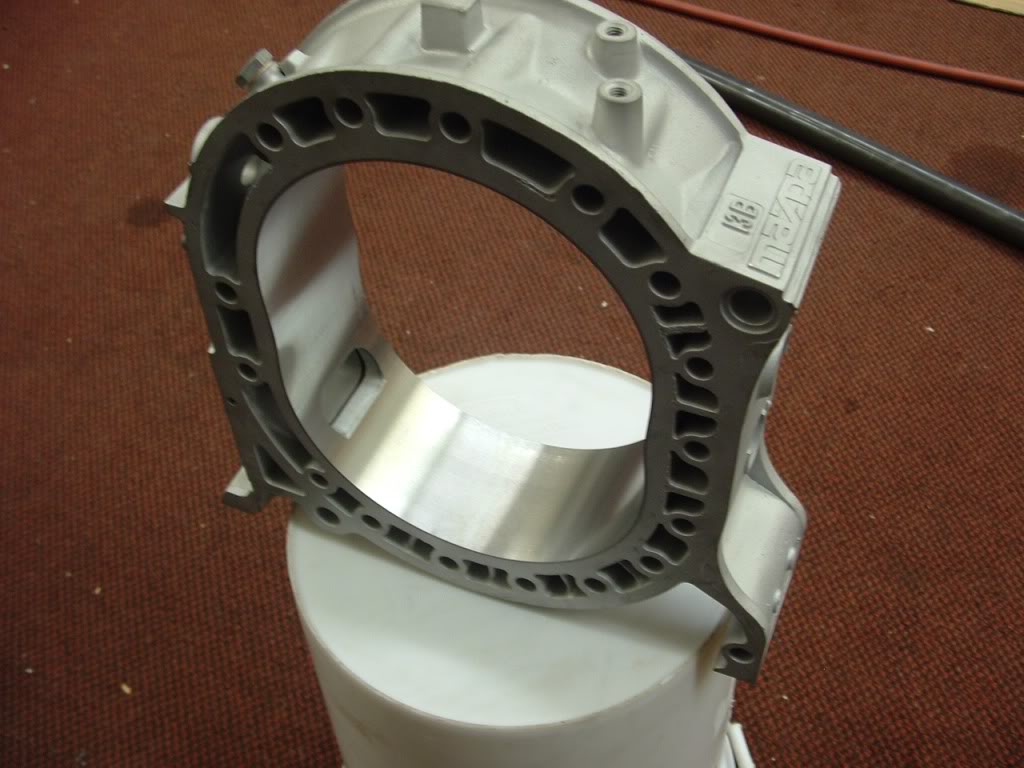
The picture above is a resurfaced rotor housing done by Goopy Performance.
It's not re-chromed or has added material,just machined to a flat workable surface,
it has potential and very cheap,but the results will vary depending on how bad of a condition your housing was,and still no real millage numbers have been posted so who knows how long it will last.
I am very curious of what resurface technique Goopy employed on the rotor housing without messing up the geometry the housing it's self?
Last edited by Chuck Norris FB; Dec 21, 2010 at 08:06 PM.
Old [Sch|F]ool
Joined: May 2001
Posts: 12,876
Likes: 575
From: Cleveland, Ohio, USA
You're right, the process I mentioned has nothing to do with rotor housings.
The process I mentioned involved fairly simple machining operations, using pre-existing tooling and jigging, and components that are pretty much off the shelf.
You're proposing a much more difficult operation, the likes of which haven't been done before and so the processes have yet to be sorted out, using components that have yet to be engineered, designed, and produced. Much less simple than just sleeving a block.
The rotor housings (except for pre-1974, and MFR engines) are corrugated sheet steel that has the aluminum cast around it, and is chrome plated. The chrome is then partially de-plated, to make it spongelike. Later housings had coatings added as well. The sheetmetal is very easy to see if you look closely at the side of the rotor housing, or just pull apart a 3mm seal engine that has more than about 150k on it and it's worn through the chrome in spots
The older engines and the MFR housings, I'm told, don't have the sheetmetal. Just chrome on aluminum. They don't like iron seals very much, pulls the chrome right off. (I've never played with one so I have no firsthand knowledge)
BTW - The alleged Chinese bus engines are iron seals on iron rotor housings. No chrome. They (again, allegedly) run for 25-60,000 km between rebuilds. There's a lot of alleged going around because info on these engines is very hard to come by. Six of "military secrets", half a dozen of "whole lotta infringement goin' on". Kind of like the mysteriously-Mazdalike Lada engines, without all the perestroika.
Also BTW - American military aircraft cylinders were ground (not bored) to size and chrome-plated. Were expected to run at 80-90% of max rated power for 5,000 hours between overhauls. (Drive a stock 12A RX-7 at 100mph for 500,000 miles) Think about how much effort was spent in making those engines phenomenally durable as you watch historical footage of aircraft being jettisoned at sea...
The process I mentioned involved fairly simple machining operations, using pre-existing tooling and jigging, and components that are pretty much off the shelf.
You're proposing a much more difficult operation, the likes of which haven't been done before and so the processes have yet to be sorted out, using components that have yet to be engineered, designed, and produced. Much less simple than just sleeving a block.
The rotor housings (except for pre-1974, and MFR engines) are corrugated sheet steel that has the aluminum cast around it, and is chrome plated. The chrome is then partially de-plated, to make it spongelike. Later housings had coatings added as well. The sheetmetal is very easy to see if you look closely at the side of the rotor housing, or just pull apart a 3mm seal engine that has more than about 150k on it and it's worn through the chrome in spots
The older engines and the MFR housings, I'm told, don't have the sheetmetal. Just chrome on aluminum. They don't like iron seals very much, pulls the chrome right off. (I've never played with one so I have no firsthand knowledge)
BTW - The alleged Chinese bus engines are iron seals on iron rotor housings. No chrome. They (again, allegedly) run for 25-60,000 km between rebuilds. There's a lot of alleged going around because info on these engines is very hard to come by. Six of "military secrets", half a dozen of "whole lotta infringement goin' on". Kind of like the mysteriously-Mazdalike Lada engines, without all the perestroika.
Also BTW - American military aircraft cylinders were ground (not bored) to size and chrome-plated. Were expected to run at 80-90% of max rated power for 5,000 hours between overhauls. (Drive a stock 12A RX-7 at 100mph for 500,000 miles) Think about how much effort was spent in making those engines phenomenally durable as you watch historical footage of aircraft being jettisoned at sea...
Goopy only removes material at this time. They do not add any. Although, there results have been great from what I have seen so far (not personally).
I seen somewhere that they will be re-chroming by late 2011? Hopefully that's true...
But as far as removing the old steel liner and pressing in a new one, it's not going to happen. Don't expect any company, anytime soon to do this. It's one of those things where you need some type of back round to understand it. I am by no means some sort of know-it-all machinist. But I know what it takes to do this, and it's just not going to happen.
Best bet would be to mill out the entire chrome plating, fill the gouged metal liner by welding, Milling again. Then re-chroming or cermet coatings and milling again. But ceramic coatings have been nothing but problems so far. This cost would also be high i'm sure.
I seen somewhere that they will be re-chroming by late 2011? Hopefully that's true...
But as far as removing the old steel liner and pressing in a new one, it's not going to happen. Don't expect any company, anytime soon to do this. It's one of those things where you need some type of back round to understand it. I am by no means some sort of know-it-all machinist. But I know what it takes to do this, and it's just not going to happen.
Best bet would be to mill out the entire chrome plating, fill the gouged metal liner by welding, Milling again. Then re-chroming or cermet coatings and milling again. But ceramic coatings have been nothing but problems so far. This cost would also be high i'm sure.


Joined: Mar 2001
Posts: 31,851
Likes: 3,239
From: https://www2.mazda.com/en/100th/
The rotor housings (except for pre-1974, and MFR engines) are corrugated sheet steel that has the aluminum cast around it, and is chrome plated. The chrome is then partially de-plated, to make it spongelike. Later housings had coatings added as well. The sheetmetal is very easy to see if you look closely at the side of the rotor housing, or just pull apart a 3mm seal engine that has more than about 150k on it and it's worn through the chrome in spots
The older engines and the MFR housings, I'm told, don't have the sheetmetal. Just chrome on aluminum. They don't like iron seals very much, pulls the chrome right off. (I've never played with one so I have no firsthand knowledge)
to do a press in liner, would require a whole new design, basically.
i think the MFR housings are sand cast, machined and chromed. they are kind of low tech, but they are meant to be run for 24 hours and thrown out....
As an experiment I would like to try a ductile iron insert used in conjunction with some softer apex seals. (example: ALS)
My reasoning - one of the main reasons chrome is used is for it's high resistance to galling. Therefor it would probably turn out that Mazda apex seals wouldn't be the seal of choice when softening the surface they slide on. Ductile iron being softer should require softer seals to resist galling.
lets say 60,000km (~37k miles) is all you could get out of a set of iron inserts. It is still well worth it to me because in the 6 years I've owned my car i have maybe put 25k on it. not to mention this would allow for a lot of ease of mind and expand confidence in tuning and experimentation by having to not worry so much about damaging housings.. (assuming the cost was minimal to have a new insert pressed in.)
My reasoning - one of the main reasons chrome is used is for it's high resistance to galling. Therefor it would probably turn out that Mazda apex seals wouldn't be the seal of choice when softening the surface they slide on. Ductile iron being softer should require softer seals to resist galling.
lets say 60,000km (~37k miles) is all you could get out of a set of iron inserts. It is still well worth it to me because in the 6 years I've owned my car i have maybe put 25k on it. not to mention this would allow for a lot of ease of mind and expand confidence in tuning and experimentation by having to not worry so much about damaging housings.. (assuming the cost was minimal to have a new insert pressed in.)
Old [Sch|F]ool
Joined: May 2001
Posts: 12,876
Likes: 575
From: Cleveland, Ohio, USA
25k is about a year's worth of driving for me, including the fact that I put the car up for the winter.
Just sayin'.
For the effort, you may as well look into entire housings instead of inserts. The really difficult part is the inner surface, after all. The rest is just an exhaust port, some skin to hold the coolant in, some bungs for the spark plugs, and a couple oil pan rails. That would appear to me to be simpler than trying to design a coolant- and compression-tight interface around components that were not designed to be any more than one-piece and disposable.
Wonder if Dart or Brodix would be interested. Hmm.
- Pete (In before the B word)
Just sayin'.
For the effort, you may as well look into entire housings instead of inserts. The really difficult part is the inner surface, after all. The rest is just an exhaust port, some skin to hold the coolant in, some bungs for the spark plugs, and a couple oil pan rails. That would appear to me to be simpler than trying to design a coolant- and compression-tight interface around components that were not designed to be any more than one-piece and disposable.
Wonder if Dart or Brodix would be interested. Hmm.
- Pete (In before the B word)
Thread Starter
Banned. I got OWNED!!!
Joined: Aug 2009
Posts: 297
Likes: 0
From: Chicago,IL

Once Again people read my previous post,this is not DIY. simply suggesting this idea to any manufacture that already has the equipment or with little added investment needed to manufacture the 3mm thick sleeve,This concept is well with in mazdas capabilities to manufacture and i will be sending them an email with greater detail of the concept than what i have already stated on this thread.
Peejay you have misunderstood the housing Sleeve concept twice,Don't take this personally Because it's my fault that i don't have a CAD for everyone to see. the sleeve it's self is aprox 3mm thick which means it's no where near the coolant jackets. The interlocking channels for which this 3mm sleeve is mate with the prepared rotor housing to seal off the combustion pressure, is of i would describe has having gear teeth of extreme small proportions at extremely close intervals from one another.
If you have any more questions feel free to ask.
Personally i think this sleeve concept is very doable and i know some of the type of equipment that is needed,the process and the detailed steps for which to manufacture it. (not DIY friendly)
Image spending half for a removable oem quality sleeve than having to buy a full priced rotor housing that your will have to throw away entirely.
Peejay you have misunderstood the housing Sleeve concept twice,Don't take this personally Because it's my fault that i don't have a CAD for everyone to see. the sleeve it's self is aprox 3mm thick which means it's no where near the coolant jackets. The interlocking channels for which this 3mm sleeve is mate with the prepared rotor housing to seal off the combustion pressure, is of i would describe has having gear teeth of extreme small proportions at extremely close intervals from one another.
If you have any more questions feel free to ask.
Personally i think this sleeve concept is very doable and i know some of the type of equipment that is needed,the process and the detailed steps for which to manufacture it. (not DIY friendly)
Image spending half for a removable oem quality sleeve than having to buy a full priced rotor housing that your will have to throw away entirely.
Last edited by Chuck Norris FB; Dec 29, 2010 at 05:46 AM.

I understood what you meant, I just do not think it will work. I have used a variety of sleeves over the years, and even the top end Dart MDS sleeves area PITA. You are not taking into account thermal expansion, fretting, or much else beyond what it would take to slide a sleeve into place. The seal at the spark plugs alone will drive use mad with failure points.
Now, there is some work being done out there to be able to repair worn out housings- Goopy can resurface them and is working ona process to strip the OEM chrome lining off then re-chrome them. If that works then even housings with deep scratches, galling etc have the potential to live again, as the sheet metal substrate can be repaired prior to the rechroming process, giving an as-new housing for very reasonable money.
I personally am working on another angle, using a set of Goopy resurfaced housings I am going to have them Nikasil coated along with a set of resurfaced irons.
With the irons this is a twofold fix- first, the issue of the hard nitriding being removed when the irons are resurfaced will be moot, as the Nikasil surface is far more durable, and second the Nikasil will reduce wear to the side and corner seals quite a bit.
The Nikasil-coated rotor housings will also reduce wear as well as providing a better seal.
Lastly, I am having a set of corner seals Casidiam coated, which is a vapor deposted thin film process that yeilds an exceptionally smooth and hard surface with again, exceptional wear resistance. This will also reduce friction at the corner seals themselves, which is again desirable.
Everything I am doing has to do with making motors last a very very long time. We now have the technology to build 700hp street engines and have apex seals so durable the rotors fail before the seals do, so its time to really look at the rest of the engine. I am familiar with the Cermet processes, and think they work just fine, but are somewhat expensive. On the other hand Nikasil coated resurfaced housings and irons should be very cost effective and work extremely well.
Now, there is some work being done out there to be able to repair worn out housings- Goopy can resurface them and is working ona process to strip the OEM chrome lining off then re-chrome them. If that works then even housings with deep scratches, galling etc have the potential to live again, as the sheet metal substrate can be repaired prior to the rechroming process, giving an as-new housing for very reasonable money.
I personally am working on another angle, using a set of Goopy resurfaced housings I am going to have them Nikasil coated along with a set of resurfaced irons.
With the irons this is a twofold fix- first, the issue of the hard nitriding being removed when the irons are resurfaced will be moot, as the Nikasil surface is far more durable, and second the Nikasil will reduce wear to the side and corner seals quite a bit.
The Nikasil-coated rotor housings will also reduce wear as well as providing a better seal.
Lastly, I am having a set of corner seals Casidiam coated, which is a vapor deposted thin film process that yeilds an exceptionally smooth and hard surface with again, exceptional wear resistance. This will also reduce friction at the corner seals themselves, which is again desirable.
Everything I am doing has to do with making motors last a very very long time. We now have the technology to build 700hp street engines and have apex seals so durable the rotors fail before the seals do, so its time to really look at the rest of the engine. I am familiar with the Cermet processes, and think they work just fine, but are somewhat expensive. On the other hand Nikasil coated resurfaced housings and irons should be very cost effective and work extremely well.
Old [Sch|F]ool
Joined: May 2001
Posts: 12,876
Likes: 575
From: Cleveland, Ohio, USA
Peejay you have misunderstood the housing Sleeve concept twice,Don't take this personally Because it's my fault that i don't have a CAD for everyone to see. the sleeve it's self is aprox 3mm thick which means it's no where near the coolant jackets. The interlocking channels for which this 3mm sleeve is mate with the prepared rotor housing to seal off the combustion pressure, is of i would describe has having gear teeth of extreme small proportions at extremely close intervals from one another.
It would either have to be a lot thinner than 3mm or it would have the be the entire inner surface, else coolant seal integrity will become a factor.
The way I see it, the process will only be able to be performed once on 13B housings in order to make 12A housings, because you will need to "deck" both mating surfaces. Proper housing thickness is hard enough to get as it is, without losing a few thousandths to clean-up milling.
On top of that, whenever this kind of thing is done with any kind of useful press fit, both components will be measurably warped and will require machining to size. So, in addition to having to true the mating faces, it's highly likely that the apex seal surface will also need to be trued flat again.
If you don't use a hefty press fit, wear between the sleeve and the housing will probably be rapid. The rotor housing doesn't stay still at all when the engine - relative motion between the rotor housing and the side housing is what causes the chrome to flake off of the edges. On a small scale the rotor housing is bowing out and resetting with every cycle as the engine turns. (Until you detonate and it bows hard enough to break a dowel pin that is!)
Thats very true and unless you get an amazing press fit the fretting- the movement of the 'sleeve" relative to the housing- will be a major issue. Not even sure exactly how you would be able to control it effectively. Mechanical means such as interlocking ribs or pins introduce another failure point, and AFAIK there is no useful/cost effective adhesive, and while you could maybe use a sprayed plasma welding technique, once again, its just not going to be cost effective.
You know honestly, it would likely be more cost effective to simply have the sleeves machined and new housings cast around them the same way Mazda does then have them chrome lined, again as Mazda does, than to rig up a sleeve.
In fact, based on my recent experiences with medium scale casting of cast iron and aluminum bits in China, my guess is a run of say, 1000 pairs (that 2000 individuals for the challenged) made up for about $300 a set, maybe a tick more for the chrome lining. Figure $750 to get them here in a container, and another $1000 in customs fees, and it is a financially feasible project. You certianly are NOT going to have a custom sleeve made and installed for under $400 each.
Now, lets say I had 1000pairs done in chrome, and another 1000pairs done in Nikasil, hmmmmmm very interesting, as my guess is that the Nikasil will add only $100 per housing to have done here in the states. Now it would be interesting, because the housings would actually sell for less than the OEM ones and seal and wear better.
Now of course the problem is that there would be the usual BS about quality, but I just brought in some samples of cast iron uprights, and the samples, though not production bits and a little rough, were better and more dimensionally accurate than the original OEM version. Its all in the quality you are willing to pay for. Sure we can buy cheaper bits from other manufacturers, but paying 3-5$ more per piece insures a higher level of QC.
Anywho, off the soapbox now...
You know honestly, it would likely be more cost effective to simply have the sleeves machined and new housings cast around them the same way Mazda does then have them chrome lined, again as Mazda does, than to rig up a sleeve.
In fact, based on my recent experiences with medium scale casting of cast iron and aluminum bits in China, my guess is a run of say, 1000 pairs (that 2000 individuals for the challenged) made up for about $300 a set, maybe a tick more for the chrome lining. Figure $750 to get them here in a container, and another $1000 in customs fees, and it is a financially feasible project. You certianly are NOT going to have a custom sleeve made and installed for under $400 each.
Now, lets say I had 1000pairs done in chrome, and another 1000pairs done in Nikasil, hmmmmmm very interesting, as my guess is that the Nikasil will add only $100 per housing to have done here in the states. Now it would be interesting, because the housings would actually sell for less than the OEM ones and seal and wear better.
Now of course the problem is that there would be the usual BS about quality, but I just brought in some samples of cast iron uprights, and the samples, though not production bits and a little rough, were better and more dimensionally accurate than the original OEM version. Its all in the quality you are willing to pay for. Sure we can buy cheaper bits from other manufacturers, but paying 3-5$ more per piece insures a higher level of QC.
Anywho, off the soapbox now...
Joined: Mar 2001
Posts: 31,851
Likes: 3,239
From: https://www2.mazda.com/en/100th/
the Mazda pieces are excellent, they are 100,000mile parts that are also capable of big power numbers, but they are TOO EXPENSIVE. MSRP on an new FD rotor housing is in the $800+ range, which is about DOUBLE what it was 10 years ago.
so we reuse....
this means there IS a market for a housing that is NEW, at a reasonable price even if it doesn't last 100,000miles.
it does seem like everyone except PJ, puts on very few miles on their toy/race cars AND we're all afraid of blowing em up, cause it costs so much to rebuild

talking head

Joined: Apr 2008
Posts: 2,775
Likes: 15
From: Perth, WA, OZ
ahem,,
firstly goopy is REMOVING material only,,
they are not re-plating,, and i have seen them post on several sites to that extent
secondly ,, i think you are all wrong when your assuming it is a machining process
-- and i am bound not to elaborate----
\
thirdly,, glassman is posting on other forums about a rechrome process in trial ,,
and i was needling him for hints to the process,, and hinting heavily to him regards nikasil
-not to steal his process,, but rather hoping to push him in the right direction for the common good
( and his seals are apparently used successfully in nikasil and direct iron housings in some UAV applications )
the idea of surface facing/reconditioning housings and also re-chroming has been around a while,,
and fails more than success is the common theme
however,, glassman is onto it ( the rechroming )
and all are hoping for a successful trial result with pineapple
there is several other players around in other nations/ markets
that have twigged ( or rather had been there before )
to the almost obvious process that goopy are using to take the housing back to a common smooth surface
and again i cannot elaborate further so as to allow things to take there natural evolution without market pressure
firstly goopy is REMOVING material only,,
they are not re-plating,, and i have seen them post on several sites to that extent
secondly ,, i think you are all wrong when your assuming it is a machining process
-- and i am bound not to elaborate----
\
thirdly,, glassman is posting on other forums about a rechrome process in trial ,,
and i was needling him for hints to the process,, and hinting heavily to him regards nikasil
-not to steal his process,, but rather hoping to push him in the right direction for the common good
( and his seals are apparently used successfully in nikasil and direct iron housings in some UAV applications )
the idea of surface facing/reconditioning housings and also re-chroming has been around a while,,
and fails more than success is the common theme
however,, glassman is onto it ( the rechroming )
and all are hoping for a successful trial result with pineapple
there is several other players around in other nations/ markets
that have twigged ( or rather had been there before )
to the almost obvious process that goopy are using to take the housing back to a common smooth surface
and again i cannot elaborate further so as to allow things to take there natural evolution without market pressure

Removing the insert without destroying the housing isn't going to happen. Even if someone could get get them out efficiently on a large scale, machining the housings and then coming up with some other insert doesn't really seem cost effective, Chuck.
If anything, since Mazda stopped production on the older housing, they should sell off the tooling, molds, information and rights to making them. But I'm sure that's not happening since the Renesis housings are basically the same thing, minus the exhaust port.
If anything, since Mazda stopped production on the older housing, they should sell off the tooling, molds, information and rights to making them. But I'm sure that's not happening since the Renesis housings are basically the same thing, minus the exhaust port.
Goopys current RESURFACING process removes material, and it works. HOWEVER, Goopy is working on a process that, in my understanding, strips the existing chrome layer from the sheet metal substrate, then re-chromes the surface back to as-new condition. My understanding is they are close, maybe as close as 3-6 months out frombeing able to make it available. This would indicate they have it in at least testing somewhere.
Nikasil is not a new idea for this application, and in fact I believe Mazda themselves used Nikasil housings and irons in some of thier race engines, and I have it on reasonable authority that others in the industry have successfully proven them out but the "market" ignored the results. I believe that was due to the fact that at the time good used cores were plentiful and new housings were cheap. This is no longer the case, and its not likely to get any better.
There may also have been issues in the Nikasil coatings themselves either "stripping" from the substrates or chewing up apex, side, and corner seals rapidly. These are all issues with Nikasil we have since solved.
The Casidiam coatings are the most interesting for use on the corner seals, as the solid corner seals, being cast iron as opposed to the electroless nickel plated OEM materials, tend to wear and even can gall to the surface of the irons.
I put a lot of information out there, and I do not really care who uses it as it can only help advance what we have available to us to keep these engines alive.
Nikasil is not a new idea for this application, and in fact I believe Mazda themselves used Nikasil housings and irons in some of thier race engines, and I have it on reasonable authority that others in the industry have successfully proven them out but the "market" ignored the results. I believe that was due to the fact that at the time good used cores were plentiful and new housings were cheap. This is no longer the case, and its not likely to get any better.
There may also have been issues in the Nikasil coatings themselves either "stripping" from the substrates or chewing up apex, side, and corner seals rapidly. These are all issues with Nikasil we have since solved.
The Casidiam coatings are the most interesting for use on the corner seals, as the solid corner seals, being cast iron as opposed to the electroless nickel plated OEM materials, tend to wear and even can gall to the surface of the irons.
I put a lot of information out there, and I do not really care who uses it as it can only help advance what we have available to us to keep these engines alive.
Old [Sch|F]ool
Joined: May 2001
Posts: 12,876
Likes: 575
From: Cleveland, Ohio, USA
Funny enough I got the idea to do it from things other engine builders have posted
