


FD Side Seal Clearance


Thread Starter
Full Member

Joined: Jul 2001
Posts: 75
Likes: 0
From: Rockford, IL
FD Side Seal Clearance
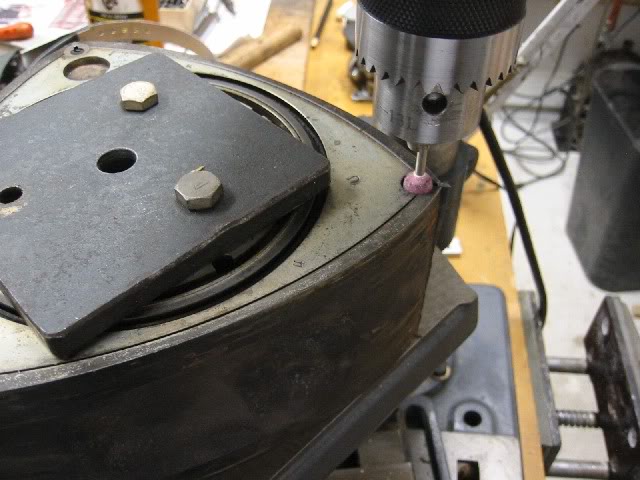
I'm working on my first rotary engine rebuild (FD) and can't quite figure out what proper side seal clearance should feel like with a feeler gauge and/or visually look like. I am grinding the side seal ends in a dead rotor with a 0.4" diameter stone so I have a radius on each end that nicely matches the corner seal radius. I have all the side and corner seals installed in each face when I check with the feeler gauge. I can get a 0.002-0.003" feeler gage to slide with drag but I believe the side seal is deforming a tiny bit in the groove to allow room for the feeler gauge. The curved surfaces makes checking with a feeler gage difficult to assess proper drag. I can't "feel" any axial clearance in the side seals with the feeler gage removed by trying to slide the side seal back and forth in its groove by hand. With a handheld 52x digital microscope I also can't see any real clearance between the side and corner seals (see attached image) either.
When I depress all corner and side seals at once with a block of wood, they all spring back nice but if I push on an individual side seal the ends hang down a bit. Push the corner seal and the side seal ends will pop back out. I can also remove and reinstall one at a time each corner seal with the side seals in place. Right now with all the side and corner seals installed I can tip the rotor upside down and nothing falls out.
Are my side seals to tight?
Any advice would be greatly appreciated,
Glenn
When I depress all corner and side seals at once with a block of wood, they all spring back nice but if I push on an individual side seal the ends hang down a bit. Push the corner seal and the side seal ends will pop back out. I can also remove and reinstall one at a time each corner seal with the side seals in place. Right now with all the side and corner seals installed I can tip the rotor upside down and nothing falls out.
Are my side seals to tight?
Any advice would be greatly appreciated,
Glenn

As long as the .002 feeler passes through, your good. .002 is minimal factory clearance and perfectly fine if your trying to build a tight engine with great compression. I usually try to go. 003 on the rear rotor cause it gets hotter back there so you need a little bit more expansion room. If those clearances are too loose, the engine will never make good compression as each rotor face will have 4 leak points at those 4 corners. Your pic looks perfect.




Old [Sch|F]ool


Joined: May 2001
Posts: 12,862
Likes: 568
From: Cleveland, Ohio, USA
N/A, as long as the seals can still pop back up then they're good enough. Centrifugal force throws the seals outwards and the gaps open up, also the ends of the seal will never be PERFECT and they will wear off against the corner seal... or dig into the corner seal...
I build to .0015" gap, which is "just barely loose enough to pop up".
I've also built engines that had gaps in the .008-.012 range and they worked fine too. Didn't have the low RPM "pop" of the tight engines, but they did work just fine.
I build to .0015" gap, which is "just barely loose enough to pop up".
I've also built engines that had gaps in the .008-.012 range and they worked fine too. Didn't have the low RPM "pop" of the tight engines, but they did work just fine.
Trending Topics



Joined: Mar 2001
Posts: 30,804
Likes: 646
From: FL-->NJ/NYC again!
Loose side seal clearances are unacceptable IMO, and lead to an engine with excessive blowby and oil that quickly gets diluted with fuel. one and a half thousandths is indeed the way to go, but I don't go much looser, even for high powered (500+) turbo engines.
Old [Sch|F]ool
Joined: May 2001
Posts: 12,862
Likes: 568
From: Cleveland, Ohio, USA
You'd think that, but I never noticed a difference. My tight clearance engines would add a quart every 1000-1500mi just like the loose ones.
Old [Sch|F]ool
Joined: May 2001
Posts: 12,862
Likes: 568
From: Cleveland, Ohio, USA


So an extra quart of fluid (fuel) in your oil is actually considered normal and OK? Just curious, had some oil/fuel dilution issues and about a quart was how much I would notice it gained. Should it only be happening while the car is on? I notice I get some fuel in my oil while the car is off. Fuel rails were removed so I know it wasn't the injectors. Been thinking about running a thicker oil because of the dilution. I know 20w50 is controversial but popular.
How long is it taking it for the fuel to dilute one fuel quart in the sump?
"Elusive, not deceptive!”
Joined: May 2007
Posts: 930
Likes: 13
From: Slidell, LA
This is how you can grind them for 100% contact on the drive end and exact clearance at the other end.
(it decreases wear rate like an uneven cut would do)
This is how you can have zero clearance for the life of the engine.

(it decreases wear rate like an uneven cut would do)

This is how you can have zero clearance for the life of the engine.

Old [Sch|F]ool
Joined: May 2001
Posts: 12,862
Likes: 568
From: Cleveland, Ohio, USA
Bear in mind - I am tuned fairly rich for drivability reasons, and being a bridge port, half the time at idle and coasting the engine is misfiring so that's all that much more fuel wash happening.

Thread
Thread Starter
Forum
Replies
Last Post
