


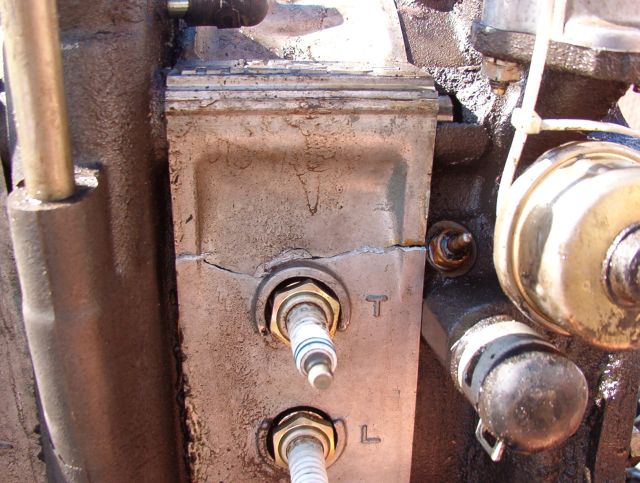
crack rotor housing


talking head

Joined: Apr 2008
Posts: 2,775
Likes: 15
From: Perth, WA, OZ
too hot a trailing plug from the outset
.. curiously the issue is far less common in australia
where i have dealt with a lot of housings and always looked out for the issue , and have only seen it a couple of times and only in the N326 housings
( which has same leading spark location as the US s4 NA and US only s4 T housings )
the hotter the plug , the less it can radiate heat away from the tips and out through the threads
i would suspect it is the higher resulting temperature differential between the plug surface area and the threads that is causing distortion
.. curiously the issue is far less common in australia
where i have dealt with a lot of housings and always looked out for the issue , and have only seen it a couple of times and only in the N326 housings
( which has same leading spark location as the US s4 NA and US only s4 T housings )
the hotter the plug , the less it can radiate heat away from the tips and out through the threads
i would suspect it is the higher resulting temperature differential between the plug surface area and the threads that is causing distortion
Last edited by bumpstart; Sep 10, 2013 at 06:03 PM.


Trending Topics



this might be a stupid question, but it didn't freeze did it?
Front or rear rotor?
Check engine mounts. Often if there is a dowel issue on the rear rotor (pretty much all dowel issues are on the rear rotor anyway) you will find that the engine mounts are damaged, as there is more stress on the dowels if all the torque is being transferred through the block instead of the mounts. Usually dowel problems result from high temperatures + knock. I have never before seen a case where the rotor housing failed before the iron though. What power level is this running? Maybe it is more a result of super high cylinder pressures without knock since you are running E85?
Can you see any casting flaws or anything that may have weakened that area? If it were my engine I would break it the rest of the way apart and try to see if there are any material defects and/or any signs of fatigue cracking.
Front or rear rotor?
Check engine mounts. Often if there is a dowel issue on the rear rotor (pretty much all dowel issues are on the rear rotor anyway) you will find that the engine mounts are damaged, as there is more stress on the dowels if all the torque is being transferred through the block instead of the mounts. Usually dowel problems result from high temperatures + knock. I have never before seen a case where the rotor housing failed before the iron though. What power level is this running? Maybe it is more a result of super high cylinder pressures without knock since you are running E85?
Can you see any casting flaws or anything that may have weakened that area? If it were my engine I would break it the rest of the way apart and try to see if there are any material defects and/or any signs of fatigue cracking.

Thread Starter
Senior Member

Joined: Nov 2006
Posts: 472
Likes: 16
From: connecticut
the issue was on the rear rotor only,irons are good everything seen good no sings of knock on plugs, egt was on 1300f the car made 397 h.p@14 psi when I increase the boost to 21 psi the housing explode.the engine its all apart for a total inspection its everything look good put it back together.
doubt it was freeze related since it hasn't been that cold, yet and after his reply it rules that out.
simply sounds like engine twist due to too much timing, but this is a rather rare failure mode result.
check the rotor and housing for any scuff/witness marks of contact, they may be very minor but that is all it takes.
simply sounds like engine twist due to too much timing, but this is a rather rare failure mode result.
check the rotor and housing for any scuff/witness marks of contact, they may be very minor but that is all it takes.

yep, the only other time i have seen anything similar was when a rotor tried to escape the engine...

but i could envision the rotor tapping the trochoid surface could put enough pressure on the housing to crack it while not causing such extensive damage. or there simply was so much pressure from a detonation cycle that the housing deformed before the rotor/seals gave up(weak aluminum casting or flawed/dirty aluminum mix).
but i could envision the rotor tapping the trochoid surface could put enough pressure on the housing to crack it while not causing such extensive damage. or there simply was so much pressure from a detonation cycle that the housing deformed before the rotor/seals gave up(weak aluminum casting or flawed/dirty aluminum mix).
Last edited by RotaryEvolution; Sep 13, 2013 at 02:08 PM.

You said u turned the boost up.
Detonation. Not enough fuel or too much timing.
Not enough octane
I've done away with trailing ignition all together to avoid this type of problem.
What is you timing under boost ?
What's was ur a/f under boost?
What fuel pump and regulator are u using?
Detonation. Not enough fuel or too much timing.
Not enough octane
I've done away with trailing ignition all together to avoid this type of problem.
What is you timing under boost ?
What's was ur a/f under boost?
What fuel pump and regulator are u using?

Joined: Mar 2001
Posts: 31,851
Likes: 3,239
From: https://www2.mazda.com/en/100th/
i saw that page... scares the hell out of me when i think of what could happen with a stock flywheel when it happens.
luckily these sort of failures are extremely rare.
the damage of yours looks a little less extensive but on the FD engine i got in, the key managed to hold back the stock flywheel and only sheared it half way through(likely because there was no load on the engine when it let go).
luckily these sort of failures are extremely rare.
the damage of yours looks a little less extensive but on the FD engine i got in, the key managed to hold back the stock flywheel and only sheared it half way through(likely because there was no load on the engine when it let go).
Last edited by RotaryEvolution; Sep 13, 2013 at 06:11 PM.
Joined: Mar 2001
Posts: 31,851
Likes: 3,239
From: https://www2.mazda.com/en/100th/
i saw that page... scares the hell out of me when i think of what could happen with a stock flywheel when it happens.
luckily these sort of failures are extremely rare.
the damage of yours looks a little less extensive but on the FD engine i got in, the key managed to hold back the stock flywheel and only sheared it half way through(likely because there was no load on the engine when it let go).
luckily these sort of failures are extremely rare.
the damage of yours looks a little less extensive but on the FD engine i got in, the key managed to hold back the stock flywheel and only sheared it half way through(likely because there was no load on the engine when it let go).
Thread Starter
Senior Member
Joined: Nov 2006
Posts: 472
Likes: 16
From: connecticut
You said u turned the boost up.
Detonation. Not enough fuel or too much timing.
Not enough octane
I've done away with trailing ignition all together to avoid this type of problem.
What is you timing under boost ?
What's was ur a/f under boost?
What fuel pump and regulator are u using?
Detonation. Not enough fuel or too much timing.
Not enough octane
I've done away with trailing ignition all together to avoid this type of problem.
What is you timing under boost ?
What's was ur a/f under boost?
What fuel pump and regulator are u using?
12 deg on timing and 10 split
2 bosch 044 and a aeromotive regulator
egt 1300 deg.