


Balancing Oil pressure


Thread Starter
Rotary Freak

Joined: Nov 2001
Posts: 2,715
Likes: 1
From: trinidad and tobago
 Balancing Oil pressure
I've been talking to a guy who told me about a mod where a hole is drilled into the front and rear irons (plates) on the left side of the motor. The holes are then tapped and connected via a length of braided hose , he said this is to connect the oil port/s and balances the oil pressures within both plates ??!!. anyone know about this mod ??, anyone have any detail ??, what are the benefits ??


Rotary Enthusiast
Joined: Oct 2002
Posts: 1,165
Likes: 0
From: California, Bay Area
It's called a loop line,... it makes sure the rear( i think) main bearing gets as much pressure as the front,.. another point of this mod is that you can then block off the oil passage that goes thru the dowl pins,.. so cracking the plate here is no longer an problem

BDC Motorsports
Joined: Jun 2002
Posts: 3,667
Likes: 6
From: Grand Prairie, TX
Originally Posted by drago86
It's called a loop line,... it makes sure the rear( i think) main bearing gets as much pressure as the front,.. another point of this mod is that you can then block off the oil passage that goes thru the dowl pins,.. so cracking the plate here is no longer an problem


B

Lives on the Forum
Joined: Feb 2001
Posts: 26,664
Likes: 22
From: n
Originally Posted by drago86
another point of this mod is that you can then block off the oil passage that goes thru the dowl pins,.. so cracking the plate here is no longer an problem
-Ted
Rotary Enthusiast
Joined: Oct 2002
Posts: 1,165
Likes: 0
From: California, Bay Area
sorry BDC,.. i havnt actually done this, only heard about it from you and other,.. i guess i got some of the details mixed up.
Reted,.. it is my understanding that when if the plate cracks you dont care as much,.. not so much prevention as making it not so screwed if it does happen type of thing.
Reted,.. it is my understanding that when if the plate cracks you dont care as much,.. not so much prevention as making it not so screwed if it does happen type of thing.
Lives on the Forum
Joined: Feb 2001
Posts: 26,664
Likes: 22
From: n
Originally Posted by drago86
Reted,.. it is my understanding that when if the plate cracks you dont care as much,.. not so much prevention as making it not so screwed if it does happen type of thing.
Most of the time, the rotors ends up contacting the rotor housing, and havoc ensues.
At the very least, the rotor and rotor housing are goners.
Extreme case...
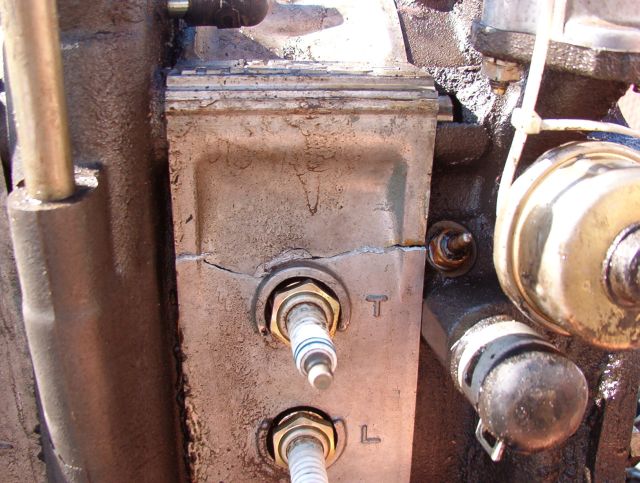
More pics of the same motor...
http://fc3spro.com/TECH/HOF/K2RD/k2rdhof01.html
I would think the pressurized oil would make for less flex.
Think of a straw...when empty, it bend very easily.
Fill the straw up with your favorite drink and bend each end to seal the straw and liquid in - try and bend it now?
-Ted
Trending Topics
Thread Starter
Rotary Freak
Joined: Nov 2001
Posts: 2,715
Likes: 1
From: trinidad and tobago
BDC , thanks for the replies and pics you put up . However , I can't figure it all out , can you do a simplified drawing and post it so that I can trace all the oil lines , including the original ones ? , thanks again.

adiabaticly inefficient
Joined: Aug 2001
Posts: 386
Likes: 0
From: nw houston,TX or w. hollywood,CA
holy crap
Originally Posted by RETed
Trust me, when the dowel mounts crack, your motor is basically screwed.
Most of the time, the rotors ends up contacting the rotor housing, and havoc ensues.
At the very least, the rotor and rotor housing are goners.
Extreme case...
More pics of the same motor...
http://fc3spro.com/TECH/HOF/K2RD/k2rdhof01.html
I would think the pressurized oil would make for less flex.
Think of a straw...when empty, it bend very easily.
Fill the straw up with your favorite drink and bend each end to seal the straw and liquid in - try and bend it now?
-Ted
Most of the time, the rotors ends up contacting the rotor housing, and havoc ensues.
At the very least, the rotor and rotor housing are goners.
Extreme case...
More pics of the same motor...
http://fc3spro.com/TECH/HOF/K2RD/k2rdhof01.html
I would think the pressurized oil would make for less flex.
Think of a straw...when empty, it bend very easily.
Fill the straw up with your favorite drink and bend each end to seal the straw and liquid in - try and bend it now?
-Ted

spoon!

Joined: Sep 2002
Posts: 1,208
Likes: 50
From: Dousman, WI
Originally Posted by RETed
I would think the pressurized oil would make for less flex.
Think of a straw...when empty, it bend very easily.
Fill the straw up with your favorite drink and bend each end to seal the straw and liquid in - try and bend it now?
Think of a straw...when empty, it bend very easily.
Fill the straw up with your favorite drink and bend each end to seal the straw and liquid in - try and bend it now?

Rotary Enthusiast

Joined: Jan 2003
Posts: 1,255
Likes: 0
From: fl
i thought that kind of failure was only possible on high boost engines. so it just "let go" at 8k, nothing else was determined? all this time i though the worst thing n/a's had to worry about apex seal chatter or failure at that kind of spead. sheesh.
Lives on the Forum
Joined: Feb 2001
Posts: 26,664
Likes: 22
From: n
An ignition timing "glich" was suspected of causing the failure.
Datalogs show the engine was around 8,200RPM when it died.
Yeah, you wouldn't think an NA engine would explode like that, but the pics are real.
-Ted
Datalogs show the engine was around 8,200RPM when it died.
Yeah, you wouldn't think an NA engine would explode like that, but the pics are real.
-Ted
Banned. I got OWNED!!!
Joined: Mar 2001
Posts: 2,306
Likes: 1
From: lebanon
Originally Posted by RETed
An ignition timing "glich" was suspected of causing the failure.
Datalogs show the engine was around 8,200RPM when it died.
Yeah, you wouldn't think an NA engine would explode like that, but the pics are real.
-Ted
Datalogs show the engine was around 8,200RPM when it died.
Yeah, you wouldn't think an NA engine would explode like that, but the pics are real.
-Ted
Interesting failure

No timing glitch can casue that

Statitonary gears do and can fail.
Banned. I got OWNED!!!
Joined: Aug 2002
Posts: 257
Likes: 1
From: Stony Point NY
"Reted"...Trust me, when the dowel mounts crack, your motor is basically screwed.
Most of the time, the rotors ends up contacting the rotor housing, and havoc ensues.
At the very least, the rotor and rotor housing are goners." ..
The damage on this picture is unnecessary.... this should not have happed with a aspirated engine. I bet this engine was assembled incorrectly or out of balance. ..we build engines here and i puerto rico with 190-250 HP of nitrous and we rarly see this..
Most of the time, the rotors ends up contacting the rotor housing, and havoc ensues.
At the very least, the rotor and rotor housing are goners." ..
The damage on this picture is unnecessary.... this should not have happed with a aspirated engine. I bet this engine was assembled incorrectly or out of balance. ..we build engines here and i puerto rico with 190-250 HP of nitrous and we rarly see this..



Couldn't agree more, looks like the e-shaft drove the rotor into the rotor housing and the rest was catastrophic history.
Back on topic, I know Rob of Pineapple Racing offers this mod. Anyone have a detailed description of the mod (were to drill and tap etc) and its full benefits (balances the oil pressure, and I would assume another benefit would be more uniform oil temps from front to rear also)??
~Mike.........
Back on topic, I know Rob of Pineapple Racing offers this mod. Anyone have a detailed description of the mod (were to drill and tap etc) and its full benefits (balances the oil pressure, and I would assume another benefit would be more uniform oil temps from front to rear also)??
~Mike.........


How much detail is needed on this
It can be seen in a pic the line comes right off the oil filter location after the rear regulator and is taped back into the factory block off that leads directly to the front bearing.
It can be seen in a pic the line comes right off the oil filter location after the rear regulator and is taped back into the factory block off that leads directly to the front bearing.


Thread Starter
Rotary Freak
Joined: Nov 2001
Posts: 2,715
Likes: 1
From: trinidad and tobago
Sorry to bring this one back guys , but I'm thinking of doing this mod while i'm at it , so .......... is this mod really worth the trouble ? can I keep my "normal" oil flow with this mod ? Can someone post pics again , BDC's dont work anymore .
I wish I was driving!
Joined: Dec 2001
Posts: 5,241
Likes: 84
From: BC, Canada
The oiling passages of the 13B are as follows: The oil returns from the oil cooler and enters the oil filter. Out of the oil filter, the oil flows straight down the drilled oil passage to the rear stationary gear, and just below the oil filter, the oil hits a 90 degree turn into the dowel pins. The oil flows through the dowel pins to the front iron, where the oil makes another 90 degrees turn and heads straight down. Midway down the iron, the oil makes another 90 degrees turn, and heads straight towards the front stationary gear bearing.
That's 3 90 degree turns to feed the front stationary gear, and basically no turns comparatively to feed the rear stationary gear. Based on the the oil pressure, oil passage diameter, and pump flow rate, its pretty acceptable to see a 3-5 psi drop for each 90 degree turn (this include 90 degree AN fittings!) With the oil pressure regulated to 90 psi at 8000rpm, the front stationary gear will be seeing 75-80 psi. At higher rpms than this, this reduction in pressure can cause severe engine damage that we all know about (such as Ted's pictures above).
The "loop line" reduces this pressure drop by adding a parallel oil passage to the front stationary gear. Typically, an adaptor plate is placed under the oil filter, and a braided steel line is tapped from the filtered oil. The line is run to the front iron, where the factory oil passage plug is drilled out and tapped to fit the other end of the "loop line". Some people block off the upper dowel pins, in an attempt to correct the oil loss problem in the event of cracking a dowel landing, but it essentially defeats the fundamental intent of doing this modification. By adding two parallel oil runs, you severely decrease the pressure drop offered across a single run, especially one with a large number of 90 degree turns. With the loop line in place, the pressure differential between the stationary gears is typically within 2-3 psi at 9000 rpm and 90 psi, with the front stationary still being slightly lower.
At a regulated pressure of 90 psi below the oil filter at 8000 rpm, an enlarged MOP feed in the front cover, in my testing, was hovering well below 70 psi. The MOP feed has an extra 90 degree turn compared to just the front stationary gear, and my location of a pressure sending unit tap (welded to the front cover) added a fifth 90 degree turn... so 5 90 degree turns saw a pressure drop of over 20 psi.
Based on my findings, I decided that this modifcation is only required when spending a lot of time above 8500 rpm, and build engines accordingly. You can base your decisions however you wish.
That's 3 90 degree turns to feed the front stationary gear, and basically no turns comparatively to feed the rear stationary gear. Based on the the oil pressure, oil passage diameter, and pump flow rate, its pretty acceptable to see a 3-5 psi drop for each 90 degree turn (this include 90 degree AN fittings!) With the oil pressure regulated to 90 psi at 8000rpm, the front stationary gear will be seeing 75-80 psi. At higher rpms than this, this reduction in pressure can cause severe engine damage that we all know about (such as Ted's pictures above).
The "loop line" reduces this pressure drop by adding a parallel oil passage to the front stationary gear. Typically, an adaptor plate is placed under the oil filter, and a braided steel line is tapped from the filtered oil. The line is run to the front iron, where the factory oil passage plug is drilled out and tapped to fit the other end of the "loop line". Some people block off the upper dowel pins, in an attempt to correct the oil loss problem in the event of cracking a dowel landing, but it essentially defeats the fundamental intent of doing this modification. By adding two parallel oil runs, you severely decrease the pressure drop offered across a single run, especially one with a large number of 90 degree turns. With the loop line in place, the pressure differential between the stationary gears is typically within 2-3 psi at 9000 rpm and 90 psi, with the front stationary still being slightly lower.
At a regulated pressure of 90 psi below the oil filter at 8000 rpm, an enlarged MOP feed in the front cover, in my testing, was hovering well below 70 psi. The MOP feed has an extra 90 degree turn compared to just the front stationary gear, and my location of a pressure sending unit tap (welded to the front cover) added a fifth 90 degree turn... so 5 90 degree turns saw a pressure drop of over 20 psi.
Based on my findings, I decided that this modifcation is only required when spending a lot of time above 8500 rpm, and build engines accordingly. You can base your decisions however you wish.
Here is a link to a thread of a motor build I did with most all of the wetsump oil mods I know of.
https://www.rx7club.com/rotary-car-performance-77/pics-blue-tiis-engine-build-new-type-primary-port-489429/
Included but not limited to:
oil pump pick up tube velocity stacked
ported oil pump inlet
ported oil pump outlet
shimmed front regulator
relocated outlet to oil cooler
race rear pressure regulator
loop line mod
windowed clearanced stat gear bearings
extra passage in e-shaft rear
teardrop ported e-shaft passages
race rotor oil jets
e-shaft thermal bypass deleted
clearanced deep groove rotor bearings
matchporting all passages
oil pan baffle plate
What did I forget?
https://www.rx7club.com/rotary-car-performance-77/pics-blue-tiis-engine-build-new-type-primary-port-489429/
Included but not limited to:
oil pump pick up tube velocity stacked
ported oil pump inlet
ported oil pump outlet
shimmed front regulator
relocated outlet to oil cooler
race rear pressure regulator
loop line mod
windowed clearanced stat gear bearings
extra passage in e-shaft rear
teardrop ported e-shaft passages
race rotor oil jets
e-shaft thermal bypass deleted
clearanced deep groove rotor bearings
matchporting all passages
oil pan baffle plate
What did I forget?
