When you click on links to various merchants on this site and make a purchase, this can result in this site earning a commission. Affiliate programs and affiliations include, but are not limited to, the eBay Partner Network.
finally made the jump to get into the rotary world after a long time of watching from a distance. Im looking to rebuild a 13b rew and found a JDM motor that will seem to be a decent start. I understand there are some wiring differences and am ok with some extra work. Are there any resources or pointers with correctly doing the wiring and understanding different connectors from a US chassis to a JDM engine?
I understand some wiring is shorter and needs to be routed further, as well as some connectors that have fewer pins on JDM harnesses. I am in California so there is a little more going on with those cars and harnesses to my understanding.
correct... the physical engines are the same. you dont need to do anything at all with the wiring. you just put the engine in and lay the usdm harness same as it was. redbul will be here shortly to let you know about the coils lol
Many of the woirds on the japanese diagrams are actually english, but written in the Japanese alphabet for foreign words. Spend a weekend learning these.
Here is a test; Use the above table to spell "Clutch" (Hint: ) Ku-Ra- Chi
Thanks! Really appreciate the help. Looks like im going to be trying a bit of translation. Just for example; if I was to plug a USDM harness into the engine, would all be plug and play to the same as a US engine?
you keep asking the same question and are receiving the same answer. what are you secretly trying to ask or can you describe in simple terms what you are confused about?
you keep asking the same question and are receiving the same answer. what are you secretly trying to ask or can you describe in simple terms what you are confused about?
I got a yes before, but also a yes minus emissions on the JDM harness. If emissions is a factor, then I do wonder as well if thats a change in the harness exclusively, or if the engine has a slight different compatibility on the plugs outside of the mechanical internals. Just trying to confirm that if I remove the JDM harness out of the situation it will work plug and play. Thats all, apologies for any confusion.
Last edited by Milosavich; Aug 1, 2025 at 03:13 PM.
Depends what you mean by "engine". Largely the keg will be the same, but early USDM may have had an additional port in the back rotor housing for some sort of sensor. Otherwise the UIM and LIM on JDM will be missing ports for the USDM emissions equipment not needed for the JDM motor.
That may mean there is up to three plugs on the USDM "Emissions Harness" that will be surplus on a JDM build.
If you are looking to use an original USDM ecu, the ecu might look for those plugs to be hooked up to something.
The plugs could be bridged by some sort of resister to fool the ecu.
Unfortunately the wiring manuals don't have a clear picture of all the connect0rs on a particlar harness in one place.
You have to scrutinize the wiring diagrams and map out the harness associated with it..
Likely you can find that someone on here has done that.
You could likely grab a used JDM harness to lay out and compare to your USDM harness.
But be mindful either of those harness may already been modified or truncated.
You might consider going directly to a simplified engine management layout with emission and syncronized twin turbo deletes.
If that is the case, you might consider going to one of the custom harnesses available.
It would be a waste to spend $1200 on a new harness, only to find you are going to clip off half the connectors in a symplified set up.
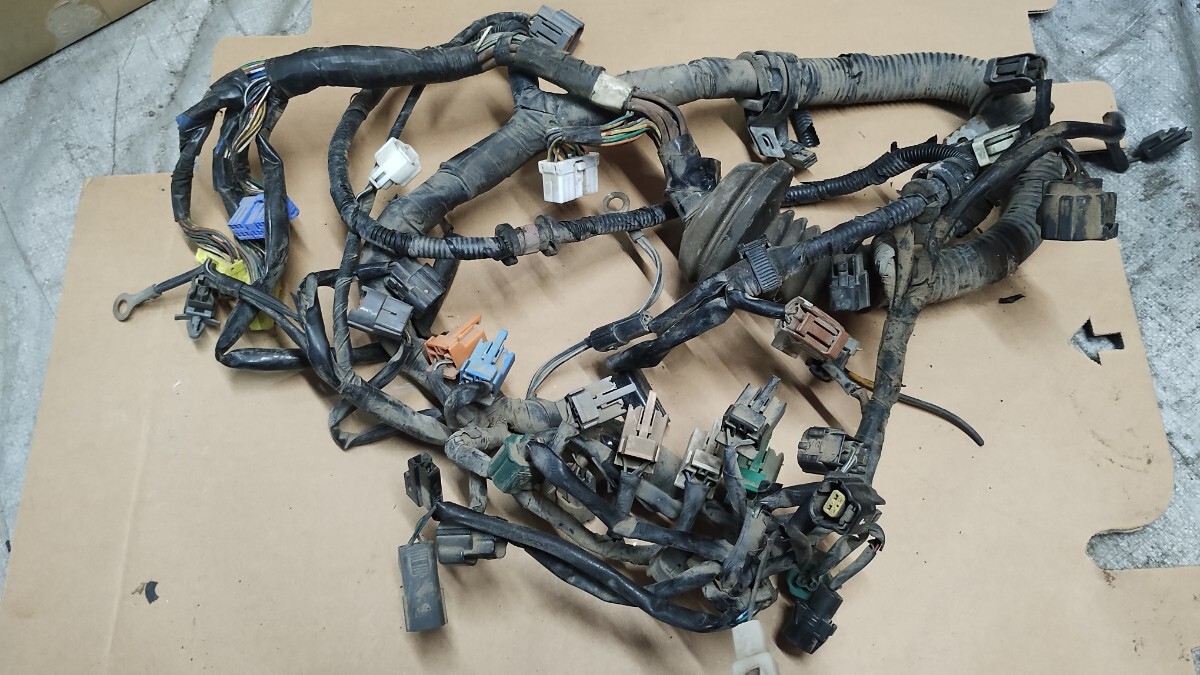
A while back I spread out about five JDM emission harnesses to see if I had a complete one. Each harness was missing 1~4 connectors. Often the long leg that runs back to sensors on the transmssion is cut-off, because the wrecker did not want to bother to go under the car to undo the clips., I guess.
There is one connector missing, can you spot where it was?
Here are a bunch of (mostly) JDM LIM and UIM I recently had sand blasted. On the LIM, the horizontal bump was likely for emmisiion recirculation required for US (or perhaps only California) cars. You can see a plug in place of were the USDM emission valve would have been attached. On the undersides of the UIM, likely early and later JDM are evident. The early JDM has a pedestal and the later one (in the middle) was cast without it. The USDM UIM would have holes machined into that pedestal to accommodate another emission related valve.
I understand. Very interesting on the change in the manifold, good to know that may be something I need to look into. As far as a simpler layout is concerned, Im not completely decided, but Im generally not a fan of a larger turbo with greater lag and the different experience. I know the twin setup is a rats nest, but that change in driving experience is a big concern. Any thoughts?
On the engine harness, im lucky in this situation to work at mazda in CA, since I get the employee discount haha. If I were to go the OEM US harness route, they surprisingly have a single engine harness in stock, while all other main harnesses are completely discontinued. Still expensive but not quite as bad
redbul is confusing you with a lot of additional information that is not relevant to your question. the answer you are looking for is yes.
regardless of where the ENGINE/KEG/BLOCK came from, EVERY 13brew will accept whatever harness is laid on it regardless of steering wheel configuration. they are not lhd/rhd specific. some of the equipment on them is but it doesnt matter because you would transfer over the parts from your original motor. during the recovery process, it will be very obvious what you can and can not reuse.
To FD AuTo's point, a basic rebuilt keg can be built out in either direction to meet a RHD or LHD configuration, but, in the majority of cases, I would bet, the build out would be into some custom configuration.
Last year we shipped out about 100 motor pieces to a speciality rotary engine builder and got four good rebuilts back. Most of the parts were from RHD sourced locally, or from Japan, but we fully expect they could go into either RHD or LHD cars.