


Haltech how do you tune fuel air temp correction?


Thread Starter

Joined: Jul 2002
Posts: 9,387
Likes: 4
From: Nashville, TN
how do you tune fuel air temp correction?
would anyone care to share their fuel air temp correction maps?
i dynod tuned my car with the "zero" area being ~120*F on a IAT fuel map that ludwig says he uses for most cars.
my AFRs on the dyno were high 10s @ ~120*F at the top of my power pulls and running through the gears loaded up on the dyno, but when i'm out on the street and the IATs are 40 degrees cooler the AFRs are stupid rich... it seems like it's just way too much correction.
so i decided i'd go try leaning out the cooler section of the IAT map. i removed 1% on the 83*F temp and got the AFRs a little closer to where they should be, then realized that i really have no way to tune this map to below what the ambient temp is at that exact time while driving on the street.
how do you all do it? or does everyone just use a fairly standard fuel IAT correction map?
my main issue is that my IATs climb substantially when doing power pulls. the IAT can start at ~80*F while cruising on the interstate, but climb to ~120*F at the top of 4th gear for example, which is a 40* change. i dyno tuned under the assumption that the air mass vs fuel would always be in a constant state of change (and steady, as we're on earth's atmosphere), and i would never had to mess with the IAT map, but this does not seem to be the case.
here is the one i'm using (original, before i removed fuel from it):
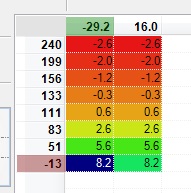
i dynod tuned my car with the "zero" area being ~120*F on a IAT fuel map that ludwig says he uses for most cars.
my AFRs on the dyno were high 10s @ ~120*F at the top of my power pulls and running through the gears loaded up on the dyno, but when i'm out on the street and the IATs are 40 degrees cooler the AFRs are stupid rich... it seems like it's just way too much correction.
so i decided i'd go try leaning out the cooler section of the IAT map. i removed 1% on the 83*F temp and got the AFRs a little closer to where they should be, then realized that i really have no way to tune this map to below what the ambient temp is at that exact time while driving on the street.
how do you all do it? or does everyone just use a fairly standard fuel IAT correction map?
my main issue is that my IATs climb substantially when doing power pulls. the IAT can start at ~80*F while cruising on the interstate, but climb to ~120*F at the top of 4th gear for example, which is a 40* change. i dyno tuned under the assumption that the air mass vs fuel would always be in a constant state of change (and steady, as we're on earth's atmosphere), and i would never had to mess with the IAT map, but this does not seem to be the case.
here is the one i'm using (original, before i removed fuel from it):


Welcome to the world of open loop, empirical tuning. There is no easy answer to your question. You're going through the same thing that all the early fuel injection engineers went through back in the 70s.
What I would say, based on my experience, is this. Copying somebody else's IAT map is a starting point at best. Professional tuners don't have a choice, because they can't sit in the car and put a gazillion hours into it. You just have to start with whatever conditions you began tuning the car at and move on from there.
You literally have to drive the car for a year to get it tuned with minimal AFR fluctuation, and you have to ask yourself whether you want it to go leaner when the weather changes or go richer. In my experience, AFRs will fluctuate at least +/- 0.3:1 . Best you'll get it is something like 10.7:1 in the summer and 11.2 in the winter, if you make adjustments a few times in a year. That's assuming your altitude doesn't change during traveling.
I always end up having a different IAT map on every car, because I always start tuning under some different condition.
My other advice is, don't spend much time trying to calculate the density of air or any other such physics based approach to populate environmental correction tables. I mean you can do it, but you'll still end up making significant changes based on real world results. Even normal VE tuning configurations aren't really physics-based enough for that to work--they're just more sophisticated look up tables.
The response to AFR's climbing during pulls is to make a judgment call as to how you are going to bias the correction table. At some point it will go leaner or richer than you want it to. It's unavoidable.
What I would say, based on my experience, is this. Copying somebody else's IAT map is a starting point at best. Professional tuners don't have a choice, because they can't sit in the car and put a gazillion hours into it. You just have to start with whatever conditions you began tuning the car at and move on from there.
You literally have to drive the car for a year to get it tuned with minimal AFR fluctuation, and you have to ask yourself whether you want it to go leaner when the weather changes or go richer. In my experience, AFRs will fluctuate at least +/- 0.3:1 . Best you'll get it is something like 10.7:1 in the summer and 11.2 in the winter, if you make adjustments a few times in a year. That's assuming your altitude doesn't change during traveling.
I always end up having a different IAT map on every car, because I always start tuning under some different condition.
My other advice is, don't spend much time trying to calculate the density of air or any other such physics based approach to populate environmental correction tables. I mean you can do it, but you'll still end up making significant changes based on real world results. Even normal VE tuning configurations aren't really physics-based enough for that to work--they're just more sophisticated look up tables.
The response to AFR's climbing during pulls is to make a judgment call as to how you are going to bias the correction table. At some point it will go leaner or richer than you want it to. It's unavoidable.
Thread Starter
Joined: Jul 2002
Posts: 9,387
Likes: 4
From: Nashville, TN
OK arghx, i appreciate the response.
NOW, can you tell me an example of a few maps you've seen that have air temp correction? i'm wondering ABOUT how much correction people use between 80*F and 120*F. i would have guessed it to be a ~1% difference --much less than my current air temp map.
i was afraid the only solution is to just zero the air temp map for everything under my 100-120*F range (my "zero" on the dyno) and just richen/lean the air temp map while out on the street to match my dyno AFRs, but i am looking for some input as to what correction others use to make, just to make sure i'm not way off, or to look for any "rule of thumb" with air temp tuning.
NOW, can you tell me an example of a few maps you've seen that have air temp correction? i'm wondering ABOUT how much correction people use between 80*F and 120*F. i would have guessed it to be a ~1% difference --much less than my current air temp map.
i was afraid the only solution is to just zero the air temp map for everything under my 100-120*F range (my "zero" on the dyno) and just richen/lean the air temp map while out on the street to match my dyno AFRs, but i am looking for some input as to what correction others use to make, just to make sure i'm not way off, or to look for any "rule of thumb" with air temp tuning.


Sensor type and placement is also going to come into play. If the sensor isn't seeing a true representation of what is going into the engine, you're going to have issues.
Thread Starter
Joined: Jul 2002
Posts: 9,387
Likes: 4
From: Nashville, TN
ludwig, how far does the IAT need to be sticking up into the air stream?
i drilled and threaded the 3/8npt haltech IAT sensor and the threads are quite far into the aluminum, so it's about as far in as it can go (in the stock mazda location on the bottom of the UIM).
i drilled and threaded the 3/8npt haltech IAT sensor and the threads are quite far into the aluminum, so it's about as far in as it can go (in the stock mazda location on the bottom of the UIM).


ludwig, how far does the IAT need to be sticking up into the air stream?
i drilled and threaded the 3/8npt haltech IAT sensor and the threads are quite far into the aluminum, so it's about as far in as it can go (in the stock mazda location on the bottom of the UIM).
i drilled and threaded the 3/8npt haltech IAT sensor and the threads are quite far into the aluminum, so it's about as far in as it can go (in the stock mazda location on the bottom of the UIM).
Thread Starter
Joined: Jul 2002
Posts: 9,387
Likes: 4
From: Nashville, TN
i had a friend assist with some street tuning tonight and we got the map very nicely tuned to the low-mid 11's AFRs.
we ended up doing some testing out on the street with the intake temps both low and high, and we determined that zeroing out the correction from ~80*F to ~120*F worked best and had very little change in AFR. we also found later in the evening (when the intake temps dropped to 60*F) that 60*F requires about 1.3% more fuel than 80*F to keep the AFRs in check. so the air temp maps i was using were just too much correction. my IAT fuel correction map looks very similar to the one in the haltech FD base map, but with about 1.5% LESS correction below 80*F than the haltech version.
i will have to wait for a random cold night to see how low i can get the IATs before messing with the air temp map any more.
just some "FYI" in case anyone else tinkers with their air temp map.
we ended up doing some testing out on the street with the intake temps both low and high, and we determined that zeroing out the correction from ~80*F to ~120*F worked best and had very little change in AFR. we also found later in the evening (when the intake temps dropped to 60*F) that 60*F requires about 1.3% more fuel than 80*F to keep the AFRs in check. so the air temp maps i was using were just too much correction. my IAT fuel correction map looks very similar to the one in the haltech FD base map, but with about 1.5% LESS correction below 80*F than the haltech version.
i will have to wait for a random cold night to see how low i can get the IATs before messing with the air temp map any more.
just some "FYI" in case anyone else tinkers with their air temp map.
Trending Topics

Joined: Sep 2005
Posts: 25,581
Likes: 136
From: Smiths Falls.(near Ottawa!.Mapquest IT!)
This raises the question of whether the FD AIT sensor should be moved then.
I got the FD intake on the FC engine.
Really hate the location of the Fast acting AIT being on the upper manifold.
So that raises the question of if the AIT should be moved up to,say a location on the Greddy elbow????
apologies Jacob, if this is a slight thread jack,but it does seem, related.
ludwig, how far does the IAT need to be sticking up into the air stream?
i drilled and threaded the 3/8npt haltech IAT sensor and the threads are quite far into the aluminum, so it's about as far in as it can go (in the stock mazda location on the bottom of the UIM).
i drilled and threaded the 3/8npt haltech IAT sensor and the threads are quite far into the aluminum, so it's about as far in as it can go (in the stock mazda location on the bottom of the UIM).

Thread
Thread Starter
Forum
Replies
Last Post
immanuel__7
2nd Generation Specific (1986-1992)
89
Sep 5, 2015 10:23 AM
befarrer
Microtech
3
Aug 22, 2015 05:52 PM