


Peripheral Ports?

Thread Starter
Full Member

Joined: Sep 2003
Posts: 142
Likes: 0
From: abilene(shithole)texas
Peripheral Ports?
how is the Peripheral Port diffrent that a bridge or street port? what is the process in doing it, also what kind of performance gains does it produce?
what does the finished product look like? pictures would be great
what does the finished product look like? pictures would be great
Senior Member
Joined: Jan 2004
Posts: 339
Likes: 0
From: So Cal.
i think that periphrial ports are just the location of the port. when you get it a block ported they shave off metal around the port. this changes the timing of the engine and also allows the power to be increased.
Senior Member
Joined: Sep 2003
Posts: 376
Likes: 0
From: Aurora, IL and Milwaukee, WI
Periphrial ports are race only ports. In a periphrial ported engine, the normal side intake ports are filled in and a massive intake port is created on the rotor housing much like the exhaust port. Periphrial ports have massive power in the upper RPM band, dont idle very well below 3000rpm and can easily spin to 10k and above.
he is quick link is a small picture
ehh link didnt work.
he is quick link is a small picture
ehh link didnt work.

P Ports are insane.
There is no longer a side intake. They drill a hole in the side of the housing and it is a direct entrance.
Racing beats housings were crazy when I stopped by there at Sevenstock.
The water jacket is compromised and they fill it in with a putty stuff to seal around it. That's one of the main reasons why the P-ports don't last long.
I forget HP amounts but it's big. Also Very non streetable. Like a 1.5k idle at best.
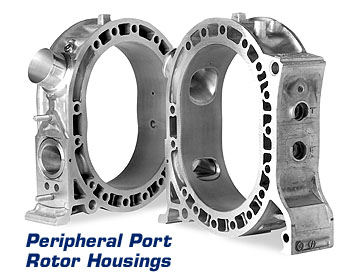 here is RB's housings. The silver intake on the top left is it.
There is no longer a side intake. They drill a hole in the side of the housing and it is a direct entrance.
Racing beats housings were crazy when I stopped by there at Sevenstock.
The water jacket is compromised and they fill it in with a putty stuff to seal around it. That's one of the main reasons why the P-ports don't last long.
I forget HP amounts but it's big. Also Very non streetable. Like a 1.5k idle at best.
here is RB's housings. The silver intake on the top left is it.
Last edited by Digi7ech; Feb 11, 2004 at 05:19 PM.


Old [Sch|F]ool


Joined: May 2001
Posts: 12,876
Likes: 575
From: Cleveland, Ohio, USA
Originally posted by SpeedFreak03
holy **** that is one huge intake! I can tell why they aren't streetable... !
!
holy **** that is one huge intake! I can tell why they aren't streetable...
!
I'm sitting out on this one. I'll just fire up the popcorn popper and sit back and watch.
 Who wants extra butter?
Trending Topics





Full Member

Joined: Nov 2003
Posts: 192
Likes: 8
From: .
I have 4 pp's on the road, number 5 will be joining them very soon. The oldest is a 12a pp I built 2 1/2 years ago and is a daily driver. It still starts and runs as well as it did when I built it. Flat 13's in street trim.
Full Member
Joined: Nov 2003
Posts: 192
Likes: 8
From: .
Originally posted by peejay
SHHH!!! Don't tell anyone you're driving a PP on the street! Remember they idle at like 5000rpm and don't start making power until like 14,000...
SHHH!!! Don't tell anyone you're driving a PP on the street! Remember they idle at like 5000rpm and don't start making power until like 14,000...

Junior Member
Joined: Jan 2004
Posts: 25
Likes: 1
From: Goodview VA
I've always wondered about the reason for the side intake ports. I don't know about the effect on seals, but the port size and timing are the factors determining the powerband. Model (O.S.) wankels don't use side porting and they're docile.
Thanks
Thanks
Old [Sch|F]ool
Joined: May 2001
Posts: 12,876
Likes: 575
From: Cleveland, Ohio, USA
Same reason Mazda went to side exhaust ports: Less port timing for similar port volume/opening area.
Downside (for intake) being that during the opening phase of the intake port, it be quite difficult for the airflow to make basically a 180 degree turn followed by a 70-90 degree turn downwards. Bridge ports help this greatly, and peripheral ports solve it completely.
Downside (for intake) being that during the opening phase of the intake port, it be quite difficult for the airflow to make basically a 180 degree turn followed by a 70-90 degree turn downwards. Bridge ports help this greatly, and peripheral ports solve it completely.
Old [Sch|F]ool
Joined: May 2001
Posts: 12,876
Likes: 575
From: Cleveland, Ohio, USA
It's not really "max area", a race peripheral port barely has more port area than a stocker. However, the port placement is more avantageous for VE, at the expense of having far too much overlap to idle well or cruise well.
NSU used small peripheral ports on their production engines. Their solution to the idle/cruise problem was twofold: first, they used an automatic transmission (semiautomatic, actually) so the torque converter would take up the low-end slack, and second, they used a smallish (10A-sized) engine in a heavyish (FC-sized) car for the Ro80. So the engine is under fairly heavy load.
Still, that little engine made a peak of ~120hp at only 5500rpm.
NSU used small peripheral ports on their production engines. Their solution to the idle/cruise problem was twofold: first, they used an automatic transmission (semiautomatic, actually) so the torque converter would take up the low-end slack, and second, they used a smallish (10A-sized) engine in a heavyish (FC-sized) car for the Ro80. So the engine is under fairly heavy load.
Still, that little engine made a peak of ~120hp at only 5500rpm.

Thread
Thread Starter
Forum
Replies
Last Post
