


Would using an Ampco Oiler help longevity in the RX7?


Thread Starter
Junior Member

Joined: Jun 2002
Posts: 25
Likes: 0
From: Portland, Oregon
Would using an Ampco Oiler help longevity in the RX7?
Hi guys,
I installed one of these: http://www.ampcolubes.com/
into the family mini-van in order to counteract the effects of the EGR gunking up the intake plenum.
What I can say is that the oily mist of air being injected into the intake stream seems subjectively to make the engine smoother and more powerful (no I don't have dyno readings to back that up, I am using the 'seat of pants' dyno) but it definitely has STOPPED oil usage completely. The minivan used to use a little bit of oil between changes. It now doesn't use any at all.
My theory is that the small amount of oil coming through the intake air is providing a better seal around the rings in the combustion chamber, reducing both blow-by and crankcase oil consumption. This means that the mist of Marvel Mystery Oil is getting to the rings and providing both a better seal and hopefully lower wear.
Here's the question. Given that our beloved RX7s tend to wear out the apex seals after relatively few miles compared to say a normal piston gasser and certainly a diesel engine, would introduction of a continuous mist of oil (e.g. Marvel Mystery oil) via this device help to reduce the wear of the apex seals?
What do you guys think?
I installed one of these: http://www.ampcolubes.com/
into the family mini-van in order to counteract the effects of the EGR gunking up the intake plenum.
What I can say is that the oily mist of air being injected into the intake stream seems subjectively to make the engine smoother and more powerful (no I don't have dyno readings to back that up, I am using the 'seat of pants' dyno) but it definitely has STOPPED oil usage completely. The minivan used to use a little bit of oil between changes. It now doesn't use any at all.
My theory is that the small amount of oil coming through the intake air is providing a better seal around the rings in the combustion chamber, reducing both blow-by and crankcase oil consumption. This means that the mist of Marvel Mystery Oil is getting to the rings and providing both a better seal and hopefully lower wear.
Here's the question. Given that our beloved RX7s tend to wear out the apex seals after relatively few miles compared to say a normal piston gasser and certainly a diesel engine, would introduction of a continuous mist of oil (e.g. Marvel Mystery oil) via this device help to reduce the wear of the apex seals?
What do you guys think?


Sir Braps A lot
Joined: Jul 2006
Posts: 2,001
Likes: 1
From: Hilliard, OHIO
well a lot of the reason these motors fail is carbon build up on the apex seals. what people have done to help with this is add meth injection and premixing 2 stroke oil in the gas. when i took my turbo manifold off last year my motor was still shinny inside with very little carbon build up as i do both premix and have an AEM meth kit. i think this is a good idea but there has been many ideas to help out the rotary.
Thread Starter
Junior Member
Joined: Jun 2002
Posts: 25
Likes: 0
From: Portland, Oregon

3MP


Hi guys,
I installed one of these: http://www.ampcolubes.com/
into the family mini-van in order to counteract the effects of the EGR gunking up the intake plenum.
What I can say is that the oily mist of air being injected into the intake stream seems subjectively to make the engine smoother and more powerful (no I don't have dyno readings to back that up, I am using the 'seat of pants' dyno) but it definitely has STOPPED oil usage completely. The minivan used to use a little bit of oil between changes. It now doesn't use any at all.
I installed one of these: http://www.ampcolubes.com/
into the family mini-van in order to counteract the effects of the EGR gunking up the intake plenum.
What I can say is that the oily mist of air being injected into the intake stream seems subjectively to make the engine smoother and more powerful (no I don't have dyno readings to back that up, I am using the 'seat of pants' dyno) but it definitely has STOPPED oil usage completely. The minivan used to use a little bit of oil between changes. It now doesn't use any at all.
My theory is that the small amount of oil coming through the intake air is providing a better seal around the rings in the combustion chamber, reducing both blow-by and crankcase oil consumption. This means that the mist of Marvel Mystery Oil is getting to the rings and providing both a better seal and hopefully lower wear.
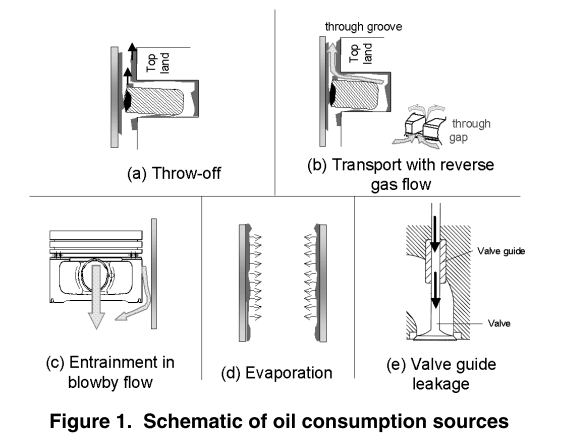
One big factor is evaporation. If injecting this oil reduces temperatures or changes in certain areas of the combustion chamber, it's entirely possible that it will mitigate this tendency. The oil you are injecting may affect the oil film and certain interactions at the piston rings. It may somehow affect the oil dilution; oil dilution increases the tendency to oil throw off.
Here's the question. Given that our beloved RX7s tend to wear out the apex seals after relatively few miles compared to say a normal piston gasser and certainly a diesel engine, would introduction of a continuous mist of oil (e.g. Marvel Mystery oil) via this device help to reduce the wear of the apex seals?
In the first gen, the OMP mixed oil through the carburetor. This the oil flowed from the beginning of the intake manifold into the engine. 2 stroke engines can come with oil metering pumps that do the same thing. In the 2nd gen, oil injectors were located on the primary intake runners near the primary ports. They also had injectors positioned in the center of the trochoid surface, just like the FD which has no intake manifold oil injectors. Back then Mazda was using Fluorocarbon resin coating on the housings, which is inferior to the FD's Carbon-graphite coating:
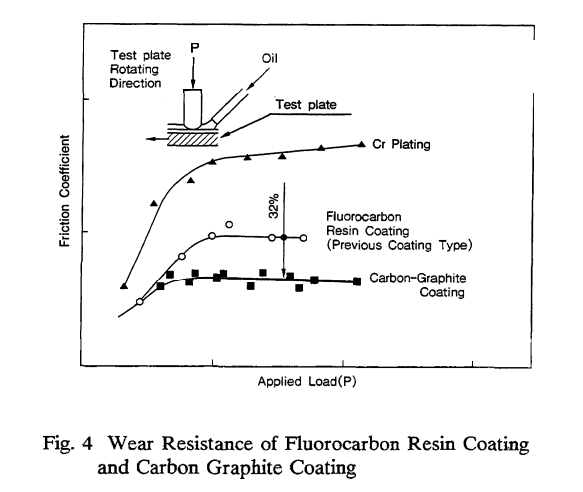
That combustion surface is going to wear out over time and lose whatever coating it has, increasing the amount of friction between the apex seal and the trochoid surface. It's no different in principle than a piston engine losing its crosshatch pattern on the bore wall. So right there we can say that new housings are going to wear at a slower rate due to decreased friction.
Generally speaking, more lubricating oil reduces apex seal temperature until it reaches a point where additional oil does nothing. This is the principle upon which the computer controlled oil metering strategy was developed.

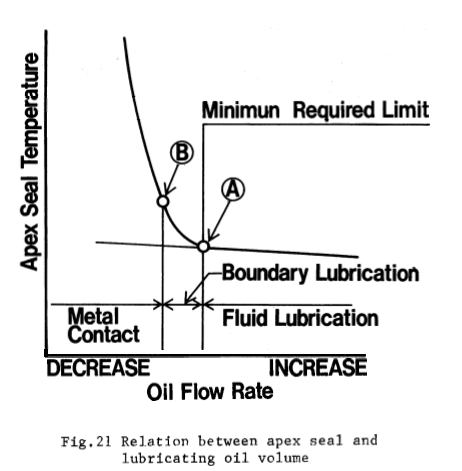
All other things held equal (driving style etc), the best thing you could probably do to reduce apex seal wear might just be running new housings.
Thread Starter
Junior Member
Joined: Jun 2002
Posts: 25
Likes: 0
From: Portland, Oregon
arghx, Thank you for the thoughtful and detailed response.
To be clear, the Ampco oiler is NOT injecting normal lubricating oil (e.g. engine oil). It is designed to use Marvel Mystery Oil (MMO). To my understanding, MMO was invented back in the 1920s as a blend of lightweight oil and solvents. It is designed to be mixed with fuel and burned, or used as a top cylinder lubricant for flat-top engines, and the Ampco oil was developed for exactly this reason.
The Ampco oiler is designed to introduce a mist of MMO into the air entering the intake plenum. It is an exceedingly small amount, and based on what I see on the minivan, it takes thousands of miles to get through a quart of MMO - it draws off a very very small amount from intake plenum vacuum.
Being such a lightweight oil mixture, I believe MMO works because it is expressly designed to both lubricate AND burn cleanly. One of the big problems I see with the oil injection of conventional motor oil is that conventional motor oil is NOT designed to burn. It is designed to resist burning and to provide lubrication. MMO is designed to provide light lubrication, cleaning properties, AND is designed to burn. Certainly it is designed to be mixed with gas and atomized.
I am likely going to hook one of the Ampco oilers to my FD, and just wanted to see what you guys think.
Sincerely,
3MP
To be clear, the Ampco oiler is NOT injecting normal lubricating oil (e.g. engine oil). It is designed to use Marvel Mystery Oil (MMO). To my understanding, MMO was invented back in the 1920s as a blend of lightweight oil and solvents. It is designed to be mixed with fuel and burned, or used as a top cylinder lubricant for flat-top engines, and the Ampco oil was developed for exactly this reason.
The Ampco oiler is designed to introduce a mist of MMO into the air entering the intake plenum. It is an exceedingly small amount, and based on what I see on the minivan, it takes thousands of miles to get through a quart of MMO - it draws off a very very small amount from intake plenum vacuum.
Being such a lightweight oil mixture, I believe MMO works because it is expressly designed to both lubricate AND burn cleanly. One of the big problems I see with the oil injection of conventional motor oil is that conventional motor oil is NOT designed to burn. It is designed to resist burning and to provide lubrication. MMO is designed to provide light lubrication, cleaning properties, AND is designed to burn. Certainly it is designed to be mixed with gas and atomized.
I am likely going to hook one of the Ampco oilers to my FD, and just wanted to see what you guys think.
Sincerely,
3MP
Trending Topics


^ It wont. It is designed for cars that do not have hardened valve seats. It is supposed to help prevent wear in the upper part of the engine since lead was removed from the gasoline. It will only work "well" on a non boosted carbed engine.
IMHO, It is a completely useless product for our cars. The Electronic OMP in our cars was designed to lubricate the engine components not lubricated by the oil pump. Some people feel that is not enough so they add premix.
You can tell that is is designed for old cars, look at the product advertisement and the design of the product itself.
IMHO, It is a completely useless product for our cars. The Electronic OMP in our cars was designed to lubricate the engine components not lubricated by the oil pump. Some people feel that is not enough so they add premix.
You can tell that is is designed for old cars, look at the product advertisement and the design of the product itself.
Thread Starter
Junior Member
Joined: Jun 2002
Posts: 25
Likes: 0
From: Portland, Oregon
Wow. I disagree. Yes it was originally designed to inject MMO into flathead engines but the original intent isn't in question here.
The device is designed to use intake plenum vacuum and use it to draw a thin mist of MMO into the intake air. Clearly it works to do this. The question is, would this have any benefits when used with an FD.
Would a mist of MMO in the intake charge air help to lubricate apex seals and clean carbon off the chamber walls? It would certainly seem so as MMO is well known as an effective lubricant/solvent mix. Using it in the intake charge air would also arguably be more effective than premix as the MMO would be undiluted compared to premix.
The density of the MMO in the intake charge would depend on intake plenum vacuum. Does anyone have a map of vacuum va RPM on an FD? That would give a clue as to the amount of MMO density bs RPM.
To simply state that a design is invalid because the idea is old is false. To state that a design cannot be used because it is not used per initial intent is also untrue.
Sincerely
3MP
The device is designed to use intake plenum vacuum and use it to draw a thin mist of MMO into the intake air. Clearly it works to do this. The question is, would this have any benefits when used with an FD.
Would a mist of MMO in the intake charge air help to lubricate apex seals and clean carbon off the chamber walls? It would certainly seem so as MMO is well known as an effective lubricant/solvent mix. Using it in the intake charge air would also arguably be more effective than premix as the MMO would be undiluted compared to premix.
The density of the MMO in the intake charge would depend on intake plenum vacuum. Does anyone have a map of vacuum va RPM on an FD? That would give a clue as to the amount of MMO density bs RPM.
To simply state that a design is invalid because the idea is old is false. To state that a design cannot be used because it is not used per initial intent is also untrue.
Sincerely
3MP
Wow. I disagree. Yes it was originally designed to inject MMO into flathead engines but the original intent isn't in question here.
The device is designed to use intake plenum vacuum and use it to draw a thin mist of MMO into the intake air. Clearly it works to do this. The question is, would this have any benefits when used with an FD.
The device is designed to use intake plenum vacuum and use it to draw a thin mist of MMO into the intake air. Clearly it works to do this. The question is, would this have any benefits when used with an FD.
Would a mist of MMO in the intake charge air help to lubricate apex seals and clean carbon off the chamber walls? It would certainly seem so as MMO is well known as an effective lubricant/solvent mix. Using it in the intake charge air would also arguably be more effective than premix as the MMO would be undiluted compared to premix.
The OMP injects more oil when the engine load is increased, same goes if you premix. The thing you are talking about would do the exact opposite.
Also, I think it would not be a good idea to inject MMO into your engine. you are much better off injecting 2 cycle engine oil. MOO was formulated back in the 1920's and to my knowledge has not been changed. There has been a huge advancments in technology of oil formulating in the 90 pluss years since MMO was introduced to the US market.
Plus how well do you think the MMO would atomize if it is being pulled through a nozzle? Certainly not better than being injected into the engine through the injectors in the form of premix.
Disclamer: I am not suggesting MMO does not work as advertised, I just think it will not works as well as 2 cycle oil.
If you think MMO is so great start using it in your car and report back to us.



Joined: Mar 2001
Posts: 30,814
Likes: 655
From: FL-->NJ/NYC again!
MMO is not recommended by the owners of Rotary Performance, one of the premier and longest-open rotary shops in the country. It was told to me many years ago by them not to use the stuff..... lubricants yes, cleaning agents no.
As an engine builder who warranties his engines, I see no need for this Oiler. Just my opinion
Edit: also, n/a rotaries have been known to run for 200,000+ miles on one set of apex seals..... Call it 100,000+ for a turbo enigne. Method of failure tends to be acute (ie detonation) vs from chronic use.
As an engine builder who warranties his engines, I see no need for this Oiler. Just my opinion
Edit: also, n/a rotaries have been known to run for 200,000+ miles on one set of apex seals..... Call it 100,000+ for a turbo enigne. Method of failure tends to be acute (ie detonation) vs from chronic use.
Thread Starter
Junior Member
Joined: Jun 2002
Posts: 25
Likes: 0
From: Portland, Oregon
Those are good points. I agree that the Ampco oiler would have max effect at high vacuum...at idle.
So it would likely have a cleaning and lube effect at low RPMs. That may still be helpful to clean and lube.
I do think MMO works well. I have used it extensively in my piston vehicles, including gassers and diesels. It totally works. Why do shops not recommend its use? What is the reasoning?
Sincerely
3MP
So it would likely have a cleaning and lube effect at low RPMs. That may still be helpful to clean and lube.
I do think MMO works well. I have used it extensively in my piston vehicles, including gassers and diesels. It totally works. Why do shops not recommend its use? What is the reasoning?
Sincerely
3MP

