


What in the world did i just come across?


Thread Starter

Joined: Jun 2006
Posts: 1,254
Likes: 0
From: Charlotte, NC
 What in the world did i just come across?
take a look at these intercooler pipes that i came across, have to be the craziest thing ive seen in a while. Any one have more info on these things? Anyone using these.
http://www.lindseyracing.com/LR/Part...OLERTUBES.html
http://www.lindseyracing.com/LR/Part...OLERTUBES.html




Depending on how much these things are I would like to try one on my FD. My prediction is a much lower hp number due to the added resistance of the flowing air. I think the turbo would spool much slower as well. I think trying the product would be worth-it. I did not see a price anywhere, did any one else?




Pretty expensive also for something being used in conjunction with a traditional intercooler. On the bottom of the page they show it setup to replace an intercooler also. But each 12" section is $425 not including the lines, pump, or anything else needed to run it. Maybe it really isnt anymore expensive than a good quality intercooler now that I think of it.
Trending Topics

Junior Member

Joined: Dec 2008
Posts: 25
Likes: 0
From: Australia
$350 for a 6" length one up to $425 for the 12". The short one flows 375cfm, im not familiar with how much flow is needed. Would this pose a restriction? It's certainly an interesting product. Might be useful in an intercoolerless water/meth injection setup.

Full Member
Joined: Oct 2007
Posts: 83
Likes: 0
From: Coronado, CA
Well at the very bottom of the page it says "The benefit here is, where the factory intercooler flows 205 CFM at 28" of water column, this unit is estimated to flow over 500 CFM with the tubular end tanks in place. " ...now whether or not the actual numbers are close to that...also the weight difference would come into question...because if its really that much more efficient...that could be a serious bonus for high horsepower setups...where they could actually use 500 CFM...haha

Noob

Joined: Mar 2008
Posts: 182
Likes: 0
From: AR
Its supposed to replace an intercooler, not in conjunction with it.
I have never seen one in use, might buy it and try it on another car though, not my FD.
And from the looks of things, the longer it is the better.
If it actually works well... it would be a great space saver and you would probably spend close to $600 total with pump, fittings, misc things you need to get it to work properly... not too bad but the pump will just be another thing that can go bad as the time passes.
I have never seen one in use, might buy it and try it on another car though, not my FD.
And from the looks of things, the longer it is the better.
If it actually works well... it would be a great space saver and you would probably spend close to $600 total with pump, fittings, misc things you need to get it to work properly... not too bad but the pump will just be another thing that can go bad as the time passes.




they have a kit:
http://www.lindseyracing.com/mm5/mer...gory_Code=KITS
The shop that I work at uses something similar for blower motors. They sandwich a radiator between the blower and motor and run water lines to an external radiator with an electric pump.
http://www.lindseyracing.com/mm5/mer...gory_Code=KITS
The shop that I work at uses something similar for blower motors. They sandwich a radiator between the blower and motor and run water lines to an external radiator with an electric pump.

awesome...
My first question was: are they restrictive and what would the pressure drop be?
They claim:
two THPs are used in parallel in place of an air-to-air intercooler on a Porsche 944 Turbo. The benefit here is, where the factory intercooler flows 205 CFM at 28" of water column, this unit is estimated to flow over 500 CFM with the tubular end tanks in place.
So they are claiming they flow twice as much as factory intercooler that comes on that car. Which is probably a horrible IC to begin with. I'm curious how they would stack up to aftermarket ICs with regards to the cooling ability vs. the pressure drop.
One other concern is the increased demand this places on your coolant system. I'd guess you'd want a Koyo radiator and this also adds more lines that need to be "burped" during a coolant flush.
Really intriguing though. FDs do have a huge issue with frontal space. Especially when keeping the A/C. Me thinks you'd need to spend at least $1,000 to do these right . But there are a lot of aftermarket IC kits which cost more than that.
My first question was: are they restrictive and what would the pressure drop be?
They claim:
two THPs are used in parallel in place of an air-to-air intercooler on a Porsche 944 Turbo. The benefit here is, where the factory intercooler flows 205 CFM at 28" of water column, this unit is estimated to flow over 500 CFM with the tubular end tanks in place.
So they are claiming they flow twice as much as factory intercooler that comes on that car. Which is probably a horrible IC to begin with. I'm curious how they would stack up to aftermarket ICs with regards to the cooling ability vs. the pressure drop.
One other concern is the increased demand this places on your coolant system. I'd guess you'd want a Koyo radiator and this also adds more lines that need to be "burped" during a coolant flush.
Really intriguing though. FDs do have a huge issue with frontal space. Especially when keeping the A/C. Me thinks you'd need to spend at least $1,000 to do these right . But there are a lot of aftermarket IC kits which cost more than that.


We had an FC with that intercooler in our booth at sevenstock last year, even had a sample of the product on our table. It's a very nice piece but we haven't done much testing with it yet. Our customer who is using it said his boost gauge (post IC) is reading a pound or 2 higher and his turbo response feels quicker. Didn't really have a whole lot of detail on the intake temps and how they compared though.

looks really interesting
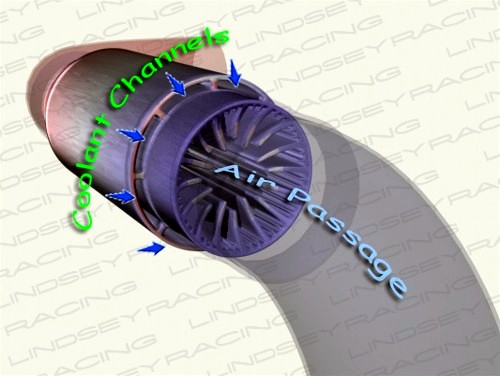
The Thermal Hard Pipe is an air to water intercooler made from Aluminum. Aluminum is known for the fact that is has a very fast heat transfer rate compared to other metals. When we pass heated air through the inner finned tube "Air Passage", the heated air passes over these fins and they absorb the heat. From there, we pull that heat out and away from those fins by the outer jacket's Coolant Passage.
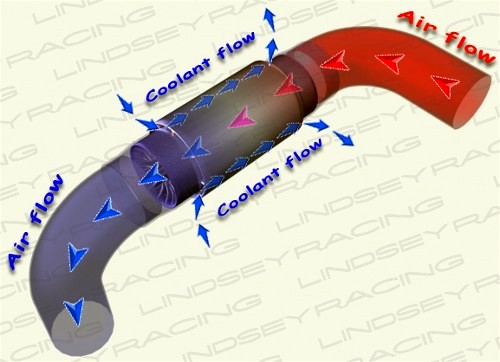
We run a liquid through this Coolant Passage and this is used to pull the heat away from the fins, cooling the heated air in the inner Air Passage. The Thermal Hard Pipes have an incredible 101.5 inches of linear surface. This means for every inch of air passage, we have 101.5 square inches of surface contacting the heated air less the perforations.
We run the liquid through the Coolant Passage in the opposite direction of the flow of heated air in the Air Passage. This makes for the coldest possible output.
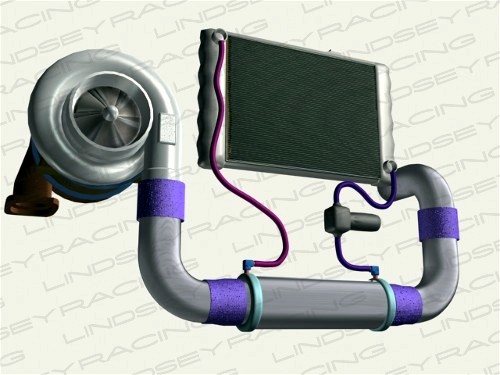
The Thermal Hard Pipe is an air to water intercooler made from Aluminum. Aluminum is known for the fact that is has a very fast heat transfer rate compared to other metals. When we pass heated air through the inner finned tube "Air Passage", the heated air passes over these fins and they absorb the heat. From there, we pull that heat out and away from those fins by the outer jacket's Coolant Passage.
We run a liquid through this Coolant Passage and this is used to pull the heat away from the fins, cooling the heated air in the inner Air Passage. The Thermal Hard Pipes have an incredible 101.5 inches of linear surface. This means for every inch of air passage, we have 101.5 square inches of surface contacting the heated air less the perforations.
We run the liquid through the Coolant Passage in the opposite direction of the flow of heated air in the Air Passage. This makes for the coldest possible output.

Joined: May 2005
Posts: 3,243
Likes: 42
From: Kennewick, Washington
I definitely wouldn't run this from the same coolant reservoir as your engine. it would have to be a separate entity.
And I then question the life of the pump.
And I then question its actual effectiveness compared to a standard IC
And I then question the life of the pump.
And I then question its actual effectiveness compared to a standard IC
Water pumps are very simple and last a very long time. Your own engine coolant runs on a water pump. I'm guessing if you used the same system, it would simply piggy back to your stock "add coolant" warning system, which would be convenient.
Agreed, I'd like to see some empirical data.

Mother****ing Wow
Joined: Jul 2008
Posts: 1,290
Likes: 0
From: NJ
It's an air to water set-up... nothing new.
PWR has had something nearly identical on the market for nearly a decade.

Running it through with the radiator coolant is common practice.... The 180* water will deff cool the 400*+ temps well. Some people also run a small heat exchanger before the coolant enters the intercooler.
When I worked for a pro-import team back in 2003 we ran 2 of the PWR units on a 20b
PWR has had something nearly identical on the market for nearly a decade.
Running it through with the radiator coolant is common practice.... The 180* water will deff cool the 400*+ temps well. Some people also run a small heat exchanger before the coolant enters the intercooler.
When I worked for a pro-import team back in 2003 we ran 2 of the PWR units on a 20b

Looks promising, I might use one before and one after my v-mount i/c. I'm considering pumping methanol thru the pipe coolers and returning it back to the fuel cell. I could use my aux. injection pump to accomplish this.



Ok - I seriously just ruined my shorts after looking at that engine bay... 
Damn, now I have another thing on the list of goodies I "have" to buy for my FD. DAMN YOU RX7CLUB!!!
Damn, now I have another thing on the list of goodies I "have" to buy for my FD. DAMN YOU RX7CLUB!!!
In liquid form, water/antifreeze would be much better at cooling and much safer.