When you click on links to various merchants on this site and make a purchase, this can result in this site earning a commission. Affiliate programs and affiliations include, but are not limited to, the eBay Partner Network.
Unfortunately it wasn't pinched, the o-ring was perfectly in its groove but the groove is wrong in that location (RED below), I'm in talks with the manufacturer for a fix/replacement. Blue would be the correct or better path.
Interesting! That may be a variation in casting on your rear iron, or whoever made the pan just didn't plan things well .
Dale
Yes, a casting variation would account for the area below the regulator in the picture but the o-ring still goes airborne in the 90deg corner where the housing meets the iron, so I tend to think the o-ring path is wrong.
it's the Bacon / Winchester pan. He said my rear plate casting is different than the one he based his design on. I'm sending it back to get a custom fix.
I'm about to re-seal my oil pan using Permatex Ultra Black. Can anyone provide more info about the formulation change? What changed and when did the change happen?
Is there anything I should be concerned about with the new formula? I had an old tube of this stuff in my garage from 5-7 years ago. The label on the back on the old and newer one says not to be used on parts that contact gasoline.
Every rotary engine has some fuel dilution of the oil to some extent and over time. If the label says it’s not compatible with fuel, I wouldn’t use it.
Every rotary engine has some fuel dilution of the oil to some extent and over time. If the label says it’s not compatible with fuel, I wouldn’t use it.
That was my initial reaction too when I saw the label. But there seems to be enough tribal knowledge from guys like Banzai and IRP that indicate it works. Maybe the seal degradation from gasoline exposure is slow since it's diluted in the oil.
There seems to be other variables that affect the seal besides the sealant, like application method and torque sequence. I also got a new oil pan, the IRP brace, and the IRP motor mounts with a second steel arm.
I installed an Xcessive oil pan on my FD, did not fully remove the crossmember, gooped the s** out of the thing, had to slide the pan in side ways. What a cluster! Started leaking about a week after the install. This time I removed the crossmember, got some studs, cleaned everything, put the pan on dry (has an o ring) and strangely enough it has been fine ever since.
One of the few sealants I have used that actually works on that kind of thing is Honda Bond.
Dave
I dropped the subframe to gain enough room to work comfortably.
I spent a couple hours cleaning and prepping the block surface. I used a blade and then a scotch brite pad to remove all the old RTV. Even after visually removing all the old RTV, I noticed the block surface still felt oily. I would wipe the surface with a clean towel using Simple Green and IPA, and it kept turning dark even after multiple times. So I just kept wiping with IPA until the towels stopped turning dark. One thing I noticed was that the iron surfaces needed a lot more wipes before it became clean compared to the aluminum rotor housing surface. Initially, I was a little perplexed by why the iron surfaces kept feeling oily even after so many wipes. But I just kept wiping and it eventually cleaned up.
I'm going to wait a week before I put oil in. I want to make sure the RTV is fully cured.






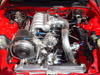






 .
.