


Now What Have I Done - Oil in the Intake


Now What Have I Done - Oil in the Intake
I could sure use some help here, I am really stumped by this one. As you can see from the picture there is oil in the intake manifold. As they say, here's the rest of the story -
Engine is a fresh rebuild, my first time putting a rotary together. It is a half bridge port motor (not my first choice but that's what the car came with). I started it up for the first time this weekend. When I bought the car it had a Microtech ECU in it. I didn't want to run that so I found a PowerFC. But this meant I had to completely rebuild the emissions and engine harnesses. Not trusting the work done elsewhere by the previous mechanic in the wiring department I decided to start it up on an original Mazda ECU. I just wanted to let it idle, not drive it, to make sure my wiring or his previous alterations didn't smoke the PowerFC.
Well it really had a hard time idleing, I had to raise the idle somewhat, it did smoke some, and as you can imagine with the half bridge it ran very uneven. Also checked my TPS to see if it was in spec and can't get the upper range to adjust. Thought maybe that is the cause of the bad idle.
So I am getting ready to put the PowerFC in, hoping it will correct the idle a little and I notice the oil in the throttle body / UIM.
So what's up with this? Do any of you guys have any ideas where the oil is coming from? I imagine this is the cause of some of the smoke I see but how's it getting in there?
Thanks for any help you guys can give me,
Jeff
Engine is a fresh rebuild, my first time putting a rotary together. It is a half bridge port motor (not my first choice but that's what the car came with). I started it up for the first time this weekend. When I bought the car it had a Microtech ECU in it. I didn't want to run that so I found a PowerFC. But this meant I had to completely rebuild the emissions and engine harnesses. Not trusting the work done elsewhere by the previous mechanic in the wiring department I decided to start it up on an original Mazda ECU. I just wanted to let it idle, not drive it, to make sure my wiring or his previous alterations didn't smoke the PowerFC.
Well it really had a hard time idleing, I had to raise the idle somewhat, it did smoke some, and as you can imagine with the half bridge it ran very uneven. Also checked my TPS to see if it was in spec and can't get the upper range to adjust. Thought maybe that is the cause of the bad idle.
So I am getting ready to put the PowerFC in, hoping it will correct the idle a little and I notice the oil in the throttle body / UIM.
So what's up with this? Do any of you guys have any ideas where the oil is coming from? I imagine this is the cause of some of the smoke I see but how's it getting in there?
Thanks for any help you guys can give me,
Jeff




I was running an open throttle body so I could get to the air bleed screw. IC piping was not hooked up.
These turbos weren't on the car when I bought it. When I bought the car it would barely run and smoked badly. I put these turbos on to see if it was they could be the cause of the smoke. They were dry and the compressor outlet had no oil residue. I ended up rebuilding the engine. Turned out it had a couple of broken corner seals and side seals. One of the side seals damaged an oil control ring which was the cause of the earlier oil smoke.
So without the IC piping can't the turbos be ruled out?
Are the two lines from the oil filler tube the only source of oil vapor to the manifold? Only thing about that is - there is absolutely no blowby. Before I rebuilt the motor it would shoot vapor a foot or two up out of the tube.
What else can I tell you or check?
These turbos weren't on the car when I bought it. When I bought the car it would barely run and smoked badly. I put these turbos on to see if it was they could be the cause of the smoke. They were dry and the compressor outlet had no oil residue. I ended up rebuilding the engine. Turned out it had a couple of broken corner seals and side seals. One of the side seals damaged an oil control ring which was the cause of the earlier oil smoke.
So without the IC piping can't the turbos be ruled out?
Are the two lines from the oil filler tube the only source of oil vapor to the manifold? Only thing about that is - there is absolutely no blowby. Before I rebuilt the motor it would shoot vapor a foot or two up out of the tube.
What else can I tell you or check?
By the way, I have routed the vacuum lines from the tops of the OMP injectors to a nipple under the front of the UIM behind the throttle cable mounting bracket. Is that correct?


Trending Topics

Do you think that the two lines from the oil filler tube have anything to do with this? I also see a little oil around the turbo manifold joint. Isn't that where the other line from the filler tube goes?

By looking at p.F-10 (vac line diagram) in the FSM you will see one line from the oil filler neck goes through a pcv valve then to the UIM. The other oil filler neck runs to the most rear solenoid on top of the block. If you do not have this it is like GOLD post#10 FSM
On one of your earlier questions, yes you should be able to rule out the turbos since the ic piping was not connected.
This certainly is a strange problem. I am interested to hear what the culprit is.

Junior Member

Joined: Nov 2004
Posts: 8
Likes: 0
From: FL
oil in intake
Oil in intake is from the turbos. Had it happen twice already. No biggie if minimal oil leak; it actually acts like the metering jets-protects the apex seals.
Big leak is not nice-need to fix turbos. Do not forget to ensure that the metering pump, lines, and jets are working IF you repair the turbo oil leak. I blew a rear apex seal after fixing the turbo leak, and discovered the metering line was plugged with gunk when I took the engine apart. The oil-leaking turbos were lubricating the apex seals, keeping me going despite the plugged oil metering line.
Big leak is not nice-need to fix turbos. Do not forget to ensure that the metering pump, lines, and jets are working IF you repair the turbo oil leak. I blew a rear apex seal after fixing the turbo leak, and discovered the metering line was plugged with gunk when I took the engine apart. The oil-leaking turbos were lubricating the apex seals, keeping me going despite the plugged oil metering line.

Oil in intake is from the turbos. Had it happen twice already. No biggie if minimal oil leak; it actually acts like the metering jets-protects the apex seals.
Big leak is not nice-need to fix turbos. Do not forget to ensure that the metering pump, lines, and jets are working IF you repair the turbo oil leak. I blew a rear apex seal after fixing the turbo leak, and discovered the metering line was plugged with gunk when I took the engine apart. The oil-leaking turbos were lubricating the apex seals, keeping me going despite the plugged oil metering line.
Big leak is not nice-need to fix turbos. Do not forget to ensure that the metering pump, lines, and jets are working IF you repair the turbo oil leak. I blew a rear apex seal after fixing the turbo leak, and discovered the metering line was plugged with gunk when I took the engine apart. The oil-leaking turbos were lubricating the apex seals, keeping me going despite the plugged oil metering line.

Check the oil metering nozzle check valves, if you mistakenly hooked them up somewhere to the throttle body or UIM and the check valve(s) have failed then the engine would push oil through your vacuum hose and make a mess. I had one fail and oil covered the top of my engine. To see if they have bad check valves, stick a hose on the end of the metering nozzle and suck. You shouldn't be able to. Only blow.
And yes they should see filtered air, not vacuum.
And yes they should see filtered air, not vacuum.
Thanks for the suggestion, will check the OMP injectors tonight. Last night I removed the PCV valve and capped the nipple at the intake. Let it idle for 10 or 15 minutes but still had oil at the throttle body. Maybe the same oil but I don't think so since I wiped it up before I started.
Even if I had a bad injector how would the oil get to the UIM and eventually the throttle body?
Running about 5 or 6 in. vacuum at idle if that makes a difference.
Thanks again for the ideas and help.
Even if I had a bad injector how would the oil get to the UIM and eventually the throttle body?
Running about 5 or 6 in. vacuum at idle if that makes a difference.
Thanks again for the ideas and help.



Joined: Mar 2001
Posts: 30,817
Likes: 656
From: FL-->NJ/NYC again!
I'm surprised it even runs at that vacuum level.
Are you positive you installed the oil control rings and springs properly?
I've never seen a problem like yours, to be honest with you.
Are you positive you installed the oil control rings and springs properly?
I've never seen a problem like yours, to be honest with you.
Thank you for the reply Rich. You know as far as the oil control rings go I believe they are installed correctly. Am I positive - no. But I knew how they should go, I drew my arrows of rotor rotation on each face of the rotors and put the springs in so they would lock. But the possibility remains I could of screwed up. Hope not though.
As far as the vacuum goes it is hard to tell for sure. I have had such a problem getting this car to idle, I have seen it fluctuate from 5in. to 10 or 11 depending on speed etc. It does start easily. What should I be expecting from a half bridge port?
I will be putting the PowerFC in this weekend, hopefully this will solve my idle issues and I can set my air/fuel more closely. It has been idling at around 11.0 or 11.5 AFR so I think most of the smoke I see is from running too rich.
I will watch more closely what happens now that I pulled the PCV valve out.
On another note, I hooked my Mityvac up to the "vacuum" hose leading to the OMP injectors. When I put pressure on this hose it holds. When I put vacuum on it won't hold. Is that correct operation?
Thanks,
Jeff
As far as the vacuum goes it is hard to tell for sure. I have had such a problem getting this car to idle, I have seen it fluctuate from 5in. to 10 or 11 depending on speed etc. It does start easily. What should I be expecting from a half bridge port?
I will be putting the PowerFC in this weekend, hopefully this will solve my idle issues and I can set my air/fuel more closely. It has been idling at around 11.0 or 11.5 AFR so I think most of the smoke I see is from running too rich.
I will watch more closely what happens now that I pulled the PCV valve out.
On another note, I hooked my Mityvac up to the "vacuum" hose leading to the OMP injectors. When I put pressure on this hose it holds. When I put vacuum on it won't hold. Is that correct operation?
Thanks,
Jeff
Are you saying when you try to blow through the omp injector that it wont blow through and when you put vacuum on it it sucks just fine? If so thats backwards from how it should work. Air should flow into the engine through the omp injector air port, but not back the other way.
Brent, thanks for repying. When I checked it yesterday morning that is what it did. However, I started it and ran it for a little bit and checked it again. This time the oil injectors passed the pressure through. Probably would be prudent for me to remove them and inspect them closely. Probably would also be good to continue running premix until I am sure of what I have.
Prior to me rebuilding this engine the injectors were installed but not being used. The OMP was not plugged in and being run. Premix was being run by the previous owner. So do these things perhaps clog up from being exposed to the combustion chamber with no oil flowing through them? Do you think something such as carb cleaner might free them up?
Prior to me rebuilding this engine the injectors were installed but not being used. The OMP was not plugged in and being run. Premix was being run by the previous owner. So do these things perhaps clog up from being exposed to the combustion chamber with no oil flowing through them? Do you think something such as carb cleaner might free them up?
I suppose it's possible they got clogged, but i think it's more likely that the check valve inside has failed and is causing intermittent issues with air flow. Whether oil is still flowing into the engine or not is anyone's guess. The air port/check valve is there to prevent the engine from sucking the oil through the line, and instead allowing the OMP to do it's job of metering the oil. Much like a straw with a hole in it's side prevents you from sucking up a drink. The check valve allows the engine to suck air through it under vacuum then under positive pressure it prevents the oil from being spewed out allover the place.
Since your check valve has apparently failed, when you hooked it to a vacuum source close to the throttle body , it just sucked the oil into the the TB.
Yes you should continue to premix, and you should pull the nozzles out and inspect/ replace them. You won't be able to fix the check valve, but if you can somehow remove it, or drill a hole through it so it flows both directions freely, then you could put a small external check valve right at the airport, easiest method would be replacement though.
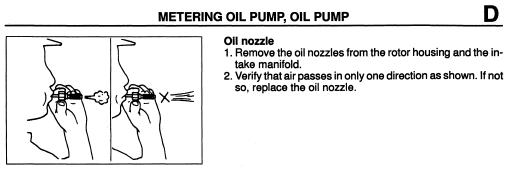
Here is how to test the check valve according to the FSM.
Since your check valve has apparently failed, when you hooked it to a vacuum source close to the throttle body , it just sucked the oil into the the TB.
Yes you should continue to premix, and you should pull the nozzles out and inspect/ replace them. You won't be able to fix the check valve, but if you can somehow remove it, or drill a hole through it so it flows both directions freely, then you could put a small external check valve right at the airport, easiest method would be replacement though.
Here is how to test the check valve according to the FSM.
Removed the PCV valve and put in caps at the UIM and filler tube. Still have the vent line at the bottom of the filler tube to the turbo inlet. Removed the oil injector vacuum line from the UIM (where it shouldn't have been in the first place). Oil in the throttle body is gone. I will remove and check the oil injectors as discussed above and probably try a new PCV later but this gets the immediate problem taken care of.
Thanks everyone,
Jeff
Thanks everyone,
Jeff

Thread
Thread Starter
Forum
Replies
Last Post
