


Measuring Engine Temps: Expert Opinions Needed




Measuring Engine Temps: Expert Opinions Needed
Not sure if this has been discussed before and after much searching decided to post up a thread. Given the brutal current summer heat, I am sure we are all closely monitoring our engine temps so here is my question:
What is the best location for measuring engine temps? I know the stock engine temp sensor (single wire) is located on the back driver's side of the engine but most of us no longer use the stock gauge for obvious reasons. I still have mine hooked up but frankly the gauge never moves from center and I use my PLX engine temp sensor for accurate readings. However, what is the best location to install the actual temp probe (1/8 NTP)?
I ask this because I currently have my temp sensor located here:

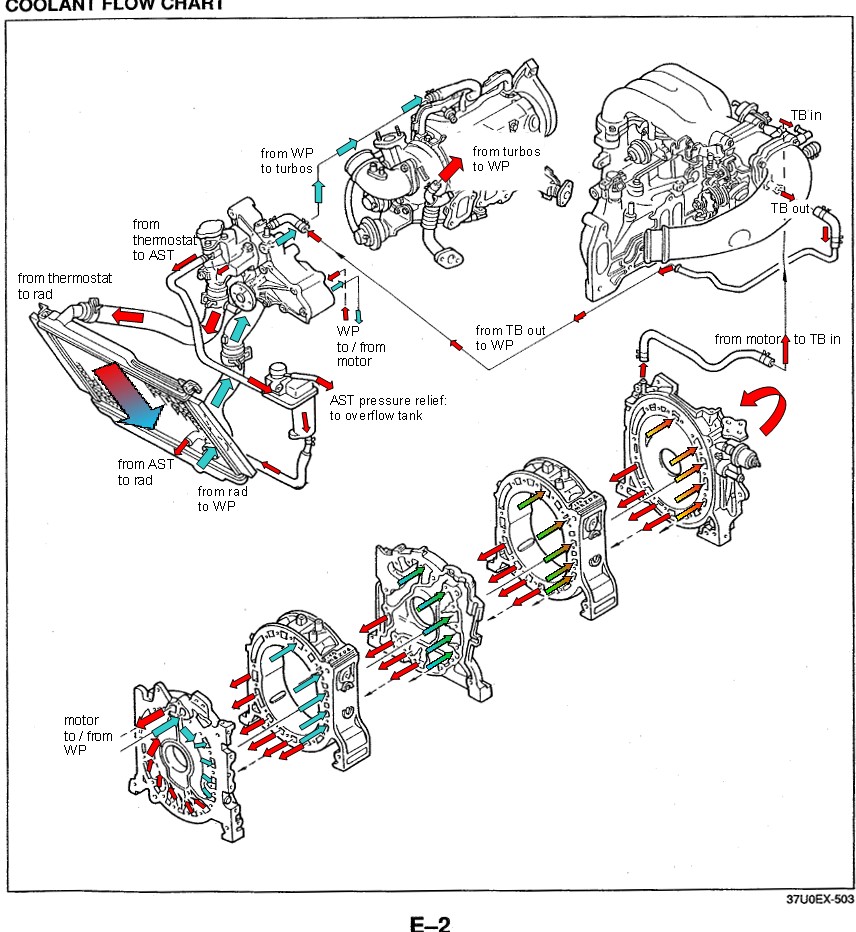
It struck me yesterday that I am currently measuring the temp of the coolant as it exists the engine and right before it enters the radiator to be cooled. So if I am correct, this is the hottest spot to measure temps and if I were to measure from the stock location, I would assume the temps at that location would be 20 - 30 degrees cooler as I would be measuring on the "cool" side of the flow or after the water had passed thru the radiator and then back into the engine.
I (Kilo Racing) just installed a custom dual pass aluminum radiator that is pretty beefy and should do a good job of cooling the 3 rotor. We took the car for a test spin at around 2 pm in 100+ degree heat (in Orlando so the humidity was also a killer). Driving around not under load temps stayed at around 90-93 degrees celsius but under load (with the AC on) we were around 99-100 (212 degrees Fahrenheit). Didn't climb above this but still higher than expected. I guess we were a little disappointed as the front end is totally sealed and we have extra vents cut into the under tray to direct air flow right at the radiator. Also have a 3,300 CFM fan and shroud installed and am running water wetter so there is not much else to do except a v mount setup. (FYI - the posted pic was before the install of the new fan and shroud).
However, when we started thinking about the location of the temp sensor I am not sure if I should worry so it brings me back to the original question:
Does the location of the water temp matter and if so, where is the best location? Also, is my theory correct that temps of the coolant will vary quite a bit by measuring on the hot side versus the cold? Hope this is useful to others as well.
What is the best location for measuring engine temps? I know the stock engine temp sensor (single wire) is located on the back driver's side of the engine but most of us no longer use the stock gauge for obvious reasons. I still have mine hooked up but frankly the gauge never moves from center and I use my PLX engine temp sensor for accurate readings. However, what is the best location to install the actual temp probe (1/8 NTP)?
I ask this because I currently have my temp sensor located here:
It struck me yesterday that I am currently measuring the temp of the coolant as it exists the engine and right before it enters the radiator to be cooled. So if I am correct, this is the hottest spot to measure temps and if I were to measure from the stock location, I would assume the temps at that location would be 20 - 30 degrees cooler as I would be measuring on the "cool" side of the flow or after the water had passed thru the radiator and then back into the engine.
I (Kilo Racing) just installed a custom dual pass aluminum radiator that is pretty beefy and should do a good job of cooling the 3 rotor. We took the car for a test spin at around 2 pm in 100+ degree heat (in Orlando so the humidity was also a killer). Driving around not under load temps stayed at around 90-93 degrees celsius but under load (with the AC on) we were around 99-100 (212 degrees Fahrenheit). Didn't climb above this but still higher than expected. I guess we were a little disappointed as the front end is totally sealed and we have extra vents cut into the under tray to direct air flow right at the radiator. Also have a 3,300 CFM fan and shroud installed and am running water wetter so there is not much else to do except a v mount setup. (FYI - the posted pic was before the install of the new fan and shroud).
However, when we started thinking about the location of the temp sensor I am not sure if I should worry so it brings me back to the original question:
Does the location of the water temp matter and if so, where is the best location? Also, is my theory correct that temps of the coolant will vary quite a bit by measuring on the hot side versus the cold? Hope this is useful to others as well.

Yes, the location does matter. Ideally, like oil temp, you'd have two sensors to report your pre and post radiator temps to show how effective your cooling solution is or isn't. However, I think with one or the other, you can draw some conclusions as to whether what you have is sufficient or not.
Given the choice, I would take post-radiator for the location.
Given the choice, I would take post-radiator for the location.

Joined: Jul 2001
Posts: 10,672
Likes: 413
From: Charlottesville VA 22901
In my opinion if it's 100 out down in FL with your AC on and you're keeping the water temps at 100c you're doing fine.
Yep that's were most everyone puts the water temp sensor for reasons you already addressed.
some folks use the rear iron position on the 13b because there's already a spot for it but they give up the stock reading (not much use anyway) and I think either location will give you accurate readings.
I may be wrong but I think on the 13b the PFC reads from the stock plate/iron position and my gauge reads from the thermo housing and the gauge and PFC pretty much stay the same temp.
Yep that's were most everyone puts the water temp sensor for reasons you already addressed.
some folks use the rear iron position on the 13b because there's already a spot for it but they give up the stock reading (not much use anyway) and I think either location will give you accurate readings.
I may be wrong but I think on the 13b the PFC reads from the stock plate/iron position and my gauge reads from the thermo housing and the gauge and PFC pretty much stay the same temp.


I can't see exactly where you have it mounted but that general location is fine as long as it is low enough to sense the coolant temperature even if there is a pocket of air.
When I was running a fluidyne with 50/50, I routinely saw 100 to 105C in ambient 100F. 50/50 however has very little headroom before you get microboiling. I run Evans NPG+ for the last 7 years and never had a heat related issue even when I was in 120F in Arizona with only one oil cooler. No cavitation on the water pump, no corrosion. Yes, it's expensive at $42/gallon but everything else is expensive on this car.
When I was running a fluidyne with 50/50, I routinely saw 100 to 105C in ambient 100F. 50/50 however has very little headroom before you get microboiling. I run Evans NPG+ for the last 7 years and never had a heat related issue even when I was in 120F in Arizona with only one oil cooler. No cavitation on the water pump, no corrosion. Yes, it's expensive at $42/gallon but everything else is expensive on this car.
Yes, the location does matter. Ideally, like oil temp, you'd have two sensors to report your pre and post radiator temps to show how effective your cooling solution is or isn't. However, I think with one or the other, you can draw some conclusions as to whether what you have is sufficient or not.
Given the choice, I would take post-radiator for the location.
Given the choice, I would take post-radiator for the location.
I can't see exactly where you have it mounted but that general location is fine as long as it is low enough to sense the coolant temperature even if there is a pocket of air.
When I was running a fluidyne with 50/50, I routinely saw 100 to 105C in ambient 100F. 50/50 however has very little headroom before you get microboiling. I run Evans NPG+ for the last 7 years and never had a heat related issue even when I was in 120F in Arizona with only one oil cooler. No cavitation on the water pump, no corrosion. Yes, it's expensive at $42/gallon but everything else is expensive on this car.
When I was running a fluidyne with 50/50, I routinely saw 100 to 105C in ambient 100F. 50/50 however has very little headroom before you get microboiling. I run Evans NPG+ for the last 7 years and never had a heat related issue even when I was in 120F in Arizona with only one oil cooler. No cavitation on the water pump, no corrosion. Yes, it's expensive at $42/gallon but everything else is expensive on this car.
Because I am in FL, I run close to 70/30 water to coolant mixture with Purple Ice water wetter. After the test drive, we did listen for signs of boiling but hear nothing. I've heard about the Evans NPG but doesn't that make the temps go up (although this is good with the NPG)?

Okay, so if I am reporting 212 F on the post-radiator side (and also post thermostat too - basically right under where the radiator cap is but low in the housing) what the stock location temp most likely be? I am tempted to shoot the cooling hose going back into the engine to see what its temp is so I would know how much the radiator is cooling.
I would say that 212F pre-radiator isn't bad in FL heat. With the setup you have, I would expect it to run a little cooler but that could just be a by product of the FMIC.
Trending Topics
I meant to say post-engine/pre-radiator side, my apologies. Don't know what post-radiator temps are but I hope lower than my 212 pre temps.

I have my water temp sender mounted with a T into the coolant hose going to the throttle body, it's getting water after it's fully passed through the block on the way back to the water pump housing. It's always within 1-2 deg C of the PowerFC's readout which is pulling from the ECU sensor on the back of the waterpump housing.
If you don't have the TB coolant hoses you can pull the return nipple on the waterpump housing and drill/tap that hole for the sender. Getting the temp just before the thermostat is where you want to read from, that will give you the hottest numbers and realistically what the engine is seeing.
Dale
If you don't have the TB coolant hoses you can pull the return nipple on the waterpump housing and drill/tap that hole for the sender. Getting the temp just before the thermostat is where you want to read from, that will give you the hottest numbers and realistically what the engine is seeing.
Dale


I have mine T'd into a hose the runs from a nipple on the back of the thermostat housing to the nipple that sticks up under the UIM (I believe that used to be used for the throttle body lines). This way its at the hottest point and before the Thermostat, I didn't like having it post-thermostat as I couldn't keep track of the temps until the thermostat was open, so a stuck thermostat, or air in the system could cause lots of problems and I would never see it until it was too late.
What temps are you seeing now? I see between 198-215 degrees F (which seems a bit hotter than most, but i dont have air in the system or a leak, and i have a koyo radiator in the stock position, it runs a bit hot but it hasn't given me any problems). thats with weather between 90 and 100. both highway and around town and without an undertray (which i just installed today). I also don't have an FMIC in the way of the radiator.
What temps are you seeing now? I see between 198-215 degrees F (which seems a bit hotter than most, but i dont have air in the system or a leak, and i have a koyo radiator in the stock position, it runs a bit hot but it hasn't given me any problems). thats with weather between 90 and 100. both highway and around town and without an undertray (which i just installed today). I also don't have an FMIC in the way of the radiator.
Because I am in FL, I run close to 70/30 water to coolant mixture with Purple Ice water wetter. After the test drive, we did listen for signs of boiling but hear nothing. I've heard about the Evans NPG but doesn't that make the temps go up (although this is good with the NPG)?
With Evans NPG I never heard it again in the last 6 years. I also run an electric water pump from a VW VR6 to keep coolant circulating after shutdown.
Evans NPG and water injection are two must have items for our car. With 3 blown motors I will never go without these two items. They are hard to get used to but the status quo was not acceptable to me.
In fact, I'm running Alberto old motor at 14 psi regularly for the last 4000 miles with no major issues (idle is uneven with the street porting) with Evans and NPG.

^That motor ran Evans most of its life also until 2 years ago.
A couple of points to keep in mind:
- my old Mercedes SLK which has a coolant temp gauge with numbers would routinely run up to 100*C in stop/go traffic at which point the fans would engage to improve air flow through the rad to cool things down.
- the radiator (like the intercooler) operates on air flow to cool the medium inside of it. If the air flowing through the rad is 100*C then it would be difficult to get the medium inside the radiator (heat exchanger) cooler than the air flowing through it.
A couple of points to keep in mind:
- my old Mercedes SLK which has a coolant temp gauge with numbers would routinely run up to 100*C in stop/go traffic at which point the fans would engage to improve air flow through the rad to cool things down.
- the radiator (like the intercooler) operates on air flow to cool the medium inside of it. If the air flowing through the rad is 100*C then it would be difficult to get the medium inside the radiator (heat exchanger) cooler than the air flowing through it.
 So the air flow into the radiator would be 38*C which isn't great but the radiator should be able to cool things down a bit from the pre-radiator coolant of 100*C.
So with the NPG, the theory here is is has a much higher boiling point which is the main benefit right? The downside is it is not as efficient but you trade that off for the boiling point so on balance this is better?
And back to one of my original questions: If I were to also measure from the stock temp location, what would I see if my current pre-radiator location temp is 100*C? I guess at the end of the day I need to conclude wether I am comfortable with the current temps on the car.



Joined: Mar 2001
Posts: 30,814
Likes: 655
From: FL-->NJ/NYC again!
In the end David I think your 'problem' lies in that extra rotor in the engine bay, not to mention your monster snail 
I agree that those temps are nothing to worry about. Now if you planned to roadrace the car then some further tweaking may be in order. But for the street you're doing ok.
Chris' father has us doing some maintenance on his 20B, and one of the things I plan to do is install a water temp gauge, so I might have some comparo data to report back at some point.
P.S. One thing you may want to consider---- look into the DEI Titanium heat blanket. I recently switched over from the style that you're running to the DEI piece and was pleasantly surprised at the improved heat reduction in my engine bay. The T6 version isn't cheap (almost 400 on fleabay) but based on what I've seen on my FD and on a few customer's cars, I really feel it can help.
I agree that those temps are nothing to worry about. Now if you planned to roadrace the car then some further tweaking may be in order. But for the street you're doing ok.
Chris' father has us doing some maintenance on his 20B, and one of the things I plan to do is install a water temp gauge, so I might have some comparo data to report back at some point.
P.S. One thing you may want to consider---- look into the DEI Titanium heat blanket. I recently switched over from the style that you're running to the DEI piece and was pleasantly surprised at the improved heat reduction in my engine bay. The T6 version isn't cheap (almost 400 on fleabay) but based on what I've seen on my FD and on a few customer's cars, I really feel it can help.

Something someone else touched on as well is your front mount. You might want to consider a Vmount at sometime in the future. Not sure if there is room in your engine bay to squeeze one in. Granted I only run a 2 rotor, but switching over made a HUGE difference here in AZ where temps are routinely above 105 this time of year. Running temps in the summertime with my old PF SMIC used to be 91 to 96, but now rarely go over 87C with the Vmount setup. One final thought would be to consider a hood with additional venting such as the Amemiya AD9, but I'm not sure if you want to consider this look or not. You might try 80/20 on your water to antifreeze mixture, but again, that will probably only buy you a degree or so. Do your coolant temps climb if caught in traffic? This is something to really watch and consider as well if you're close to the margins, as you seem to be.
Edit: After re-reading your first post David, I'd have to agree with others. Given the conditions (2 pm, mid-day 100+ with high humidity), I'd say that your system is actually pretty optimized given the fact that you're running a front mount. I'd vote for that being the biggest culprit of your temps based on the experience of people I've known here in AZ who've run front mounts here in the past.
Edit: After re-reading your first post David, I'd have to agree with others. Given the conditions (2 pm, mid-day 100+ with high humidity), I'd say that your system is actually pretty optimized given the fact that you're running a front mount. I'd vote for that being the biggest culprit of your temps based on the experience of people I've known here in AZ who've run front mounts here in the past.
D'oh! That's right. I'm too tired to post accurate tech these days...
In the end David I think your 'problem' lies in that extra rotor in the engine bay, not to mention your monster snail
I agree that those temps are nothing to worry about. Now if you planned to roadrace the car then some further tweaking may be in order. But for the street you're doing ok.
Chris' father has us doing some maintenance on his 20B, and one of the things I plan to do is install a water temp gauge, so I might have some comparo data to report back at some point.
P.S. One thing you may want to consider---- look into the DEI Titanium heat blanket. I recently switched over from the style that you're running to the DEI piece and was pleasantly surprised at the improved heat reduction in my engine bay. The T6 version isn't cheap (almost 400 on fleabay) but based on what I've seen on my FD and on a few customer's cars, I really feel it can help.
I agree that those temps are nothing to worry about. Now if you planned to roadrace the car then some further tweaking may be in order. But for the street you're doing ok.
Chris' father has us doing some maintenance on his 20B, and one of the things I plan to do is install a water temp gauge, so I might have some comparo data to report back at some point.
P.S. One thing you may want to consider---- look into the DEI Titanium heat blanket. I recently switched over from the style that you're running to the DEI piece and was pleasantly surprised at the improved heat reduction in my engine bay. The T6 version isn't cheap (almost 400 on fleabay) but based on what I've seen on my FD and on a few customer's cars, I really feel it can help.
$400 bucks for a turbo blanket? Damn will the madness never stop? I did just rewrap the downpipe in the DEI titanium wrap so I guess it would match at least.
Something someone else touched on as well is your front mount. You might want to consider a Vmount at sometime in the future. Not sure if there is room in your engine bay to squeeze one in. Granted I only run a 2 rotor, but switching over made a HUGE difference here in AZ where temps are routinely above 105 this time of year. Running temps in the summertime with my old PF SMIC used to be 91 to 96, but now rarely go over 87C with the Vmount setup. One final thought would be to consider a hood with additional venting such as the Amemiya AD9, but I'm not sure if you want to consider this look or not. You might try 80/20 on your water to antifreeze mixture, but again, that will probably only buy you a degree or so. Do your coolant temps climb if caught in traffic? This is something to really watch and consider as well if you're close to the margins, as you seem to be.
Edit: After re-reading your first post David, I'd have to agree with others. Given the conditions (2 pm, mid-day 100+ with high humidity), I'd say that your system is actually pretty optimized given the fact that you're running a front mount. I'd vote for that being the biggest culprit of your temps based on the experience of people I've known here in AZ who've run front mounts here in the past.
Edit: After re-reading your first post David, I'd have to agree with others. Given the conditions (2 pm, mid-day 100+ with high humidity), I'd say that your system is actually pretty optimized given the fact that you're running a front mount. I'd vote for that being the biggest culprit of your temps based on the experience of people I've known here in AZ who've run front mounts here in the past.
I am already at a 70/30 mix of coolant so the extra degree or so is no big deal I think particularly with the Purple Ice added in. Curiously, my temps go down when sitting in traffic. They we in the 92-93*C range versus around 100*C under load at highway speeds. I immediately thought we had the fans running backwards but they are correct. In addition to the radiator fan, I have two pull fans in the ac condenser so I guess with the FMIC, this is blocking better air flow.
When I go back to pick up the car, I am going to get the body shop guys to cut bigger vents into the undertray draw more air up into the radiator area.
Another quick question... do they eventually start to drop at freeway speed or continue to "creep"?
You may want to do a quick experiment and take it for a 5-10 mile test drive in your current undertray config. Then have them tape over some (if not all) of the extra vents that you've put in the undertray to see if it helps or makes the problem worse. The fact that your temps go UP at speed indicates to me that something "could be" incorrect with the ducting, so adding more vents may just make the problem worse. You could be getting some reverse flow through the addition of more vents and adding even more "could" make the problem worse. Just food for thought! I'd at least try it before assuming that more vents will help.
Another quick question... do they eventually start to drop at freeway speed or continue to "creep"?
Another quick question... do they eventually start to drop at freeway speed or continue to "creep"?
The temps don't continue to creep up, they stabilize at around 100*C but then don't climb. Thye also don't fall though.
This is based on my driving BEFORE the new radiator was installed. With the new radiator setup I don't have enough info to be sure what is going on. Kilo took the car out on Saturday for about 25 minutes and reported back to me with what is posted up.
Another thought I had was to cover up the vents I had cut into the top of the hood to see what happens. Maybe they are bleeding out fresh air at the wrong time:
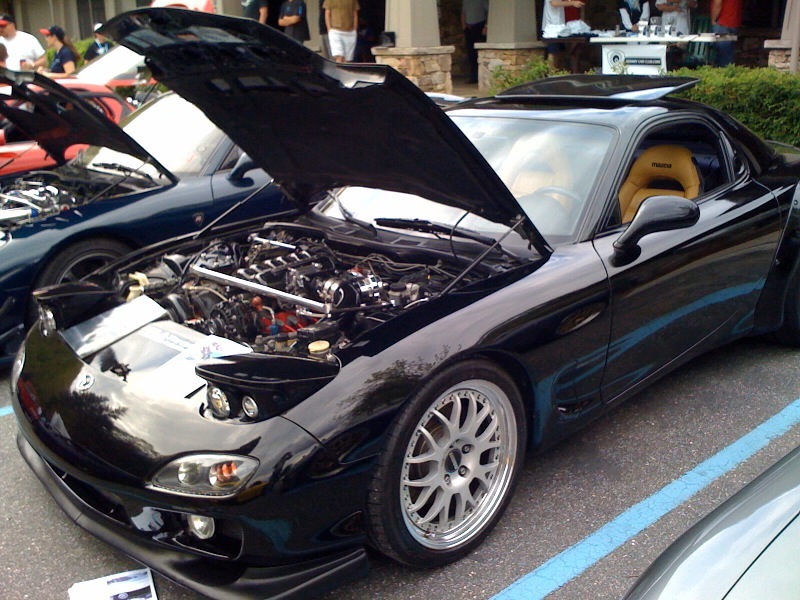
Wish I had a better pic here at work but you can sort of see the vents that run across where the alternator is. When stopped I can see heat coming out so I know then they work but maybe at highway speeds they should be positioned somewhere else?
David,
I would guess that your hood vents are definitely helping, based on their position. How much cooler does it run at night? Mid 90C range? How about during the winter months when temps are in the 70s. Does it drop to the upper 80C range? You might PM Banzai Racing and several other 3 rotor owners (if you haven't already done this) to see if any or most are running significantly cooler. Again, I think a Vmount would definitely helped, based on my experience and the experiece of others here in AZ who switched from front mounts to vmounts, but how much improvement would you see? I'd say maybe 5 to 10C, which would still leave you in the 90C range. You'd need to ask yourself if it's worth the additional cost and down time.
On a side note, are your intake temps better now with your new configuration in the bumper?
I would guess that your hood vents are definitely helping, based on their position. How much cooler does it run at night? Mid 90C range? How about during the winter months when temps are in the 70s. Does it drop to the upper 80C range? You might PM Banzai Racing and several other 3 rotor owners (if you haven't already done this) to see if any or most are running significantly cooler. Again, I think a Vmount would definitely helped, based on my experience and the experiece of others here in AZ who switched from front mounts to vmounts, but how much improvement would you see? I'd say maybe 5 to 10C, which would still leave you in the 90C range. You'd need to ask yourself if it's worth the additional cost and down time.
On a side note, are your intake temps better now with your new configuration in the bumper?
David,
I would guess that your hood vents are definitely helping, based on their position. How much cooler does it run at night? Mid 90C range? How about during the winter months when temps are in the 70s. Does it drop to the upper 80C range? You might PM Banzai Racing and several other 3 rotor owners (if you haven't already done this) to see if any or most are running significantly cooler. Again, I think a Vmount would definitely helped, based on my experience and the experiece of others here in AZ who switched from front mounts to vmounts, but how much improvement would you see? I'd say maybe 5 to 10C, which would still leave you in the 90C range. You'd need to ask yourself if it's worth the additional cost and down time.
On a side note, are your intake temps better now with your new configuration in the bumper?
I would guess that your hood vents are definitely helping, based on their position. How much cooler does it run at night? Mid 90C range? How about during the winter months when temps are in the 70s. Does it drop to the upper 80C range? You might PM Banzai Racing and several other 3 rotor owners (if you haven't already done this) to see if any or most are running significantly cooler. Again, I think a Vmount would definitely helped, based on my experience and the experiece of others here in AZ who switched from front mounts to vmounts, but how much improvement would you see? I'd say maybe 5 to 10C, which would still leave you in the 90C range. You'd need to ask yourself if it's worth the additional cost and down time.
On a side note, are your intake temps better now with your new configuration in the bumper?
Don't know about AITs just yet as my PLX AIT gauge is not properly configured. Wanted to resolve this during the last trip but time got away from me. I need to ask Kilo to tell what the Microtech AIT reading is.
Everytime I have had higher coolant temps at speed, it was due to air in the coolant system or some kind of other coolant system issue like a tired hose clamp or minor leak somewhere.
Have Kilo do a coolant system pressure test while the car is there.
Have Kilo do a coolant system pressure test while the car is there.


The location you have your gauge is the best; it reflects the engine operating temperature and that's what is important. You could obtain post radiator temp for information on how effective your cooling system is but to evaluate you would need much more info like water flow rate (hugely affects heat rejection in the radiator) system pressure and the exact BTU capacity of your coolant mixture. In the end unless you are a numbers cruncher it's gee whiz only. The only additional temperature I would be interested in is oil temp as (from what I understand) 20% of the engine's cooling is from the oil system and the oil operating temp is directly related to turbo life. BTW, is your turbo's bearing housing water cooled? If not I would definately hook it up to the engine's cooiing system (I'm sure the provisions are there).
I live East of Orlando on Merritt Island and a couple of weeks ago and ran some solo2. Drove 50 miles there, ran hard five runs and drove home and with AC on 92 - 95C, AC off 95-101C. Stock cooling system except for a Koyo Rad. My sensor (PLX) is exactly where yours is. I had a good log of the temperature but can't find it now....
I live East of Orlando on Merritt Island and a couple of weeks ago and ran some solo2. Drove 50 miles there, ran hard five runs and drove home and with AC on 92 - 95C, AC off 95-101C. Stock cooling system except for a Koyo Rad. My sensor (PLX) is exactly where yours is. I had a good log of the temperature but can't find it now....