


LONG: Bonez cat, possible clog | midpipe swap | boost control | dyno | *VID/PICS*



 LONG: Bonez cat, possible clog | midpipe swap | boost control | dyno | *VID/PICS*
LONG: Bonez cat, possible clog | midpipe swap | boost control | dyno | *VID/PICS*
Alright this is kind of long, pardon the length. This all happened in the last couple of days, just trying to get some ideas from people with good brains and experience....
------------------------------------------------------------------------
Hey guys, I'm a little stumped right now. Need some input from the gurus out there. I just got done street tuning my car a couple of days ago and went to go to a local dyno on Friday to get some baseline numbers and try to sort out a strange boost/motor smoothness problem I've been having. WOT pulls on the street is a good way to go to jail in a hurry, I would like to avoid that The last couple of months I noticed that when I run higher boost on my non sequential twins (higher than 11 psi, I have been running ~13.5 psi since almost two years ago shortly after I went to a dyno last) the motor is not as smooth at higher boost/RPM as it was before. I can feel what feels like little bumps in motor torque. I decided to go out and log some data of the car and noticed that AFRs are about where they were before, a little less smooth however, but boost pressure is falling off more than it was previously at high RPM (above 5k). If I run 11 psi or less, the bumpy torque problem does not show up. My first inclination is that there may be an ignition problem which may explain the bumpy AFR readings and corresponding bumpy torque. Was not too sure why boost was falling off... no apparent boost leak, only thing I can think of is a boost leak I can't detect or perhaps an exhaust restriction...
So I did a quick tune up before running over the dynojet: fresh oil, plugs, air filters, 91 octane fuel. You see can my other mods in my vbgarage (see sig). Made three pulls, did not change any settings as I was in data gathering mode. I will post up the dyno charts later when I get the dyno files, but here are the results from what I can remember (some corrections applied... will report details later):
288 whp/245 rwtq @ ~13.5 psi (AFR ~ 11.0:1)
284 whp/241 rwtq @ ~13.5 psi (AFR ~ 10.8:1, air temp reading was off leading to richer condition)
257 whp/210 rwtq @ ~10 psi (AFR ~ 11.0:1, ran lower boost after hearing from a shop staffer my cat may be clogged he heard my 2nd run, listen to the comments after run #2 [2:50-4:17])
Here's the video, sorry I didn't bother to edit it (little over 6 minutes long, not too bad): VIDEO [95.3 MB], 16:9 aspect ratio
I have the timing squared away, haven't changed it for almost two years since my last dyno session in Dec '07. I have been making some changes to my fuel injection map however, as I've been fine tuning it over the past year and a half. My boost pressure has been harder to maintain steady at high RPM, especially when I run more than 11 psi. Lately, in the last couple of months, it's become very obvious that at higher boost, it will drop off at least 1-2 psi approaching 8 grand and I can feel it by the seat of my pants. Almost two years ago I made pretty much the exact same hp/tq numbers on a very similar dyno and weather conditions, and I was running less boost and more fuel... you'll notice the torque/hp curve for the 10 psi run is way smoother (it feels great actually on the street, at higher boost, the car hauls slightly more *** but has the bumps in torque, not good, and the lack of smoothness really wrecks any perception of power & speed).
I thought it may be related to ignition, and I confess I haven't checked my coils, igniter, wiring, connectors, grounds, etc... my plugs are fine. I just pulled out a set that had almost 3k miles on them (passed CA smog too!) and they looked just fine. My plug wires are three years old about 20k miles on them. When I get some time in the next month or two I will check the ign out and let you know what I find. I was planning on going drag racing and some Auto-X but I guess that's gonna have to wait
After dyno pull #2, one of the shop folks (an old, wise man, had to be 45+) mentioned that the exhaust note sounded like there was excessive backpressure and to be careful. He thought my cat converter may be clogged. Right away I thought that might be why it was so hard to keep my boost stable at high RPM and the other guys in the shop thought the same. When I told them I had a cat, they gave me the "what is wrong with you,
  why would you have a cat on a rotary car" kind of trip, I was laughing. They were super cool, but they warned me that running the motor that rich often enough will kill the converters, just a matter of time. Well, duh
  I did one more pull at lower boost and paid the guys and left. So I decided to run another experiment. What would happen if I put a midpipe on my car? I've always wanted to do it but am not a fan of the fuel stink. I borrowed my gf's MP (thanks honey!), put that sucker on and went for a spin today... before I got on it, I added about 3% fuel to my map just to be on the safe side. Left the boost control alone, wanted to see how it would react...
Guess what? My low boost setting for 10 psi suddenly became 12psi. And it was boost CREEPING. The exact opposite of having the converter on the car. And the AFRs were almost 0.2 LEANER in the same part of my map, even after I added the extra fuel in. The weather and temps the last couple of days did not change too much, so it should have minimal impact on my AFRs. I dialed the B/C back down to around 10 psi and it was still creeping a bit. Motor felt very smooth at 10psi, no problem. I didn't have time to mess with it too much more, so I ran the HI setting, but dialed it down before pushing it, to see if I still have bumpy torque syndrome.
Got on it and shot straight to ~13+ psi around 4500 RPM, and it was still creeping a little bit! Not as bad as the 10 psi setting but still opposite of having the cat on the car. The boost was much more stable and didn't exhibit the bumps in boost and fuel as I was seeing in my other logs when I had the cat on the car. AFRs were again about 0.2 point leaner than what I tuned for in the same part of the map, in spite of my richening. The HI setting on my B/C had a much higher GAIN than the LO setting, from my previous effort to keep 13+ psi boost up at high RPM, it helped me in this case to keep the boost stable (see attached pic from B/C manual). Only problem is the AFR curve was a lot more bumpy than what I tuned for /w the cat on the car, and I'm still not getting that lovin' feeling from my motor. HOWEVER, it feels a shitload faster than before at both boost settings. I'd be willing to bet I got another 15-20 hp out of it at least (was running a little leaner too). I'll tell you what, it completely changed the character of my car at those boost levels. Makes me want to get one but I just can't get away with that constant fuel smell.
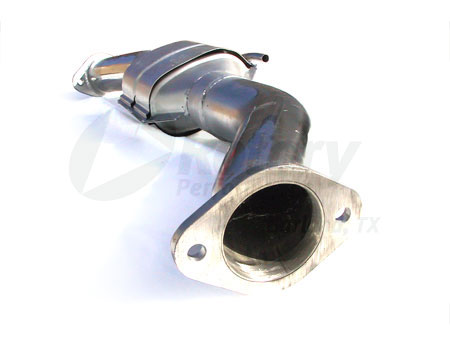
So I took some pics of the cat. Check them out HERE I shook it around, stuck my hand in there, didn't hear any rattling. If you look at the converter element, the mesh does seem to be intact... although I'm no expert on what a clogged unit would look like. I have seen some other pics of clogged ones and they look nothing like mine. It's a Bonez hi flow unit. Bought it used over 3 years ago. Ran it w/o an air pump for the last 2.9 years (or so), I just recently had the air injection system working again and had the tube welded back on. It's got at least 17k miles on it, not too sure how many miles it had before...
QUESTIONS:
1. Do you guys think I may have a clogged cat and that's a major contributor my boost drop at high RPM? Or am I paranoid?
2. Anyone you know of run more than a steady, reliable 13 psi on stock twins w/ a cat converter in place?
3. What kind of milage are you cat users getting out of your cats?
Alright this is kind of long, pardon the length. This all happened in the last couple of days, just trying to get some ideas from people with good brains and experience....
------------------------------------------------------------------------
Hey guys, I'm a little stumped right now. Need some input from the gurus out there. I just got done street tuning my car a couple of days ago and went to go to a local dyno on Friday to get some baseline numbers and try to sort out a strange boost/motor smoothness problem I've been having. WOT pulls on the street is a good way to go to jail in a hurry, I would like to avoid that
The last couple of months I noticed that when I run higher boost on my non sequential twins (higher than 11 psi, I have been running ~13.5 psi since almost two years ago shortly after I went to a dyno last) the motor is not as smooth at higher boost/RPM as it was before. I can feel what feels like little bumps in motor torque. I decided to go out and log some data of the car and noticed that AFRs are about where they were before, a little less smooth however, but boost pressure is falling off more than it was previously at high RPM (above 5k). If I run 11 psi or less, the bumpy torque problem does not show up. My first inclination is that there may be an ignition problem which may explain the bumpy AFR readings and corresponding bumpy torque. Was not too sure why boost was falling off... no apparent boost leak, only thing I can think of is a boost leak I can't detect or perhaps an exhaust restriction...So I did a quick tune up before running over the dynojet: fresh oil, plugs, air filters, 91 octane fuel. You see can my other mods in my vbgarage (see sig). Made three pulls, did not change any settings as I was in data gathering mode. I will post up the dyno charts later when I get the dyno files, but here are the results from what I can remember (some corrections applied... will report details later):
288 whp/245 rwtq @ ~13.5 psi (AFR ~ 11.0:1)
284 whp/241 rwtq @ ~13.5 psi (AFR ~ 10.8:1, air temp reading was off leading to richer condition)
257 whp/210 rwtq @ ~10 psi (AFR ~ 11.0:1, ran lower boost after hearing from a shop staffer my cat may be clogged he heard my 2nd run, listen to the comments after run #2 [2:50-4:17])
Here's the video, sorry I didn't bother to edit it (little over 6 minutes long, not too bad): VIDEO [95.3 MB], 16:9 aspect ratio
I have the timing squared away, haven't changed it for almost two years since my last dyno session in Dec '07. I have been making some changes to my fuel injection map however, as I've been fine tuning it over the past year and a half. My boost pressure has been harder to maintain steady at high RPM, especially when I run more than 11 psi. Lately, in the last couple of months, it's become very obvious that at higher boost, it will drop off at least 1-2 psi approaching 8 grand and I can feel it by the seat of my pants. Almost two years ago I made pretty much the exact same hp/tq numbers on a very similar dyno and weather conditions, and I was running less boost and more fuel... you'll notice the torque/hp curve for the 10 psi run is way smoother (it feels great actually on the street, at higher boost, the car hauls slightly more *** but has the bumps in torque, not good, and the lack of smoothness really wrecks any perception of power & speed).
I thought it may be related to ignition, and I confess I haven't checked my coils, igniter, wiring, connectors, grounds, etc... my plugs are fine. I just pulled out a set that had almost 3k miles on them (passed CA smog too!) and they looked just fine. My plug wires are three years old about 20k miles on them. When I get some time in the next month or two I will check the ign out and let you know what I find. I was planning on going drag racing and some Auto-X but I guess that's gonna have to wait
After dyno pull #2, one of the shop folks (an old, wise man,
had to be 45+) mentioned that the exhaust note sounded like there was excessive backpressure and to be careful. He thought my cat converter may be clogged. Right away I thought that might be why it was so hard to keep my boost stable at high RPM and the other guys in the shop thought the same. When I told them I had a cat, they gave me the "what is wrong with you, why would you have a cat on a rotary car" kind of trip, I was laughing. They were super cool, but they warned me that running the motor that rich often enough will kill the converters, just a matter of time. Well, duh I did one more pull at lower boost and paid the guys and left. So I decided to run another experiment. What would happen if I put a midpipe on my car? I've always wanted to do it but am not a fan of the fuel stink. I borrowed my gf's MP (thanks honey!), put that sucker on and went for a spin today... before I got on it, I added about 3% fuel to my map just to be on the safe side. Left the boost control alone, wanted to see how it would react...Guess what? My low boost setting for 10 psi suddenly became 12psi. And it was boost CREEPING. The exact opposite of having the converter on the car. And the AFRs were almost 0.2 LEANER in the same part of my map, even after I added the extra fuel in. The weather and temps the last couple of days did not change too much, so it should have minimal impact on my AFRs. I dialed the B/C back down to around 10 psi and it was still creeping a bit. Motor felt very smooth at 10psi, no problem. I didn't have time to mess with it too much more, so I ran the HI setting, but dialed it down before pushing it, to see if I still have bumpy torque syndrome.
Got on it and shot straight to ~13+ psi around 4500 RPM, and it was still creeping a little bit! Not as bad as the 10 psi setting but still opposite of having the cat on the car. The boost was much more stable and didn't exhibit the bumps in boost and fuel as I was seeing in my other logs when I had the cat on the car. AFRs were again about 0.2 point leaner than what I tuned for in the same part of the map, in spite of my richening. The HI setting on my B/C had a much higher GAIN than the LO setting, from my previous effort to keep 13+ psi boost up at high RPM, it helped me in this case to keep the boost stable (see attached pic from B/C manual). Only problem is the AFR curve was a lot more bumpy than what I tuned for /w the cat on the car, and I'm still not getting that lovin' feeling from my motor. HOWEVER, it feels a shitload faster than before at both boost settings. I'd be willing to bet I got another 15-20 hp out of it at least (was running a little leaner too). I'll tell you what, it completely changed the character of my car at those boost levels. Makes me want to get one but I just can't get away with that constant fuel smell.
So I took some pics of the cat. Check them out HERE I shook it around, stuck my hand in there, didn't hear any rattling. If you look at the converter element, the mesh does seem to be intact... although I'm no expert on what a clogged unit would look like. I have seen some other pics of clogged ones and they look nothing like mine. It's a Bonez hi flow unit. Bought it used over 3 years ago. Ran it w/o an air pump for the last 2.9 years (or so), I just recently had the air injection system working again and had the tube welded back on. It's got at least 17k miles on it, not too sure how many miles it had before...
QUESTIONS:
1. Do you guys think I may have a clogged cat and that's a major contributor my boost drop at high RPM? Or am I paranoid?
2. Anyone you know of run more than a steady, reliable 13 psi on stock twins w/ a cat converter in place?
3. What kind of milage are you cat users getting out of your cats?



Does this cat require air injection to function properly? There are usually two types, and if you dont run air to a cat that needs it thats a great way to clog it in a hurry. Especially if your running real rich.
I've tuned the car to run reasonably lean under off boost conditions (AFR cruise 16, idle 13, transitions 12-13). One contributor to possible death of cat is I had my fans running full time for the last 2+ years and a questionable thermostat, it would take a while to warm up the car, and hence run richer under all conditions... I fixed that problem
Maybe it's time for something new.One thing I noticed from the SMB website: http://www.smb.net.au/fullexhaustsystems-mazdarx7.htm
Ceramic core high flow converter, the lead in and lead out tubes and flanges are 304 stainless steel, we have found the ceramic core high flow converters are satisfactory for up to around the 200kw mark over that consider the metallic substrate converters. see universal converters for details
200 kW = 268 hp
Not sure if that's wheel or flywheel, what dyno, what weather conditions, etc... but that makes me wonder about the inherent exhaust restriction due to the converters and an appropriate boost level you can maintain on stock turbos...
 They have a metallic one I've been reading about that reduces exhaust backpressure by a few psi. I may have to get one of them.
Regarding increased boost with flow rates and such, I also found this on the SMB website:
Confused at which converter to go for? From our in-house flow bench testing, in a back to back test, the following results were gained, (note: our machine is not a certified machine), and is used to simply do back to back comparisons, therefore the CFM figures should not be taken as gospel.
However the percentage change should be the same percentage difference on a certified calibrated machine, the converters shown below gave the following results.
Catco 3" in 3" out 299 CFM
Carsound 3" in 3" out 299 CFM
Metallic substrate 3" in 3" out 408 CFM = 36% increase if flow rate
Metallic substrate 4" in 4" out 437 CFM = 46% increase in flow rate Pressure differential:
Test carried out on Nissan 200 SX (Silvia) the maximum pressure in the dump pipe using a carsound 3" converter was 4psi, with the 3" metallic substrate converter this dropped to 1.5psi, and thus increased the boost to the engine by a further 2 psi.
Maybe I can get my 13+ psi with one of the metallic units...
Confused at which converter to go for? From our in-house flow bench testing, in a back to back test, the following results were gained, (note: our machine is not a certified machine), and is used to simply do back to back comparisons, therefore the CFM figures should not be taken as gospel.
However the percentage change should be the same percentage difference on a certified calibrated machine, the converters shown below gave the following results.
Catco 3" in 3" out 299 CFM
Carsound 3" in 3" out 299 CFM
Metallic substrate 3" in 3" out 408 CFM = 36% increase if flow rate
Metallic substrate 4" in 4" out 437 CFM = 46% increase in flow rate Pressure differential:
Test carried out on Nissan 200 SX (Silvia) the maximum pressure in the dump pipe using a carsound 3" converter was 4psi, with the 3" metallic substrate converter this dropped to 1.5psi, and thus increased the boost to the engine by a further 2 psi.
Maybe I can get my 13+ psi with one of the metallic units...


If your CAT clogs, the power will flatten out on the top end--kind of feels like a rev limiter of sorts. Have you looked in the cat you pulled to see what it looks like inside?
FWIW, excessive richness alone shouldn't be a problem for most cats unless there is excess oxygen in the exhaust (due to an engine miss or ?). This is because the excess fuel just acts as a coolant unless there is oxygen present allowing for a reaction in the cat, which can lead to overheating and cat failure.
FWIW, excessive richness alone shouldn't be a problem for most cats unless there is excess oxygen in the exhaust (due to an engine miss or ?). This is because the excess fuel just acts as a coolant unless there is oxygen present allowing for a reaction in the cat, which can lead to overheating and cat failure.
Looking from aft end forward:
Looking from fwd end aft:
Since I can't see the actual catalyst elements, I really wouldn't have any idea unless I flow tested the unit or cut it up... any other ideas?
Trending Topics

Any change in the level of exhaust restriction will affect the boost control settings and have at least some effect on engine efficiency. But these *** dyno reports from your fist post are not very useful. I thought you had a Datalogit? post some logs at least, and these logs should include AFR data. Which boost controller are you using and what are its exact settings? It sounds like a Greddy Spec II or E-01, or maybe a Blitz. Post a log of your boost pattern with and without the converter and include the relevant boost controller settings for each log. Did it have significant boost oscillations?
More exhaust backpressure will push against the flapper and force it open. You may have just needed to retune the EBC. Sometimes it helps to retune the boost controller from scratch. Drop the gain to near zero and set the solenoid duty to a lower value. Tune the start boost until it spikes, add more solenoid duty, then dial in the gain last.
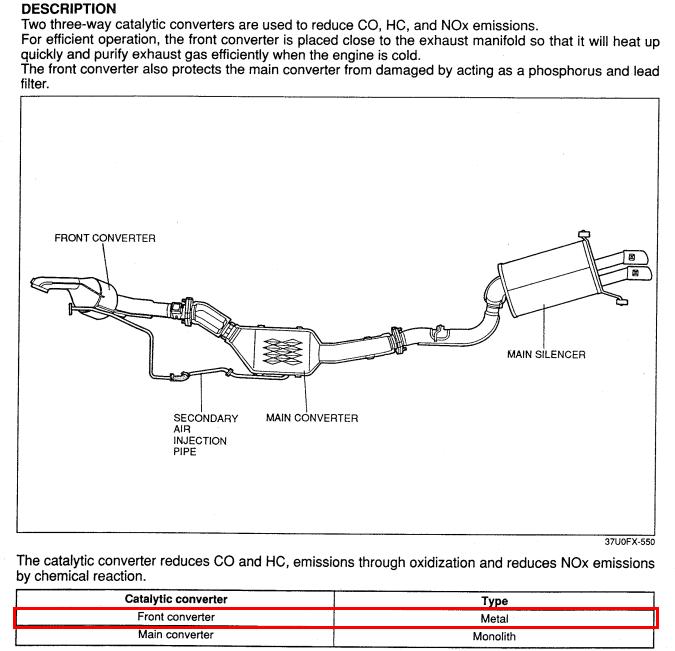
If you care about reliability, stay away. The least reliable converter ever used on a rotary engine was the Metallic precat in the FD. That was the first and last metallic-type converter used on an Rx-7. Starting with the series 2cars, all the prior converters were the typical monolith type. This includes the two precats found on the 2nd gen cars. Due to the side exhaust ports and vast improvements in technology, the Rx-8's use one monolith type cat and have eliminated the split air pipe altogether, instead using a simplified ACV with only port air control.
More exhaust backpressure will push against the flapper and force it open. You may have just needed to retune the EBC. Sometimes it helps to retune the boost controller from scratch. Drop the gain to near zero and set the solenoid duty to a lower value. Tune the start boost until it spikes, add more solenoid duty, then dial in the gain last.
Originally Posted by mdpalmer
Maybe I can get my 13+ psi with one of the metallic units...
 pics of logs & link to logs
10 psi, HF Cat, Street

13.7 psi, HF Cat, Street

13.5 psi, HF Cat, Dynorun 1

13.5 psi, HF Cat, Dynorun 2

10 psi, HF Cat, Dynorun 3

10 psi intended (did not change B/C settings from before, just put MP on), MP, Street

13.5 psi, MP, Street

No.
More exhaust backpressure will push against the flapper and force it open. You may have just needed to retune the EBC. Sometimes it helps to retune the boost controller from scratch. Drop the gain to near zero and set the solenoid duty to a lower value. Tune the start boost until it spikes, add more solenoid duty, then dial in the gain last.
If you care about reliability, stay away. The least reliable converter ever used on a rotary engine was the Metallic precat in the FD. That was the first and last metallic-type converter used on an Rx-7. Starting with the series 2cars, all the prior converters were the typical monolith type. This includes the two precats found on the 2nd gen cars. Due to the side exhaust ports and vast improvements in technology, the Rx-8's use one monolith type cat and have eliminated the split air pipe altogether, instead using a simplified ACV with only port air control.
It's hard to tell from the pics what the condition of the cells may be--it doesn't appear to be broken or cracked though. Try shining a strong light into one end while checking the other (backlit condition) and you may be able to detect open cells. Keep in mind that there are two bricks in there, a front and rear. The most vulnerable cells are usually directly opposing the inlet. Do you hear anything rattling around in there?

You could get one of these:
http://www.etoolcart.com/exhaustback...twaebpt01.aspx
or just check any local exhaust shop to see if they'll test it for you.
http://www.etoolcart.com/exhaustback...twaebpt01.aspx
or just check any local exhaust shop to see if they'll test it for you.

Cat really needs the oxygen to help burn off the hydrocarbons otherwise it will eventually start reducing in flow area due to carboning up.
It would interesting to see the exhaust system back pressure. Maybe you could add a pressure xdcr and instrument to the ECM.
High exhaust backpressure could result in limiting turbine speed and ultimate boost. Engine would then defuel allowing backpressure to relieve then turbine spoolup again with fuel added based upon MAP until high back pressure then engine defuels...... and the cycle goes on. This is only hypothesis as your plots don't really reveal this. Seems also that the non-sequentials would also contribute to the effect due to the spool time delays. Can you expand the plots to reveal short time hacks; maybe show the sub 1 second events?
It would interesting to see the exhaust system back pressure. Maybe you could add a pressure xdcr and instrument to the ECM.
High exhaust backpressure could result in limiting turbine speed and ultimate boost. Engine would then defuel allowing backpressure to relieve then turbine spoolup again with fuel added based upon MAP until high back pressure then engine defuels...... and the cycle goes on. This is only hypothesis as your plots don't really reveal this. Seems also that the non-sequentials would also contribute to the effect due to the spool time delays. Can you expand the plots to reveal short time hacks; maybe show the sub 1 second events?

A good high-flow cat should flow about 90% of a midpipe. With that dramatic of a difference between the highflow cat and the midpipe, I think we can safely say the highflow cat is bad.
I've been running an SMB highflow metal cat for a few years now, runs great. For the heck of it a few months back I swapped a midpipe in. Power-wise and boost wise, I noticed pretty much no difference, only real difference was the car was much stinkier.
The statement that metal cats are bad because the precat was a metal element is a fallacy. Newer metal cats are WAY different than the technology in the stock pre-cat, remember it was designed in the early '90s, housed in a thick cast iron pipe, and placed directly after the turbos. Cats have come leaps and bounds since then.
The SMB metal cats are excellent - fit and finish is superb, and they last. Only real downside is I've heard it's tricky or impossible to pass emissions with them. I've heard good things about the Bonez and emissions tests, however.
It wasn't clear if you were running the airpump with your setup. Cats really need the airpump to pass emissions, it's unclear if it hurts cat life. IMHO, the reason your Bonez cat failed is running lean (16:1) cruising AF's and running very rich for a long time. Both of those situations are really hard on the cat.
The way I see it, you have quite a few good options -
- Run a midpipe. Stinkier, more creep, louder, but it works and they're cheap.
- Get another Bonez highflow. Can pass Cali emissions, good quality, reduces stink, noise, and creep. Less power than a midpipe. You need to tune for 14.7:1 AF cruise ratios on it to keep it happy.
- Get an SMB highflow cat. It's kind of inbetween the other two options - maybe some more creep, maybe some more power, definitely less stink than the midpipe, and you probably won't pass emissions. You can abuse it much more than the Bonez, the metal core is VERY hardy, you don't have to run an airpump and you can run leaner AF's.
Might also be worth looking into your ignition system. The plugs sound relatively fresh, so that shouldn't be an issue. If you have GOOD plug wires, like NGK's or Magnecors, they should be fine. If you haven't replaced the coil pack harness with the new updated part, do so - that fixes a lot of high RPM misfires people have had.
Good luck,
Dale
I've been running an SMB highflow metal cat for a few years now, runs great. For the heck of it a few months back I swapped a midpipe in. Power-wise and boost wise, I noticed pretty much no difference, only real difference was the car was much stinkier.
The statement that metal cats are bad because the precat was a metal element is a fallacy. Newer metal cats are WAY different than the technology in the stock pre-cat, remember it was designed in the early '90s, housed in a thick cast iron pipe, and placed directly after the turbos. Cats have come leaps and bounds since then.
The SMB metal cats are excellent - fit and finish is superb, and they last. Only real downside is I've heard it's tricky or impossible to pass emissions with them. I've heard good things about the Bonez and emissions tests, however.
It wasn't clear if you were running the airpump with your setup. Cats really need the airpump to pass emissions, it's unclear if it hurts cat life. IMHO, the reason your Bonez cat failed is running lean (16:1) cruising AF's and running very rich for a long time. Both of those situations are really hard on the cat.
The way I see it, you have quite a few good options -
- Run a midpipe. Stinkier, more creep, louder, but it works and they're cheap.
- Get another Bonez highflow. Can pass Cali emissions, good quality, reduces stink, noise, and creep. Less power than a midpipe. You need to tune for 14.7:1 AF cruise ratios on it to keep it happy.
- Get an SMB highflow cat. It's kind of inbetween the other two options - maybe some more creep, maybe some more power, definitely less stink than the midpipe, and you probably won't pass emissions. You can abuse it much more than the Bonez, the metal core is VERY hardy, you don't have to run an airpump and you can run leaner AF's.
Might also be worth looking into your ignition system. The plugs sound relatively fresh, so that shouldn't be an issue. If you have GOOD plug wires, like NGK's or Magnecors, they should be fine. If you haven't replaced the coil pack harness with the new updated part, do so - that fixes a lot of high RPM misfires people have had.
Good luck,
Dale
thanks
A good high-flow cat should flow about 90% of a midpipe. With that dramatic of a difference between the highflow cat and the midpipe, I think we can safely say the highflow cat is bad.
I've been running an SMB highflow metal cat for a few years now, runs great. For the heck of it a few months back I swapped a midpipe in. Power-wise and boost wise, I noticed pretty much no difference, only real difference was the car was much stinkier.
The statement that metal cats are bad because the precat was a metal element is a fallacy. Newer metal cats are WAY different than the technology in the stock pre-cat, remember it was designed in the early '90s, housed in a thick cast iron pipe, and placed directly after the turbos. Cats have come leaps and bounds since then.
The SMB metal cats are excellent - fit and finish is superb, and they last. Only real downside is I've heard it's tricky or impossible to pass emissions with them. I've heard good things about the Bonez and emissions tests, however.
It wasn't clear if you were running the airpump with your setup. Cats really need the airpump to pass emissions, it's unclear if it hurts cat life. IMHO, the reason your Bonez cat failed is running lean (16:1) cruising AF's and running very rich for a long time. Both of those situations are really hard on the cat.
The way I see it, you have quite a few good options -
- Run a midpipe. Stinkier, more creep, louder, but it works and they're cheap.
- Get another Bonez highflow. Can pass Cali emissions, good quality, reduces stink, noise, and creep. Less power than a midpipe. You need to tune for 14.7:1 AF cruise ratios on it to keep it happy.
- Get an SMB highflow cat. It's kind of inbetween the other two options - maybe some more creep, maybe some more power, definitely less stink than the midpipe, and you probably won't pass emissions. You can abuse it much more than the Bonez, the metal core is VERY hardy, you don't have to run an airpump and you can run leaner AF's.
Might also be worth looking into your ignition system. The plugs sound relatively fresh, so that shouldn't be an issue. If you have GOOD plug wires, like NGK's or Magnecors, they should be fine. If you haven't replaced the coil pack harness with the new updated part, do so - that fixes a lot of high RPM misfires people have had.
Good luck,
Dale
I've been running an SMB highflow metal cat for a few years now, runs great. For the heck of it a few months back I swapped a midpipe in. Power-wise and boost wise, I noticed pretty much no difference, only real difference was the car was much stinkier.
The statement that metal cats are bad because the precat was a metal element is a fallacy. Newer metal cats are WAY different than the technology in the stock pre-cat, remember it was designed in the early '90s, housed in a thick cast iron pipe, and placed directly after the turbos. Cats have come leaps and bounds since then.
The SMB metal cats are excellent - fit and finish is superb, and they last. Only real downside is I've heard it's tricky or impossible to pass emissions with them. I've heard good things about the Bonez and emissions tests, however.
It wasn't clear if you were running the airpump with your setup. Cats really need the airpump to pass emissions, it's unclear if it hurts cat life. IMHO, the reason your Bonez cat failed is running lean (16:1) cruising AF's and running very rich for a long time. Both of those situations are really hard on the cat.
The way I see it, you have quite a few good options -
- Run a midpipe. Stinkier, more creep, louder, but it works and they're cheap.
- Get another Bonez highflow. Can pass Cali emissions, good quality, reduces stink, noise, and creep. Less power than a midpipe. You need to tune for 14.7:1 AF cruise ratios on it to keep it happy.
- Get an SMB highflow cat. It's kind of inbetween the other two options - maybe some more creep, maybe some more power, definitely less stink than the midpipe, and you probably won't pass emissions. You can abuse it much more than the Bonez, the metal core is VERY hardy, you don't have to run an airpump and you can run leaner AF's.
Might also be worth looking into your ignition system. The plugs sound relatively fresh, so that shouldn't be an issue. If you have GOOD plug wires, like NGK's or Magnecors, they should be fine. If you haven't replaced the coil pack harness with the new updated part, do so - that fixes a lot of high RPM misfires people have had.
Good luck,
Dale
-Thanks Dale, I've read some of your posts on the SMB unit.
-I ran my Bonez for almost 3 years w/o an air pump. I just recently reinstalled the AP in the last two months.
-The next thing for me to check is the ignition system. My plugs were basically brand new during the street and dyno tests.
-I tuned the AFs leaner in cruise to improve gas milage, not too sure what the impact was on EGTs (I think I just may get a gauge), although it may have also been a contributor to possible cat failure.
Originally Posted by DaleClark
The SMB metal cats are excellent - fit and finish is superb, and they last. Only real downside is I've heard it's tricky or impossible to pass emissions with them.
Newer metal cats are WAY different than the technology in the stock pre-cat, remember it was designed in the early '90s, housed in a thick cast iron pipe, and placed directly after the turbos. Cats have come leaps and bounds since then.
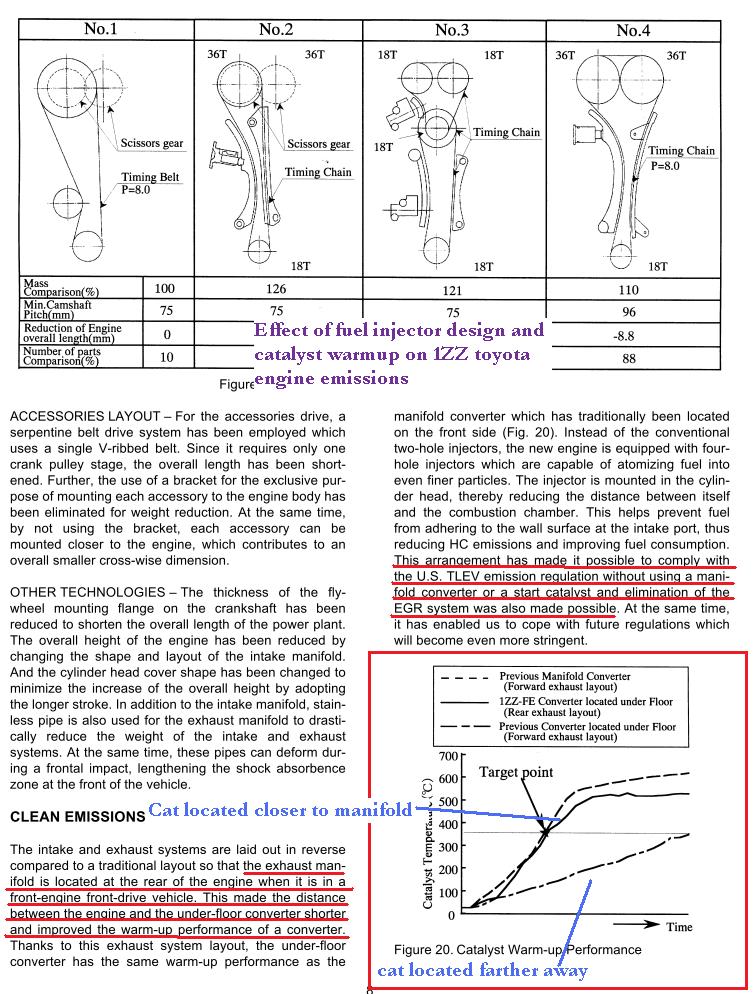
Your cat doesn't filter as well as the stock one (either precat or main cat) so it lasts equal/longer but pollutes more over the life of the component. To me it's not a matter of advances in technology, but simply the difference between an OEM design and an aftermarket one. When comparing an OEM metal cat to an aftermarket metal cat, we're not talking about major advances in technology here. We are talking about a difference in design goals. One was designed and tested for the specific vehicle to meet specific emissions goals, the other was not. The best thing Mazda did for emissions was, in response to new EPA cat life requirements, to change the engine architecture completely (side exhaust ports) which made precats unnecessary. Now that's an advance in technology.
It's also kind of like saying that regular monolith high flow cats are "better" than OEM spec ones. It's kind of a weird comparison. One is designed to minimize emissions for a long life even as the converter degrades (OEM ones in general) and the other is designed to be just effective enough to get by for a while, in order to maximize flow. All this is kind of academic though if the OP just wants to get rid of the gas smell, but since he has California emissions to deal with I think an effective aftermarket monolith type cat seems a safer bet in the long run.
The best cat I've ever tested was only 25%-->30% of the flow of an equivalent 3" pipe at a give pressure drop.
As an example, let's take a cat that is rated to flow ~300 cfm at 20.3" of H2O.... a typical number. That is one forth to one sixth of what a mid pipe might flow at that same pressure drop.
+1 for the post above by arghx
The 90% is just from my experience, no hard numbers. I expected a noticeable difference in my car with the midpipe and didn't notice any at all. Heck, the car wasn't even really louder with the midpipe over the SMB cat.
Was much smellier, though.
My car is running sequential twins as well. Didn't have any problems with creep either, same boost pattern. My car is making just over 300hp to the ground, for point of reference.
Dale
Was much smellier, though
.My car is running sequential twins as well. Didn't have any problems with creep either, same boost pattern. My car is making just over 300hp to the ground, for point of reference.
Dale


If you order a harness today, it will be be updated one. The original version had a separate ground wire which was attached to one of the bolts for the coils. If you don't have this extra ground attachment, you already have the updated harness. Unless you have a 92-93 FD which has been unmolested, most cars would already have this replaced by now.
dynojet runfiles (change extension from .txt --> .drf), dyno graph pics
I wanted to thank all of you who chimed in to give your $0.02. Dale, Arghx, Speed of light, Majik, and everyone else... I really appreciate it. I am trying to share my experience with the car, hopefully it will help someone in similar shoes, sometimes I feel like I am operating in a vacuum, so-to-speak, it's not like I have anyone I can just call and say, "hey fix my car" I think most of us are in that boat.... You guys and this forum are a significant contributor to enabling me to make this car fun and reliable. Arghx, I like your method of making attachments and then using image locations in the rx7club to show images in the body of posts, so I am using it here, thanks for the tip Anyway...
I'm attaching a picture of three UNCORRECTED/and SAE CORRECTED, HOWEVER THEY ARE SMOOTHED, dynojet runs (all /w my Bonez hiflow cat). It would probably more useful if I plotted the AFR's & boost on the same graph, but that will come later, this is more of an FYI for anyone who is following the thread. Take all of this with a grain of salt, there are a lot of variables influencing the results you see here. Every dyno reads a little different, and my old run was on a different dyno under different ambient conditons....
1. 10/09/09, ~13.5 psi peak boost, dropping to 12.5 psi @ redline
2. 10/09/09, ~10 psi peak boost, dropping to 9ish psi @ redline
3. 12/15/07, ~12.5 psi peak boost dropping to 11 psi @ redline
UNCORRECTED

SAE CORRECTED
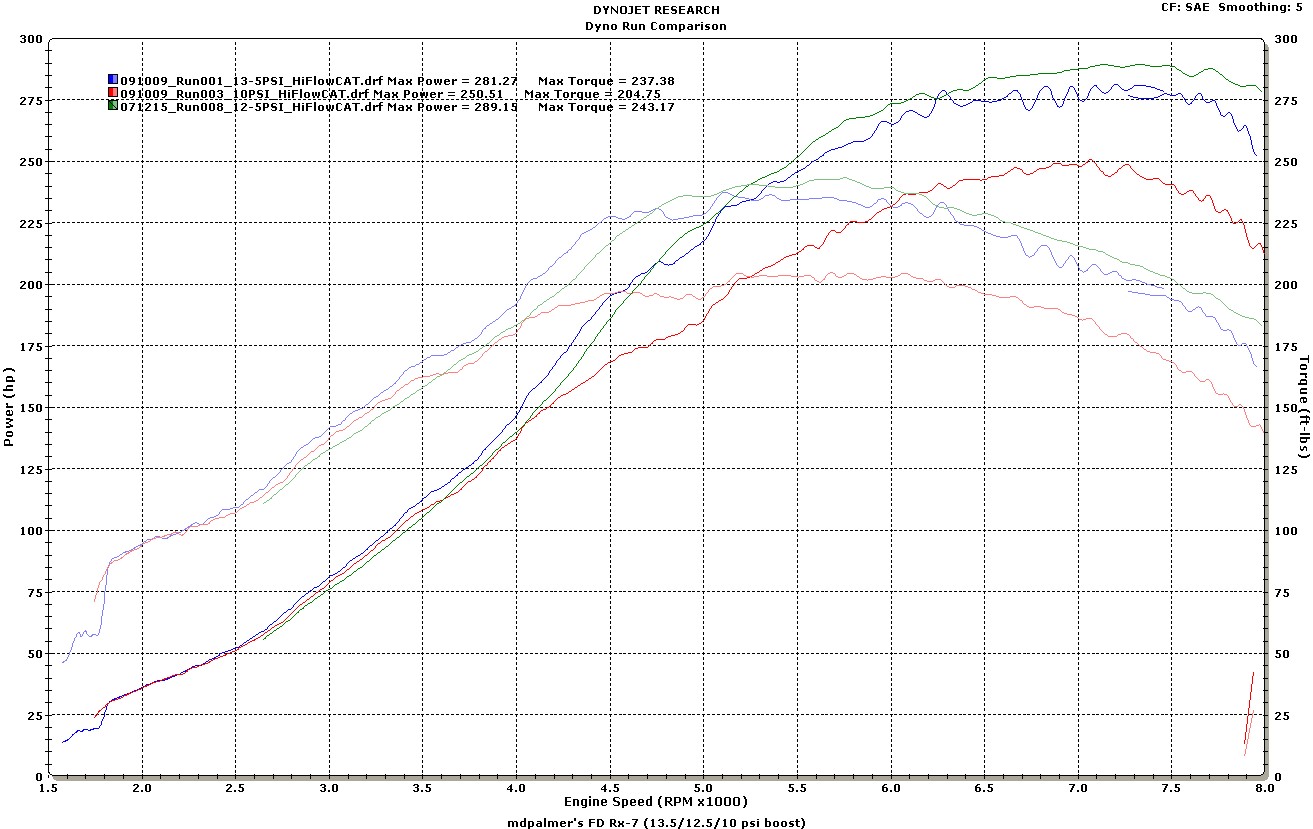
I'm also attaching the dynojet runfiles, just change the extension from .txt to .drf and WinPEP7 should be able to read it (for those of you who know how to use it). Please note that any corrections applied to the recent data (10-09-09) are not accurate. The ambient temp and altitude are not correct (4500'... Santa Ana is not in the mountains!). However, I want to draw attention to several items:
1. Notice how much smoother my old (12-15-07) dynorun was. No huge oscillations/bumps in tq/hp. I was running less boost and making more and smoother power than recently.
2. Notice how much more bumpy my new (10-09-09) dyno runs were. Bumps all over the place! Especially in upper RPM's (after 4.5k when full boost is online) For the last few months I've been feeling this on the street
3. Notice my 10psi run has some bump too, as compared to my old run from 12-15-07
4. Notice I gained some low end tq by leaning the fuel out (very generally speaking, I went from mid 11's --> 12.5-13 AFR in transition from light to full boost)
5. The dyno's WBO2 readings were not reliable so I didn't plot them
This is just an FYI. I have yet to look at my ignition system. It's pretty obvious to me I have some higher RPM/boost related fueling and/or ignition problems. However, I would like to report that my boost dropping off issue has been resolved... just did some testing today!


I think most of us are in that boat.... You guys and this forum are a significant contributor to enabling me to make this car fun and reliable. Arghx, I like your method of making attachments and then using image locations in the rx7club to show images in the body of posts, so I am using it here, thanks for the tip Anyway...I'm attaching a picture of three UNCORRECTED/and SAE CORRECTED, HOWEVER THEY ARE SMOOTHED, dynojet runs (all /w my Bonez hiflow cat). It would probably more useful if I plotted the AFR's & boost on the same graph, but that will come later, this is more of an FYI for anyone who is following the thread. Take all of this with a grain of salt, there are a lot of variables influencing the results you see here. Every dyno reads a little different, and my old run was on a different dyno under different ambient conditons....
1. 10/09/09, ~13.5 psi peak boost, dropping to 12.5 psi @ redline
2. 10/09/09, ~10 psi peak boost, dropping to 9ish psi @ redline
3. 12/15/07, ~12.5 psi peak boost dropping to 11 psi @ redline
UNCORRECTED
SAE CORRECTED
I'm also attaching the dynojet runfiles, just change the extension from .txt to .drf and WinPEP7 should be able to read it (for those of you who know how to use it). Please note that any corrections applied to the recent data (10-09-09) are not accurate. The ambient temp and altitude are not correct (4500'... Santa Ana is not in the mountains!). However, I want to draw attention to several items:
1. Notice how much smoother my old (12-15-07) dynorun was. No huge oscillations/bumps in tq/hp. I was running less boost and making more and smoother power than recently.
2. Notice how much more bumpy my new (10-09-09) dyno runs were. Bumps all over the place! Especially in upper RPM's (after 4.5k when full boost is online) For the last few months I've been feeling this on the street
3. Notice my 10psi run has some bump too, as compared to my old run from 12-15-07
4. Notice I gained some low end tq by leaning the fuel out (very generally speaking, I went from mid 11's --> 12.5-13 AFR in transition from light to full boost)
5. The dyno's WBO2 readings were not reliable so I didn't plot them
This is just an FYI. I have yet to look at my ignition system. It's pretty obvious to me I have some higher RPM/boost related fueling and/or ignition problems. However, I would like to report that my boost dropping off issue has been resolved... just did some testing today!

Thread
Thread Starter
Forum
Replies
Last Post
stickmantijuana
MoTeC
5
Sep 10, 2015 07:58 PM
