When you click on links to various merchants on this site and make a purchase, this can result in this site earning a commission. Affiliate programs and affiliations include, but are not limited to, the eBay Partner Network.
Big fan of K&N. I've used them on everything from my personal cars, race cars, motorcycles, go-peds, etc.. I've done a lot of back to back dyno tests and their replacement panel filters or entire intake systems have often made 10-20hp over stock:
...on an engine the filter flow isn’t constant in that every intake cycle results in frequency pulsing/resonance that cause the cotton fibers to dance around and this greatly increases their true filtering capability. That’s not going to be replicated by the fram guy testing method...
Maybe "dancing" vs not doesn't precisely define the issue. I think it's a similar phenomenon, but not, IMO, "dancing."
Here's what I (nerdy engineer) think it is:
During high-speed airflow a K&N's small fibers take a set, bent over in the direction of airflow, like wheat in a field when the wind is blowing.
When the airflow periodically slows, the fibers can stand back up and catch the small particles. Since it takes time for them to bend (take a set) again with airflow, on-off airflow, which happens frequently during driving (either shifting or intake pulsations), allows many of them to remain close to "vertical" in a position to catch small particles.
This also means that if the filter is too small, air flow rate never decreases enough to let the small fibers return to vertical. So there's a double "whammy" with a too small K&N filter - more airflow restriction, and impaired filtering ability.
With a paper filter, this same issue doesn't apply, so high airflow rate won't reduce its filtering ability. This also corresponds with paper filters having more restriction.
i do find it interesting that they sell residential washable MERV11 filters that don’t use the cloth layered design. They use a synthetic fiber built similar to everything else on the market. There’s no code against fibers in the airstream for residential/MERV filters. Is that because they’re a “me too” and just building a filter to meet existing code, or are they saying that the automotive filter system isn’t actually as good at filtering? A division of my company builds HEPA, but they don’t build the actual media…I need to find some time to speak to our suppliers as well as see if K&N will divulge more…
the filtration difference between a fan and a resonant intake system is likely why and was discussed earlier in the thread
regardless of why it does work different than those tests, they are proven to be well effective on ICEs in numerous applications opposite of what the fan based tests tend to indicate.
this subject is right up there with climate change, rotary engines suck, and other 1 + 1 can equal 3 if “we feel and believe it in our heart” like kinds of subject matter.
.
Although I really like the idea of putting something sticky inside the intake piping to identify if particles were getting past the filter, I'm very skeptical about the filter media 'dancing' or 'vibration' theories David Vizard presented in that video. Cars aren't magic, whatever phenomenon happens on a vehicle can be replicated or even exaggerated with a well-designed test environment. It's possible that today's K&N media is still less effective at capturing contaminants than OEM or other aftermarket, but they are now good enough to keep engines healthy.
It's hard to prove the AEM filter actually caused Howard's engine housing problems in the first place, especially if Elite had possession of his vehicle for a long time. Questions like that are why I do a lot of my own work. I'm not the best mechanic but I'm rarely in a rush and so far I've managed to avoid cutting the wrong corners.
Last edited by scotty305; Nov 24, 2023 at 11:52 PM.
"It's hard to prove the AEM filter actually caused Howard's engine housing problems in the first place"
this is a correct statement, however Dr Iannetti's firm opinion is that foreign material in the charge air caused the condition and the filter is the culprit. having more than ten hours of conversation with him on a range of technical matters leads me to place him in the number one slot as to rotary matters. with apologies to my old firm EF Hutton, "when Dr Iannetti talks I listen."
i believe attempting to assess filtration efficacy might be one of the most challenging projects on the planet and as such i will completely pass on any published results.
as i said in post one, my judgement re K&N V AEM will be based on empiricism. K&N no scratches. AEM scratches. case closed for me. i don't need to analyze filters.
other air filtration matters also matter.
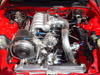
my bet is 90% of the single turbo setups are using too small a filter and more than half locate it near the IC exhaust flow. Air Filters matter and so does System Design.
i suggest that all single turbo guys, for 2024, add a intake air temperature THERMOCOUPLE. you will probably not like to learn your actual IATs.
Very fortunate that Delete was nowhere near my engine. FYI, the engine in my car is a new Mazda block circa 2022. my car escaped from Delete in 2018.
That's a very important detail I missed, thanks for clearing it up. I agree it sounds like AEM filters are the wrong choice in 2023. It's good to know that K&N are the right choice, and I agree that a large filter that has access to fresh cold air is very important. I knew some of the engineers who did intake kits at AEM before the sale to K&N, and from what I remember they said that getting a source of fresh / cold / dense air to the filter was more important than fitting large intake pipes, and more important than a very large filter. Obviously bigger is better if you can make it fit, and there is some filter size which would be too small but most OEM cars have avoided undersized air filters since the early 2000s.
The founder of AEM, John Concialdi, passed away earlier this year. He and the other owners sold the electronics side of AEM to Holley a few years ago. He loved building things and modifying cars, could be found in the shop most weekends wrenching on his twin-turbo LSX Studebaker even after he retired.
the diesel trucks all have something like this filter setup available, the filter is made by a company called Donaldson
the Ford one even has a little indicator to show when the filter needs changing
I would just look at what pro drift cars use. Often greater than 1,000 horsepower, fast throttle response, and the need to filter massive amounts of junk. A lot use K&N filters as well as other brands. And then they put a filter protector bag over it.
I would just look at what pro drift cars use. Often greater than 1,000 horsepower, fast throttle response, and the need to filter massive amounts of junk. A lot use K&N filters as well as other brands. And then they put a filter protector bag over it.
The few I saw run an all day session with the same filter before cleaning. I would bet that 10 minutes worth of driving is worse than 1 year of street car use. Have you ever seen the radiator fins on a pro drift car. Horrendous.