


Air Bypass valve: One way only? Or Am I being lied to by a stranger?


Thread Starter
Junior Member

Joined: Dec 2004
Posts: 19
Likes: 0
From: West Lafayette, IN
 Air Bypass valve: One way only? Or Am I being lied to by a stranger?
I have a mostly stock FD (metal AST, downpipe) with the stock Air Bypass (blowoff) Valve disconnected from the airbox. The hole in the airbox has a rubber stopper covering it, so there should be no leakage of engine bay air into the airbox. I'm happy with the extra audio feedback from my turbo, but would hate to think of buying an after-market noisemaker.
Recently however, I ran into someone who claimed to be a former FD owner who said that disconnecting the ABV from the airbox was bad because it "sucks in dirty engine-bay air under vacuum". Doing my own research (again) I can ONLY find references to the ABV venting excess pressure from the intake, NOT allowing air in. I would imagine that conceivably, the valve _could_ open while the turbo is not generating boost, which _would_ mean unfiltered air is flowing into the intake, but I can't find any indication that it actually does that. Is he correct, or is he messing with me?
Recently however, I ran into someone who claimed to be a former FD owner who said that disconnecting the ABV from the airbox was bad because it "sucks in dirty engine-bay air under vacuum". Doing my own research (again) I can ONLY find references to the ABV venting excess pressure from the intake, NOT allowing air in. I would imagine that conceivably, the valve _could_ open while the turbo is not generating boost, which _would_ mean unfiltered air is flowing into the intake, but I can't find any indication that it actually does that. Is he correct, or is he messing with me?



The stock BOV isn't fully shut at idle, but it doesn't draw in a significant amount of air.
One concept most people have trouble with is the intake tract BEFORE the throttle body is NOT UNDER VACUUM. The TB creates a restriction and the restriction creates the vacuum in the intake manifold. The intake tract up to the TB is under slightly less than atmospheric pressure, VERY slightly.
Many people have run them open air vented for a long time with no bad effects. But, if you want to cover your basess, get a 1" inlet K&N filter and clamp it to the BOV. It will still make sound but it will be muted slightly and the air coming in and out will be filtered.
Dale
One concept most people have trouble with is the intake tract BEFORE the throttle body is NOT UNDER VACUUM. The TB creates a restriction and the restriction creates the vacuum in the intake manifold. The intake tract up to the TB is under slightly less than atmospheric pressure, VERY slightly.
Many people have run them open air vented for a long time with no bad effects. But, if you want to cover your basess, get a 1" inlet K&N filter and clamp it to the BOV. It will still make sound but it will be muted slightly and the air coming in and out will be filtered.
Dale

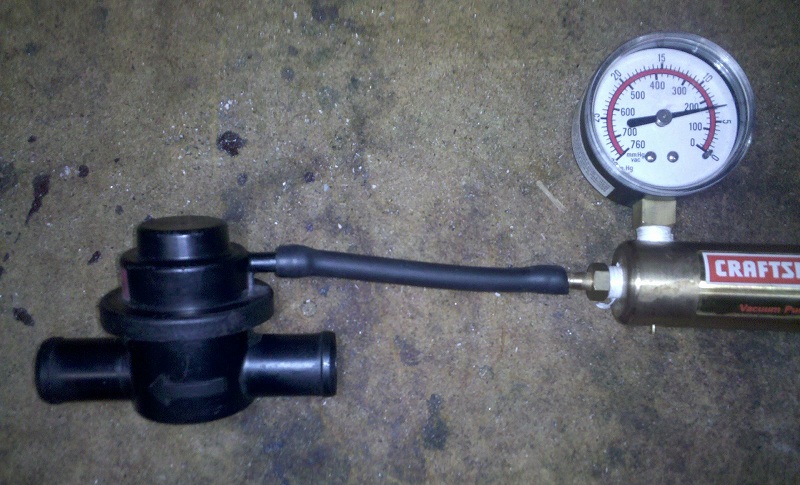
That's an FD airbypass valve right there. When about 6-7 inches of mercury are applied to the vacuum port, the valve inside lifts slightly and air can pass through. There is an arrow on the ABV to indicate which way the air should be going, but you can physically blow through either side and air will pass. If you blow from the side opposite of the arrow (against the arrow) you will notice that air does not flow as smoothly through it, but it will still pass through... you'd have to try it yourself to see what I mean.
The ABV is hooked to manifold vacuum to operate it. Manifold vacuum is going to be more than the requisite 7 inches at idle, so the valve will be open. Since the FD doesn't have an airflow sensor it doesn't matter much if the valve is left open to atmosphere from a driveability perspective. On the 2nd gen cars (which do have an airflow meter) you need to connect a check valve to a vented ABV or unmetered air will enter the engine and cause problems.
Interestingly enough, I actually pressurized the factory ABV on a bench one time to see how much boost it could hold. At 50psi the hose I was using blew off. It's an extremely simple and reliable design.
Thread Starter
Junior Member
Joined: Dec 2004
Posts: 19
Likes: 0
From: West Lafayette, IN
Interesting. I did hold my hand over it at idle and didn't feel suction, but it sounds like it should be to little to notice.
So to summarize: technically it's true but I probably don't need to worry about it. It might not be a bad idea to get a filter to be safe. I'll look at doing that then.
Would an aftermarket valve have the same issue? Or would it generally require more vacuum to open? Or do they usually come with a filter built in?
Thanks for the replies!
So to summarize: technically it's true but I probably don't need to worry about it. It might not be a bad idea to get a filter to be safe. I'll look at doing that then.
Would an aftermarket valve have the same issue? Or would it generally require more vacuum to open? Or do they usually come with a filter built in?
Thanks for the replies!
Aftermarket valves are usually closed at idle, but they can open under vacuum conditions. Also, aftermarket BOV's don't respond as well as the stocker, the stock one has very fast response.
Really, with the twins, there's no good reason to use an aftermarket BOV unless you're dying for a big whistle under your hood. Open venting the stocker makes a fun woosh noise and that's fine by me. Mine is actually routed back into my intake (and HKS RS) which mutes it down a notch.
Dale
Really, with the twins, there's no good reason to use an aftermarket BOV unless you're dying for a big whistle under your hood. Open venting the stocker makes a fun woosh noise and that's fine by me. Mine is actually routed back into my intake (and HKS RS) which mutes it down a notch.
Dale
https://www.rx7club.com/3rd-generation-specific-1993-2002-16/changing-spring-stock-bov-276067/
Trending Topics
As far as response I mean reacting to low throttle input and low boost conditions. Most aftermarket BOV's I've seen will flutter or surge at low throttle inputs, the pressure doesn't overcome the spring.
All in all Mazda did a really good job on the BOV on the FD.
Dale
All in all Mazda did a really good job on the BOV on the FD.
Dale


That's actually not true. Aftermarket valves have stronger springs and close much sooner than the stock BOV. This allows the boost to build slightly quicker and give slightly better turbo response (not a lot, but it at least does something positive). Garfinkle used to mod the stock BOV to use a stronger spring so it would close sooner like aftermarket BOV's:
https://www.rx7club.com/showthread.php?t=276067
https://www.rx7club.com/showthread.php?t=276067

Thread
Thread Starter
Forum
Replies
Last Post
Jeff20B
1st Generation Specific (1979-1985)
73
Sep 16, 2018 07:16 PM
