


aftermarket intakes worse than stock?


Banned. I got OWNED!!!
Joined: Mar 2009
Posts: 1,045
Likes: 0
From: NC
Not true in general, and especially if your compressor is working within a good efficiency area
Tout = Tin + (Tin x [-1+(Pout/Pin)^0.263])/efficiency
re: http://www.enginelogics.com/cmaps.html
- Sandro
Tout = Tin + (Tin x [-1+(Pout/Pin)^0.263])/efficiency
re: http://www.enginelogics.com/cmaps.html
- Sandro
The other thing you have to keep in mind is if you're going down the road at anything above 25 mph the residence time of the air in the engine bay is literally seconds before it gets sucked into the intake or out under the car (better yet, through a vented hood), so how much heat really gets transferred to the intake air from the engine bay duriing a freeway run? This is far more an issue with drag racers who have to sit on a starting grid, or for street racers running from a dig. I also have addiotnal air "vents" going to my air intake so it doesn't get a direct blast from the radiator/IC.
Last edited by no_more_rice; Dec 28, 2009 at 03:16 PM.

Ah, I see. I'm trying to keep my car relatively stock, so I think I'll be content with the stock air box and the exhaust it has now. However, if I ever choose to do more, I'll go ahead and invest in a Power FC.


Originally Posted by no_more_rice
so how much heat really gets transferred to the intake air from the engine bay duriing a freeway run?
I give some props to xlr8 for this. So few people have the ability to say that. U have alot of respect in my book
and to add to the convo, I ran some numbers.
Assuming 72% efficiency on the turbo at the given moment the following temperatures occur:
15psi at 70 degree intake results in 227 degree output
15psi at 110 degree intake results in 279 degree output
so an increase in 40deg in resulted in a >50 deg out. Wow never knew that
5psi at 70deg = 117 deg out
5psi at 110deg = 161 deg out
again wow. Just on the compression of air alone.
and to add to the convo, I ran some numbers.
Assuming 72% efficiency on the turbo at the given moment the following temperatures occur:
15psi at 70 degree intake results in 227 degree output
15psi at 110 degree intake results in 279 degree output
so an increase in 40deg in resulted in a >50 deg out. Wow never knew that
5psi at 70deg = 117 deg out
5psi at 110deg = 161 deg out
again wow. Just on the compression of air alone.

But, again, if you have a large enough IC, the extra 40F (or whatever BDC measured) between a true "cold" air intake and warm engine bay intake will result in an insignificant difference in charge temps, because the IC will knock down the higher temps to 20 C above ambient anyway.
The other thing you have to keep in mind is if you're going down the road at anything above 25 mph the residence time of the air in the engine bay is literally seconds before it gets sucked into the intake or out under the car (better yet, through a vented hood), so how much heat really gets transferred to the intake air from the engine bay duriing a freeway run? This is far more an issue with drag racers who have to sit on a starting grid, or for street racers running from a dig. I also have addiotnal air "vents" going to my air intake so it doesn't get a direct blast from the radiator/IC.
The other thing you have to keep in mind is if you're going down the road at anything above 25 mph the residence time of the air in the engine bay is literally seconds before it gets sucked into the intake or out under the car (better yet, through a vented hood), so how much heat really gets transferred to the intake air from the engine bay duriing a freeway run? This is far more an issue with drag racers who have to sit on a starting grid, or for street racers running from a dig. I also have addiotnal air "vents" going to my air intake so it doesn't get a direct blast from the radiator/IC.
E.g. with re. to the formula and example in the link, assuming air inlet to the compressor is 40 deg higher (i.e. 110 F instead of 70 deg in the example), everything else equal (efficiency and compression ratio), calculated Tout is 280 F v. 228 F, i.e. 52 F higher. Air temperature difference is actually "carried over" with a 30% gain (more or less depending on efficiency)
- Sandro
Did someone mention my name??? 
The remarks about intake temps led me to find this old post from my airbox thread.
https://www.rx7club.com/3rd-generation-specific-1993-2002-16/cheap-stock-airbox-mod-121491/
Much of it isn't pertinent, but some of it is regarding temp differences between a stock airbox, and a modified stock airbox:
There is no better intake than a properly modified stock airbox .......... as long as you have room for it 
The remarks about intake temps led me to find this old post from my airbox thread.
https://www.rx7club.com/3rd-generation-specific-1993-2002-16/cheap-stock-airbox-mod-121491/
Much of it isn't pertinent, but some of it is regarding temp differences between a stock airbox, and a modified stock airbox:
So I finally got the hell around to doing all this, been running it for about two months. To start, I left the support bracing (i.e. the "grids") in place and only cleared the holes. I removed the cross-box that feeds air from the IC duct to the front of the intake box, and sealed the IC duct and intake snorkle with race tape. Initial impressions were that the intake temps as measured right in front of the primary turbo inlet using a thermocouple and Fluke meter showed roughly the same temps as were found before the mod during regular cruising, as well as the same temperature rises when the fans were turned on to cool the engine. HOWEVER, the temp drop when going from a stoplight with the fans on to regular cruising was much quicker, and the temps actually dropped, rather than simply ratcheting higher as one drives, as was the case with the stock set up. What really was nce to see was the drop in temps at the intake elbow, again via thermocouple and Fluke meter, plumbed into the AWS intake pipe. Here, the temps were found to run ~5 C cooler on average, but the real nice thing was how quickly the intake temps get back down from any rise they incur, either through turbo usage or fans blowing on stock IC. This is of course due to the fact that the air duct is now forcing all the air through the IC, with none slipping by into the intake. Note also that I've removed the battery from the engine bay and blocked off the cooling duct for that as well. So all air goes through the IC.
I still see intake temps running between 25-30C on the freeway, with jumps to 45-50 with turbo usage. But they drop RIGHT back down again as soon as the heat load is removed. Driving with the fans on (really not needed on the freeway, just wanted to see...) gives ~35C or so, no real shift from normal cruising. Sitting and idling with the fans on still raises the intake temps to ~55C or so after a while, but they will cool down to the 35C or so when driving again. It now only requires a sustained 35mph or so to get this to happen, whereas it needed 40-45 mph before.
So I had to tear the turbos off due to doolant leak on the coolant return line (note to 'yall: replace the sealing copper washers EVERY time you loosen a banjo connection. They will NOT reseal with the old washer...), and decided to take adams advice and pull the bracing. It wasn't doing much anyway (box is **** for strong!).
I will tell you there is a MAJOR difference between leaving the bracings in and removing them. Whether this is turbulence related or just raw cross sectional intake area, there is DEFINATELY more power and faster spool with them removed.
So. Pull the grids, remove the cross pipe, and seal the IC duct and intake snorkle. I will also mention that I am running NO restrictions in my WG and TPCT lines (i.e. pills removed, though mine were actually restrictors drilled). I get 8.5psi on the primary to 4500, then 9psi to ~6000, then a slight fall off. Plenty for Seattle area traffic and COPS (thick these days...), and I can delay that turbo rebuild for a while longer...
Good product, and mine is especially good as it still retains the "inspected by" sticker.. a real "kick"
I still see intake temps running between 25-30C on the freeway, with jumps to 45-50 with turbo usage. But they drop RIGHT back down again as soon as the heat load is removed. Driving with the fans on (really not needed on the freeway, just wanted to see...) gives ~35C or so, no real shift from normal cruising. Sitting and idling with the fans on still raises the intake temps to ~55C or so after a while, but they will cool down to the 35C or so when driving again. It now only requires a sustained 35mph or so to get this to happen, whereas it needed 40-45 mph before.
So I had to tear the turbos off due to doolant leak on the coolant return line (note to 'yall: replace the sealing copper washers EVERY time you loosen a banjo connection. They will NOT reseal with the old washer...), and decided to take adams advice and pull the bracing. It wasn't doing much anyway (box is **** for strong!).
I will tell you there is a MAJOR difference between leaving the bracings in and removing them. Whether this is turbulence related or just raw cross sectional intake area, there is DEFINATELY more power and faster spool with them removed.
So. Pull the grids, remove the cross pipe, and seal the IC duct and intake snorkle. I will also mention that I am running NO restrictions in my WG and TPCT lines (i.e. pills removed, though mine were actually restrictors drilled). I get 8.5psi on the primary to 4500, then 9psi to ~6000, then a slight fall off. Plenty for Seattle area traffic and COPS (thick these days...), and I can delay that turbo rebuild for a while longer...
Good product, and mine is especially good as it still retains the "inspected by" sticker.. a real "kick"


Cool. Just don't blame the intakes for the engine popping!! There are other reasons to invest in a PFC. You should get one man.

BDC Motorsports

Joined: Jun 2002
Posts: 3,667
Likes: 6
From: Grand Prairie, TX
But, again, if you have a large enough IC, the extra 40F (or whatever BDC measured) between a true "cold" air intake and warm engine bay intake will result in an insignificant difference in charge temps, because the IC will knock down the higher temps to 20 C above ambient anyway.
The other thing you have to keep in mind is if you're going down the road at anything above 25 mph the residence time of the air in the engine bay is literally seconds before it gets sucked into the intake or out under the car (better yet, through a vented hood), so how much heat really gets transferred to the intake air from the engine bay duriing a freeway run? This is far more an issue with drag racers who have to sit on a starting grid, or for street racers running from a dig. I also have addiotnal air "vents" going to my air intake so it doesn't get a direct blast from the radiator/IC.
The other thing you have to keep in mind is if you're going down the road at anything above 25 mph the residence time of the air in the engine bay is literally seconds before it gets sucked into the intake or out under the car (better yet, through a vented hood), so how much heat really gets transferred to the intake air from the engine bay duriing a freeway run? This is far more an issue with drag racers who have to sit on a starting grid, or for street racers running from a dig. I also have addiotnal air "vents" going to my air intake so it doesn't get a direct blast from the radiator/IC.
B

Constant threat

Joined: Jul 2001
Posts: 4,968
Likes: 39
From: near Wichita, Kansas
It only makes sense that the cooler the air INTO the intake, the better. Look at any OEM car from the last 20 years....they all have nose or fender intakes fed by various forms of a snorkel.
Additionally, if one uses something other than the 'cone style' intakes, one doesn't have to worry about ingesting water in the event a large puddle or flooded road is encountered.
Personally I did my own version of the 'cheap bastard' airbox mod and am totally happy with it.
Additionally, if one uses something other than the 'cone style' intakes, one doesn't have to worry about ingesting water in the event a large puddle or flooded road is encountered.
Personally I did my own version of the 'cheap bastard' airbox mod and am totally happy with it.
Banned. I got OWNED!!!
Joined: Mar 2009
Posts: 1,045
Likes: 0
From: NC
I'm all for having the intake hanging out in the breeze if doing so was practical, Brian, but short of a Firebird "ghettolicious" (what a great word) hood scoop or having the filter practically hanging on the ground I don't see many options. Feeding an airbox from a separate duct (not shared with the IC) might be an option.
Last edited by no_more_rice; Dec 28, 2009 at 06:45 PM.
Banned. I got OWNED!!!
Joined: Mar 2009
Posts: 1,045
Likes: 0
From: NC
"Ram air" intake ducts, like the one on my Kawasaki ZX-10R, only produce a gain in hp above 100 mph or so....I really don't think there is much hp in all these crazy intake gyrations. Again, there is plenty of "cool"/ambient air that gets into your engine bay at > 50 mph. I'll remain a skeptic until proven otherwise.
Last edited by no_more_rice; Dec 28, 2009 at 06:40 PM.
Constant threat
Joined: Jul 2001
Posts: 4,968
Likes: 39
From: near Wichita, Kansas
"Ram air" intake ducts, like the one on my Kawasaki ZX-10R, only produce a gain in hp above 100 mph or so....I really don't think there is much hp in all these crazy intake gyrations. Again, there is plenty of "cool"/ambient air that gets into your engine bay at > 50 mph. I'll remain a skeptic until proven otherwise.
BDC Motorsports
Joined: Jun 2002
Posts: 3,667
Likes: 6
From: Grand Prairie, TX
I'm all for having the intake hanging out in the breeze if doing so was practical, Brian, but short of a Firebird ghetto hood scoop or having the filter practically hanging on the ground I don't see many options. Feeding an airbox from a separate duct (not shared with the IC) might be an option.

B

I give some props to xlr8 for this. So few people have the ability to say that. U have alot of respect in my book
and to add to the convo, I ran some numbers.
Assuming 72% efficiency on the turbo at the given moment the following temperatures occur:
15psi at 70 degree intake results in 227 degree output
15psi at 110 degree intake results in 279 degree output
so an increase in 40deg in resulted in a >50 deg out. Wow never knew that
5psi at 70deg = 117 deg out
5psi at 110deg = 161 deg out
again wow. Just on the compression of air alone.
and to add to the convo, I ran some numbers.
Assuming 72% efficiency on the turbo at the given moment the following temperatures occur:
15psi at 70 degree intake results in 227 degree output
15psi at 110 degree intake results in 279 degree output
so an increase in 40deg in resulted in a >50 deg out. Wow never knew that
5psi at 70deg = 117 deg out
5psi at 110deg = 161 deg out
again wow. Just on the compression of air alone.
Thanks for punching in the numbers into the formula. As the formula shows, there is a difference. However, with a solid IC setup & water injection, I believe this difference would be shrank to a few degrees.
As mentioned, this could depend on your engine bay temps at the time. With a well vented bay at speed, these numbers could significantly be reduced. Not to mention the reduced temps of a single turbo vs the twins.... The formula leaves many variables to be desired.
Look at the stock intake on this Subaru Legacy GT. They are basically STi's with smaller turbos.
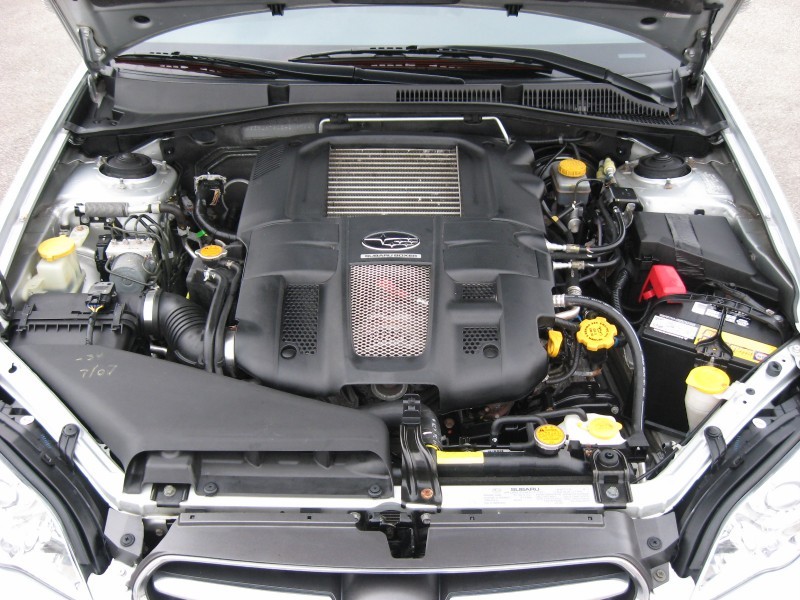
It's got that very wide scoop right by the hood line. Then it goes to the air box and MAF sensor housing assembly, and then finally through another pipe to the turbo inlet. While there is a little of the whole "ram air" thing going on, I doubt that makes much of a difference. What's more important is that the constant supply of fresh air reduces heatsoak and the plastic ducting rejects heat. It also has an air box at least equal in volume to your typical cone filter for a turbo of that size
It's honestly one of the nicest stock intakes I've ever seen. And it's quiet too. There's no way a cone filter and some cheap looking half-box is going to beat that design on a stock turbo--but people still buy them anyway.
BNR actually makes turbo upgrades for that car that will work with the stock intake.
It's got that very wide scoop right by the hood line. Then it goes to the air box and MAF sensor housing assembly, and then finally through another pipe to the turbo inlet. While there is a little of the whole "ram air" thing going on, I doubt that makes much of a difference. What's more important is that the constant supply of fresh air reduces heatsoak and the plastic ducting rejects heat. It also has an air box at least equal in volume to your typical cone filter for a turbo of that size
It's honestly one of the nicest stock intakes I've ever seen. And it's quiet too. There's no way a cone filter and some cheap looking half-box is going to beat that design on a stock turbo--but people still buy them anyway.
BNR actually makes turbo upgrades for that car that will work with the stock intake.

I know this is a very general statement, but it seems like most of the time aftermarket intakes only give good results in ideal circumstances. It's tough to beat a stock intake in most modern vehicles at least for the location that the air enters the system. I know all the aftermarket systems are offering greater flow but might not really be better at the expense of air temp. If you live in a cold climate and you're car is moving than you probably don't have to worry much about "cold air" since even the underhood temps will be lower than many climates ambient air temp. The more I read about water and water/h20 injection the more I'm sold on it. I think that it can make up for some of the shortcomings of a stock intake system
Banned. I got OWNED!!!
Joined: Mar 2009
Posts: 1,045
Likes: 0
From: NC

Btw, I avoid K&N filters and run Amsoil. K&Ns allow some fine particulate into the engine, that has been proven.
Last edited by no_more_rice; Dec 29, 2009 at 11:36 AM.
What's the total volume of the stock intake box compared to say the volume of the HKS or Apex'i intakes? I don't have access to a stock box right now, but it would be cool if someone could measure the volume. I do have Apex'i intakes I can measure.
Actually, flow is the issue. A typical highly modded FD, fitted with a straight through 3" exhaust, no cats, and significantly increased boost, can see flow through the intake almost double, which the stock air box simply isn't designed to handle (and causes unecessary restriction). In that case "open" style cone filters allow greater flow at reduced pressure drop. Putting a open style cone style filter on a near stock car is a complete waste of time. Interestingly, the S2000 has a voluminous air box with a cone filter inside, yet some of the S2K geeks still remove the air box so they can hear the "VTEC sound" even though it has proven to have a negligible effect on power
Btw, I avoid K&N filters and run Amsoil. K&Ns allow some fine particulate into the engine, that has been proven.
Btw, I avoid K&N filters and run Amsoil. K&Ns allow some fine particulate into the engine, that has been proven.
Banned. I got OWNED!!!
Joined: Mar 2009
Posts: 1,045
Likes: 0
From: NC
I have the 3" "universal" Amsoil cone filters on my FD (2).
You can try looking here http://www.amsoil.com/StoreFront/eaa.aspx
You can try looking here http://www.amsoil.com/StoreFront/eaa.aspx

Thread
Thread Starter
Forum
Replies
Last Post
trickster
2nd Generation Specific (1986-1992)
25
Jul 1, 2023 04:40 PM
immanuel__7
2nd Generation Specific (1986-1992)
89
Sep 5, 2015 10:23 AM
JIMMY54
1st Generation Specific (1979-1985)
2
Aug 12, 2015 05:40 PM
