


where's your MAF?


where's your MAF?
I've been looking at a lot of pics of mod'd turbo builds and I finally noticed that a lot of them have the air filter connected directly to the turbo inlet and that the MAF is missing. Is this because you guys are using an aftermarket ecu and a wideband O2 sensor and then tuning the fuel maps based upon RPMs?
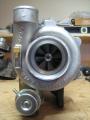


my maf is on my 97 ford explorer, i dont run a maf on my near stock TII....
I do however run a AFM, i have a 45 degree elbow off of the turbo then some duct tubing from the inlet of the AFM to the filter.
I do however run a AFM, i have a 45 degree elbow off of the turbo then some duct tubing from the inlet of the AFM to the filter.


Rotorhead

Joined: Feb 2001
Posts: 9,136
Likes: 39
From: Charlottesville, Virginia, USA
Also, the mass airflow sensor array on the 2Gen RX-7 is called an Air Flow Meter (AFM). Most people on this forum don't know that the AFM is a type of mass airflow sensor array, so they will be confused if you use the MAF sensor term that usually applies to a hot wire/film or cold wire type of sensor found on more modern engines. It would be similar to asking about the stock supercharger, which would confuse the masses who don't realize that a turbo is a type of supercharger.
Thanks for the clarification on terms.
I am still surprised by this though. It seems like the tuning is just done using inputs, and no output measurement. It seems like variance in some of the inputs could have a significant impact: injector size, fuel pressure, clean vs dirty injectors, timing etc. What is the feedback for adjusting some of these parameters?
I'll happily take an url to a faq or readme about this stuff as an answer
I am still surprised by this though. It seems like the tuning is just done using inputs, and no output measurement. It seems like variance in some of the inputs could have a significant impact: injector size, fuel pressure, clean vs dirty injectors, timing etc. What is the feedback for adjusting some of these parameters?
I'll happily take an url to a faq or readme about this stuff as an answer

MECP Certified Installer

Joined: Feb 2009
Posts: 3,176
Likes: 3
From: Mesquite, TX-DFW
Thanks for the clarification on terms.
I am still surprised by this though. It seems like the tuning is just done using inputs, and no output measurement. It seems like variance in some of the inputs could have a significant impact: injector size, fuel pressure, clean vs dirty injectors, timing etc. What is the feedback for adjusting some of these parameters?
I'll happily take an url to a faq or readme about this stuff as an answer
I am still surprised by this though. It seems like the tuning is just done using inputs, and no output measurement. It seems like variance in some of the inputs could have a significant impact: injector size, fuel pressure, clean vs dirty injectors, timing etc. What is the feedback for adjusting some of these parameters?
I'll happily take an url to a faq or readme about this stuff as an answer
Trending Topics
Thanks for the clarification on terms.
I am still surprised by this though. It seems like the tuning is just done using inputs, and no output measurement. It seems like variance in some of the inputs could have a significant impact: injector size, fuel pressure, clean vs dirty injectors, timing etc. What is the feedback for adjusting some of these parameters?
I'll happily take an url to a faq or readme about this stuff as an answer
I am still surprised by this though. It seems like the tuning is just done using inputs, and no output measurement. It seems like variance in some of the inputs could have a significant impact: injector size, fuel pressure, clean vs dirty injectors, timing etc. What is the feedback for adjusting some of these parameters?
I'll happily take an url to a faq or readme about this stuff as an answer
For the stock ECU ("Australia" means normal USDM/JDM type cars):
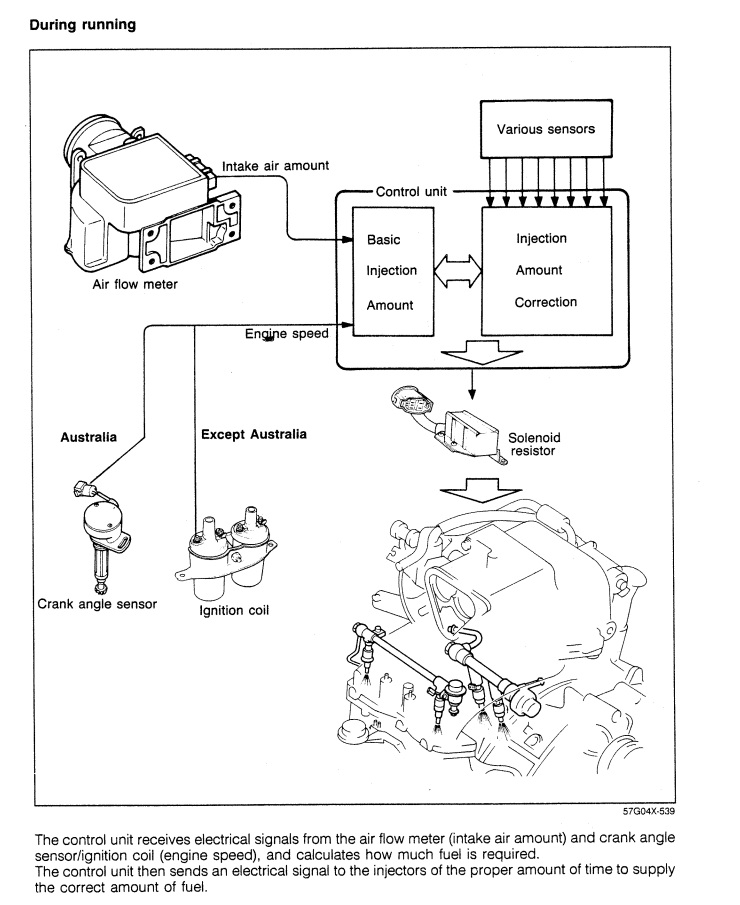

search for the factory training manual, that's where those diagrams came from.
Hmmm....
I guess what's still confusing is this: I've read where people are trying to tune so that they are leaning out the A/F mix so that only the fuel that get's burned during combustion is being injected. I guess you might call it perfectly lean, or some such. However, since leaning out too much, especially at high rpms is a major cause of engine death through detonation, this process seems dangerous. That's why I was assuming that there must be some sort of output measurement.
I'm guessing that what people are doing is putting the car on a dyno, measuring the HP/RPM curve and then tuning the A/F maps (leaning out, since you probably start with a rich/safe map) and then doing another dyno run. I suppose when you you start to see a loss of power from your tuning, implying that there's not enough fuel for the air charge, then you've found your razor's edge and then take a tiny step to the rich side.
Am I totally wrong?
I guess what's still confusing is this: I've read where people are trying to tune so that they are leaning out the A/F mix so that only the fuel that get's burned during combustion is being injected. I guess you might call it perfectly lean, or some such. However, since leaning out too much, especially at high rpms is a major cause of engine death through detonation, this process seems dangerous. That's why I was assuming that there must be some sort of output measurement.
I'm guessing that what people are doing is putting the car on a dyno, measuring the HP/RPM curve and then tuning the A/F maps (leaning out, since you probably start with a rich/safe map) and then doing another dyno run. I suppose when you you start to see a loss of power from your tuning, implying that there's not enough fuel for the air charge, then you've found your razor's edge and then take a tiny step to the rich side.
Am I totally wrong?

Joined: May 2006
Posts: 3,881
Likes: 3
From: Jacksonville, Tampa & Tallahassee
Actually, that's pretty much the gist of it...
The "output measurement" you are referring to in most cases comes from a Wideband 02 sensor. Some tune exclusively using EGT senors, but I haven't seen man posting about that these days.
It's pretty much been collectively agreed upon that 11.0 - 11.5 afr is a pretty good compromise of safety and power (excludeing ridiculous boost and/or timing) . So typically most tune to achieve those numbers (or slightly richer) and then take it to the dyno and see if there are any gains to be had by pulling some fuel or advancing timing or whatever little trick the tuner chooses to use. The dyno is importtant because while you can tune 1st 2nd and maybe 3rd gear on the street, full 4th or 5th gear pulls simply aren't gonna happen so those areas of the map tend to stay pretty rich until they can be tuned in a controlled environment.
Detonation is the death of rotaries and while it seems that most often this occurs from running too lean (pre-ignition of the air/fuel mixture) it can also happen from running too rich, although this seems to be the minority of cases
The "output measurement" you are referring to in most cases comes from a Wideband 02 sensor. Some tune exclusively using EGT senors, but I haven't seen man posting about that these days.
It's pretty much been collectively agreed upon that 11.0 - 11.5 afr is a pretty good compromise of safety and power (excludeing ridiculous boost and/or timing) . So typically most tune to achieve those numbers (or slightly richer) and then take it to the dyno and see if there are any gains to be had by pulling some fuel or advancing timing or whatever little trick the tuner chooses to use. The dyno is importtant because while you can tune 1st 2nd and maybe 3rd gear on the street, full 4th or 5th gear pulls simply aren't gonna happen so those areas of the map tend to stay pretty rich until they can be tuned in a controlled environment.
Detonation is the death of rotaries and while it seems that most often this occurs from running too lean (pre-ignition of the air/fuel mixture) it can also happen from running too rich, although this seems to be the minority of cases


Joined: Mar 2001
Posts: 31,851
Likes: 3,241
From: https://www2.mazda.com/en/100th/
Hmmm....
I guess what's still confusing is this: I've read where people are trying to tune so that they are leaning out the A/F mix so that only the fuel that get's burned during combustion is being injected. I guess you might call it perfectly lean, or some such. However, since leaning out too much, especially at high rpms is a major cause of engine death through detonation, this process seems dangerous. That's why I was assuming that there must be some sort of output measurement.
I'm guessing that what people are doing is putting the car on a dyno, measuring the HP/RPM curve and then tuning the A/F maps (leaning out, since you probably start with a rich/safe map) and then doing another dyno run. I suppose when you you start to see a loss of power from your tuning, implying that there's not enough fuel for the air charge, then you've found your razor's edge and then take a tiny step to the rich side.
Am I totally wrong?
I guess what's still confusing is this: I've read where people are trying to tune so that they are leaning out the A/F mix so that only the fuel that get's burned during combustion is being injected. I guess you might call it perfectly lean, or some such. However, since leaning out too much, especially at high rpms is a major cause of engine death through detonation, this process seems dangerous. That's why I was assuming that there must be some sort of output measurement.
I'm guessing that what people are doing is putting the car on a dyno, measuring the HP/RPM curve and then tuning the A/F maps (leaning out, since you probably start with a rich/safe map) and then doing another dyno run. I suppose when you you start to see a loss of power from your tuning, implying that there's not enough fuel for the air charge, then you've found your razor's edge and then take a tiny step to the rich side.
Am I totally wrong?
with something more adventurous its safer to start rich than it is to start lean
Joined: Mar 2001
Posts: 31,851
Likes: 3,241
From: https://www2.mazda.com/en/100th/
the 11:1? that would be air to fuel, 11pound of air to 1 pound of fuel.
lambda is actually probably slightly better to tune with, as gasoline varies, and some of us use alcohol too, stoich on every fuel is 1 lambda, but the stoich afrs are different for different fuels.
lambda is actually probably slightly better to tune with, as gasoline varies, and some of us use alcohol too, stoich on every fuel is 1 lambda, but the stoich afrs are different for different fuels.

You're all making this too complicated. 14.7 AFR is the stoichiometric ratio for gasoline. Anything lower than that is "rich", and anything higher is "lean". But these just relative terms and different conditions mean different target AFRs. Mxiture at WOT is very different from what you'll see during cruising, idle, etc...
Joined: Mar 2001
Posts: 31,851
Likes: 3,241
From: https://www2.mazda.com/en/100th/
for example the stock ecu has different zones, these zones have different calibrations, as some are accelerating, some are decelerating, steady state, etc
idle: without the airpump is like mid 12's, mazda runs it rich so it does not misifre, and then adds air pump air for the cats. with the airpump air afr will be in the 16-18:1 range
cruising; if you're just running a constant speed, load is low, fuel economy is important, so it runs 14.7:1
acceleration; load is high, we don't care about MPG, we want power, and it has to not blow up on crap fuel, so the mixture is rich. the leanest stocker, the s4 na, runs mid 12's, everything else runs richer

Thread
Thread Starter
Forum
Replies
Last Post
mulcryant
2nd Generation Specific (1986-1992)
10
Sep 9, 2015 05:24 PM
