


Turboing NA or Swap TII which one is better in the end



Joined: Feb 2001
Posts: 29,798
Likes: 128
From: London, Ontario, Canada
yea I know it will cost money, I am not sure the intentions of my statement there, but I prefer the idea of slowly gathering up parts like I would in an NA to Turbo conversion, compared to TII swap where I would just be saving up money and buying everything at once, which doesnt seem as fun, but in the end if it is that much more of an option then yea might as well, I was just figuring that in the end the extra stuff you would have to buy for a Turboing of NA like fuel management and such would still have to be purchased with a TII swap in the end if I have plans for aftermarket turbo system and piping
I realize that down the line it will cost a good amount of money no matter what if I want to add power
I realize that down the line it will cost a good amount of money no matter what if I want to add power
Yes, eventually the paths of both a turbo-NA setup and a TII swap will form a "Y" and you will end up with the same result in the end. But going with a TII swap in the first place is far more straightforward and can have a more linear cost progression.
While I agree for the most part, I think your opinion may be based on your personal habits of going overkill with parts.
AN fittings for vacuum/pressure lines, wastegate line,
T bolt clamps on radiator hoses,
T bolt clamps for -20psi intercooler pipes,
long stainless lines feeding the remote turbo oil filter, etc.
are not effective uses of money for a budget minded function>form build. If you actually use the right parts for your application and do your research without throwing money at the car you might not spend as much money as you think. I hope you don't take this personal, its only an observation.
I agree, but I didn't even have luck with the stock turbo and the NA trans.
I'm not suggesting the OP buy a TII drivetrain now though, since a good NA trans might actually last a while especially if the car is driven lightly. Mine lasted not even 5000 miles, it blew when the car was sideways though 
The main question that pops up here is, what is the alternative? Order a TII engine that has been sitting forever from one of the importers (for what your conversion will cost)? How long do you think that engine will last at 12psi (vs. 6-8psi on a 6PT)? Or order a used longblock for $1500+ shipped from the only reputable seller here? And after that you buy all the parts that you would've put on your 6 port block? That sounds ridiculous to me, if anything.
I don't understand how a TII engine swap also means buying all the parts you would have put on the 6 port block. Turbo upgrades on both engines require the same parts. To swap a TII engine into an NA means that the TII already comes with the turbo, likely the TMIC, and all the engine related stuff you would otherwise need to purchase/fabricate for the NA engine.
"Easy" is also relative. Its easy for you since you have a workplace, the proper tools and the experience to cut, fabricate and weld. For people that don't, all that work = money, and lots of it.
From my understanding the setup is trash, simple as that.
The oil drain on the pan is a bad setup because it is below the oil level,
all that piping on the same side of the engine going to the crappy TMIC to FMIC, or even if a real FMIC is used, you can either use 2" piping (proper size given the turbo and boost pressure) and throw it all away when you upgrade the turbo or use 2.5"+ piping and have crappy boost response.
And I personally had to use spacers in addition to the 2.5" exhaust spacer for clearance + all the extra gaskets.
Also the setup is a complete nightmare to service, especially those nuts/bolts on the turbo manifold to spacer 
All the intercooler piping and the extra intake manifold. Then you get to throw it all away when you upgrade to a bigger turbo Or spend $500 to $1000 to have a custom manifold made.
Or spend $500 to $1000 to have a custom manifold made.
Remember, you are throwing away all your piping and turbo stuff when you upgrade a TII engine to a larger turbo as well. The paths for both setups cross when you go big turbo.
As far as the SAFC, I don't think the power gained or the increased reliability (arguable because of the changes in timing) provided by the SAFC is worth the money and the hacked up harness if you'll upgrade to a standalone later. The AFRs are already rich enough to be safe, its the timing map that needs to be modified since the NA ECU can't read boost (and the TII ECU's maps are for 9.0:1).
As far as the spacer vs. 6 port TII, I'll let the OP decide:
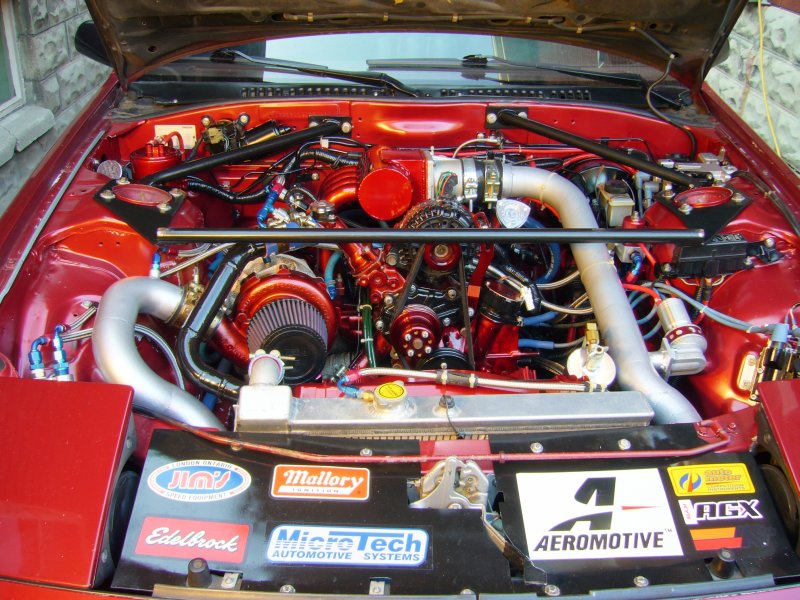

I mean to be fair Aaron, I dont think the OP can do what you did on the budget he has in mind if he is saying that a $1000 TII engine is too much money and a $800 one would be better.
I mean if $200 is the deciding factor this is not the project to be taking on
I mean if $200 is the deciding factor this is not the project to be taking on
Zip ties win races. A TII with a blown engine can be had for under $1000. Swap the parts over to your block to make a cheap 6 port turbo.

The Japan2LA intake is not a 6 port manifold, iirc, its modded to allow mounting a turbo, which otherwise requires spacers or other mods to the exhaust and turbo mounting - the 6 port manifold and accuators intrude in the space the stock turbo exhaust and turbo occupy on a TII
What is overkill to some people is just enough kill for others. I learned very, very quickly that cutting corners in certain aspects can cause some major problems. No, no one needs AN fuel lines, but a lot of the stuff you mentioned I would not have any other way. This is likely a large part as to why I don't have any problems with my cars (aside from the expected NA transmission death)
Anyone running an aftermarket wastegate should be using some kind of locking air line, it is just common sense. Running vacuum hose on a wastegate is a wonderful way to lose an engine. Indeed, someone else's car under my care almost blew up when I was tuning it due to a silicone line that popped off a wastegate nipple. Note that "locking air line" doesn't mean million dollar AN lines. It can be something as simple as a solid copper line, or a hose made at the local hydraulic shop.
It's about a dollar for a T bolt clamp, and 50¢ for a stainless worm gear clamp. I think the decision makes itself.
Tell that to all those people struggling to keep intercooler pipes together with worm gear clamps. Again, the price difference is minimal. Very few OEMs use worm gear clamps on intercooler piping.
Anyone running an aftermarket wastegate should be using some kind of locking air line, it is just common sense. Running vacuum hose on a wastegate is a wonderful way to lose an engine. Indeed, someone else's car under my care almost blew up when I was tuning it due to a silicone line that popped off a wastegate nipple. Note that "locking air line" doesn't mean million dollar AN lines. It can be something as simple as a solid copper line, or a hose made at the local hydraulic shop.
It's about a dollar for a T bolt clamp, and 50¢ for a stainless worm gear clamp. I think the decision makes itself.
Tell that to all those people struggling to keep intercooler pipes together with worm gear clamps. Again, the price difference is minimal. Very few OEMs use worm gear clamps on intercooler piping.
Must be a Canada thing because here in the US T bolt clamps are about $8 a piece so you can imagine how they'd add up. I disagree on OEMs using t bolts, I work on EVOs, STi's, Legacy's, etc. for a living and I have NEVER seen an OEM use anything but a worm gear clamp for intercooler piping, and these cars run 15psi+.
I don't know of anyone having problems with worm gear clamps at the relatively low boost levels we run. I do know that most Japanese time attack cars that see lots of abuse use worm gear clamps (Pan Speed FD for example).
As I recall, you blew the engine as well? Not to pull rank, but I've never blown up an NA turbo setup (and I have lost count on how many I have done at this point). Maybe there was something amiss with your methodology? I agree though, the transmission issue is a sticky one. It greatly depends on how the car is driven and the quality of the transmission to start with. Now with my boost at 16 PSI (dyno soon) it is time for me to abandon the NA transmission.
If you purchase from a reputable supplier (perhaps the same person who supplied your transmission?) and don't bottom of the barrel it, there is little reason to be concerned about a j-spec TII engine.
I don't understand how a TII engine swap also means buying all the parts you would have put on the 6 port block. Turbo upgrades on both engines require the same parts. To swap a TII engine into an NA means that the TII already comes with the turbo, likely the TMIC, and all the engine related stuff you would otherwise need to purchase/fabricate for the NA engine.
I don't understand how a TII engine swap also means buying all the parts you would have put on the 6 port block. Turbo upgrades on both engines require the same parts. To swap a TII engine into an NA means that the TII already comes with the turbo, likely the TMIC, and all the engine related stuff you would otherwise need to purchase/fabricate for the NA engine.
Your understanding is flawed. I fully agree that the spacer is far from ideal, but to consider it trash is a bit harsh. The spacer neatly solves the fitment issue but does create the wastegate issue. A simple relocation of the actuator to the bottom of the compressor and then modification of the rod fixes that.
Proof please. And not a quote from Corkey Bell. Real world proof. Because I'm sure you know what my reply will be to that...I'll point out all the turbo-NA setups with oil drains below oil level (mine since 2001) and the aftermarket turbo kits that are set up the same way.
2" piping is dirt cheap. The piping length in my original setup was shorter then many of the aftermarket FMIC kits for the 2nd gen. It could have been 2' shorter if I had modified the top intercooler tank.
So, your spacer was built incorrectly?
When I pulled my spacer+turbo several years ago for the GT40R installation, I didn't even need to go under the car except to loosen the two lower exhaust bolts.
Extra intake manifold?!
Remember, you are throwing away all your piping and turbo stuff when you upgrade a TII engine to a larger turbo as well. The paths for both setups cross when you go big turbo.
So, your spacer was built incorrectly?
When I pulled my spacer+turbo several years ago for the GT40R installation, I didn't even need to go under the car except to loosen the two lower exhaust bolts.
Extra intake manifold?!
Remember, you are throwing away all your piping and turbo stuff when you upgrade a TII engine to a larger turbo as well. The paths for both setups cross when you go big turbo.
The extra intake manifold is referring to the extension manifold or whatever on NA's. The intake path has an extra loop compared to the TII intake.
My spacer was not built incorrectly. It was 2.5" measured flange to flange. Common sense points out that anything with a nut on one side and a bolt on the other (which can spin as you attempt to loosen the nut) is a complete PITA to remove. I had to cut wrenches in half to make it work (and believe you did as well :P).
If you use the TII manifolds, you have no expenses for the piping to lose.
Is this 2001 again? Seriously, have I been transported back in time 8 years to repeat the same argument I faced when I made my original setup? The timing issues created by the S-AFC are well documented and immaterial. The S-AFC is only to be used at light load to pull extra fuel from the curve due to upgraded injectors when not needed. If you are making S-AFC corrections in boost, then your injectors are too large.

You also forgot to mention, that if you are doing a n/a 6 port turbo. Why not just buy aftermarket/upgraded parts? It's really all about how the op's pockets really are and experience.

Thread Starter
This Flesh A Tomb

Joined: Jan 2007
Posts: 81
Likes: 0
From: CA
I was just talking initial costs...
I mean I found a Seller who has the Intake Manifold, Front Cover, Exhaust manifold and turbo for around $400
but thats beyond the point, I am just trying to gauge the cost it will take to get the project off the ground..

Full Member
Joined: Sep 2008
Posts: 61
Likes: 0
From: ATL
I believe it is very plausible to assume that a t2 swap would include all parts and even the transmission in most cases for under $1500. This may not be the case with your specific supplier but $1500 is pretty over priced for a longblock.
In the shade

Joined: Jun 2009
Posts: 249
Likes: 0
From: PA
Your post makes no sense. The OP wants a turbocharged engine and is considering buying all the parts (LIM, UIM, manifold, turbo, front cover) individually for like $400. I was implying it would make more sense to find a cheap TII and use the parts on his good 6 port short block.
In the shade
Joined: Jun 2009
Posts: 249
Likes: 0
From: PA
Your post makes no sense. The OP wants a turbocharged engine and is considering buying all the parts (LIM, UIM, manifold, turbo, front cover) individually for like $400. I was implying it would make more sense to find a cheap TII and use the parts on his good 6 port short block.
If you don't strive to copy his setup you're stupid and will be flamed in ridiculously long posts and unwilling exposed to pictures of his setup

Aftermarket parts are a great idea, using an aftermarket turbo and EMS would save you tons of money since you'd be throwing away the stock stuff when you upgrade later. The stock turbo is overwhelmed by 6 port engines anyway. You have to port the living **** out of the wastegate to get consistent boost and still the boost is likely to drop off. I'm running a streetported (TII housings) setup on the S4 wastegate and the boost goes from 5 to about 2-3psi during 6-8000rpm.
OP: If you look in the FAQ, Hondahater (?) has a writeup on FC3Spro I think. He used the stock TII stuff so that would work for you. You'll find that for some reason most of the material regarding 6PT's are on S4s so let me know if you have any questions. Other members to PM would be Aaron, SonicRat, TOUCH, 2slow4stock.
You may be overthinking it at this point because of all this useless discussion. If you read a book about turbos or do your research you'll realize just how easy it is. Buy the manifolds, ECU, sensors, turbo (check play, port the wastegate), oil supply (oil filter pedestal from banzai, 3ft stainless line), and use the BAC lines for coolant. Get a BOV, some piping for the TID, injectors, etc. and you're set. 6 port turbo is the way to go, you will not be dissapointed. Everything in the car will basically be brand new (oil/coolant/fuel/vacuum lines, hardware), you'll have removed emissions and the engine will be super simple. You'll also have a unique setup and an extra 1000rpm to rev. Read up about automotive plumbing and hardware a little too (types of hoses, clamps, pressure/heat ratings, etc.). Try to get the heatshield with the turbo and if you have no washer fluid stuff run a duct to the air filter above the brake duct. AITs will be your enemy with high compression. If you're running the stock ECU you need to run safeguards to compensate for the aggressive timing maps (for 9.0:1 engines) so always run premium fuel and switch the plugs to BUR9EQs and change them every 8-10k.
Also Aaron, to prove that the oil drain is below the oil level you can remove your drain line with the full oil capacity in the engine and watch it pour out as if you pulled the drain plug.


Joined: Jul 2003
Posts: 2,601
Likes: 0
From: Jefferson City, Tn
i wasnt going to sit here and read all the post to see whats been covered... period the end yes an NA turbo setup is more money in the long run unless your plans of standalone and big turbo are in the picture and using factory manifolds.. but then you know to add transmissions and rear end are not designed to handle the power of an added turbo...
compared to turbo engines/tranny/rear end are designed for the boost that the car provied plus more ive seen some turboII rear ends hold 500hp with no problem now im not shure what they can hold but if your looking for 300hp i dont think that even that NA tranny can handle that its a long drawn out process that requires money and time to locate all the parts that your going to need..
im doing it now but ive done a "turbo swap" i have Turbo Transmission/DriveShaft/Rear End/Engine in a GTU chassis..
best recommendation is to sit and read and do some more reading on this forum before you decide to tackle anything or buy anything and figure out which way your going to go..
TwEaK
compared to turbo engines/tranny/rear end are designed for the boost that the car provied plus more ive seen some turboII rear ends hold 500hp with no problem now im not shure what they can hold but if your looking for 300hp i dont think that even that NA tranny can handle that its a long drawn out process that requires money and time to locate all the parts that your going to need..
im doing it now but ive done a "turbo swap" i have Turbo Transmission/DriveShaft/Rear End/Engine in a GTU chassis..
best recommendation is to sit and read and do some more reading on this forum before you decide to tackle anything or buy anything and figure out which way your going to go..
TwEaK


i wasnt going to sit here and read all the post to see whats been covered... period the end yes an NA turbo setup is more money in the long run unless your plans of standalone and big turbo are in the picture and using factory manifolds.. but then you know to add transmissions and rear end are not designed to handle the power of an added turbo...
compared to turbo engines/tranny/rear end are designed for the boost that the car provied plus more ive seen some turboII rear ends hold 500hp with no problem now im not shure what they can hold but if your looking for 300hp i dont think that even that NA tranny can handle that its a long drawn out process that requires money and time to locate all the parts that your going to need..
im doing it now but ive done a "turbo swap" i have Turbo Transmission/DriveShaft/Rear End/Engine in a GTU chassis..
best recommendation is to sit and read and do some more reading on this forum before you decide to tackle anything or buy anything and figure out which way your going to go..
TwEaK
compared to turbo engines/tranny/rear end are designed for the boost that the car provied plus more ive seen some turboII rear ends hold 500hp with no problem now im not shure what they can hold but if your looking for 300hp i dont think that even that NA tranny can handle that its a long drawn out process that requires money and time to locate all the parts that your going to need..
im doing it now but ive done a "turbo swap" i have Turbo Transmission/DriveShaft/Rear End/Engine in a GTU chassis..
best recommendation is to sit and read and do some more reading on this forum before you decide to tackle anything or buy anything and figure out which way your going to go..
TwEaK
Joined: Feb 2001
Posts: 29,798
Likes: 128
From: London, Ontario, Canada
Sorry it has taken me so long to reply. I was quite busy over the last few days and have not had time to visit the forum.
The reason for posting the picture was not to suggest the OP take on a project like mine, nor was it "self propaganda". It was to illustrate the suggested absurdity in choosing a turbo setup based upon engine bay appearance.
I appreciate the sarcasm here, but PvillKnight7, you are reading far too much into my participation in turbo NA threads. In fact I don't even often post in them anymore, and I hardly ever post pictures of my own stuff unless it illustrates a point. Is it so unexpected that I would offer input into something I am known widely for?
And I must say, I'm partial to my setup over all of the other NA-turbo setups I have seen in the past 8 years. That should be of no surprise, considering I built my setup to my own tastes.
A very good J-spec can he had for under $1000, which I will touch on later. I should mention though that the wastegate line which had popped off was zip-tied in place. The heat simply caused the tied to become brittle and fall off. A hose clamp would have fixed this issue of course. And maybe that's all it will take (with appropriate high temperature hose) to get a hose locked onto the wastegate. No need for AN stuff if you don't want it.
Nah, I don't take anything here personally. I just respond with sarcasm if I feel it could enter that territory.
I wouldn't say to use fuel injection hose because it will not handle the heat. My original coolant feeds to my TII turbo were EFI hose and it only took a few months before they were baked entirely too stiff for comfort. I noticed that the rubber had begun to crack around the edges. It's best to probably visit the hydraulic store and get the correct hose. The cost will be about the same as EFI hose from the auto parts store.
What can I say, the local hydraulics store has good prices. I should have clarified my OEM comments to say that I was referring to vehicles which have to be reliable for a million miles. Big rigs, heavy equipment, etc. Sorry, I always think of that stuff when I think of OEM turbo systems and not turbo passenger cars because I tend to take my build queues from big stuff instead of consumer stuff.
Hey, if it works for them, then I won't stop them or suggest they try anything different. But you won't find worm gear clamps on my car unless absolutely necessary (I use one where the pipe connects to the intercooler as there is not enough space for a t-bolt clamp. Oddly, it is the only clamp with a slight oil film around the seam).
Why would I do anything of the sort?! If I was at all concerned about the stock wiring I would simply perform the fuel pump rewire procedure. And I'd have some way of measuring AFRs or EGTs so I could shut the car down if necessary.
[quote]
Because the engine is a LONGBLOCK! This means NO accessories, no turbo, manifold, intakes, etc. So $1500 for the longblock from Japan2LA IN ADDITTION to to the parts you'd have to buy to make it a complete engine. Turbo upgrades cost the same on both setups assuming that you use the (IMO) proper intake manifolds and stock TII parts.
[quote]
Around here, "longblock" means an engine with accessories. "Shortblock" means a bare block. "Turn key" would be everything necessary to make it run.
Now, I am not here to bash Japan2LA because I know he sells quality stuff. But I can say that I am surprised at $1500 for an incomplete engine. Back in the day when I used to do weekends at a shop, we bought J-specs from the local supplier for under $1000 Canadian. We had "pick of the litter" so all the stuff we got was in great shape. Good compression, complete (no dented intercoolers and the like) and always clean. The ones that went into cars ran great. The ones that we tore down were nice as well. I don't think we ever had to replace a housing or iron. So, it all depends on the market as to what makes more financial sense. I would then recommend a j-spec over the turbo-NA in most cases unless it's for the reasons I have already mentioned in other threads (want to fabricate, has a great NA engine, learning experience, bored, unique, etc.).
I was a bit better. I had an enclosed garage, but it was unheated and only 12" wider then the car on each side. I think that was a record year for cold too.
Which makes quite a point for a bolt-in TII swap. 
Yes, S5 is different and I didn't account for that difference. I don't have one in front of me at the moment but I have to believe there is a way to move the actuator. Worst case, a bit of remote mounting will take care of it.
Or, as someone else in the thread said, don't both with the OEM turbos.
It's not going to blow the turbo. In the absolute worst case, you might get some blowby if the oil pan pressure is higher then it should be. But I've not experienced this in any of the cars I have done, including my own. I remember when I did the original setup with the HT-18 and everyone said the car would be a smoke show with my crappy oil drain arrangement.
Renting a mandrel bender would be a lot more then $200. Maybe $200 a day, but you would also need the space to run it and to arrange for truck freight to deliver. I don't think a mandrel bender is an option for anyone unless they know a shop with one or own a shop themselves.
Now, a standard tubing bender is far more economical. Most big rental centres should have one or know where can get one. I paid $160 to have mine for 5 days.
A better option is a $200 eBay piping kit that comes with a load of bends, couplers and clamps.
It's odd, but I remember when I did my setup years ago that people told me I would have massive lag due to my piping arrangement. Yet the turbo was an on/off switch at any RPM. Much more responsive then a TII.
You are referring to the "dynamic chamber". Now I'm not going to say that it is a better choice in manifolds, but the low end is better with the dynamic chamber then it is with a ported TII manifold. And I am referring to part throttle and light load, not wide open. There is a reason that the turbo-NA engine I am building now has fully functional aux ports and a NA lower with TII upper intake.
The wrench I had to cut was for the downpipe nuts, which actually end up in a slightly better spot then the stock TII. But the NA lower gets in the way.
A 2.5" spacer should mount the turbo without interference, but there could be some issue with the S5 turbo I am unaware of.
No, it's not personal. I was just using the past comments to illustrate my point. Modifying the cruise and idle won't result in increased fuel mileage. If anything, the car will be better on gas (mine was). Only minor corrections should be made to the load areas of the maps. 4 550CC injectors should be just right on the NA ECU at reasonable boost levels (10 PSI) on the stock turbo. At least, mine were. I'm not saying that one should use the S-AFC, but if it is the only option, then it will work.
S-AFCs and other piggybacks were used for a long time before standalones became affordable.
Again, it was to illustrate the absurdity in choosing a setup based upon engine bay appeal.
Yep, that seems like the most logical way to approach this. The OEM stuff is old, inefficient and half broken. Spend the money on an aftermarket turbo of more appropriate size, an aftermarket manifold
Then again, it all depends on the goal.
That's the most compelling argument. If someone has an NA engine that was freshly built, in good shape, that they have put some money into, it makes sense to go the turbo-NA route. And if they go that direction, it would seem that to complement this engine, there are better parts to choose then Mazda OEM turbo stuff.
Anyway, to anyone reading this thread, I'm not sure what point I'm trying to make anymore. I guess I'm trying to say that if:
-you enjoy fabrication
-you have some space and time
-you want something different
-you want to learn
-you have a nice NA engine
It is worth going the turbo-NA route. And whether you go with the TII intakes or the NA intakes will depend on how much of the first 4 of those points apply.
Others should do a TII swap.
Haha I understand. Thanks for resuscitating my post. I don't like how quickly these threads are polluted with Cake's self propaganda. He must have the best turbo 6 port ever because he defends it with such intensity. He spent so much time and money building it that it must be the best way to turbocharge a 6 port 13B.
If you don't strive to copy his setup you're stupid and will be flamed in ridiculously long posts and unwilling exposed to pictures of his setup
If you don't strive to copy his setup you're stupid and will be flamed in ridiculously long posts and unwilling exposed to pictures of his setup
I appreciate the sarcasm here, but PvillKnight7, you are reading far too much into my participation in turbo NA threads. In fact I don't even often post in them anymore, and I hardly ever post pictures of my own stuff unless it illustrates a point. Is it so unexpected that I would offer input into something I am known widely for?
And I must say, I'm partial to my setup over all of the other NA-turbo setups I have seen in the past 8 years. That should be of no surprise, considering I built my setup to my own tastes.
So, if you were worried about the wastegate line melting or blowing off the next step up would be to buy a stainless line and use hose clamps at the end. Even that is extreme IMO and a waste of money. The line is not subjected to any major heat due to its location and you are running less than 20psi. I would use a fuel injection hose and hose clamps at the most. I think its for appearance.
Must be a Canada thing because here in the US T bolt clamps are about $8 a piece so you can imagine how they'd add up. I disagree on OEMs using t bolts, I work on EVOs, STi's, Legacy's, etc. for a living and I have NEVER seen an OEM use anything but a worm gear clamp for intercooler piping, and these cars run 15psi+.
I don't know of anyone having problems with worm gear clamps at the relatively low boost levels we run. I do know that most Japanese time attack cars that see lots of abuse use worm gear clamps (Pan Speed FD for example).
I think that if you wired in a resistor in your fuel pump wiring to lower the source to about 5 volts, then did a 4th gear blast up to 120mph on 550ccx4 and 8psi on a hot day you would likely blow your engine as well. That is exactly what happened to my last engine and our pumps are known to have grounding issues. The car wouldn't even start after I put the new engine in. Even the engine had no destructive damage, the apex seal springs had been reused in the last build and flattened out eventually (after 60k of hard abuse) and it lost compression. I have pics of the seals for verification (showing the wear on the spring side and consequently the increase seal to housing clearance that made the chatter marks). It sounds like an excuse though so believe what you will.
[quote]
Because the engine is a LONGBLOCK! This means NO accessories, no turbo, manifold, intakes, etc. So $1500 for the longblock from Japan2LA IN ADDITTION to to the parts you'd have to buy to make it a complete engine. Turbo upgrades cost the same on both setups assuming that you use the (IMO) proper intake manifolds and stock TII parts.
[quote]
Around here, "longblock" means an engine with accessories. "Shortblock" means a bare block. "Turn key" would be everything necessary to make it run.
Now, I am not here to bash Japan2LA because I know he sells quality stuff. But I can say that I am surprised at $1500 for an incomplete engine. Back in the day when I used to do weekends at a shop, we bought J-specs from the local supplier for under $1000 Canadian. We had "pick of the litter" so all the stuff we got was in great shape. Good compression, complete (no dented intercoolers and the like) and always clean. The ones that went into cars ran great. The ones that we tore down were nice as well. I don't think we ever had to replace a housing or iron. So, it all depends on the market as to what makes more financial sense. I would then recommend a j-spec over the turbo-NA in most cases unless it's for the reasons I have already mentioned in other threads (want to fabricate, has a great NA engine, learning experience, bored, unique, etc.).
When I did my conversion I was working in a car-port which is a glorified parking spot with a roof.
A lot of us do this stuff in our driveways, even people with garages don't have a lot of space to devote to equipment tools, and stuff because its already packed. On top of this, not everyone wants to spend $1000 on a welder, or cutting tools, and die grinders, air compressor, etc.
I agree that its harsh, but I think such terminology is required to keep people from falling into the same path that I did, at least in my view. Relocation of the actuator will NOT work on S5 setups because of the different manifold design that pushes it outward and the engine/turbo flanges are parallel as opposed to the turbo flange being angled in S4 setups.
Or, as someone else in the thread said, don't both with the OEM turbos.
Just because it drains below the oil level doesn't mean you'll blow the turbo as soon as you run the car...it is simply a crappy setup. You can look at the oil pan and tell, maybe it isn't completely below the oil level when the engine and oil pump are running but it is far from ideal. Our oil pans are much flatter than piston engine oil pans and it does not allow you to place a bung high enough. I'm running the same setup though with no problems so I will leave this as an opinion, it surely doesn't change much in this discussion.
The piping is dirt cheap, but what about the $200+ rental for the mandrel bender (if you can even get one)? I think ebay has universal kits that are 2" (doubtful) but that is even $100+ that you would throw away when you could run the TMIC and have better boost response. Wire up a TMIC sprayer and minimize the HP output variation between the two setups.
Now, a standard tubing bender is far more economical. Most big rental centres should have one or know where can get one. I paid $160 to have mine for 5 days.
A better option is a $200 eBay piping kit that comes with a load of bends, couplers and clamps.
It's odd, but I remember when I did my setup years ago that people told me I would have massive lag due to my piping arrangement. Yet the turbo was an on/off switch at any RPM. Much more responsive then a TII.
The extra intake manifold is referring to the extension manifold or whatever on NA's. The intake path has an extra loop compared to the TII intake.
My spacer was not built incorrectly. It was 2.5" measured flange to flange. Common sense points out that anything with a nut on one side and a bolt on the other (which can spin as you attempt to loosen the nut) is a complete PITA to remove. I had to cut wrenches in half to make it work (and believe you did as well :P).
A 2.5" spacer should mount the turbo without interference, but there could be some issue with the S5 turbo I am unaware of.
Right, I think you once again took my statement personal. I said that the money spent on an SAFC isn't worth it given the result which I assume would be better drivability and increased gas mileage if you are only modifying the cruise and idle maps.
S-AFCs and other piggybacks were used for a long time before standalones became affordable.
So, the OP would see nothing like this with his current budget. I think it was rather childish for you to post your engine bay as a reaction to the seemingly personal attacks I made to you in my previous post. Still a beauty though
Then again, it all depends on the goal.
Anyway, to anyone reading this thread, I'm not sure what point I'm trying to make anymore. I guess I'm trying to say that if:
-you enjoy fabrication
-you have some space and time
-you want something different
-you want to learn
-you have a nice NA engine
It is worth going the turbo-NA route. And whether you go with the TII intakes or the NA intakes will depend on how much of the first 4 of those points apply.
Others should do a TII swap.
omg [/omg] I'm not going to even attempt to read through that. Cake, whatever your said I'm sure you're right.
When are you going to start your own one man garage business over the internets?
When are you going to start your own one man garage business over the internets?

Lol, I love reading when people answer quotes one line at a time, makes for interesting reading. Now Aaron has some points, if you have a good n/a motor and are willing to learn how to do it I would do a turbo->n/a but seeing as my motor is shot, and it seems much easier and logical I am doing a TII swap. I would suggest doing a TII swap for the average weekend warrior.

Thread
Thread Starter
Forum
Replies
Last Post
trickster
2nd Generation Specific (1986-1992)
25
Jul 1, 2023 04:40 PM
KAL797
Test Area 51
0
Aug 11, 2015 03:47 PM


