


Power lost from flywheel to wheels


Power lost from flywheel to wheels
Does anybody know approximately what percentage of power do our fc's lose from the flywheel to the wheels? I'm guessing something around 15% but I would like to hear from somebody who has dyno'd their motor outside and inside the chassis.
Thanks,
~Ant
Thanks,
~Ant

MECP Certified Installer

Joined: Feb 2009
Posts: 3,176
Likes: 3
From: Mesquite, TX-DFW
Good diagram on wikipedia. Not FC specific of course, but it holds true for most vehicles
http://en.wikipedia.org/wiki/File:En...ows_in_car.svg
http://en.wikipedia.org/wiki/File:En...ows_in_car.svg

so that comes out to a 38% decrease in power from the flywheel to the wheels. That would mean a stock s4 TII which puts out 189hp to the flywheel would put down 117hp to the wheels? If I can recall right I believe I've heard of a stock TII putting down something around 140-150 to the wheels. If the ladder is true that would be an approximately 21-23% decrease in hp.
Does this sound plausible?
Does this sound plausible?



Joined: Mar 2001
Posts: 31,849
Likes: 3,238
From: https://www2.mazda.com/en/100th/
depends on age/wear and oils and stuff. seems like the average S4 NA will dyno in the 115-120 range at the wheels. GRM tested a stock 88 t2 at 151rwhp. that puts the t2 around 18%.
friction gets bigger with rpm too, so the same t2 drivetrain behind a PP engine will eat may more HP. there is an old thread in the race section thats a PP chassis and engine dyno, in that situation the engine did 300hp and only did 220 rwhp..
in other words its not an exact fixed number
friction gets bigger with rpm too, so the same t2 drivetrain behind a PP engine will eat may more HP. there is an old thread in the race section thats a PP chassis and engine dyno, in that situation the engine did 300hp and only did 220 rwhp..
in other words its not an exact fixed number
Trending Topics
j9fd3s depends on age/wear and oils and stuff. seems like the average S4 NA will dyno in the 115-120 range at the wheels. GRM tested a stock 88 t2 at 151rwhp. that puts the t2 around 18%.
friction gets bigger with rpm too, so the same t2 drivetrain behind a PP engine will eat may more HP. there is an old thread in the race section thats a PP chassis and engine dyno, in that situation the engine did 300hp and only did 220 rwhp..
in other words its not an exact fixed number
friction gets bigger with rpm too, so the same t2 drivetrain behind a PP engine will eat may more HP. there is an old thread in the race section thats a PP chassis and engine dyno, in that situation the engine did 300hp and only did 220 rwhp..
in other words its not an exact fixed number


I'm reading an awful lot of hazy or complete misinformation here. We are talking about mechanical losses due to friction, heat etc. If you know your flywheel horsepower you can express the loss as a percentage compared to the rwhp. However if you have the same drivetrain and more or less hp the percentage loss will be different. Depending on tolerances, heat, type of lubricants etc. the mechanical loss will be the same given similar rpm's. Based on my experience there is not a significant increase in mechanical losses due to rpm's unless there are other factors such as worn components, tolerances out of spec or poor lubrication. My estimate would be that you are going to lose roughly 30 hp to the rear wheels, but this will vary slightly based on the previously mentioned factors.
I'm reading an awful lot of hazy or complete misinformation here. We are talking about mechanical losses due to friction, heat etc. If you know your flywheel horsepower you can express the loss as a percentage compared to the rwhp. However if you have the same drivetrain and more or less hp the percentage loss will be different. Depending on tolerances, heat, type of lubricants etc. the mechanical loss will be the same given similar rpm's. Based on my experience there is not a significant increase in mechanical losses due to rpm's unless there are other factors such as worn components, tolerances out of spec or poor lubrication. My estimate would be that you are going to lose roughly 30 hp to the rear wheels, but this will vary slightly based on the previously mentioned factors.
A percentage is what I'm looking for, so far we've discussed anywhere from 15%-38% which needless to say is substantially different. The PP motor went from 300hp to 220rwhp... that would be a 26% hp loss whereas (GRM) saw an 18% from a stock TII. I see a pattern, but need to crunch a few more numbers..


the problem is that people on internet forums measure their horsepower on various aftermarket dynos and the conditions are not controlled very well. The actual engineers for the manufacturers measure engine horsepower under VERY VERY controlled conditions as mandated by SAE. I have the entire SAE J1349 version 3 (2004) which explains these conditions, if anyone is interested. So while the manufacturers may not officially measure drivetrain loss, they are at least consistent and repeatable.
for purposes of internet bragging rights you might as well just use whatever rule of thumb everybody else is using
for purposes of internet bragging rights you might as well just use whatever rule of thumb everybody else is using
the problem is that people on internet forums measure their horsepower on various aftermarket dynos and the conditions are not controlled very well. The actual engineers for the manufacturers measure engine horsepower under VERY VERY controlled conditions as mandated by SAE. I have the entire SAE J1349 version 3 (2004) which explains these conditions, if anyone is interested. So while the manufacturers may not officially measure drivetrain loss, they are at least consistent and repeatable.
for purposes of internet bragging rights you might as well just use whatever rule of thumb everybody else is using
for purposes of internet bragging rights you might as well just use whatever rule of thumb everybody else is using
My point was that the power train loss is not going to be linear. Your 300 hp car detuned to 200 will still show similar power loss in hard #'s. Whether it's 30 or 50 will depend on all the factors I cited before. You can't take a percentage and apply it across the board. As an example if you boost that same 300 hp car to 900 hp you will not increase the power loss through the drive train 300%.
My motorsports class had a meeting with Andrew Randolph, a representative a ECR (Earnheart Childress Racing, spelling?). Come to find out that friction increases almost exponentially as rpm increased and I viewed a few charts that he had made of how their engines would lose more and more power as rpms increased (of course they gained more than they lossed).
Can you believe that Nascar motors have enough chemical energy to produce almost 2500hp, but because of mechanical and thermal energy losses they only make roughly 850 to the flywheel... sad sad. Anyway, I talked to him after the lecture and he said for a commercial car 10-15% is reasonably (I don't think he was really listening though) but he said their NASCAR's only lose about 10-12hp...starting from 850hp...lol I'm not even going to calculate that miniscule percentage, just make me feel bad about mine, but that's engineering for ya!
Can you believe that Nascar motors have enough chemical energy to produce almost 2500hp, but because of mechanical and thermal energy losses they only make roughly 850 to the flywheel... sad sad. Anyway, I talked to him after the lecture and he said for a commercial car 10-15% is reasonably (I don't think he was really listening though) but he said their NASCAR's only lose about 10-12hp...starting from 850hp...lol I'm not even going to calculate that miniscule percentage, just make me feel bad about mine, but that's engineering for ya!
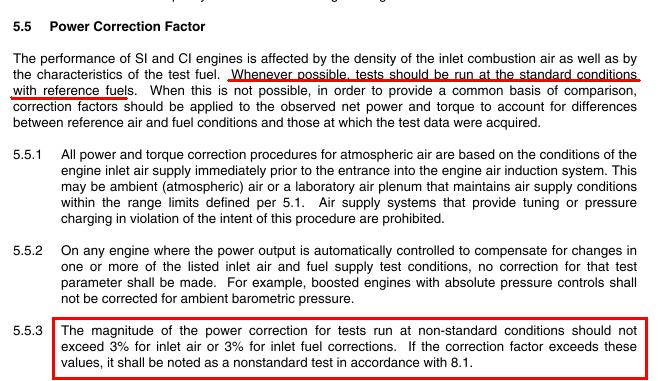
PM me your email address and I'll send you the PDF, it's maybe 250kb. It's pretty technical and calculus-intensive at some parts, but basically it gives exact specifications for ambient temp and pressure, fuel viscosity, and accessories allowed. Manufacturer tests also have to be certified by SAE reps now.
It even gives intercooler heatsoak tolerances and different atmospheric correction exponents for n/a engines, supercharged, air-to-water intercooled, and air-to-air intercooled. It makes you realize just how limited so-called "SAE" dynojet corrections really are. Real SAE corrections require far more data than a dynojet can ever collect, and truly "controlled" dyno testing cannot be performed in some tuner shop. That does not mean we should never dyno or cars, it just means that we should understand what we're really dealing with here.
It even gives intercooler heatsoak tolerances and different atmospheric correction exponents for n/a engines, supercharged, air-to-water intercooled, and air-to-air intercooled. It makes you realize just how limited so-called "SAE" dynojet corrections really are. Real SAE corrections require far more data than a dynojet can ever collect, and truly "controlled" dyno testing cannot be performed in some tuner shop. That does not mean we should never dyno or cars, it just means that we should understand what we're really dealing with here.
Lives on the Forum

Joined: Sep 2003
Posts: 5,707
Likes: 6
From: BC, Canada
The speed of the pull has an effect. The longer the pull is the less the rotating inertia will effect the results, leading to higher numbers. The intertia of the wheels and tires fitted will impact the results as will the tires' rolling resistance. The list goes on. That's why there's no hard and fast numbers for power loss, it's all just a guess really.
Exactly, but it's worse than that, not every dyno measures the same size horsepower. Take the same car with the same conditions to different brand dynos and you'll usually get different results. I'm sure this would apply to engine dynos too.
The speed of the pull has an effect. The longer the pull is the less the rotating inertia will effect the results, leading to higher numbers. The intertia of the wheels and tires fitted will impact the results as will the tires' rolling resistance. The list goes on. That's why there's no hard and fast numbers for power loss, it's all just a guess really.
The speed of the pull has an effect. The longer the pull is the less the rotating inertia will effect the results, leading to higher numbers. The intertia of the wheels and tires fitted will impact the results as will the tires' rolling resistance. The list goes on. That's why there's no hard and fast numbers for power loss, it's all just a guess really.

Lives on the Forum
Joined: Sep 2003
Posts: 5,707
Likes: 6
From: BC, Canada
Probably to keep the inertia losses lower and show a higher hp. The theory is also that with a 1:1 gear ratio, you get slightly less loss through the transmission.
I'm starting to think that a chassis dyno is just a crummy way to calculate hp period. ECR NASCAR team runs the motor through the transmission and then has a dyno on each rear wheel to calculate the power, he didn't go into too much detail after that but he said they wouldn't use a chassis dyno because the results aren't reliable enough... but for our street driving a chassis dyno is all we can ask for I guess...

Lives on the Forum
Joined: Sep 2003
Posts: 5,707
Likes: 6
From: BC, Canada
Remember, it's only the hp that's available at the wheels that does you any good in propelling you down the road.

Thread
Thread Starter
Forum
Replies
Last Post
