


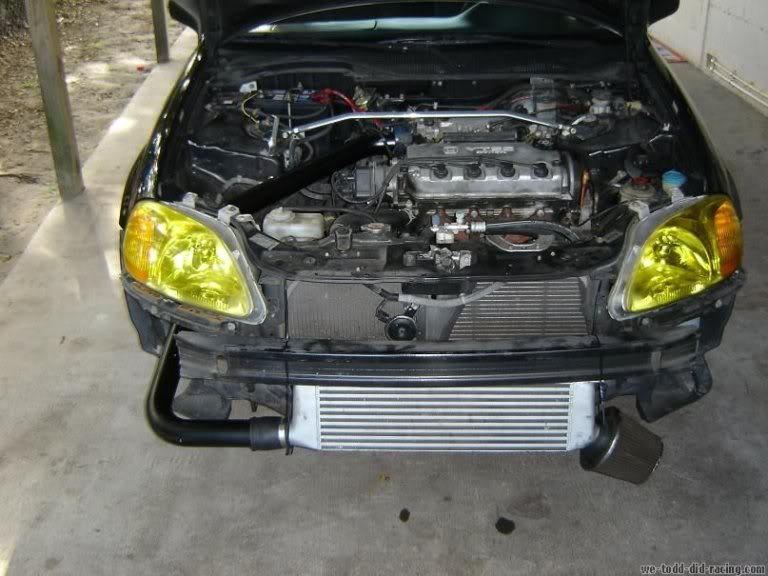
intercooler on na car?


Rotorhead

Joined: Feb 2001
Posts: 9,136
Likes: 39
From: Charlottesville, Virginia, USA
What kind of high speed are you talking, mach 4?  For a land speed record trial it might matter a little. How little I'm not sure, but how many high speed road races and drags are held below freezing temps? That's rhetorical, I am actually interested in knowing how much difference it would make at 250mph wind speed between 100*F and 50*F, to throw some numbers out there.
For a land speed record trial it might matter a little. How little I'm not sure, but how many high speed road races and drags are held below freezing temps? That's rhetorical, I am actually interested in knowing how much difference it would make at 250mph wind speed between 100*F and 50*F, to throw some numbers out there.Power required for an RX-7 to maintain the following speeds (just basic aerodynamics - ignores other factors like tire traction, drivetrain loss, vehicle weight, road grade, etc.):
250mph @ 50F = 648.7hp
250mph @ 100F = 590.7hp
100mph @ 50F = 41.5hp
100mph @ 100F = 37.8hp
50mph @ 50F = 5.2hp
50mph @ 100F = 4.7hp
As you can see, the air density (temperature and pressure) doesn't make much difference at street speeds, but it starts to have more effect once you are on the Formula One track. Speed is obviously the real killer here, as each time you 2x your speed it takes 8x more hp.

http://www.firepistons.com/
+1

Yankle My Wankel
Joined: Jul 2007
Posts: 500
Likes: 3
From: Winnipeg, MB
Assuming I didn't screw up any calculations with my highly-advanced Windows calculator, lol ...
Power required for an RX-7 to maintain the following speeds (just basic aerodynamics - ignores other factors like tire traction, drivetrain loss, vehicle weight, road grade, etc.):
250mph @ 50F = 648.7hp
250mph @ 100F = 590.7hp
100mph @ 50F = 41.5hp
100mph @ 100F = 37.8hp
50mph @ 50F = 5.2hp
50mph @ 100F = 4.7hp
As you can see, the air density (temperature and pressure) doesn't make much difference at street speeds, but it starts to have more effect once you are on the Formula One track. Speed is obviously the real killer here, as each time you 2x your speed it takes 8x more hp.
While the turbine does contribute a bit to the heat, it is actually the compressor that heats the air the most during boost. When air is compressed, its temperature rises. For example, at 15psi boost a typical turbocharger compressor will add about 150-200F to the intake air temperature. You can really see this temperature rise effect if you go to this link on fire pistons. The compression of a fire piston heats the air up to about 500-800F in order to start a fire... no hot exhaust-driven turbine needed.
http://www.firepistons.com/
+1
Power required for an RX-7 to maintain the following speeds (just basic aerodynamics - ignores other factors like tire traction, drivetrain loss, vehicle weight, road grade, etc.):
250mph @ 50F = 648.7hp
250mph @ 100F = 590.7hp
100mph @ 50F = 41.5hp
100mph @ 100F = 37.8hp
50mph @ 50F = 5.2hp
50mph @ 100F = 4.7hp
As you can see, the air density (temperature and pressure) doesn't make much difference at street speeds, but it starts to have more effect once you are on the Formula One track. Speed is obviously the real killer here, as each time you 2x your speed it takes 8x more hp.
While the turbine does contribute a bit to the heat, it is actually the compressor that heats the air the most during boost. When air is compressed, its temperature rises. For example, at 15psi boost a typical turbocharger compressor will add about 150-200F to the intake air temperature. You can really see this temperature rise effect if you go to this link on fire pistons. The compression of a fire piston heats the air up to about 500-800F in order to start a fire... no hot exhaust-driven turbine needed.
http://www.firepistons.com/
+1
Thread Starter
Senior Member
Joined: Mar 2010
Posts: 623
Likes: 0
From: wyoming
and unless rotary rocket 88 steered me wrong he told me that the s5 upper intake mani with the second and primary rails and bolt on with little modification, actually 10 plus people where on that thread and all verified the hp gains with dyno maps, i already have somone on here thats going to sell me everything i need to do the swap. idk bout you but RR88 is very respectable....


**** an NA Intercooler!  This is a TRUE Cold Air Intake for an NA. Car is a half bridgeport - four port engine.
Window AC Unit running on a gasoline generator mounted in the hatch.
The chilled air is piped directly into the intake via PVC piping.
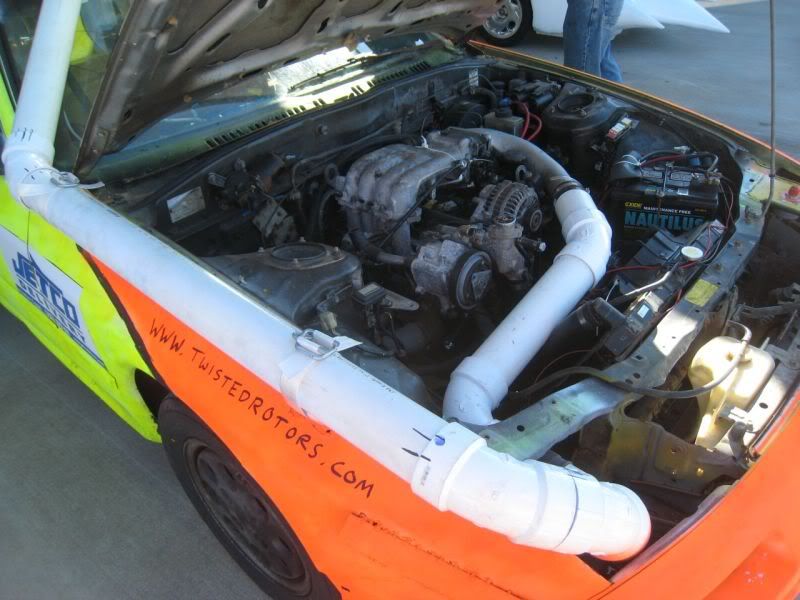
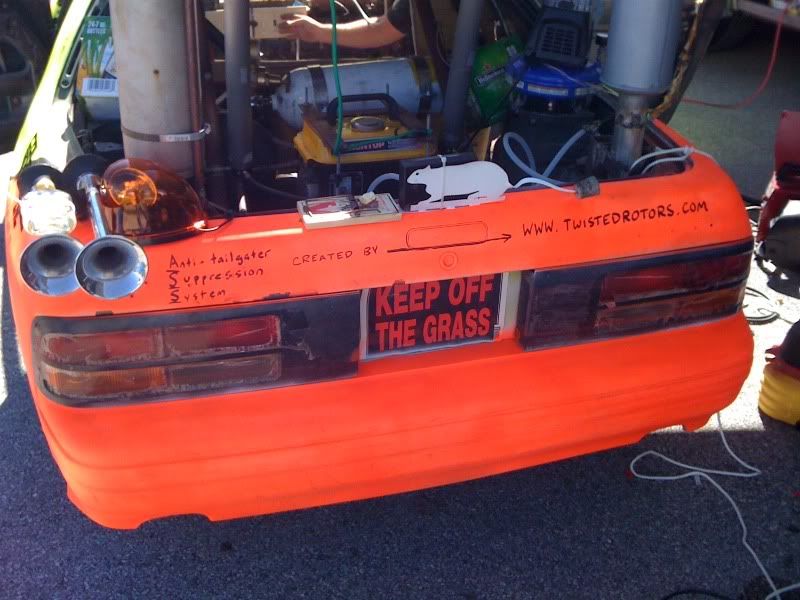


Oh yeah - we did get around to dyno-ing the setup. You actually LOSE 10 HP due to the restriction of the PVC. The laughing, pointing, giggling, and general ***-clown-ery is WAY worth the HP loss tho.

This is a TRUE Cold Air Intake for an NA. Car is a half bridgeport - four port engine.Window AC Unit running on a gasoline generator mounted in the hatch.
The chilled air is piped directly into the intake via PVC piping.
Oh yeah - we did get around to dyno-ing the setup. You actually LOSE 10 HP due to the restriction of the PVC. The laughing, pointing, giggling, and general ***-clown-ery is WAY worth the HP loss tho.



god, i made a thread with that idea like 10 years ago... still would work but i wonder if it's worth the weight of having an auxiliary A/C system to power it. lol
issue with their system is the sheer length and complexity of it, far too much restrictions for the air to be pulled freely through. like say a standard TMIC but the intercooler is a 2 way evap core/intercooler. course most people just use a cold water box for drag racing purposes.
issue with their system is the sheer length and complexity of it, far too much restrictions for the air to be pulled freely through. like say a standard TMIC but the intercooler is a 2 way evap core/intercooler. course most people just use a cold water box for drag racing purposes.
Last edited by RotaryEvolution; Jul 9, 2015 at 08:38 AM.




Thread
Thread Starter
Forum
Replies
Last Post
KAL797
Test Area 51
0
Aug 11, 2015 03:47 PM
advantage, air, car, cold, filter, forum, inline, innercooler, installing, intake, intercooler, na, reducing, rx7, temperature
