


Battery drain, anyone know the amount of current headlights draw?

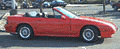
Battery drain, anyone know the amount of current headlights draw?
Got into an accident last Wednesday, ruined my hood and head light housings but otherwise the car is in good shape. No frame damage, interior work to be done, nothing. But earlier yesterday I noticed it didn't want to start up immediately and today it was dead. Got a jump, picked up a voltmeter, went to work.
10 to 1 it isn't the stereo, as that was installed a week ago and had no problems or drainage, disconnected it from the battery and pretty much eliminated that. But I checked the battery when the car is off: Every 8-9 seconds, the voltage dips by about .12-14 and goes right back up. It's on a steal interval so something in the car is kicking in every 8 seconds and slow draining the battery. I'm not sure what to make of it but I thought I'd ask here and see if anyone knows of a system that would check every 8 seconds and kick in to fix something. Only thing I can think of is my left headlight motor is not functioning, I'm not sure if it's a blockage or if it was fried after the accident. But why would it happen every 8 seconds? It's a new battery and I have checked it without the leads attached, and it isn't an alternator issue.
10 to 1 it isn't the stereo, as that was installed a week ago and had no problems or drainage, disconnected it from the battery and pretty much eliminated that. But I checked the battery when the car is off: Every 8-9 seconds, the voltage dips by about .12-14 and goes right back up. It's on a steal interval so something in the car is kicking in every 8 seconds and slow draining the battery. I'm not sure what to make of it but I thought I'd ask here and see if anyone knows of a system that would check every 8 seconds and kick in to fix something. Only thing I can think of is my left headlight motor is not functioning, I'm not sure if it's a blockage or if it was fried after the accident. But why would it happen every 8 seconds? It's a new battery and I have checked it without the leads attached, and it isn't an alternator issue.


Retractor fuse in the engine bay powers the retractors so you could pull that fuse. Also, you could, instead, perform a amperage draw test and then pull certain fuses and see which circuit is causing your issue.


Ooh okay, would I use the fuse diagram in the FAQ? What instrument would I need to check the amperage draw?
Also, when measuring voltage a meter can often bounce around within a tight range and be rather normal. Obviously, a voltage/amperage drain is not normal.
Last edited by satch; Apr 26, 2015 at 11:45 PM.

MECP Certified Installer

Joined: Feb 2009
Posts: 3,176
Likes: 3
From: Mesquite, TX-DFW
To figure out the minimum amount of current draw something is going to have, this formula works...
Wattage / volts = amps
So for low beam headlights...
55 watts / 12.6v = 4.4 amps X 2 headlights = 8.8 amps minimum
The reason I say minimum is because that equation assumes stuff is 100% efficient. High beams are 100 watts so plug that in accordingly.
Trending Topics
Oh boy then this will be complicated. If the blip in voltage is from the security system and isn't causing the drain I'm at a loss as to what would cause it... Gonna be a long weekend

I think I may be able to help you with minimal tools. Get a simple test light, not the LED style because they are sensitive. Disconnect the negative cable and put the test light in series between the negative post and the ground cable. You should not see the test light light up. If it does, it means you have a draw in the system. Consult a wiring diagram and start at the battery fuse block. Pull one fuse at a time until the draw stops (light goes out). Then, put that fuse back in. Follow the wiring diagram to find the "daughter" fuses on that circuit. There may or may NOT be a "daughter" fuse. Pull the fuses one at a time in the fuse block inside the car until you find your drain. If its a cyclic 8 second draw, it might be your retracters or a security system draw. Because you did smack something, anything is possible. It takes a fair amount of patience, but this technique USUALLY works on older cars. Me personally, I have an inductive amp probe and a lab scope that I use at work that is very, very accurate. I still have been know to default to the test light in a pinch, because the test light finds obvious stuff like light bulbs.
This article also covers it very nicely.
Parasitic Battery Drains - Diagnostic News
P.S. I know the article doesn't like test lights, but the article is directed towards automotive techs in a shop with all the proper equipment. The method I shared does work, and there are other tricks to go along with it.
If you have questions, I have a pretty strong handle on electrical issues, since it's what I do for a living.
-Ian
This article also covers it very nicely.
Parasitic Battery Drains - Diagnostic News
P.S. I know the article doesn't like test lights, but the article is directed towards automotive techs in a shop with all the proper equipment. The method I shared does work, and there are other tricks to go along with it.
If you have questions, I have a pretty strong handle on electrical issues, since it's what I do for a living.
-Ian
Last edited by ACR_RX-7; Apr 27, 2015 at 10:13 PM.
You guys are awesome.
Good news is, it's the retractors. I'm assuming since I can't even force my driver side headlight down that whatever sensor reads up or down is toasted, shouldn't be too hard to replace and luckily the headlight is stuck up so I can drive at night.
Bad news: Before I pulled the fuse (I was using ACR RX-7's method), the test light was blinking pretty rapidly, probably about twice per second. When I pulled the fuse of course it stopped, but putting it back and playing with my switches in the dash the test light stays constant, no blinking. Not sure what this means but there is no drain, cyclic or otherwise now. And the cyclic voltage dip was definitely coming from the security system.
Now I need to rip apart the front end and figure out how to fix my retractors and see if the motor is fried
Good news is, it's the retractors. I'm assuming since I can't even force my driver side headlight down that whatever sensor reads up or down is toasted, shouldn't be too hard to replace and luckily the headlight is stuck up so I can drive at night.
Bad news: Before I pulled the fuse (I was using ACR RX-7's method), the test light was blinking pretty rapidly, probably about twice per second. When I pulled the fuse of course it stopped, but putting it back and playing with my switches in the dash the test light stays constant, no blinking. Not sure what this means but there is no drain, cyclic or otherwise now. And the cyclic voltage dip was definitely coming from the security system.
Now I need to rip apart the front end and figure out how to fix my retractors and see if the motor is fried
Dammit. Spoke too soon.
There still something, if I use the test light method it lights up and fades, then if I disconnect the series completely (remove the alligator clip from the negative cable and remove the tip from the post) and wait a second or two and reattach/touch with the light it does it again, fainter or stronger depending on how long I leave it disconnected.
I tried pulling fuses but no change, and the MAIN fuse doesn't want to come out so I can't test if it's MAIN. Not sure where to go from here.
There still something, if I use the test light method it lights up and fades, then if I disconnect the series completely (remove the alligator clip from the negative cable and remove the tip from the post) and wait a second or two and reattach/touch with the light it does it again, fainter or stronger depending on how long I leave it disconnected.
I tried pulling fuses but no change, and the MAIN fuse doesn't want to come out so I can't test if it's MAIN. Not sure where to go from here.
MECP Certified Installer
Joined: Feb 2009
Posts: 3,176
Likes: 3
From: Mesquite, TX-DFW
Dammit. Spoke too soon.
There still something, if I use the test light method it lights up and fades, then if I disconnect the series completely (remove the alligator clip from the negative cable and remove the tip from the post) and wait a second or two and reattach/touch with the light it does it again, fainter or stronger depending on how long I leave it disconnected.
I tried pulling fuses but no change, and the MAIN fuse doesn't want to come out so I can't test if it's MAIN. Not sure where to go from here.
There still something, if I use the test light method it lights up and fades, then if I disconnect the series completely (remove the alligator clip from the negative cable and remove the tip from the post) and wait a second or two and reattach/touch with the light it does it again, fainter or stronger depending on how long I leave it disconnected.
I tried pulling fuses but no change, and the MAIN fuse doesn't want to come out so I can't test if it's MAIN. Not sure where to go from here.
EDIT: Illuminati confirmed, here is the voltage log, will be updating
12 AM = 12.80
1 AM = 12.72
1 PM = 12.66
I have now plugged all fuses save for retractors back in
9 PM = 12.62
10:30 PM = 12.60
12 AM = 12.58
Removed EGI COMP 30A fuse
12 PM = 12.54
Replaced EGI COMP fuse
Last edited by Captain Hook; Apr 30, 2015 at 02:41 PM. Reason: Data
Was the car used before the battery was measured at 12.8 volts or the key was turned to on before the measurement? If not it could be caused by the alternator. If that were the case, then you disconnect the B+ cable bolted to the alternator.
Last edited by satch; Apr 29, 2015 at 05:14 PM.

Thread
Thread Starter
Forum
Replies
Last Post
alphawolff
1st Generation Specific (1979-1985)
17
Nov 17, 2015 05:57 PM