


Anyone use this for water temps?



Anyone use this for water temps?


a lot of people use them. it would be better to tap the back of the waterpump housing under the thermostat but this will work if you dont want to take the front of the engine apart.
Last edited by 87 t-66; Dec 11, 2009 at 03:32 PM.

so what happens if your thermostat goes bad and doesn't open? it only shows you the temperature of the water that has already left the motor, not the water that is inside the motor.
take off your water pump housing and drill and tap it for your sensor. that's the best way to go hands down . i mean... your ecu reads the water temp off of that spot, so why not go with that spot?
plus i have experience with this. I have a buddy club one, but they're all the same. it's just less reliable than tapping your water pump housing. might as well do it right the first time... unlike what i did
take off your water pump housing and drill and tap it for your sensor. that's the best way to go hands down
. i mean... your ecu reads the water temp off of that spot, so why not go with that spot? plus i have experience with this. I have a buddy club one, but they're all the same. it's just less reliable than tapping your water pump housing. might as well do it right the first time... unlike what i did


Stupid part IMHO. Cant see temps till thermostat opens...if not then overheat and poop.
I bought a Prosport temp gauge since my stock temp gauge never worked. Then for under 7 bux i bought the fitting needed to tee into the BAC coolant line. My Prosport gauge is OK, rate it 98% good. I much rather spend under 7 bux for fitting for the bac line than spending $30+ on that stupid product.
I bought a Prosport temp gauge since my stock temp gauge never worked. Then for under 7 bux i bought the fitting needed to tee into the BAC coolant line. My Prosport gauge is OK, rate it 98% good. I much rather spend under 7 bux for fitting for the bac line than spending $30+ on that stupid product.
Trending Topics

Joined: Apr 2005
Posts: 3,785
Likes: 30
From: And the horse he rode in on...
It is a fine idea for fan switch, not so fine idea for temp gauge.
If the thermostat fails, the fan won't help you anyway, so for the switch it's ok.
With the temp gauge, you cannot see temps prior to stat opening and you don't get a good reading of the engine temp anyway, which is the REASON for having an aftermarket gauge.
And you DONT have to take apart the front of the engine. On S5 at least, you can tap the front of the thermostat housing for the temp sensor. I did and it works great. I even have the emission air-pump on with no conflict.
You just drain the coolant down, take off the thermostat neck and remove the thermostat. Stuff some paper towels down the neck to keep the shavings from dropping into the cooling system. Drill, tap enjoy!
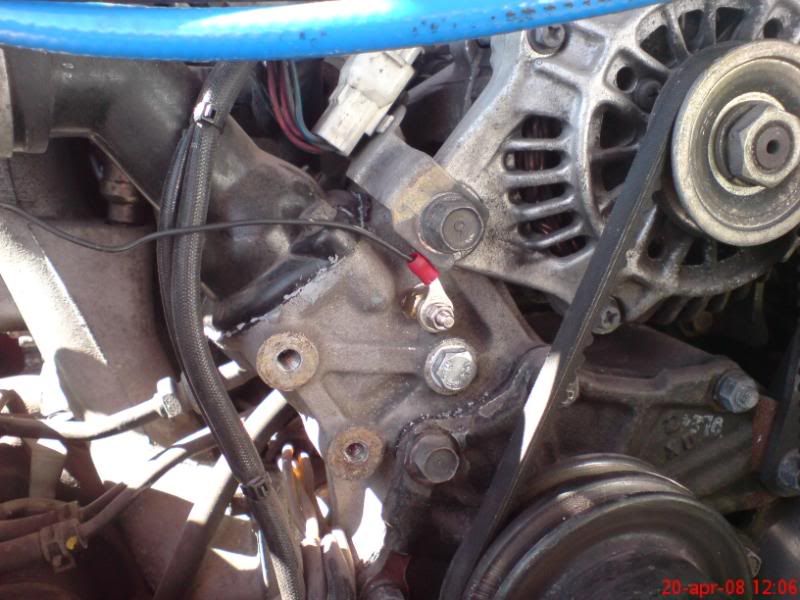
Here is a link to a pic,(not my pic, but mine was done like this after I saw it done this way.)
If the thermostat fails, the fan won't help you anyway, so for the switch it's ok.
With the temp gauge, you cannot see temps prior to stat opening and you don't get a good reading of the engine temp anyway, which is the REASON for having an aftermarket gauge.
And you DONT have to take apart the front of the engine. On S5 at least, you can tap the front of the thermostat housing for the temp sensor. I did and it works great. I even have the emission air-pump on with no conflict.
You just drain the coolant down, take off the thermostat neck and remove the thermostat. Stuff some paper towels down the neck to keep the shavings from dropping into the cooling system. Drill, tap enjoy!
Here is a link to a pic,(not my pic, but mine was done like this after I saw it done this way.)

Information Regurgitator


Joined: Feb 2001
Posts: 2,009
Likes: 214
From: Sparta TN. United States
It is a fine idea for fan switch, not so fine idea for temp gauge.
If the thermostat fails, the fan won't help you anyway, so for the switch it's ok.
With the temp gauge, you cannot see temps prior to stat opening and you don't get a good reading of the engine temp anyway, which is the REASON for having an aftermarket gauge.
And you DONT have to take apart the front of the engine. On S5 at least, you can tap the front of the thermostat housing for the temp sensor. I did and it works great. I even have the emission air-pump on with no conflict.
You just drain the coolant down, take off the thermostat neck and remove the thermostat. Stuff some paper towels down the neck to keep the shavings from dropping into the cooling system. Drill, tap enjoy!
If the thermostat fails, the fan won't help you anyway, so for the switch it's ok.
With the temp gauge, you cannot see temps prior to stat opening and you don't get a good reading of the engine temp anyway, which is the REASON for having an aftermarket gauge.
And you DONT have to take apart the front of the engine. On S5 at least, you can tap the front of the thermostat housing for the temp sensor. I did and it works great. I even have the emission air-pump on with no conflict.
You just drain the coolant down, take off the thermostat neck and remove the thermostat. Stuff some paper towels down the neck to keep the shavings from dropping into the cooling system. Drill, tap enjoy!

Yeah great idea for an e-fan thermoswitch but not so good for a temp gauge. Although since the chances of a thermostat failing are slim to none especially if you just replace it as a maintenance item.


What maintenance schedule do you recommend for the thermostat?
On a side note...
The local Mazda dealers didn't have a replacement-naturally- and even Mazdatrix now sells Stants for the second gen.
I went to NAPA, where they sold me a part so wrong it was almost humorous.
Took it back along with my correct (but dead) part and finally found that the thermostat NAPA lists for the 3rd gen is a perfect fit for the S5...even has the jiggle pin and a nicer rubber gasket than the Mazda part.

I use something like that. The downside is that there is a delay from when the car warms up to when the gauge starts to move because it only reads once the thermostat opens and lets coolant flow through the hose to the radiator.
I did not mess with the stock gauge, so I will know if the thermostat malfunctions. The aftermarket gauge will not move, and the stock gauge will read high. (don't ask how I how I know. )
)
I did it mainly because I didn't want to mess with the water pump housing and my stock gauge works fine. I only wanted an aftermarket gauge to monitor stress temps. If my stock gauge ever fails, I'll tap the pump housing.
I did not mess with the stock gauge, so I will know if the thermostat malfunctions. The aftermarket gauge will not move, and the stock gauge will read high. (don't ask how I how I know.
) I did it mainly because I didn't want to mess with the water pump housing and my stock gauge works fine. I only wanted an aftermarket gauge to monitor stress temps. If my stock gauge ever fails, I'll tap the pump housing.
And my original thermostat hasn't failed me for over 60,000 miles and 3 years. If aftermarket t-stats are known to be faulty then it would obviously be a better idea to place the sensor before it.
Your first post does seem to imply that one can avoid thermostat failure by replacing it at specified intervals- like a timing belt, say.
I didn't assume you meant to remove the thermostat and Brasso it... although a shiny thermostat is a happy thermostat.

Joined: Aug 2001
Posts: 6,096
Likes: 9
From: So Cal where the OC/LA/SB counties meet
"With the temp gauge, you cannot see temps prior to stat opening and you don't get a good reading of the engine temp anyway, which is the REASON for having an aftermarket gauge."
Your premise, I agree with. But your conclusion, not so much. I suggest a before and after sensor install actually has merit.
If the sensor is installed after the thermostat, then if the factory gauge starts to rise unusual to a learned norm and at the same time your after market gauge doesn't, then there's your alert that the thermosatat needs to be checked even earlier than if both sensors are on the same side of the thermostat.
Although crude in measure, the S4 factory temp gauge does a servicable job in giving temperature status in a preventitive manner. Although not numerically measured as with aftermarket, the learned use position of the needle common at standard operating temperatures, you know that it moving half way or more is indication something is up and the system needs to be checked.
The real problem is with S5's as their factory temp gauge is centric. So the needle doesn't move so long as the temp is somewhere in factory decided acceptible "range". Thus, you don't know you're having an overheating problem until it's already overheating.
My primary motivation for an aftermarket water temp gauge to give me first, in gross measure, preventitive information akin to what a S4 stock gauge allows. Secondarily, to give me the more refined measure we look for during our ever popular agressive driving situations.
Side note, one alternative to the HKS type upper radiator hose adaptor would be a simple T adaptor into the hose from the thermostate housing to the BAC. This idea comes from here https://www.rx7club.com/showthread.p...stall+location Note pictures in post #36 of that thread.
Your premise, I agree with. But your conclusion, not so much. I suggest a before and after sensor install actually has merit.
If the sensor is installed after the thermostat, then if the factory gauge starts to rise unusual to a learned norm and at the same time your after market gauge doesn't, then there's your alert that the thermosatat needs to be checked even earlier than if both sensors are on the same side of the thermostat.
Although crude in measure, the S4 factory temp gauge does a servicable job in giving temperature status in a preventitive manner. Although not numerically measured as with aftermarket, the learned use position of the needle common at standard operating temperatures, you know that it moving half way or more is indication something is up and the system needs to be checked.
The real problem is with S5's as their factory temp gauge is centric. So the needle doesn't move so long as the temp is somewhere in factory decided acceptible "range". Thus, you don't know you're having an overheating problem until it's already overheating.
My primary motivation for an aftermarket water temp gauge to give me first, in gross measure, preventitive information akin to what a S4 stock gauge allows. Secondarily, to give me the more refined measure we look for during our ever popular agressive driving situations.
Side note, one alternative to the HKS type upper radiator hose adaptor would be a simple T adaptor into the hose from the thermostate housing to the BAC. This idea comes from here https://www.rx7club.com/showthread.p...stall+location Note pictures in post #36 of that thread.
And that would be true. If you replace your thermostat with a replacement from a proven brand it will lower the chance of it failing in the future. Unless you plan to put 50,000+ miles on the engine I wouldn't worry about replacing it again, although you can remove it and test if you're paranoid.
Joined: Apr 2005
Posts: 3,785
Likes: 30
From: And the horse he rode in on...
"With the temp gauge, you cannot see temps prior to stat opening and you don't get a good reading of the engine temp anyway, which is the REASON for having an aftermarket gauge."
Your premise, I agree with. But your conclusion, not so much. I suggest a before and after sensor install actually has merit.
If the sensor is installed after the thermostat, then if the factory gauge starts to rise unusual to a learned norm and at the same time your after market gauge doesn't, then there's your alert that the thermosatat needs to be checked even earlier than if both sensors are on the same side of the thermostat.
Although crude in measure, the S4 factory temp gauge does a servicable job in giving temperature status in a preventitive manner. Although not numerically measured as with aftermarket, the learned use position of the needle common at standard operating temperatures, you know that it moving half way or more is indication something is up and the system needs to be checked.
The real problem is with S5's as their factory temp gauge is centric. So the needle doesn't move so long as the temp is somewhere in factory decided acceptible "range". Thus, you don't know you're having an overheating problem until it's already overheating.
My primary motivation for an aftermarket water temp gauge to give me first, in gross measure, preventitive information akin to what a S4 stock gauge allows. Secondarily, to give me the more refined measure we look for during our ever popular agressive driving situations.
Side note, one alternative to the HKS type upper radiator hose adaptor would be a simple T adaptor into the hose from the thermostate housing to the BAC. This idea comes from here https://www.rx7club.com/showthread.p...stall+location Note pictures in post #36 of that thread.
Your premise, I agree with. But your conclusion, not so much. I suggest a before and after sensor install actually has merit.
If the sensor is installed after the thermostat, then if the factory gauge starts to rise unusual to a learned norm and at the same time your after market gauge doesn't, then there's your alert that the thermosatat needs to be checked even earlier than if both sensors are on the same side of the thermostat.
Although crude in measure, the S4 factory temp gauge does a servicable job in giving temperature status in a preventitive manner. Although not numerically measured as with aftermarket, the learned use position of the needle common at standard operating temperatures, you know that it moving half way or more is indication something is up and the system needs to be checked.
The real problem is with S5's as their factory temp gauge is centric. So the needle doesn't move so long as the temp is somewhere in factory decided acceptible "range". Thus, you don't know you're having an overheating problem until it's already overheating.
My primary motivation for an aftermarket water temp gauge to give me first, in gross measure, preventitive information akin to what a S4 stock gauge allows. Secondarily, to give me the more refined measure we look for during our ever popular agressive driving situations.
Side note, one alternative to the HKS type upper radiator hose adaptor would be a simple T adaptor into the hose from the thermostate housing to the BAC. This idea comes from here https://www.rx7club.com/showthread.p...stall+location Note pictures in post #36 of that thread.
That makes me optimistic, not paranoid.
Information Regurgitator
Joined: Feb 2001
Posts: 2,009
Likes: 214
From: Sparta TN. United States
Some of you are bound and determined to do this the wrong way. Putting the sensor in the water pump housing is the proper way to do it. Also the thermostat is constantly opening and closing or in some state in-between. This is to try to keep the engine at a constant temp. Once open it doesn't stay open. It will close once the temp cools to a point and open again when it rises to a certain point. To truely see what your temps are doing the sensor must be in the housing. Run yourself in circles trying to justify putting it in the hose all you want. You will only be reading the temperature of the coolant going to the radiator, not what is circulating through the engine.
Some of you are bound and determined to do this the wrong way. Putting the sensor in the water pump housing is the proper way to do it. Also the thermostat is constantly opening and closing or in some state in-between. This is to try to keep the engine at a constant temp. Once open it doesn't stay open. It will close once the temp cools to a point and open again when it rises to a certain point. To truely see what your temps are doing the sensor must be in the housing. Run yourself in circles trying to justify putting it in the hose all you want. You will only be reading the temperature of the coolant going to the radiator, not what is circulating through the engine.
At one time last year I was running two VDO temp gauges, just to test various locations for the sending unit.
One sensor was in the stock location (under the oil pressure sending unit) and the other was in the bottom of the the front plate (there's a hex plug- NOT the drain plug- where the factory block heater was installed). Everyone says that's a terrible location, "It's in a dead end gallery!", but both gauges read exactly the same with no lag between them.
I then moved the sensor to the upper rad hose (as pictured)...same thing.
As many skeletal cats can attest, there's more than one way to do the skinning.
Information Regurgitator
Joined: Feb 2001
Posts: 2,009
Likes: 214
From: Sparta TN. United States
By this reasoning the only "proper" place for the sensor would be the stock location, would it not?
At one time last year I was running two VDO temp gauges, just to test various locations for the sending unit.
One sensor was in the stock location (under the oil pressure sending unit) and the other was in the bottom of the the front plate (there's a hex plug- NOT the drain plug- where the factory block heater was installed). Everyone says that's a terrible location, "It's in a dead end gallery!", but both gauges read exactly the same with no lag between them.
I then moved the sensor to the upper rad hose (as pictured)...same thing.
As many skeletal cats can attest, there's more than one way to do the skinning.
At one time last year I was running two VDO temp gauges, just to test various locations for the sending unit.
One sensor was in the stock location (under the oil pressure sending unit) and the other was in the bottom of the the front plate (there's a hex plug- NOT the drain plug- where the factory block heater was installed). Everyone says that's a terrible location, "It's in a dead end gallery!", but both gauges read exactly the same with no lag between them.
I then moved the sensor to the upper rad hose (as pictured)...same thing.
As many skeletal cats can attest, there's more than one way to do the skinning.
I agree there is more than one way to skin a cat, but not all of them are the right way. (
 )
)

quit yer bitching!
it's a crappy and lazy idea, why? because if you lose even a small amount of coolant then your temp guage is inperable and will be giving false readings.
so stfu with the back and forth already..
it's a crappy and lazy idea, why? because if you lose even a small amount of coolant then your temp guage is inperable and will be giving false readings.
so stfu with the back and forth already..