When you click on links to various merchants on this site and make a purchase, this can result in this site earning a commission. Affiliate programs and affiliations include, but are not limited to, the eBay Partner Network.
" Place sandpaper on a flat surface. Insert the side seal into the proper groove. Pull towards you. Repeat as necessary. We recommend 320 grit wet/dry for fast material removal and finish with 400grit. "
Slots are for .7mm and 1mm seals.
And it's somewhat decorative so it can live on the shelf instead of the toolbox.
I have the Pineapple one. It was nice as you can go a stroke or two at a time to make sure you don't take any excess off. It keeps the correct angle like some people do with the rotor and drill press/rotary tool method. I glued some sandpaper to a sheet of glass and used it as directed.
well I tried to do a few by hand and it didn't go well at all, ended up junking 2 of them.
I ended up making my own tool like the pineapple car, its not the exact angle but its close enough I can't see any difference from the stock seals with my eyes.
this isn't really a sales post but if anyones interested ill sell them for 8$ plus shipping from Pennsylvania.
it works like the pineapple one but it straddles a .5" strip of sand paper and slides on the surface that you tape the paper too, tool is about 1" square and .75" tall.
@Brrraaap can you message me about this plz. Tried to contact you thru the forum but my account is new and guessing there are restrictions in place to keep new accounts from spamming.
@Brrraaap can you message me about this plz. Tried to contact you thru the forum but my account is new and guessing there are restrictions in place to keep new accounts from spamming.
Thanks, Greg
yes you need so many posts, I can’t message you either, have you introduced yourself in the introduce yourself thread?
Summaryfor those of us who enjoy building our own engines, this tool is meant to help aid in setting the correct clearance between the side seal and the corner seal.
Things you'll still need:
1) drill press with locking table
2) drill press clamp. Harbor Freight has these for super cheap. Might be able to get away with a C-clamp as well.
3) thickness gauges
4) dremel type grinding wheel. Ideally it would be .433" (11mm) in diameter, but i have yet to find one exactly that size.
directions for use:
1) use a drill bit or preferably a pointed grinding stone in the spindle, and push it into the round hole so it bottoms out on the fixture. This will center the fixture on the drill press spindle.
2) while keeping pressure down on the fixture with the bit/wheel, lock the table on the drill press, and clamp the fixture down on the button. The button is a reinforced part of the print, and will automatically print out this way, so no need to be gentle. You don't want it to move AT ALL.
3) Once everything is locked down, raise the bit/wheel and insert a side seal. If it's a new seal move the seal so when the grinding wheel comes down it'll just barely clean clean up the end of the seal. A bit of black sharpie on the end will make it very visible if you got full clean up. Making sure the side seal is seated down against the fixture, turn the spindle on and slowly grind the end on the seal.
4) flip the seal around and do the same thing.
5) test fit in the rotor. You may need to hit it with a bit of sand paper to knock of any burr the stone made. The seal should still be long at this point. Put the seal back in the fixture and move it so the stone just barely touches, but isn't really taking any material off. Use your shims and fill the entire space between the seal and the fixture on the right hand side.
6) once you know what that number is, add .001" shim to that number and regrind the seal.
7) test fit again.
8) rinse and repeat until you have the desired clearance.
I have a few kicking around as well from when I was developing that fixture. I'd be happy give them away.
apologies for any stupid questions, I'm a complete newb to 3d printing.
I've been looking at a few places to get this printed but I'm just wondering what material is recommended to print it with? and what % infill should be used?
apologies for any stupid questions, I'm a complete newb to 3d printing.
I've been looking at a few places to get this printed but I'm just wondering what material is recommended to print it with? and what % infill should be used?
thanks in advance for the help!
you can print it from any material. I've used PLA for the ones i've printed. Infill can be pretty low. I've designed it such that any slicer will automatically reinforce the spot where the clamp goes.
if you tried messaging me on thingiverse, I can't even log into my account....I'm about done with thingiverse. I've had nothing but issues with that site lately.
you can print it from any material. I've used PLA for the ones i've printed. Infill can be pretty low. I've designed it such that any slicer will automatically reinforce the spot where the clamp goes.
if you tried messaging me on thingiverse, I can't even log into my account....I'm about done with thingiverse. I've had nothing but issues with that site lately.
I got one of these from need-a-t2 and it worked great. The job is still a bit tedious but my seals were very consistent and the results were fantastic. Be sure to have some 320 or 400 grit sandpaper at hand to remove the burrs that this kind of tool inevitably produces.
Yeah, while I could see it being faster than hand sanding, the real value of these tools are the ability to control the cut very well. Glad to hear it's helped another person out!
newest V2 version from Xtreme Rotaries that replaced the previous V1 version in the Jon Blanch video; larger motor. Heavier than you’d think due to the thick machined aluminum main top piece, lower piece appears to be machined from a carbon or some other similar laid up fiber-epoxy material.















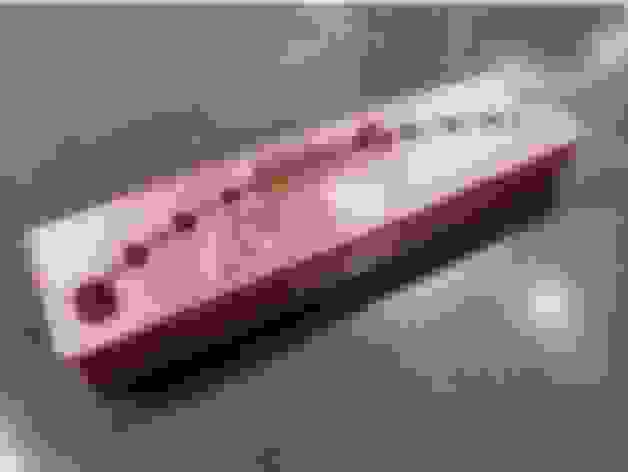







 that replaced the previous V1 version in the Jon Blanch video; larger motor. Heavier than you’d think due to the thick machined aluminum main top piece, lower piece appears to be machined from a carbon or some other similar laid up fiber-epoxy material.

