


what is all the different kinds of porting


Thread Starter
lots of potential
Joined: Oct 2007
Posts: 72
Likes: 0
From: Cincinnati,Ohio
what is all the different kinds of porting
what is all the different kinds of porting and how and why do you do em to the rotary ?
Is it expensive? performance difference?
if they are already explained on here please dont flame me just direct me in the right area please?
Is it expensive? performance difference?
if they are already explained on here please dont flame me just direct me in the right area please?

Double Ds for me to share

Joined: Mar 2005
Posts: 513
Likes: 4
From: abbotsford
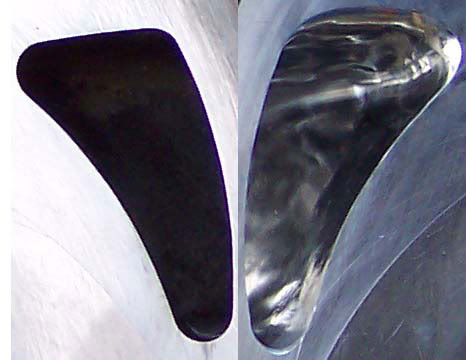
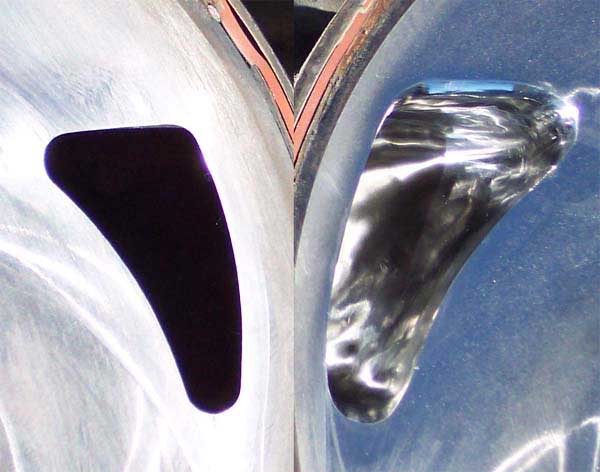
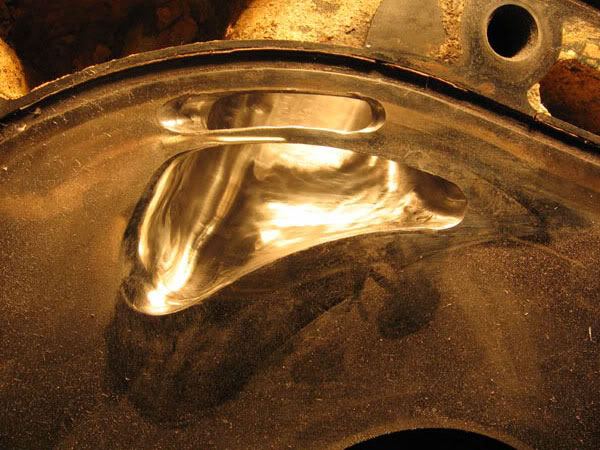
Here are a couple of common upgraded ports side by side with the stock port so you can see the difference. The only one that isn't beside the stock port is a small bridge. Bridge ports can get much larger but your driveability goes down.
Mild street port
Large street port
Small bridge port
STREET PORTS
"Street Ports" are basically mild changes that keep "within the lines" (oil and corner seal tracks) and are done for moderate performance gains with few compromises to driveability. Basically, a street port can either go "up", delaying the port closing, or "out", advancing the port opening. In practice, it is more desirable to go "up", as you are only affecting port closing and there is more room to play. Going "out" is more troublesome due to increased port overlap and the corner seal track rapidly becomes an obstacle . In practice, the farthest "out" you can take the port is to the point where at least 50% of the corner seal is supported, so it doesn't fall into the port and get consumed by the engine (which is fatal to the engine). Going "up", however, is limited mainly to the desired characteristics of the engine and the limitations of internal coolant passages. As always, be sure to consult a professional and/or purchase proven porting templates before attempting to enlarge your own ports. A small mistake can destroy valuable engine parts in the blink of an eye.
RACING PORTS
Racing ports come in many varieties, but tend to be as large as possible and introduce significant overlap. Both of these factors impact driveability and are typically not used on the street. Some of the port designs also compromise the water seals, so engine life may be reduced in favor of ultimate high-end power. Also note that these large-overlap designs are not typically used in turbocharged applications because the "boost" will tend to leak directly out the (still open) exhaust port at low to moderate RPM.
Bridgeports are simply a large port that uses a "bridge" to support the rotor's corner seal, thus preventing it from falling into the port and ruining the engine. Since the port goes all the way out to the trochoid surface, there is significant overlap with the exhaust port, reducing low-RPM power in favor of significant power gains in the high-RPM range (5,000+). Sometimes a bridgeport will extend slightly past the trochoid surface, requiring a notch in the rotor housing, but the water seals are not compromised. Of all the racing ports, this design is the most streetable and minimally impacts engine life.
J-ports are basically a bridgeport that extends well past the trochoid surface to the point it does compromise the water seals. The goal is more power at the cost of engine life -- a classic racing scenario.
Monster ports are like a J-port, only so large that they go well into the water jacket and require significant filling of the passages, cutting of the rotor housing, and other measures to allow it to work. As some of the coolant passages are actually filled, engine life is further compromised. Monster ports were developed to give similar characteristics to a peripheral port, where racing rules in some classes prohibited the latter.
Peripheral intake ports (not pictured above) are simply a big hole in each rotor housing (similar to the exhaust ports), with no side intake ports whatsoever. Contrary to side port designs, timing is determined by the apex seal rather than the leading edge of the rotor. This results in massive intake and exhaust overlap and subsequently very little low-RPM power, but the direct intake path permits incredible high-RPM power that typically peaks well over 9,000 RPM. A peripheral port (PP) engine can develop over 300 hp in a non-turbo application, but is not what normal people would consider "streetable" (but some do!). The water seals are not compromised, though some of the coolant passages are blocked by the intake passage (but to a lesser degree than Monster porting) -- the engine life is reduced by virtue of stress from high-power and high-RPM operation, but not so much by coolant leakage or hot spots around the intake area.
Mild street port
Large street port
Small bridge port
STREET PORTS
"Street Ports" are basically mild changes that keep "within the lines" (oil and corner seal tracks) and are done for moderate performance gains with few compromises to driveability. Basically, a street port can either go "up", delaying the port closing, or "out", advancing the port opening. In practice, it is more desirable to go "up", as you are only affecting port closing and there is more room to play. Going "out" is more troublesome due to increased port overlap and the corner seal track rapidly becomes an obstacle . In practice, the farthest "out" you can take the port is to the point where at least 50% of the corner seal is supported, so it doesn't fall into the port and get consumed by the engine (which is fatal to the engine). Going "up", however, is limited mainly to the desired characteristics of the engine and the limitations of internal coolant passages. As always, be sure to consult a professional and/or purchase proven porting templates before attempting to enlarge your own ports. A small mistake can destroy valuable engine parts in the blink of an eye.
RACING PORTS
Racing ports come in many varieties, but tend to be as large as possible and introduce significant overlap. Both of these factors impact driveability and are typically not used on the street. Some of the port designs also compromise the water seals, so engine life may be reduced in favor of ultimate high-end power. Also note that these large-overlap designs are not typically used in turbocharged applications because the "boost" will tend to leak directly out the (still open) exhaust port at low to moderate RPM.
Bridgeports are simply a large port that uses a "bridge" to support the rotor's corner seal, thus preventing it from falling into the port and ruining the engine. Since the port goes all the way out to the trochoid surface, there is significant overlap with the exhaust port, reducing low-RPM power in favor of significant power gains in the high-RPM range (5,000+). Sometimes a bridgeport will extend slightly past the trochoid surface, requiring a notch in the rotor housing, but the water seals are not compromised. Of all the racing ports, this design is the most streetable and minimally impacts engine life.
J-ports are basically a bridgeport that extends well past the trochoid surface to the point it does compromise the water seals. The goal is more power at the cost of engine life -- a classic racing scenario.
Monster ports are like a J-port, only so large that they go well into the water jacket and require significant filling of the passages, cutting of the rotor housing, and other measures to allow it to work. As some of the coolant passages are actually filled, engine life is further compromised. Monster ports were developed to give similar characteristics to a peripheral port, where racing rules in some classes prohibited the latter.
Peripheral intake ports (not pictured above) are simply a big hole in each rotor housing (similar to the exhaust ports), with no side intake ports whatsoever. Contrary to side port designs, timing is determined by the apex seal rather than the leading edge of the rotor. This results in massive intake and exhaust overlap and subsequently very little low-RPM power, but the direct intake path permits incredible high-RPM power that typically peaks well over 9,000 RPM. A peripheral port (PP) engine can develop over 300 hp in a non-turbo application, but is not what normal people would consider "streetable" (but some do!). The water seals are not compromised, though some of the coolant passages are blocked by the intake passage (but to a lesser degree than Monster porting) -- the engine life is reduced by virtue of stress from high-power and high-RPM operation, but not so much by coolant leakage or hot spots around the intake area.


Thread
Thread Starter
Forum
Replies
Last Post
Jeff20B
1st Generation Specific (1979-1985)
73
Sep 16, 2018 07:16 PM
HalifaxFD
Canadian Forum
126
May 9, 2016 07:06 PM
