


Has anyone gotten the vacuum advance to work right with an aftermarket carb?


Thread Starter
Joined: Aug 2001
Posts: 3,742
Likes: 1
From: California
Has anyone gotten the vacuum advance to work right with an aftermarket carb?
Instead of just disconnecting the vacuum lines and running the distributor on centrifugal advance alone?


Most aftermarket carbs have a few different vac ports on the carb. One will advance during acceleration and the other function the same as manifold vacuum. What I did was hook a vac gauge (long long hose) the each of the ports and observe the gauge while driving.


The weber type carbs don't normally have these fittings in them. You could drill and tap a nipple for it I suppose. RB did for the MOP lines into the Dellortos. I think it would go before the butterflies where the chokes are. Not sure whether it would be before or after the chokes.
Trending Topics
Wrong! You want vacuum going to the dizzy at idle and under cruise, this contributes to a good idle and smooth cruising. The engine relies on the internal mechanical advance to properly advance the timing under acceleration while the vacuum advance disappears under acceleration due to loss of vacuum.

Lives on the Forum

Joined: Jun 2004
Posts: 11,359
Likes: 14
From: Grand Rapids Michigan
Wrong! You want vacuum going to the dizzy at idle and under cruise, this contributes to a good idle and smooth cruising. The engine relies on the internal mechanical advance to properly advance the timing under acceleration while the vacuum advance disappears under acceleration due to loss of vacuum.
If you have vacuum advance at idle, all its going to do is defeat the entire purpose of the system. Try hooking your **** up right for once, and then tell me I'm wrong.
I originally had mine backwards (after rat's nest removal), as you are suggesting to do. I corrected it, reset the idle speed, mixture, and timing, and tried it out. There was absolutely no comparison between the two arrangements. A working vacuum advance system will give you much more "grunt" when coming off a "cruise" state...

Hunting Skylines

Joined: Apr 2001
Posts: 3,431
Likes: 4
From: Brisbane, Queensland, Australia.
Wrong! You want vacuum going to the dizzy at idle and under cruise, this contributes to a good idle and smooth cruising. The engine relies on the internal mechanical advance to properly advance the timing under acceleration while the vacuum advance disappears under acceleration due to loss of vacuum.
Hunting Skylines
Joined: Apr 2001
Posts: 3,431
Likes: 4
From: Brisbane, Queensland, Australia.
Oh God! Here we go again...
If you have vacuum advance at idle, all its going to do is defeat the entire purpose of the system. Try hooking your **** up right for once, and then tell me I'm wrong.
I originally had mine backwards (after rat's nest removal), as you are suggesting to do. I corrected it, reset the idle speed, mixture, and timing, and tried it out. There was absolutely no comparison between the two arrangements. A working vacuum advance system will give you much more "grunt" when coming off a "cruise" state...
If you have vacuum advance at idle, all its going to do is defeat the entire purpose of the system. Try hooking your **** up right for once, and then tell me I'm wrong.
I originally had mine backwards (after rat's nest removal), as you are suggesting to do. I corrected it, reset the idle speed, mixture, and timing, and tried it out. There was absolutely no comparison between the two arrangements. A working vacuum advance system will give you much more "grunt" when coming off a "cruise" state...
As an engines load increases the combustion process is becoming more efficient due to the pressure in the chamber which means it needs less ignition timing.
That's why there are two systems. One to increase with rpm and one to decrease with load.
You'd need to understand the internal workings of the engine to understand why the ignition works the way it does. Not just assume that "more advance equals more power."

Lives on the Forum
Joined: Jun 2004
Posts: 11,359
Likes: 14
From: Grand Rapids Michigan
Alright, I just have to say this. Or rather, ask this question of my doubters;
Why would you want to retard the timing at the exact point where you ask the motor to produce more power? Just think about it for a minute....
Why would you want to retard the timing at the exact point where you ask the motor to produce more power? Just think about it for a minute....

just another joe

Joined: Apr 2007
Posts: 295
Likes: 0
From: Pascagoula, MS
got this from engineers edge.....
Advancing ignition timing makes the spark happen sooner, retarding makes it happen later. That may sound pedantic, but it's a baseline for everything else involving timing. It gets more complicated from there.
To get maximum efficiency and power, the timing has to match the burn rate of the fuel at all RPMs. Too soon and you will get preignition, which not only robs you of power but can damage the engine. Too late and the piston is already going down by the time combustion occurs, so you lose power. As the engine turns faster, and the burn rate of the fuel is the same, the spark must occur sooner.
Older engines had two mechanisms in the distributors for dealing with this. One was a centrifugal (mechanical) advance, using counterweighs working against spring tension to change the position of the static assembly as relative to the rotating assembly. The other was a vacuum advance, which worked one of two ways, depending on how the hose was connected.
Straight manifold vacuum will advance the timing at idle, which makes the engine run a little cooler, but also increases emissions. This prevents hot start kickback by bringing in the extra advance after the engine has started. As vacuum increases, timing will increase. At WOT, when preignition is most likely to occur, there is no vacuum, so the timing is backed off.
Ported vacuum is an invention that is designed to decrease emissions. At idle, there is no vacuum advance. A port on the carb gives it more vacuum as the throttle is opened, until the point where vacuum drops off (near WOT), where there is no vacuum.
This gets more complicated because gasoline comes in many octane ratings. Lower octane fuels burn more rapidly, and so the timing needs to be retarded. High octane fuels have a smoother burn rate and you can get away with more advance. This is a generalization, but, up to a point, the more vacuum advance you can get away with, the more efficiency and power you will get.
Advancing ignition timing makes the spark happen sooner, retarding makes it happen later. That may sound pedantic, but it's a baseline for everything else involving timing. It gets more complicated from there.
To get maximum efficiency and power, the timing has to match the burn rate of the fuel at all RPMs. Too soon and you will get preignition, which not only robs you of power but can damage the engine. Too late and the piston is already going down by the time combustion occurs, so you lose power. As the engine turns faster, and the burn rate of the fuel is the same, the spark must occur sooner.
Older engines had two mechanisms in the distributors for dealing with this. One was a centrifugal (mechanical) advance, using counterweighs working against spring tension to change the position of the static assembly as relative to the rotating assembly. The other was a vacuum advance, which worked one of two ways, depending on how the hose was connected.
Straight manifold vacuum will advance the timing at idle, which makes the engine run a little cooler, but also increases emissions. This prevents hot start kickback by bringing in the extra advance after the engine has started. As vacuum increases, timing will increase. At WOT, when preignition is most likely to occur, there is no vacuum, so the timing is backed off.
Ported vacuum is an invention that is designed to decrease emissions. At idle, there is no vacuum advance. A port on the carb gives it more vacuum as the throttle is opened, until the point where vacuum drops off (near WOT), where there is no vacuum.
This gets more complicated because gasoline comes in many octane ratings. Lower octane fuels burn more rapidly, and so the timing needs to be retarded. High octane fuels have a smoother burn rate and you can get away with more advance. This is a generalization, but, up to a point, the more vacuum advance you can get away with, the more efficiency and power you will get.
Lives on the Forum
Joined: Jun 2004
Posts: 11,359
Likes: 14
From: Grand Rapids Michigan
Wikipedia has a decent writeup on this. Apparently, everybody who stated an opinion on this matter was correct is some way.
Routing the vacuum line to manifold is used for emission controls.
Routing the vacuum line to a ported source is used for performance.
Assuming that Drivefast7 is interested in performance, rather than emission control, he should use ported vacuum...
Routing the vacuum line to manifold is used for emission controls.
Routing the vacuum line to a ported source is used for performance.
Assuming that Drivefast7 is interested in performance, rather than emission control, he should use ported vacuum...
Hunting Skylines
Joined: Apr 2001
Posts: 3,431
Likes: 4
From: Brisbane, Queensland, Australia.
Wikipedia has a decent writeup on this. Apparently, everybody who stated an opinion on this matter was correct is some way.
Routing the vacuum line to manifold is used for emission controls.
Routing the vacuum line to a ported source is used for performance.
Assuming that Drivefast7 is interested in performance, rather than emission control, he should use ported vacuum...
Routing the vacuum line to manifold is used for emission controls.
Routing the vacuum line to a ported source is used for performance.
Assuming that Drivefast7 is interested in performance, rather than emission control, he should use ported vacuum...
From the engineers edge article above.
A port on the carb gives it more vacuum as the throttle is opened, until the point where vacuum drops off (near WOT), where there is no vacuum.
Lives on the Forum
Joined: Jun 2004
Posts: 11,359
Likes: 14
From: Grand Rapids Michigan
That's almost right Revhead. The idea behind this is, as soon as you tip into the throttle the ignition will advance, giving you a tad more power.
If you set it up with manifold vacuum (assuming that the emissions have been removed) then once you tip into the throttle, the ignition will retard, resulting in less power.
One point though, even at wide open throttle, there will be vacuum above the throttle plates. This will be based off of the flow of air over the port. It provides a sort of siphoning effect to produce the vacuum...
If you set it up with manifold vacuum (assuming that the emissions have been removed) then once you tip into the throttle, the ignition will retard, resulting in less power.
One point though, even at wide open throttle, there will be vacuum above the throttle plates. This will be based off of the flow of air over the port. It provides a sort of siphoning effect to produce the vacuum...
Hunting Skylines
Joined: Apr 2001
Posts: 3,431
Likes: 4
From: Brisbane, Queensland, Australia.
That's almost right Revhead. The idea behind this is, as soon as you tip into the throttle the ignition will advance, giving you a tad more power.
If you set it up with manifold vacuum (assuming that the emissions have been removed) then once you tip into the throttle, the ignition will retard, resulting in less power.
One point though, even at wide open throttle, there will be vacuum above the throttle plates. This will be based off of the flow of air over the port. It provides a sort of siphoning effect to produce the vacuum...
If you set it up with manifold vacuum (assuming that the emissions have been removed) then once you tip into the throttle, the ignition will retard, resulting in less power.
One point though, even at wide open throttle, there will be vacuum above the throttle plates. This will be based off of the flow of air over the port. It provides a sort of siphoning effect to produce the vacuum...
Hunting Skylines
Joined: Apr 2001
Posts: 3,431
Likes: 4
From: Brisbane, Queensland, Australia.
Do me a favour and read this article, especially the part about pressure, engine load and how it relates to ignition timing. It's very informative.
http://www.bristoldyno.com/tech/ignitiontiming.htm
http://www.bristoldyno.com/tech/ignitiontiming.htm
Lives on the Forum
Joined: Jun 2004
Posts: 11,359
Likes: 14
From: Grand Rapids Michigan
Okay, I read it, but I don't agree with everythign they say when it applies to rotary engines. In fact, they even contradict themselves on a few points. Short on time right now, or I'd list those points for you.
Quote: "It can't just "produce" vacuum out of thin air if the port is under atmospheric pressure."
The vacuum is created by the air flowing over the port, using a siphoning effect. Think about it...
Quote: "It can't just "produce" vacuum out of thin air if the port is under atmospheric pressure."
The vacuum is created by the air flowing over the port, using a siphoning effect. Think about it...
Hunting Skylines
Joined: Apr 2001
Posts: 3,431
Likes: 4
From: Brisbane, Queensland, Australia.
Okay, I read it, but I don't agree with everythign they say when it applies to rotary engines. In fact, they even contradict themselves on a few points. Short on time right now, or I'd list those points for you.
Quote: "It can't just "produce" vacuum out of thin air if the port is under atmospheric pressure."
The vacuum is created by the air flowing over the port, using a siphoning effect. Think about it...
Quote: "It can't just "produce" vacuum out of thin air if the port is under atmospheric pressure."
The vacuum is created by the air flowing over the port, using a siphoning effect. Think about it...
The air doesn't flow "over the port." The diaphragm is exposed to the same pressure as the air outside the port. If the port is under positive pressure it will not draw a vacuum. It's simple as that.
I could post the LOAD ignition map that Microtech supply with their ECU's for rotarys. It will show that the highest ignition value is at 30" of vacuum and slowly ramps down to 0* as pressure reaches atmospheric. But what would they know. It doesn't agree with your point of view.
Last edited by REVHED; Oct 30, 2007 at 06:55 AM.

With the stock setup (at least the SEs), it is really manifold vac, but they add a solenoid to vent to atmoshphere under idle conditions. This means no vac advance at idle, but just above idle you'll see it kick in if you rev the engine a bit looking at it with the timing light. At WOT, there is no vac advance. Technically, the pressure at the intake is *slightly* less than atmospheric (pressure drop due to air filter, intake, heating effects, etc.) but these effects are all pretty minor.
For an aftermarket carb, you'll want to use the ported source if available. If a ported source is not available, you can connect to manifold vac (drill and tap a fitting if needed) and use the stock solenoid that controls vac advance (assuming that your emissions control unit is still in place).
I'll post up the vac advance curves in a mintue so you guys can take a look.
Kent
Here are the pics:
This is from the '85 FSM. You'll notice there is an error on the engine RPMs for mechanical advance (they have engine RPM as half dizzy RPM, the engine RPM is really 2x dizzy RPM).
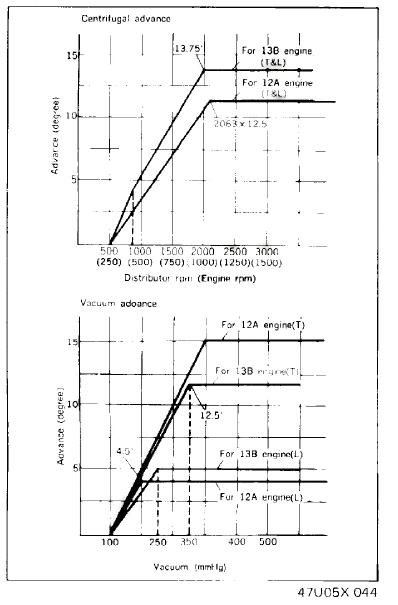
Here is the corrected figure:

NOTE: These figures show dizzy advance. The real engine advance is 2x these values.
For an aftermarket carb, you'll want to use the ported source if available. If a ported source is not available, you can connect to manifold vac (drill and tap a fitting if needed) and use the stock solenoid that controls vac advance (assuming that your emissions control unit is still in place).
I'll post up the vac advance curves in a mintue so you guys can take a look.
Kent
Here are the pics:
This is from the '85 FSM. You'll notice there is an error on the engine RPMs for mechanical advance (they have engine RPM as half dizzy RPM, the engine RPM is really 2x dizzy RPM).
Here is the corrected figure:
NOTE: These figures show dizzy advance. The real engine advance is 2x these values.
Last edited by gsl-se addict; Oct 30, 2007 at 08:21 AM. Reason: added pics